This article is deeply problematic for a number of reasons. Wildfire risk increased in western US is due to both climate change and poor forest management, much of which is down to Forest Service aggressively extinguishing fires for nearly a century in forests adapted to burn 1/4
Similarly, traditional logging activities do relatively little to reduce fire risk, as what regrows is often more flammable than mature forests. Best tools we have – thinning small trees and brush combined with controlled burns – are not econ viable for the timber industry 2/4
Traditional environmentalists are not without blame here; we need to ensure that pre-commercial thinning and controlled burns are not unduly restricted by environmental regulations. But laying our entire history of poor forest management at their feet is extremely misleading. 3/4
The arc of the scenario universe is long, but it bends inevitably toward more realistic emissions.
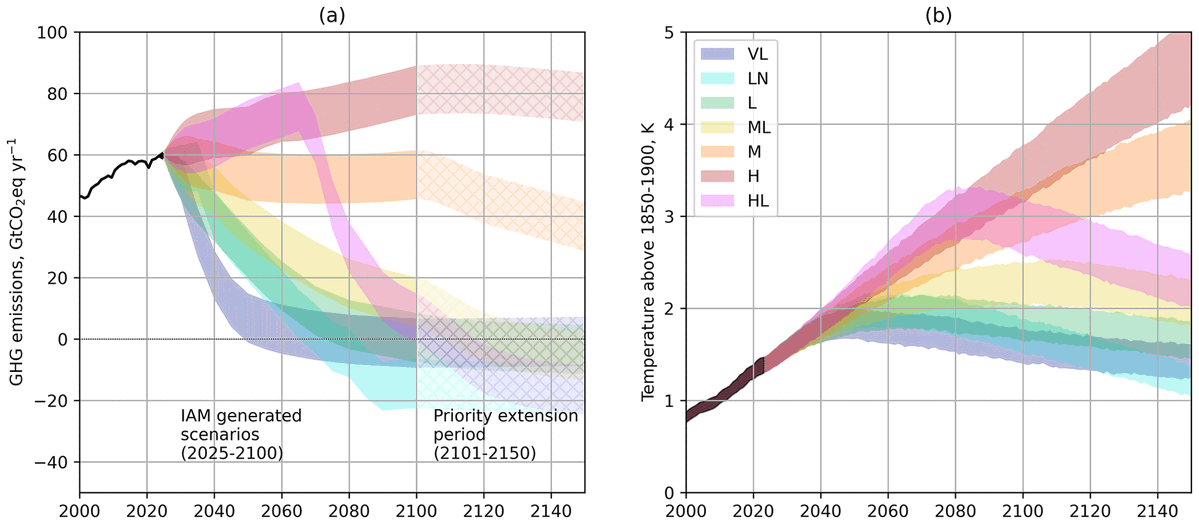
A new paper outlining the emissions scenarios we will be using in the upcoming IPCC AR7 report notes that "the CMIP6 high emission levels (quantified by SSP5-8.5) have become implausible".
It outlines a yet-to-be-released high emissions scenario notably lower than the one (SSP5-8.5) used in the prior IPCC 6th Assessment Report:
This is a change that a number of us in the community have long advocated, going back to Justin Ritchie's work in 2017.gmd.copernicus.org/articles/19/26…
And in 2020 Glen Peters and I published a piece in Nature arguing that high emissions scenarios were no longer "business as usual", and that more realistic emissions make for better climate policy: nature.com/articles/d4158…
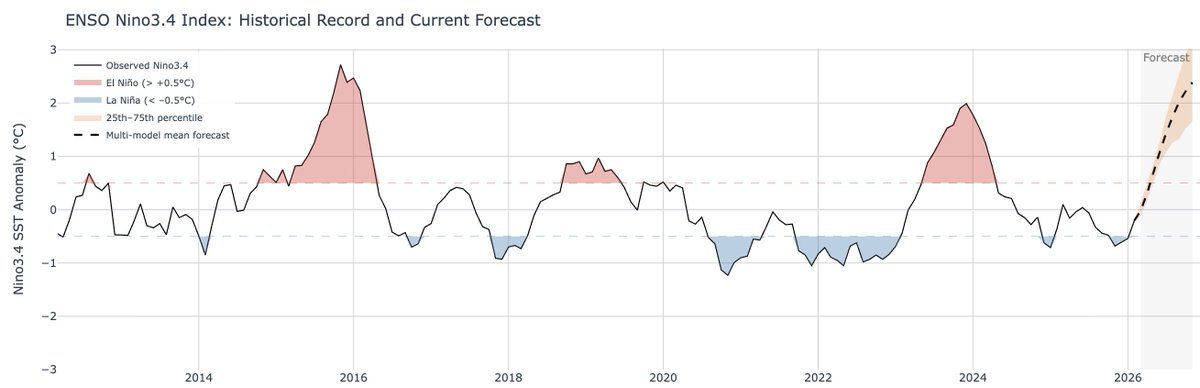
El Niño is coming, and it is shaping up to be a big one.
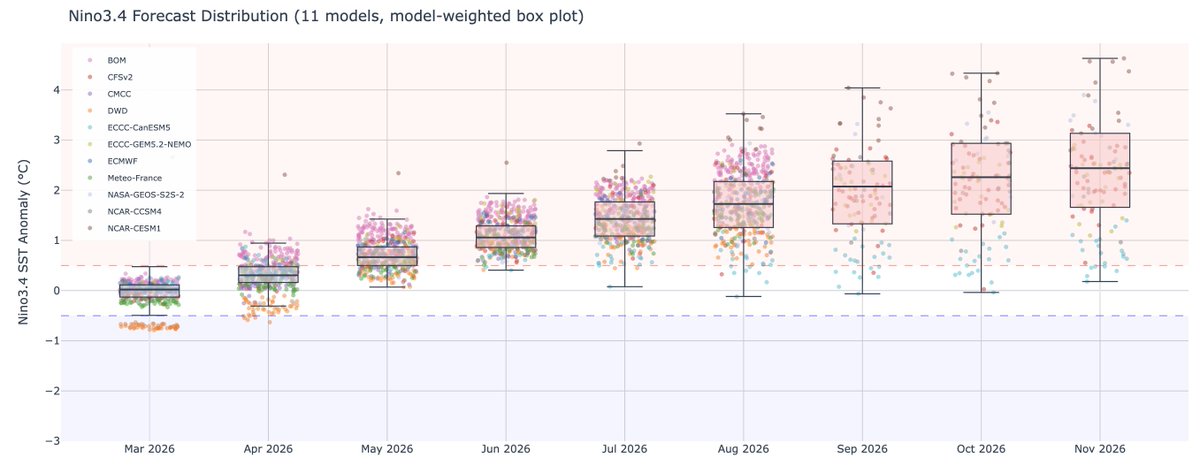
Over at The Climate Brink I've put together a compilation of the latest forecasts by different modeling groups. They suggest that we might see an event comparable in strength to what we saw in 2016.
This is based on a collection of 11 different models (and 455 individual ensemble members) all updated since the start of March. I've put an interactive version of the data up on the Climate Dashboard here: dashboard.theclimatebrink.com/#enso
While there remains a big spread in models (and some models only run through August), more than half the runs show a strong (>1.5C Nino3.4) event developing by August and a very strong event (>2C) by the end of the year.
As a rare climate scientist working in Silicon Valley, I've been drinking from the AI firehose a lot more than my peers. I thought it would be helpful to lay out my experiences of both the promise and pitfalls of using AI to accelerate scientific research.
As a bit of background, I've been working with these tools since late 2022, and seen firsthand how they have dramatically improved over time. I’ve also worked with frontier AI labs to evaluate how well LLMs answer climate questions, and to help enable AI tools to support scientific collaboration.
So what do AI tools do well for scientific work? In short, coding.
Scientists are generally not software engineers. Much of their coding is self-taught, and many struggle with writing code quickly, producing well-documented reproducible code, and fixing errors.
My new State of the Climate report over at @CarbonBrief finds that 2025 had the:
⬆️ Warmest ocean heat content
⬆️ Tied as second warmest surface temps
⬆️ Second warmest troposphere
⬆️ Record high sea level and GHGs
⬇️ Record low winter Arctic ice
Read the article here:
Ocean heat content increased by 23 billion trillion joules, which was around 39 times greater than global primary energy use this year. This is the largest rise in OHC since 2017; overall OHC has increased by over 500 zettajoules since the 1940s.carbonbrief.org/state-of-the-c…
@CarbonBrief 2025 tied with 2023 as the second warmest surface temperatures. It was nominally the second warmest in NASA and DCENT datasets, and third warmest in NOAA, Hadley, Berkeley, Copernicus, JRA-3Q, and China-MST. In all cases uncertainties overlap with 2023.
After a modest decline over the first half of the year (and after record 2024 warmth), global temperatures are ticking back up. The past two days have been the warmest on record for this time of year in ERA5 and the highest temperature anomalies since January.
With 26 days of October now reporting in ERA5, October 2025 will be the third warmest on record after 2023 and 2024.
Weather models expect global temperatures to remain relatively flat over the coming week as extreme Northern Hemisphere warmth persists, and anomalies (departures from normal) will be at or above the levels the highest levels any we've seen earlier in the year
Last week the German Meteorological Society warned that "the 3-degree limit could be exceeded as early as 2050".
While not possible to fully rule out, the assessed warming scenarios we published in the IPCC AR6 report find this to be extremely unlikely.
If we look a the full ensemble of CMIP6 models we see a small number (3 of 37 models) reaching 3C by 2050. However, these three have both too much historical warming (~2.2C in 2024) and what an unrealistically high climate sensitivity (>5C per doubling CO2) as we noted here: nature.com/articles/d4158…
However, if we constrain CMIP6 to match recent observed global temperatures, we see no models reaching 3C until at least 2060: carbonbrief.org/analysis-what-…