1/ The appointment of 3 political cronies w/ no expertise to coordinate technical & investigative work of the BDL auditors means millions of your $ deposits will be squandered, months we don’t have will be wasted, & forensic audit (with all its limitations) is fully politicized.
2/ It isn’t just the forensic audit. Remember a regular financial audit is being done at the request of IMF and donor countries. This is technical work and requires a competent technical team to coordinate and oversee. MOF is undermining future IMF negotiations & financial rescue
3/ The audits should be suspended & any forensic audit results rejected completely until a committee of independent professionals is appointed and all of the other issues we’ve raised are addressed.
4/ All this while people are drowning in the sea, desperate to escape this broken country. We have no time nor money to waste, people are dying. They just don’t care, the 2 parties fighting over the forensic audit installed incompetent cronies to undermine the entire workstream.
• • •
Missing some Tweet in this thread? You can try to
force a refresh

1/ The Gap Law proposed by BDL & Gov't is brilliant because it entirely sidesteps the core technical challenges that derailed every prior attempt at a solution. I ran several simulations below to illustrate the structure's fragility and what depositor recovery may be. See 👇
BDL and the Gov't assume there is $35B of ineligible deposits to be written off out of $66B. That number is absurdly large. The ineligible deposit write-offs are highly contested, and the amount is uncertain.
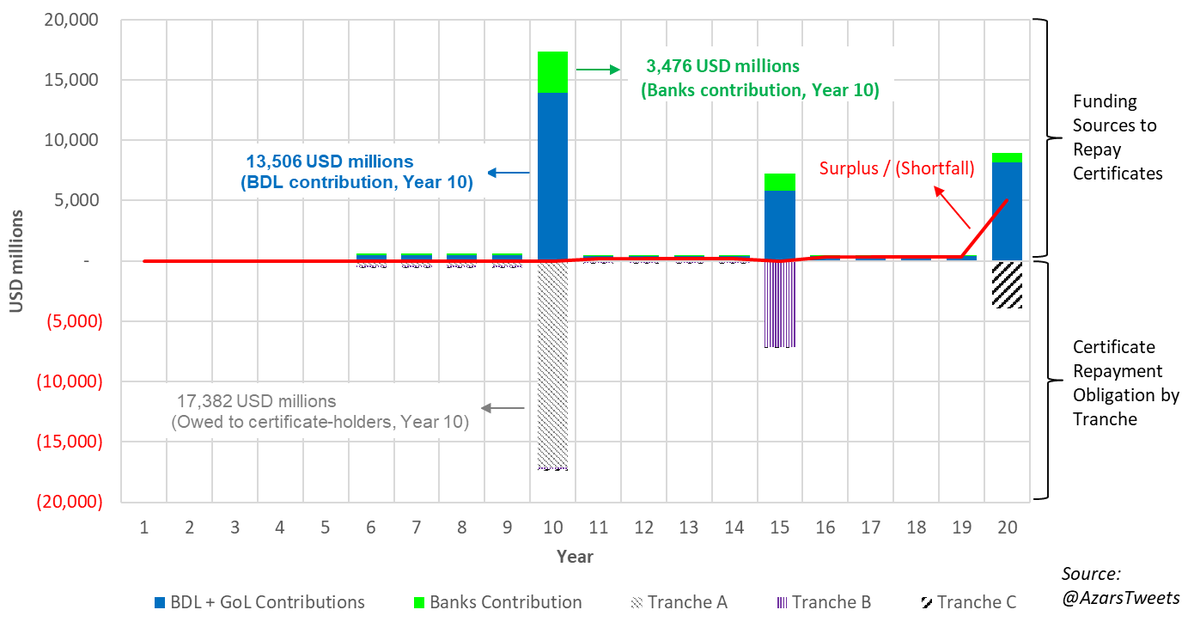
In any case, the scenario below assumes $35B of ineligible deposits is, in fact, written off. The chart shows the annual repayments for each Certificate (negative numbers) and the source of funding for such repayment (positive numbers).
In Year 10, BDL will owe $13.5B and the Banks will owe $3.5B to repay Certificate A.
There is no chance the Banks can pay $3.5B. For reference, if only $5B of ineligible deposits are written off instead of $35B, the Banks liability in Year 10 jumps up to $6.8B from $3.5B. The entire net worth of the Banks will be in the $3B range after the restructuring...
If one or more Banks can't pay their share, what happens? The law doesn't really say. Does BDL pay on their behalf? Does the bank become insolvent? Does the Certificate liability represent a deposit-level liability for the Bank? Or is it more junior or senior? What happens to the unpaid portion of a Certificate? The law doesn't say.
1/ Why can't Lebanon just pay Iraq for the fuel it sends to avoid this self-inflicted crisis? We can't afford it and never intended to pay. After 3 years, we now owe ~$2 bn, ~10% of GDP!
The issue came up in 2021. MPs told us to ignore it
2/ Stabilizing the LBP is BDL's only objective. But it's unwilling to do what is needed to achieve sustainable currency stability and economic growth: restructuring the financial sector. So it stabilizes the LBP at the expense of public living standards and future generations.
3/ So how has the LBP has been stabilized? One main way is by significantly increasing taxes and electricity tariffs while cutting/maintaining low public spending.
The trades between Optimum Invest (OI) & Banque du Liban (BDL) are part of an elaborate accounting fraud and money laundering plot that OI facilitated. The Kroll report doesn't vindicate OI. A simple explanation of what happened:
** Firstly, this is damning for: (i) Alvarez & Marsal, which only uncovered 2 of 45 such trades in its poor-quality report; (ii) Deloitte, the auditor who didn't raise any red flags; & (iii) current BDL management for failing to investigate (investigate anything, not just this!)
2/ Anatomy of the trade
Simultaneously,
(a) BDL lends 100 to OI
(b) OI uses 100 to buy a Treasury bond from BDL for a price of 100 [numbers for illustration]
(c) BDL buys the same bond from OI for 150
(d) OI takes the excess 50, pays 49 to BDL as commission & keeps 1 as profit
1. No change in the IMF view on financial sector restructuring: address losses upfront, respect the hierarchy of claims (i.e., bank shareholders lose first and then depositors), protect small depositors, and limit use of public assets/money given the unsustainable public debt.
2. The IMF recognizes that proposals calling for "Gov't to pay the losses using its assets" & "not touch any deposits" are NOT viable. They simply don't work b/c the numbers don't add up.
This is a message directed at Lebanese MPs and uninformed economists promoting such ideas
1/ Stop everything and read the three-part investigation by @MaucourantNada describing never-before seen details of the European money laundering investigation into Lebanon's central bank governor. I will summarize below:
2/ Firstly, the investigations were launched starting in 2020 as a result of the Panama Papers leak, a change in financial disclosure rules and related anti-money laundering laws in Europe, and, in some cases, complaints filed by watchdog organizations abroad, incl @NowActs.
3/ So yes, contrary to popular opinion in Lebanon, Omar Harfoush and Wadi3 Akl have nothing to do with the investigations and are not behind them in any way. They are only exploiting them for political gain.
Practically, this doesn't change much for the economy or depositors
It's being sold as "a step towards implementing the IMF deal" but it actually cuts against the philosophy of the deal - recognizing ALL losses upfront & not dragging it
- Financial sector losses should be resolved through a comprehensive bank resolution framework, not piecemeal circulars
- What about banks other losses (BDL exposure, etc.). These are much larger than the fx losses referenced in the article/circular, so why are they ignored?
- Will BDL adopt the new rate on its b/s & finally admit to its own capital/fx losses or will it continue hiding them via fraud?
- How much fx losses do banks actually have, how will they plausibly be closed over 5 years, and why use a fake 15,000 rate? Why drag on this misery?