Lets talk a bit about forest management. There is growing acknowledgement among (some) policymakers that we need to tackle the combination of climate change, fuel buildup in our forests, and development in high-risk wildland urban interface areas.
First of all, we all acknowledge that climate change has played a major role in making wildfires worse. Human emissions of greenhouse gases have increased spring and summer temperatures by around 2C in the Western U.S. over the past century. 2/15
This has extended both the area and time periods in which forests burn; in parts of California, fire season is now 50 days longer. The recent NCA4 suggested that about half the increase in burned area in the Western U.S. since 1980s can be attributed to a changing climate. 3/15
However, even if we were to magically slash our emissions to zero tomorrow, the climate would simply stop warming, not return to the conditions of the 1970s. The best we can hope for is to make our current climate the new normal and avoid making things potentially much worse 4/15
To reduce the severity of wildfires in our current climate, we need to improve forest management. We need to deal with the legacy of a century of overzealous fire suppression efforts in ecosystems adapted to frequent low-level burns. 5/15
We need to start controlling fires instead of extinguishing them, thinning small trees in some regions and doing controlled burns to clear out accumulated fuels. Some estimates suggest that 20 million acres will need to be thinned and/or burned to minimize fire risk. 6/15
At the same time, we need to allow the best available science to guide us and avoid extreme logging of our public forests under the guise of fire mitigation. We need to work to return to a regime where we can both actively manage forests and control natural ignitions. 7/15
We also need to streamline regulations around prescribed burns and thinning, removing red tape that trades short-term improvements in air quality for orange-sky catastrophes down the road. 8/15
We need to work closely with communities to get buy-in for forest management solutions and tailor interventions to what works best for their surrounding ecosystem and their socioeconomic reality. What works for Malibu and Paradise may be quite different! 9/15
We need to work with and learn from native fire practitioners who understand the land and have generations of experience with effective management techniques. We also need to institute better liability protections for groups undertaking prescribed burns. 10/15
We need to work from communities out, intensively managing areas in the wildland urban interface, but also acknowledge the need to eventually do prescribed burns and other management in more remote wildland regions to avoid air quality disasters associated with megafires. 11/15
We need to provide significantly more resources to harden homes and communities, paying for ember-resistant vent screens, defensible space clearing, and other cost-effective risk-reduction measures. 12/15
But we also need to deal with the drivers behind much of the wildland-urban interface expansion in California: our limited housing stock and astronomical prices. More housing and more affordable housing in urban areas can go a long way to reducing assets at risk. 13/15
Overall, its past time we gave forest management and wildfire risk reduction the resources it deserves. The 1989 Loma Prieta earthquake caused $10 billion in damages, but we spent $70 billion on earthquake retrofits after it occurred. 14/15
Yet despite hundreds of billions in losses from wildfires over the past five years, we only spend a small fraction today on wildfire risk reduction than what we spend on earthquake safety. While simply throwing money at the problem won't solve it, more resources are essential. 16
• • •
Missing some Tweet in this thread? You can try to
force a refresh

With all the July model runs now in, it is very likely that 2026 will see the largest El Niño event since records began in the late 1800s – and potentially by a truly mind-blowing margin. The median estimate is now 3.6C, roughly 0.8C hotter than the prior record (2.75C).
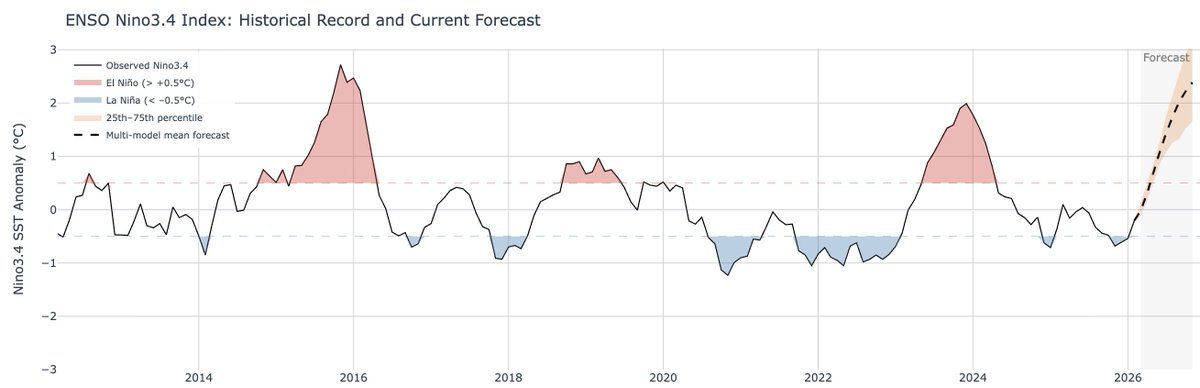
The 2026/2027 El Niño event has already grown faster than any prior events (at least on an ONI basis). Here its observed and projected future evolution compared to the strongest prior El Niño events in recorded history.
Currently 13 out of 14 dynamical models expect a record setting event based on the Niño 3.4 region sea surface temperature anomalies (ONI), with overall odds of a record sitting at 91% across all 667 model ensemble members.
Heat waves are driven by weather patterns but occur on the backdrop of a rapidly warming world. Without climate change the current European heat wave would have been ~3.2 °C (5.8 °F) cooler.
Heat impacts are non-linear, so this higher severity can lead to much greater suffering
Europe has been warming at a much faster rate than the world as a whole: roughly twice as fast as the global average, and 40% faster than the global land average.
This warming has been fastest in the winter months – driven in part by greater absorption of sunlight with less winter snow cover – but has been rapid year-round:
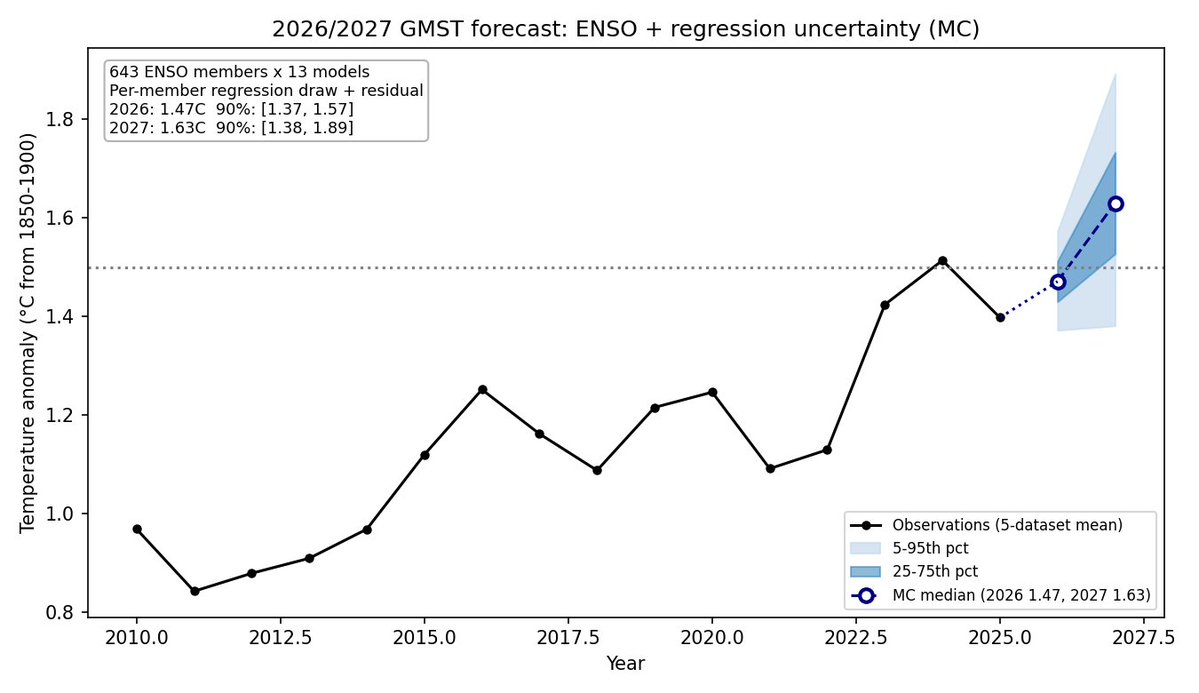
Today the @WMO released projections of where temperatures may end up over the next five years (baed on 13 different models and 250 ensemble members).
Their estimates for 2026 and 2027 are quite close to my (updated) ones:
My 2026 uncertainties are narrower as I'm using the first four months of data for the year to constrain my estimate. I also have a more up-to-date El Nino forecast than the WMO models (which are initialized considerably earlier and don't reflect the likely development of a very strong event.
@WMO I've also updated my estimates using data through April and the latest El Nino forecasts, which slightly bumped up the 2026 and 2027 central values compared to my last estimate that only used data through March: theclimatebrink.com/p/higher-warmi…
The arc of the scenario universe is long, but it bends inevitably toward more realistic emissions.
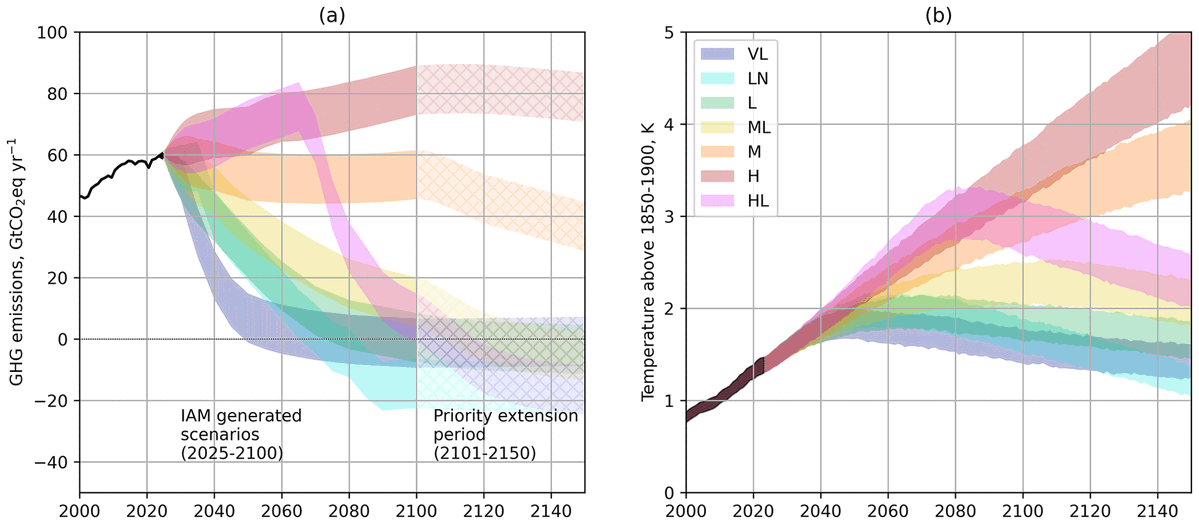
A new paper outlining the emissions scenarios we will be using in the upcoming IPCC AR7 report notes that "the CMIP6 high emission levels (quantified by SSP5-8.5) have become implausible".
It outlines a yet-to-be-released high emissions scenario notably lower than the one (SSP5-8.5) used in the prior IPCC 6th Assessment Report:
This is a change that a number of us in the community have long advocated, going back to Justin Ritchie's work in 2017.gmd.copernicus.org/articles/19/26…
And in 2020 Glen Peters and I published a piece in Nature arguing that high emissions scenarios were no longer "business as usual", and that more realistic emissions make for better climate policy: nature.com/articles/d4158…
El Niño is coming, and it is shaping up to be a big one.
Over at The Climate Brink I've put together a compilation of the latest forecasts by different modeling groups. They suggest that we might see an event comparable in strength to what we saw in 2016.
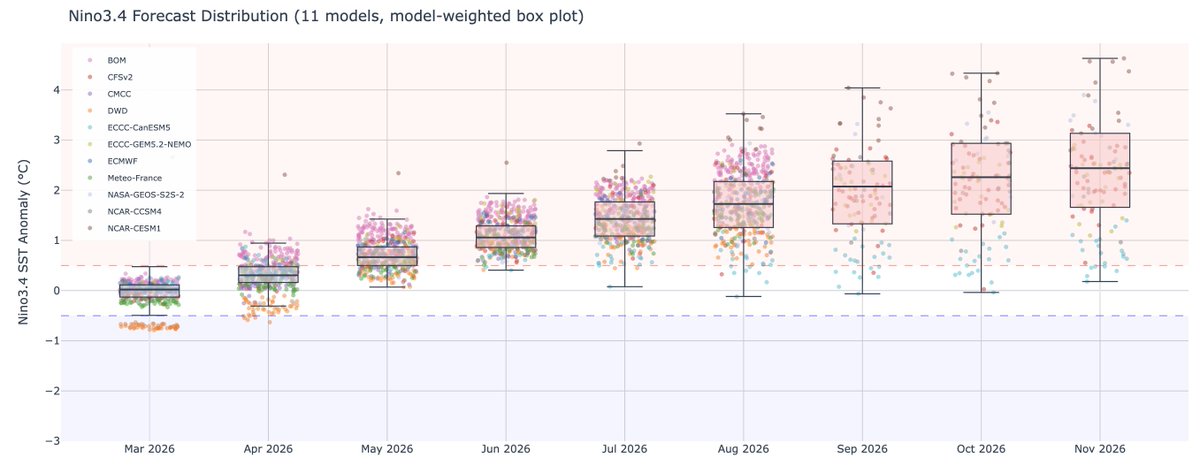
This is based on a collection of 11 different models (and 455 individual ensemble members) all updated since the start of March. I've put an interactive version of the data up on the Climate Dashboard here: dashboard.theclimatebrink.com/#enso
While there remains a big spread in models (and some models only run through August), more than half the runs show a strong (>1.5C Nino3.4) event developing by August and a very strong event (>2C) by the end of the year.
As a rare climate scientist working in Silicon Valley, I've been drinking from the AI firehose a lot more than my peers. I thought it would be helpful to lay out my experiences of both the promise and pitfalls of using AI to accelerate scientific research.
As a bit of background, I've been working with these tools since late 2022, and seen firsthand how they have dramatically improved over time. I’ve also worked with frontier AI labs to evaluate how well LLMs answer climate questions, and to help enable AI tools to support scientific collaboration.
So what do AI tools do well for scientific work? In short, coding.
Scientists are generally not software engineers. Much of their coding is self-taught, and many struggle with writing code quickly, producing well-documented reproducible code, and fixing errors.