1/ What does "aerosol" or "airborne" transmission suggest to people?
I am impressed by the accuracy of the responses. Indeed the **most important implication is that transmission occurs in shared room air**, and protecting against that.
I am impressed by the accuracy of the responses. Indeed the **most important implication is that transmission occurs in shared room air**, and protecting against that.
https://twitter.com/jljcolorado/status/1310641884398669824
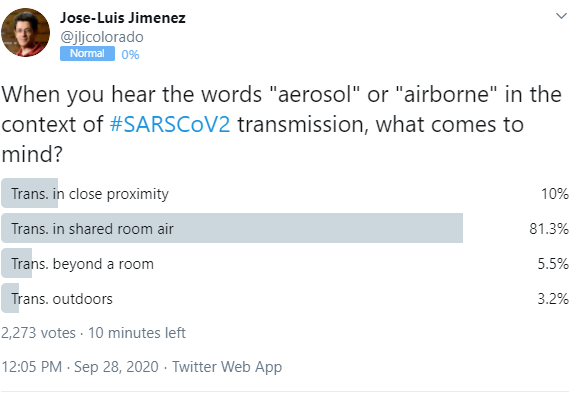
2/ Transmission in close proximity is ALSO dominated by aerosols (sciencedirect.com/science/articl…).
But since social distance and masks work well for that, the practical implications of accepting aerosol transmission are much smaller for that.
And indeed many fewer ppl think of that
But since social distance and masks work well for that, the practical implications of accepting aerosol transmission are much smaller for that.
And indeed many fewer ppl think of that
3/ Trans. beyond shared room ("long range") possible, but much less likely.
Won't be clear till there is low prevalence.
E.g. long range trans. for smallpox could only be proven for an outbreak in complete absence of community transmission: academic.oup.com/aje/article-ab…
Won't be clear till there is low prevalence.
E.g. long range trans. for smallpox could only be proven for an outbreak in complete absence of community transmission: academic.oup.com/aje/article-ab…
4/ Transmission outdoors is possible but FAR less likely than indoors. Overwhelming majority of superspreading is indoors
Trans. can happen outdoors, but very unlikely except for close conversation without masks (there are some documented cases of transmission this way)
Trans. can happen outdoors, but very unlikely except for close conversation without masks (there are some documented cases of transmission this way)
5/ Of course many responses to this poll were from people who follow my colleagues & I, and have learned about aerosol transmission through the discussions and materials we provide
But this demonstrates that if we provide accurate info, it can be accurately understood.
But this demonstrates that if we provide accurate info, it can be accurately understood.
• • •
Missing some Tweet in this thread? You can try to
force a refresh