A quick take on Palantir $PLTR - not interested in the least. What ultimately rules it out for me is how few customers they have, and hard it is to implement as a new customer. Yes, recent growth has spiked to 42% but 2019 ARPU growth was 8%. It's all about landing new custs.
It can take $1M+ just to implement! Palantir more resembles a services org for analytics & data enrichment (from intel sources), than an enterprise SaaS platform. So think of Palantir more as IBM or SAP (services over their analytics platform), not Databricks or Alteryx.
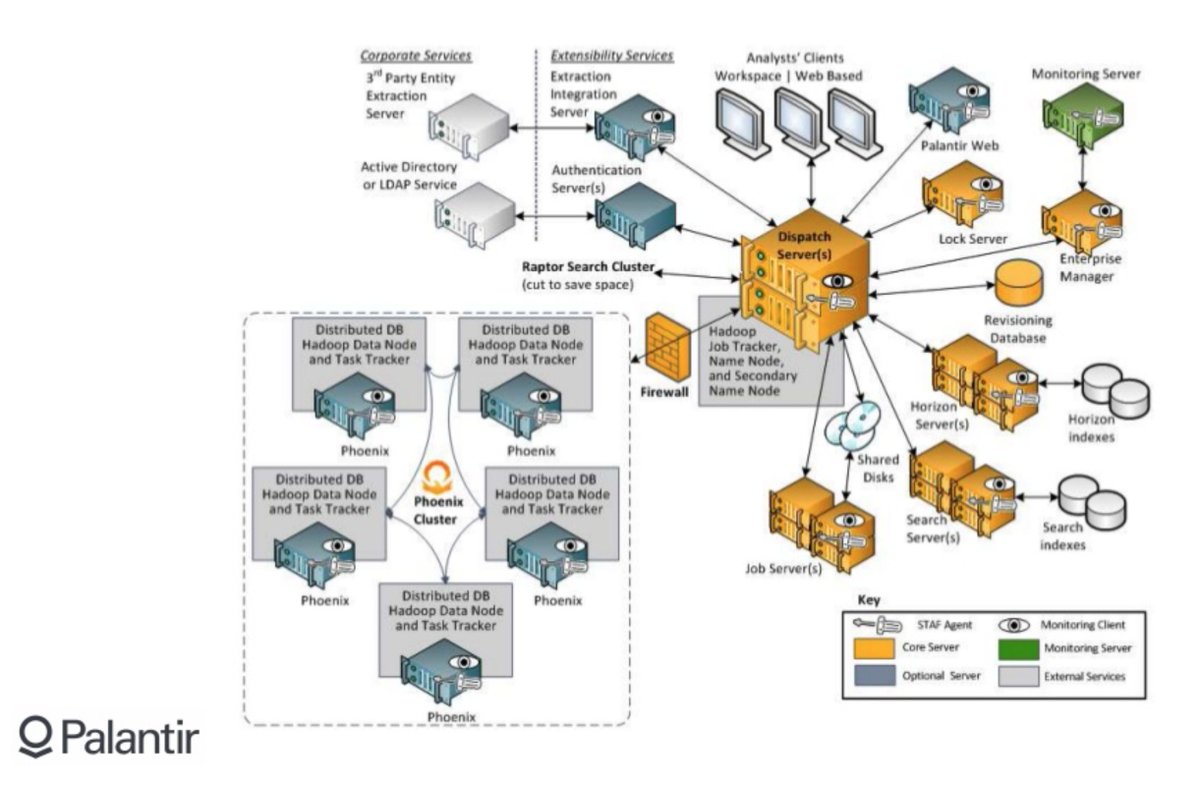
Difficult to find anything about their underlying architecture. Their current web page on it, today, points to a 2012 Youtube video. Any info I can find is typically from 2012-2017, like these diagrams. Look how complex it is. (Quite clear in how difficult implementation is.)
Here is a blog post from 2018 where they talk about open-source tools, which is really the only view into what they use in Hadoop - Cassandra and Spark. They discuss Postgres so maybe they moved on from Oracle. medium.com/palantir/palan…
So as near as I can figure out from this is that the underlying architecture is Oracle or Postgres db for metadata, Lucene for search (engine driving Elastic $ESTC), and Hadoop clusters using Cassandra distributed NoSQL for data store, and Apache Spark for analytics.
Analytics-aaS (yes, "ass") is always going to be black-box (proprietary technologies at the heart of a platform), but this company is even more so - they cannot even tell us what and where it is in use in the fed govt, 1/2 of their business.
Just one sign of the amount of secrecy they have to maintain - they had to revise their S-1 an additional 7 times. Latest tells us there is no shareholder voting rights at all. techcrunch.com/2020/09/21/pal…
Too much secrecy around their platform, and the view we DO have into their platform is that it is extremely complex and difficult to implement. It requires heavy services to onboard new customers, while existing customers are hardly growing. None of this appeals to me. /fin
• • •
Missing some Tweet in this thread? You can try to
force a refresh
Resolution: Greatly improve the security and privacy of the network traffic from your home network and device, with a few simple steps.
I follow @Cloudflare for their enterprise solutions, but they help us consumers out too. And a lot of it is free.
A thread... /1
The content of your web traffic is encrypted (HTTPS) - but your ISP can still see what domains you are calling. Help protect your web requests by using 1.1.1.1 (fast & secure DNS resolver), and 1.1.1.1 for Families (block known malware sites, or malware + adult content). /2
It's easy to switch your entire home network to it. Change your router's DNS lookups to 1.1.1.1/1.0.0.1 (or 1.1.1.2/1.0.0.2 for malware block, or 1.1.1.3/1.0.0.3 for adult content block). See setup instructions on developers.cloudflare.com/1.1.1.1/
/3
Lots of folks brooding about $FSLY and asking my take over past week. My take is... “I want more info”. I am not one to rush decisions, and want to see what earnings shows on Wed before deciding. /1
Basically Fastly proved it is mortal. Rev will be at the 42% they just pegged it at (the Q in question already ended) which is right back in the high end of the range it was bouncing around at pre-pandemic. /2
They have always had a volatile top line that waxes and wanes, so is nothing new. Just a bit jarring after the huge tailwind of last Q. And this does not factor much into their future potential and long term success. /3
Today’s new One feature is a bigger deal than I thought it’d be from yesterday’s teaser. Bold moves that are understated from the headline. Cloudflare just took a big step into ‘s lane. /1
They are angling Access to be an SSO, not only accessing internal apps via Zero Trust (like ZPA), but also for all the other SaaS apps your enterprise uses. (Which up til now was solely the purview of the Gateway secure web gateway side.) /2
They are not eliminating . They will work with them and a wide variety of other identity providers, including multiple simultaneously. But after relying on Okta and others for establishing identity, they take over SSO to any enterprise apps from there. /3
The market sure in love with $NET today in realizing they are a $ZS competitor. Some of us have known this was coming since... uh (checks notes).... February.
Let’s refresh on a few past tidbits.... /1
“Sound familiar? It turns out Cloudflare is now a direct competitor to Zscaler. ... This new product line, Cloudflare for Teams, is a carbon copy of Zscaler.” - me back in Feb /2
The thing to watch now... they didn’t charge for it til Sept 1. (Very nice of them to help out in the chaos of pandemic.) This Q will have Teams contributing 1 month, while Q4 will have a full Q ... as mentioned in my recent Edge Network writeup. /3 hhhypergrowth.com/what-are-edge-…
The Friday scoop from Forbes played out. $TWLO acquired Segment, a “customer data platform” startup. This adds integration tools, ingest pipelines, customer vision, and analytics into Twilio stack. /1
Lawson really clarifies what they went after: “Communications was just the entry point for the real opportunity, which has been really providing a comprehensive platform for customer engagement....”. /2
“... The one thing that’s always been missing from Twilio as we’ve been building up this customer engagement platform is understanding of the end users themselves. We power the communications, but we don’t actually know who the customers are.” /3
enhances Workers w stateful objects. This opens a huge new use cases for app dev. blog.cloudflare.com/introducing-wo…. Blog post from @KentonVarda does a good job in showing its potential in laymen’s terms. This is pretty exciting from a developer stand point. /1
This is way more impactful than the “edge db” I was guessing (a stateful data store). This is stateful OBJECTS — instead of having a shared db across Worker instances, the Worker instance itself is what is shared. /2
Basically, shared objects can be maintaining state as a mini in-mem storage and logic pod. Think of it as a shared spreadsheet or doc. With this new feature, each doc is a separate Worker instance - you aren’t storing the data in a shared (multi-tenant) database or API layer. /3