1. Yes, @kkondik is spot on in terms of the assessment here. In my forecast- which comes back out Sunday, the NC Senate seat is seat 50- although there are reasons to believe it was looking soft before this happened. Primary bc the @CalforNC was focused on wooing Indies & mod Rs
2. to the exclusion of any other efforts and messaging as I knew it would be when I was fervently hoping a stronger nominee would emerge. Sadly, NC's bench sat out, failing to realize how good the atmosphere would be in 2020- looking at 2020 & Burr's open seat which si DUMB,
3. my research being blacklisted off election twitter, it was hard for me to convince people back in 2019 that come fall of 2020 it would be a dominant environment to topple Tillis. So they end up w Tillis, and for the 2nd time the Ds find themselves getting screwed by the sexual
4. appetites of older white men. But this will also give us a good test of how much the D electorate will tolerate. We know how bad the R electorate is- they tried and almost succeeded in sending a child molester to the Senate in Alabama. They weren't thwarted in that effort by
5. R voters- they were thwarted by a surge of Dems and Indies. Control of the senate is on the line. I don't see Tillis dropping out and I don't see the Dems dropping him. Maybe he'll realize too that the only way he ever could win this race was via NC's college educated Ds & Is
6. and driving massive black turnout by focusing on the stakes of control of the senate and tying Tillis to Trump. That was the campaign he should have been running all along- and the fallacy of his "get Rs to bail on Tillis plan" was already apparent. But in terms of "guy wanted
7. to cheat on his wife" scandal rendering him unelectable? I'm guessing no, not in this environment with control of the senate at stake.
• • •
Missing some Tweet in this thread? You can try to
force a refresh

For half a century, America built the broadest middle class in history. Then came Reaganomics. Forty-five years later, the results are in.
In 1928, on the eve of the Great Depression, the richest 1 percent of Americans collected 23.9 percent of all income in the United States.
Over the next fifty years, that share would be cut by more than half. Through progressive era trust-busting, labor reform, taxation, social insurance, and public investment, Americans built the broadest middle class in the nation’s history. By the late 1970s, the top 1 percent claimed just 9 percent of national income.
Today, that share has climbed above its 1928 level.
That fact alone should force us to rethink much of what we’ve been told about the American economy. Because if the richest 1 percent now capture a larger share of national income than they did on the eve of the Great Depression and we have just created the world’s 1st trillionaire, then the obvious question is not whether Americans are unhappy with the economy. The obvious question is how we got here.
To answer that question, we have to understand what the first Gilded Age actually was.
For many Americans, the phrase evokes images of grand mansions, railroad tycoons, and industrial fortunes. For ordinary people, it looked very different. It looked like children working twelve-hour shifts in textile mills and coal mines. It looked like six-day work weeks that routinely stretched to sixty or seventy hours. The five-day work week did not exist. Overtime protections did not exist. Workplace safety protections were minimal or nonexistent.
The conditions for the bottom 50% of Americans were often brutal.
In 1911, 146 garment workers—most of them young immigrant women and girls—died in the Triangle Shirtwaist Factory fire in New York City. Some burned alive. Others jumped from upper-story windows to escape the flames. The factory owners had locked the exits.
🚨🧵The Confederacy Lost the War.
It Did Not Lose the Peace.
American defeated the rebellion militarily, but failed to hold its leaders accountable. The result was one of the most successful historical revision campaigns in modern history-transforming traitors into heroes, rebellion into heritage, and defeat into memory.
On April 20, 1861, Robert E. Lee resigned from the United States Army.
“Save in defense of my native State, I never desire again to draw my sword,” he would later write in explaining his decision.
It was not a rash choice. Lee had spent more than three decades serving the nation. He graduated from West Point without a single demerit, distinguished himself in the Mexican-American War, and was widely regarded as one of the finest officers in the Army. He had also sworn an oath—not to Virginia, not to Arlington, and not to the South, but to the Constitution of the United States.
When Virginia seceded, Lee faced a choice. He loved the Union and opposed secession. He understood that war meant breaking the bonds forged in the blood of their own grandfathers in the American Revolution. Yet, when forced to choose between the nation he served and the state he now considered “his country”, Lee chose Virginia.
Lee was hardly alone. During the American Civil War, 304 West Point graduates rejected their oath of allegiance to the United States and chose to serve in armed rebellion for the Confederate States Army.
His approval ratings are underwater. Independents are fleeing Republicans like they have herpes. The economy is dragging him down. Inflation from his dumbass tariffs are dragging him down. Gas price spikes from the Iran War is dragging him down. His billion dollar ballroom is weighing him down.
Democrats are poised to win big in the fall midterms.
And yet none of that changes the central reality of American politics in 2026: America can’t stop Trump.
America cannot stop Donald Trump because he is supported by what amounts to a political cult. Not only would MAGA still support Trump if he shot someone on 5th Avenue, they would pull the trigger for him themselves if he asked them to do it.
Every constitutional mechanism capable of stopping him and holding him accountable requires the support of elected Republicans — and Republicans now operate inside a political system where opposing Trump is political suicide.
Trump’s approval among the MAGA base comes close to 100%.
Think about that. After raising prices he promised to lower on Day 1, covering up for his fellow Epstein cronies, and reneging on his most important brand of “no new wars,” these motherfuckers are like, “thank you sir, may we have another!”
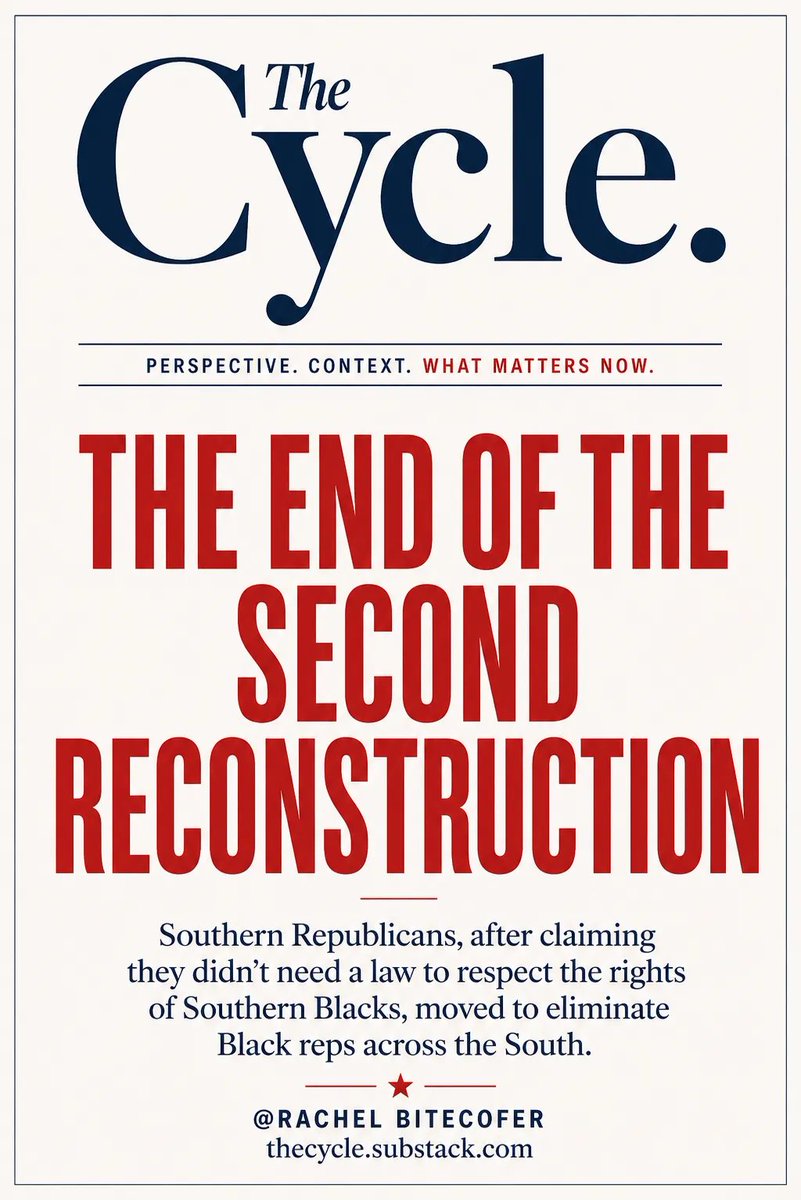
Southern Republicans, after claiming they didn’t need a law to respect the rights of Southern Blacks, moved immediately to eliminate Black reps across the South.
Most Americans think this is a fight over a handful of congressional districts.
It is much, much worse than that.
Plz read and share this 🧵
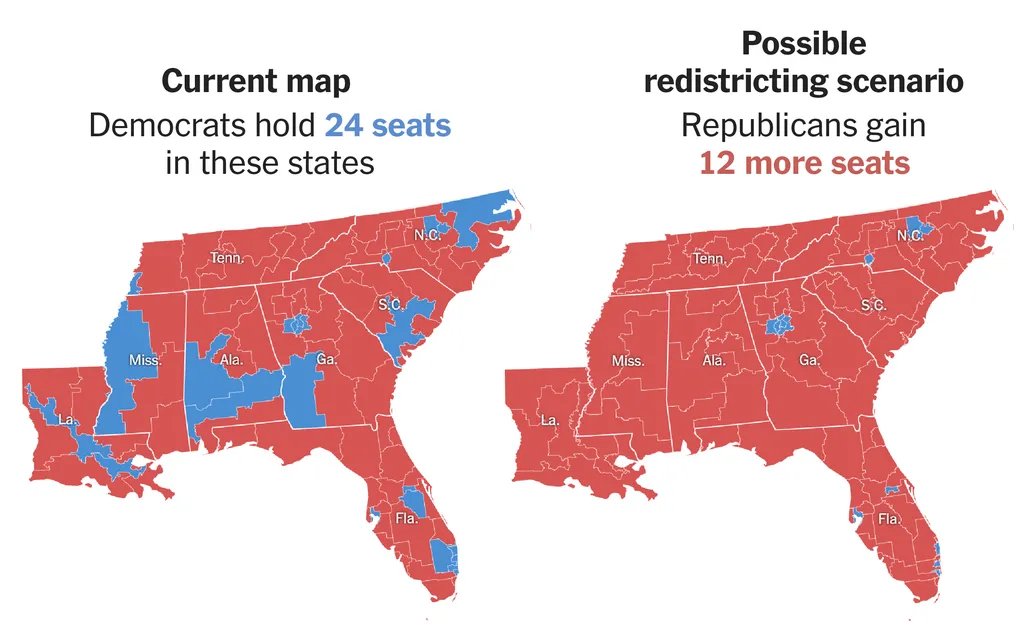
Over the past several days, Southern legislatures have moved with breathtaking speed to dismantle Black political representation across the South after the Supreme Court’s decision in Louisiana v. Callais weakened the Voting Rights Act’s anti-dilution framework.
In Louisiana, lawmakers quickly advanced a map eliminating one of the state’s two Black-opportunity congressional districts. In Tennessee, Republicans finalized a map splintering Memphis and dismantling the state’s only majority-Black congressional district. In Alabama and South Carolina, officials are already preparing new challenges and redraws.
Within a decade the South may look like this:
Most people hear “redistricting” and think about Congress. A few House seats. A partisan fight in Washington. But the modern Voting Rights Act did not merely shape Congress. Its most profound transformation occurred at the state and local level throughout the South.
The Voting Rights Act did not simply protect the right to cast a ballot. It protected the ability of Black communities to translate votes into actual representation. That distinction is everything.
🚨Please Stop Trying to Murder Trump
Political Assassination Is the Road to Civil War
One unstable individual commits an act of political violence, and suddenly an entire political coalition gets recast as an existential enemy in the minds of millions of angry people. And once people become convinced their families, their country, their way of life, or their movement is under attack, violence stops feeling offensive to them and starts feeling defensive. Necessary. Patriotic, even.
That is the road to political bloodshed.
I need you to understand something very clearly:
The assassination of Donald Trump would be one of the worst possible things that could happen to the United States of America right now.
And I don’t mean morally. I mean strategically, politically, socially, historically. I mean, as someone who studies authoritarianism, democratic collapse, political violence, and mass behavior for a living, the idea of Trump being assassinated is absolutely terrifying—not because Trump himself is good for democracy, he is a threat! Trump has purged democratic institutions, legitimized conspiracy theories, radicalized distrust, and pushed the boundaries of authoritarian politics in ways America has never experienced in the modern era.
But there is something much more dangerous than an authoritarian movement slowly losing public support and that is an authoritarian movement transformed into a martyr cult. And I really do not think enough Americans understand what would happen if Trump were successfully assassinated.
We are already got a preview of it.
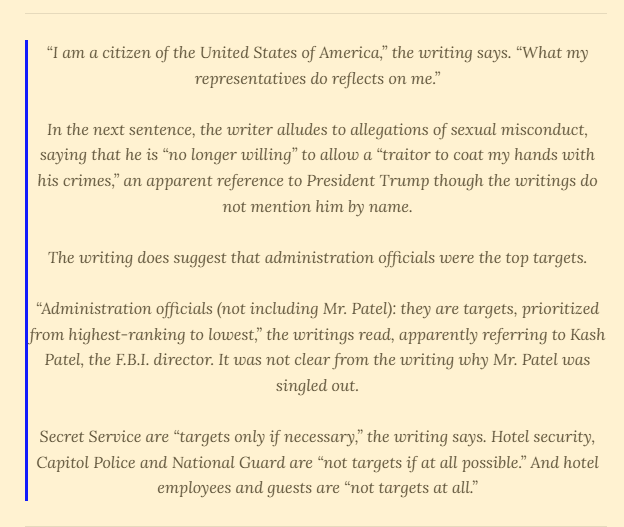
The man accused of murdering Charlie Kirk left behind evidence that made his political motivations crystal clear. And the same is true with this latest suspect. The motives were there. I’m going to include his writing because I’m already watching people pretend this is somehow ambiguous when it really isn’t.
🔥Hell Hath No Fury Like a Woman Scorned
Elon's latest baby mama exposes the MAGA narrative machine
One of the persistent mysteries of modern politics is why the online right always seems to move in lockstep. A scandal breaks, even fake scandals like the Biden Crime Family and within minutes thousands of accounts are repeating the same attacks.
Via the GOP’s Wall of Sound, things like trans people on beer cans or fake policies like CRT become MAJOR ISSUES. A talking point appears on Twitter, and suddenly it’s everywhere—from influencers to Fox News hosts to members of Congress.
To outsiders, it looks like spontaneous grassroots consensus.
But according to former MAGA influencer Ashley St. Clair—who spent nearly a decade inside the ecosystem—that appearance is largely an illusion. What she describes (while doing her makeup for some reason, Gen Z is weird) is something far more structured: a coordinated political messaging system that runs through influencers, consulting firms, billionaire donors, and conservative media.
Think of it less like a movement and more like an information supply chain.
And here’s how it works.
1. The Command Center: Influencer Group Chats
At the core of the system are large private group chats populated by influencers, operatives, and most important, politicians and conservative media outlets.