Rachel Bitecofer 🗽🦆 Profile picture
National political analyst/strategist, pollster, PhD. Be smarter than your friends- read The Cycle on Substack. This ...
Jul 26 • 10 tweets • 12 min read
đź§µDonald Trump Wants to Steal the 2026 Midterms. Can He?

It’s the question hanging over American politics like a dark shroud.

If Donald Trump is willing to plot insurrection, ignore court orders, purge the Justice Department, pardon political allies, indict his enemies, threaten election officials, and openly test the limits of presidential power, what’s to stop him from simply stealing the 2026 midterm elections?Image Whether Americans know it or not, it isn’t a paranoid question anymore. It’s a rational one.

After all, we’ve already watched this “president” refuse to accept defeat, pressure state officials to “find” votes, and inspire an attack on the Capitol in an effort to overturn an election he lost by a landslide. That same president is back in office, surrounded by far more loyal advisers and with four years of experience learning where the guardrails held—and where they didn’t.

So let’s answer the question honestly. Can Donald Trump steal the 2026 midterms?

The answer is he has limited opportunities to do so given that Senate Republicans blocked the SAVE ACT because election administration and certification is decentralized and controlled by the states.

Trump cannot simply cancel congressional elections by executive order or declare Republicans the winners because he wants them to be. That said, an incumbent president with unethical motives can use the enormous powers of the federal government to pressure states, intimidate election officials, shape public perception, manufacture constitutional crises, and tilt the playing field.
Jul 15 • 9 tweets • 13 min read
đź§µAmerica's Third Founding:
In the wake of whatever Trump does, America needs to get its constitutional house in order

Americans love to debate how to fix our democracy.

End Citizens United. Abolish the Electoral College. Ban partisan gerrymandering. Expand the House of Representatives. Impose congressional term limits. Prevent another corrupt president from abusing the powers of the office.

One of the greatest failures of American civic education is that we teach people what government does, but rarely how government changes. We memorize the three branches of government and the Bill of Rights, yet few Americans understand the difference between constitutional law and ordinary legislation—or why that distinction determines whether a reform is politically possible.

The United States has already been founded twice.

The first founding came in 1787, when the Constitution established a new system of government unlike any the world had seen. The Bill of Rights soon followed as the political compromise that secured ratification, creating the constitutional framework that has endured for more than two centuries.

The second founding came after the Civil War.

The nation nearly destroyed itself over slavery and secession. Four years of unimaginable bloodshed settled the question of whether the Union would survive, but victory on the battlefield was only the beginning. During Reconstruction, Congress required the former Confederate states to ratify the Thirteenth, Fourteenth, and Fifteenth Amendments before they could fully reclaim representation in the federal government.

Those amendments transformed the Constitution. They abolished slavery, established birthright citizenship, guaranteed equal protection and due process, and prohibited denying the right to vote on the basis of race. The Fourteenth Amendment, in particular, became the constitutional foundation for much of modern American liberty. Many of the civil rights and individual freedoms Americans take for granted today trace directly back to the Second Founding.

Every generation inherits the Constitution, but only one generation has had an opportunity to fundamentally remake it: the Civil War generation.

Today, America faces another constitutional moment, not because states are preparing to leave the Union, but because many of the assumptions built into an eighteenth-century Constitution no longer fit the realities of twenty-first-century politics. Unlimited campaign spending, partisan gerrymandering, an Electoral College that can reject the national popular vote, and growing concerns about presidential accountability have exposed weaknesses the Framers could never have anticipated.

Yet our political debate almost always skips over the most important question.

Can these problems actually be fixed? Some can, most cannot—at least not through ordinary legislation. Congress cannot abolish the Electoral College. It cannot rewrite the constitutional qualifications for the presidency. It cannot simply declare that money is no longer protected political speech if the Supreme Court continues to interpret the First Amendment as it does today.

To do these things the Constitution itself must be changed and the process to do so is arduous- hard to pull off in the best of times and these are not the best of times.

To amend the Constitution you need a 2/3rds vote in both chambers of Congress and ratification by 3/4s of the states. This is why despite passing through both the House and Senate, the Equal Rights Amendment failed to reach ratification.

In a country that can’t even pass a budget through normal legislation those barriers aren’t just hard, they are impossible. The last time we successfully amended the Constitution it was in 1996 and the issue was preventing congress from giving itself current-term pay raises. Hardly controversial.

History teaches us that America’s greatest constitutional reforms have never emerged from ordinary politics. They have emerged from extraordinary crises. The Constitution replaced the failed Articles of Confederation. The Reconstruction Amendments followed the Civil War. Each founding was born from a national reckoning that forced Americans to rethink the rules by which they governed themselves.

If America experiences another constitutional reckoning, we should not waste it. We should already know which reforms would strengthen our democracy—and what it would actually take to achieve them.

That is the purpose of this essay.Image Reform One: Restoring Political Equality
Democracy rests on a simple promise: every citizen is politically equal.

Not economically equal. Not socially equal. Politically equal.

Every American gets one vote, and every vote carries the same weight. The legitimacy of democratic government depends on the idea that no citizen’s voice should count more than another’s simply because of wealth.

For most of American history, that principle was imperfectly realized but broadly understood. Wealthy Americans have always enjoyed advantages in politics, but there was also broad agreement that government could place reasonable limits on the role of money in elections to protect the integrity of representative government.

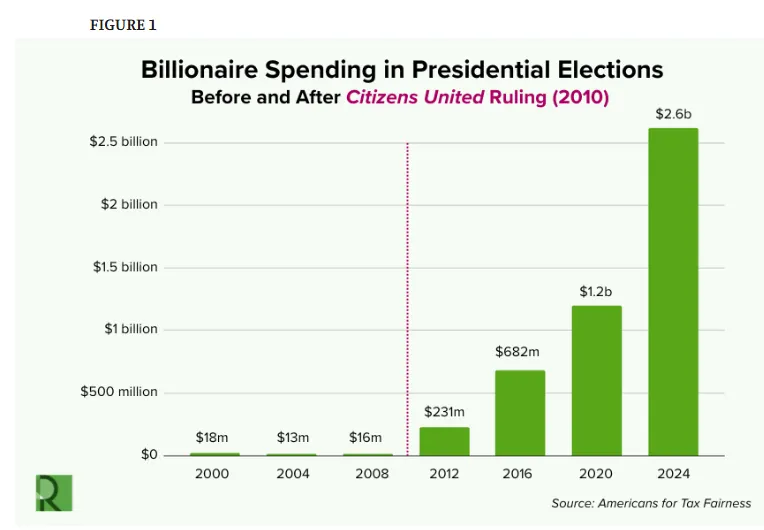
Over the past several decades, however, the Republican-controlled Supreme Court has moved in a different direction. Building on earlier decisions, the Court concluded that spending money to advocate for political candidates is protected by the First Amendment because money enables political speech. That constitutional reasoning reached its most famous expression in Citizens United v. Federal Election Commission.

Its practical effect has been unmistakable.

Modern American elections are now dominated by an arms race of Super PACs, billionaire donors, dark money organizations, and outside spending that would have been almost unimaginable a generation ago. Every citizen still receives one vote, but not every citizen possesses the same political voice. Those with extraordinary wealth can spend virtually unlimited sums shaping campaigns, financing advertisements, and influencing the political conversation.

Many Americans believe that is inconsistent with the democratic ideal of political equality. The question becomes: how do we change it?

There are only two realistic paths.

The first is judicial. A future Supreme Court could reverse or substantially narrow Citizens United and related decisions, concluding that the First Amendment permits greater regulation of money in politics than the current Court recognizes.

The second is constitutional.Image
Jun 24 • 21 tweets • 10 min read
🚨How Reaganomics Brought Back the Gilded Age:

For half a century, America built the broadest middle class in history. Then came Reaganomics. Forty-five years later, the results are in.

In 1928, on the eve of the Great Depression, the richest 1 percent of Americans collected 23.9 percent of all income in the United States.

Over the next fifty years, that share would be cut by more than half. Through progressive era trust-busting, labor reform, taxation, social insurance, and public investment, Americans built the broadest middle class in the nation’s history. By the late 1970s, the top 1 percent claimed just 9 percent of national income.

Today, that share has climbed above its 1928 level.Image That fact alone should force us to rethink much of what we’ve been told about the American economy. Because if the richest 1 percent now capture a larger share of national income than they did on the eve of the Great Depression and we have just created the world’s 1st trillionaire, then the obvious question is not whether Americans are unhappy with the economy. The obvious question is how we got here.

To answer that question, we have to understand what the first Gilded Age actually was.
Jun 3 • 21 tweets • 10 min read
🚨🧵The Confederacy Lost the War.
It Did Not Lose the Peace.

American defeated the rebellion militarily, but failed to hold its leaders accountable. The result was one of the most successful historical revision campaigns in modern history-transforming traitors into heroes, rebellion into heritage, and defeat into memory.Image On April 20, 1861, Robert E. Lee resigned from the United States Army.

“Save in defense of my native State, I never desire again to draw my sword,” he would later write in explaining his decision.

It was not a rash choice. Lee had spent more than three decades serving the nation. He graduated from West Point without a single demerit, distinguished himself in the Mexican-American War, and was widely regarded as one of the finest officers in the Army. He had also sworn an oath—not to Virginia, not to Arlington, and not to the South, but to the Constitution of the United States.Image
May 21 • 15 tweets • 5 min read
🚨🧵Why America Can’t Stop Trump

Donald Trump is broadly unpopular.

That much is true.

His approval ratings are underwater. Independents are fleeing Republicans like they have herpes. The economy is dragging him down. Inflation from his dumbass tariffs are dragging him down. Gas price spikes from the Iran War is dragging him down. His billion dollar ballroom is weighing him down.Image Democrats are poised to win big in the fall midterms.
And yet none of that changes the central reality of American politics in 2026: America can’t stop Trump.

America cannot stop Donald Trump because he is supported by what amounts to a political cult. Not only would MAGA still support Trump if he shot someone on 5th Avenue, they would pull the trigger for him themselves if he asked them to do it.
May 13 • 19 tweets • 7 min read
🚨The End of the Second Reconstruction:

Southern Republicans, after claiming they didn’t need a law to respect the rights of Southern Blacks, moved immediately to eliminate Black reps across the South.

Most Americans think this is a fight over a handful of congressional districts.

It is much, much worse than that.

Plz read and share this 🧵Image Over the past several days, Southern legislatures have moved with breathtaking speed to dismantle Black political representation across the South after the Supreme Court’s decision in Louisiana v. Callais weakened the Voting Rights Act’s anti-dilution framework.
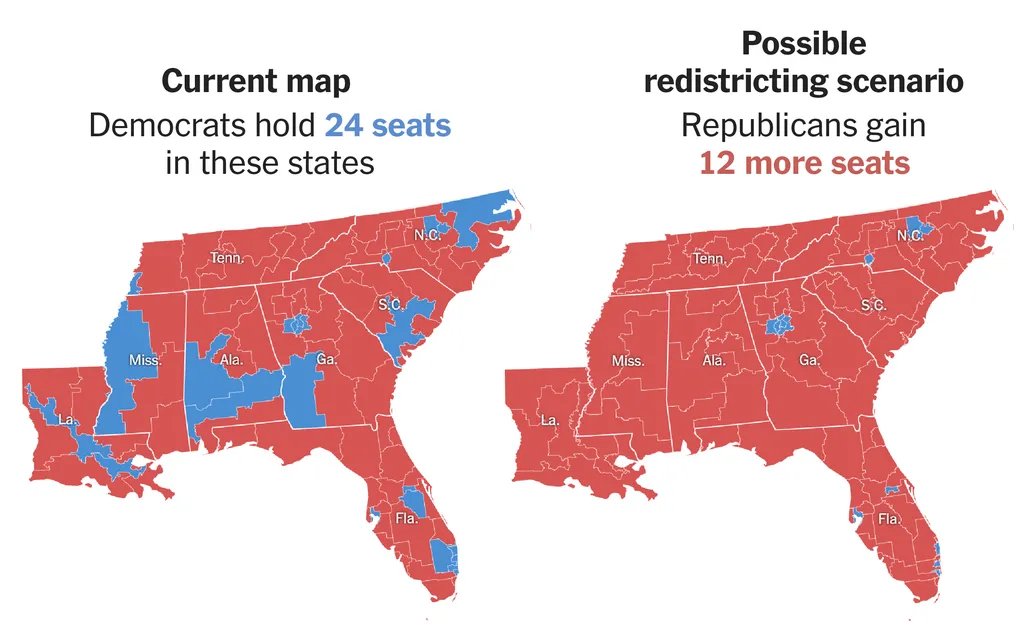
In Louisiana, lawmakers quickly advanced a map eliminating one of the state’s two Black-opportunity congressional districts. In Tennessee, Republicans finalized a map splintering Memphis and dismantling the state’s only majority-Black congressional district. In Alabama and South Carolina, officials are already preparing new challenges and redraws.

Within a decade the South may look like this:Image
Apr 29 • 13 tweets • 5 min read
🚨Please Stop Trying to Murder Trump
Political Assassination Is the Road to Civil War

One unstable individual commits an act of political violence, and suddenly an entire political coalition gets recast as an existential enemy in the minds of millions of angry people. And once people become convinced their families, their country, their way of life, or their movement is under attack, violence stops feeling offensive to them and starts feeling defensive. Necessary. Patriotic, even.

That is the road to political bloodshed.Image I need you to understand something very clearly:
The assassination of Donald Trump would be one of the worst possible things that could happen to the United States of America right now.

And I don’t mean morally. I mean strategically, politically, socially, historically. I mean, as someone who studies authoritarianism, democratic collapse, political violence, and mass behavior for a living, the idea of Trump being assassinated is absolutely terrifying—not because Trump himself is good for democracy, he is a threat! Trump has purged democratic institutions, legitimized conspiracy theories, radicalized distrust, and pushed the boundaries of authoritarian politics in ways America has never experienced in the modern era.
Apr 16 • 18 tweets • 7 min read
MUST READ & RT đź§µ

🔥Hell Hath No Fury Like a Woman Scorned
Elon's latest baby mama exposes the MAGA narrative machine

One of the persistent mysteries of modern politics is why the online right always seems to move in lockstep. A scandal breaks, even fake scandals like the Biden Crime Family and within minutes thousands of accounts are repeating the same attacks.

Via the GOP’s Wall of Sound, things like trans people on beer cans or fake policies like CRT become MAJOR ISSUES. A talking point appears on Twitter, and suddenly it’s everywhere—from influencers to Fox News hosts to members of Congress.

To outsiders, it looks like spontaneous grassroots consensus. But according to former MAGA influencer Ashley St. Clair—who spent nearly a decade inside the ecosystem—that appearance is largely an illusion. What she describes (while doing her makeup for some reason, Gen Z is weird) is something far more structured: a coordinated political messaging system that runs through influencers, consulting firms, billionaire donors, and conservative media.

Think of it less like a movement and more like an information supply chain.

And here’s how it works.
Apr 5 • 16 tweets • 5 min read
The entire world is looking at America like WTF and most Americans still have no idea anything is wrong.
Here's why:

🚨Democracy on Autopilot
America expanded the right to vote without building the civic culture democracy requires

This week brought another round of buried headlines declaring that Americans don’t understand their own government.

The latest national civics assessment shows just 22% of eighth-grade students scoring “proficient” in civics, while roughly 31% fall below basic competency. Surveys of college students find that about 60% cannot identify the term length of members of Congress, and adult civics quizzes routinely show large shares of Americans unable to answer basic questions about how the federal government works.Image On social media we are seeing one common theme from foreigners:
WTF is wrong with you, America?!

To which I am forced to reply with the sad reality that most Americans have still no idea that any of this is even happening.

No, really. Go out in the world. Do you a get a sense people realize they are living through what is shaping up to be a historical clusterfuck of epic proportions. One commentator said the guy behind him in line at the airport didn’t understand why the TSA lines were so long, so he told him its from the shutdown.

Dude said “what shutdown?!”
Mar 15 • 15 tweets • 4 min read
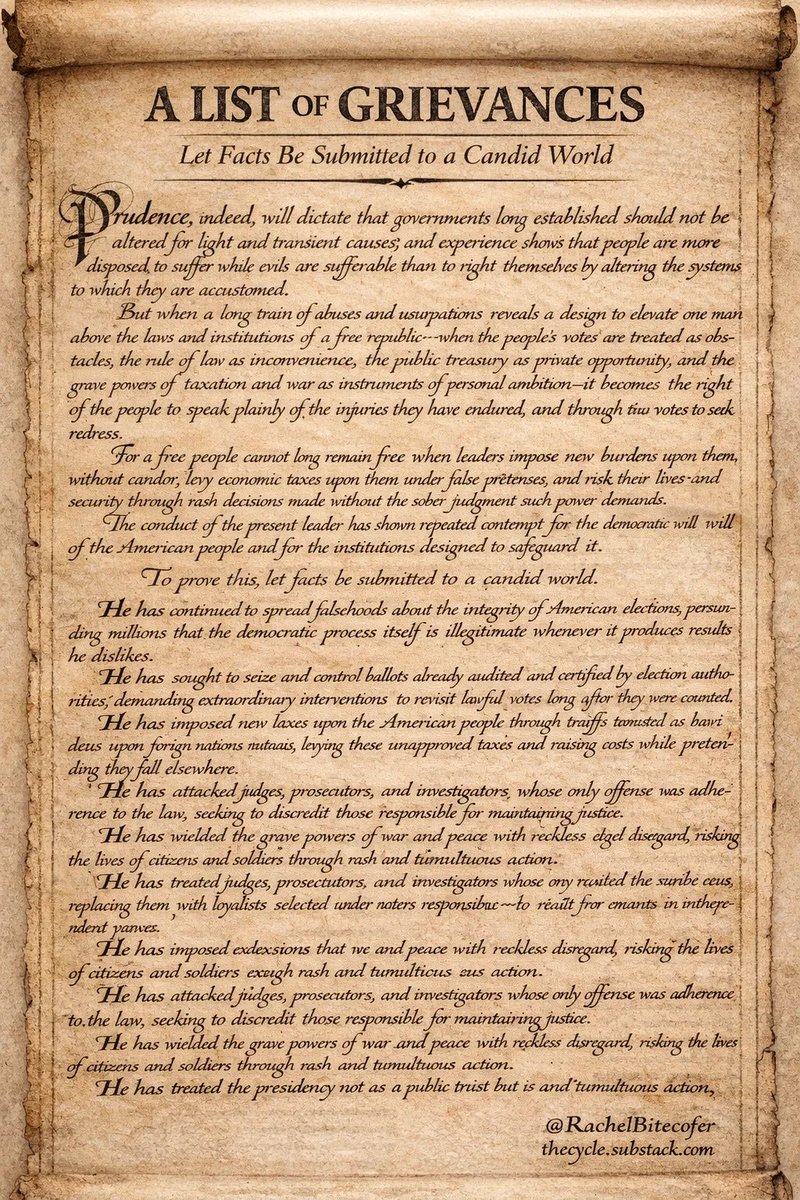
🚨🚨🚨A List of Grievances
Let Facts Be Submitted to a Candid World

Prudence, indeed, will dictate that governments long established should not be altered for light and transient causes; and experience shows that people are more disposed to suffer while evils are sufferable than to right themselves by altering the systems to which they are accustomed.Image But when a long train of abuses and usurpations reveals a design to elevate one man above the laws and institutions of a free republic—when the people’s votes are treated as obstacles, the rule of law as inconvenience, the public treasury as private opportunity, and the grave powers of taxation and war as instruments of personal ambition—it becomes the right of the people to speak plainly of the injuries they have endured, and through their votes to seek redress.
Mar 12 • 18 tweets • 6 min read
🚨The Pentagon’s Armageddon Problem
When Christian Nationalism Runs the U.S. Military

Pete Hegseth's White Christian Nationalist wet dream was to start war in the the Middle East to bring on biblical apocalypse.

And here we are. đź§µImage As American troops were prepped to attack Iran, some were told something rather chilling.

According to complaints filed with a military watchdog group, soldiers were briefed that the conflict unfolding in the Middle East was part of “God’s divine plan.” Some commanders reportedly referenced the Book of Revelation and framed the war in prophetic terms.

Think about that for a second.

American soldiers — sent halfway around the world with rifles and drones — being told they are participating in biblical prophecy.
Mar 9 • 12 tweets • 5 min read
🚨🚨🚨Iran’s Other Leverage: WATER

A couple days ago I wrote about the first lever Iran holds in this war: the Strait of Hormuz. If Iran disrupts shipping through that narrow channel between Iran and Oman, roughly one-fifth of the world’s oil supply gets caught in the crossfire. Oil spikes. Shipping markets panic. The global economy starts sweating. That’s leverage.Image But Hormuz is only half the story. Because there’s another vulnerability sitting right across the Persian Gulf—one that almost nobody outside the region knows about.

The modern cities of the Gulf are built in the middle of a motherfucking desert. Dubai. Abu Dhabi. Doha. Kuwait City. Manama.

Like this kind of desert!!!Image
Mar 5 • 22 tweets • 9 min read
🚨🚨🚨Shit is About to Hit The Fan in the Strait of Hormuz:

For 60 years, Middle East Experts Have Feared Exactly What Trump Just Did

There are a lot of people in the Middle East tonight who are staring at their phones and wondering what tomorrow is going to bring.

Airspace is closing. Flights are being rerouted. Oil markets are jumping. Somewhere right now a tanker captain is trying to figure out whether it is safe to move through the narrow strip of water that carries a fifth of the world’s oil supply.Image Somewhere else a sailor on an American warship is getting briefed about what it means to enter that same strip of water after Iran has warned that any vessel attempting to pass could be attacked.

For most Americans this still feels distant, abstract, like another foreign policy story unfolding somewhere far away. But the truth is that the next phase of this crisis is likely to unfold in one very specific place.

A place that most Americans had probably never heard of until this week.

The Strait of Hormuz.Image
Feb 15 • 18 tweets • 7 min read
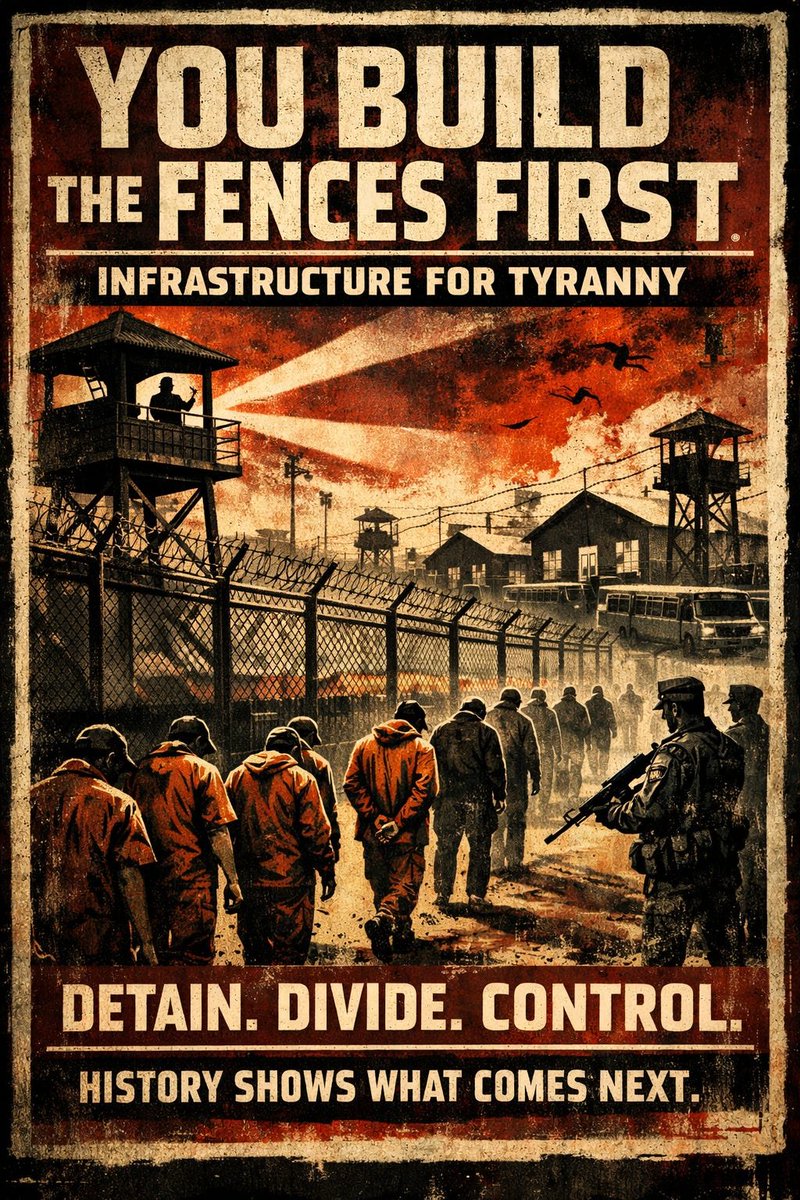
🚨🚨🚨 🧵You Build the Fences First
Infrastructure for Tyranny

In 1933, the Nazis did not hide Dachau.

They invited outsiders to see it.

Foreign correspondents were escorted through the newly opened Dachau Concentration Camp and shown neat barracks, orderly rows of bunks, and prisoners moving through structured routines. Guards stood upright and disciplined. The grounds appeared controlled, even efficient. What visitors saw looked administrative.Image The violence — already present — was kept out of sight.
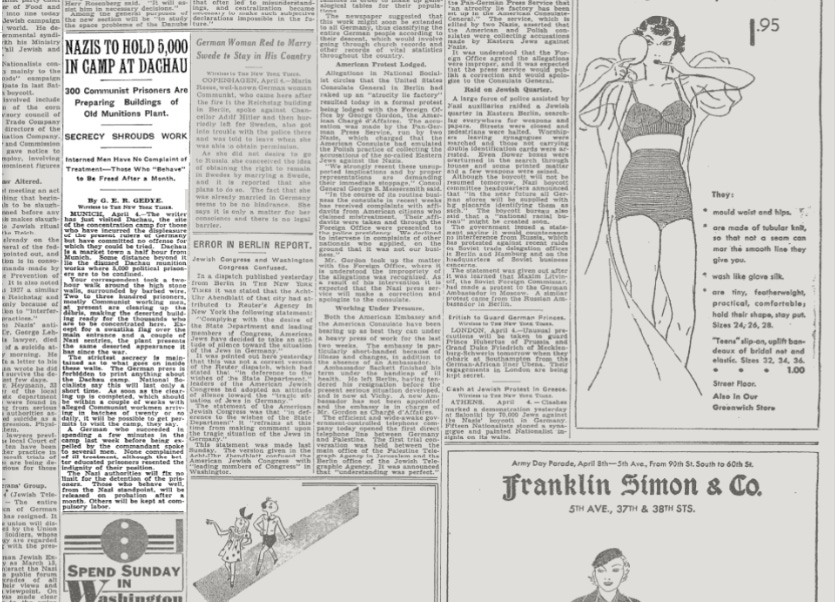

Early outside impressions could therefore be framed in bureaucratic language: order, discipline, containment, political detention. The regime understood something essential: if you shape what observers see, you shape how institutions are understood.

And in 1933, Dachau was not yet a symbol of industrialized mass murder. It was a political detention center. Its prisoners were primarily communists, social democrats, trade unionists, journalists, and critics of the new regime.Image
Feb 4 • 14 tweets • 6 min read
đź§µHow Putin Pulled Off The Greatest Intelligence Operation in History:

Putin's Small Investments Have Yielded Large Returns

This is a story about the best investment anyone’s ever made—anytime, anywhere.

Not a company.

Not a weapon.

Not a technology.

An idea. Image In the early 2010s, Vladimir Putin looked at the United States and saw something most Americans refused to see about themselves. Not weakness in our military or the economy, but a country still strong by nearly every objective measure—and increasingly persuadable that it wasn’t.
By 2016, America had built the most powerful information ecosystem in human history: global reach, instant amplification, frictionless distribution, and no limits on money. And it had paired that system with almost no meaningful guardrails when it came to political speech. You couldn’t lie to sell a product. You couldn’t defraud investors. But lying to sell politics? That lives in a vast gray zone, protected by law, amplified by platforms, and rewarded by attention.
Feb 2 • 17 tweets • 9 min read
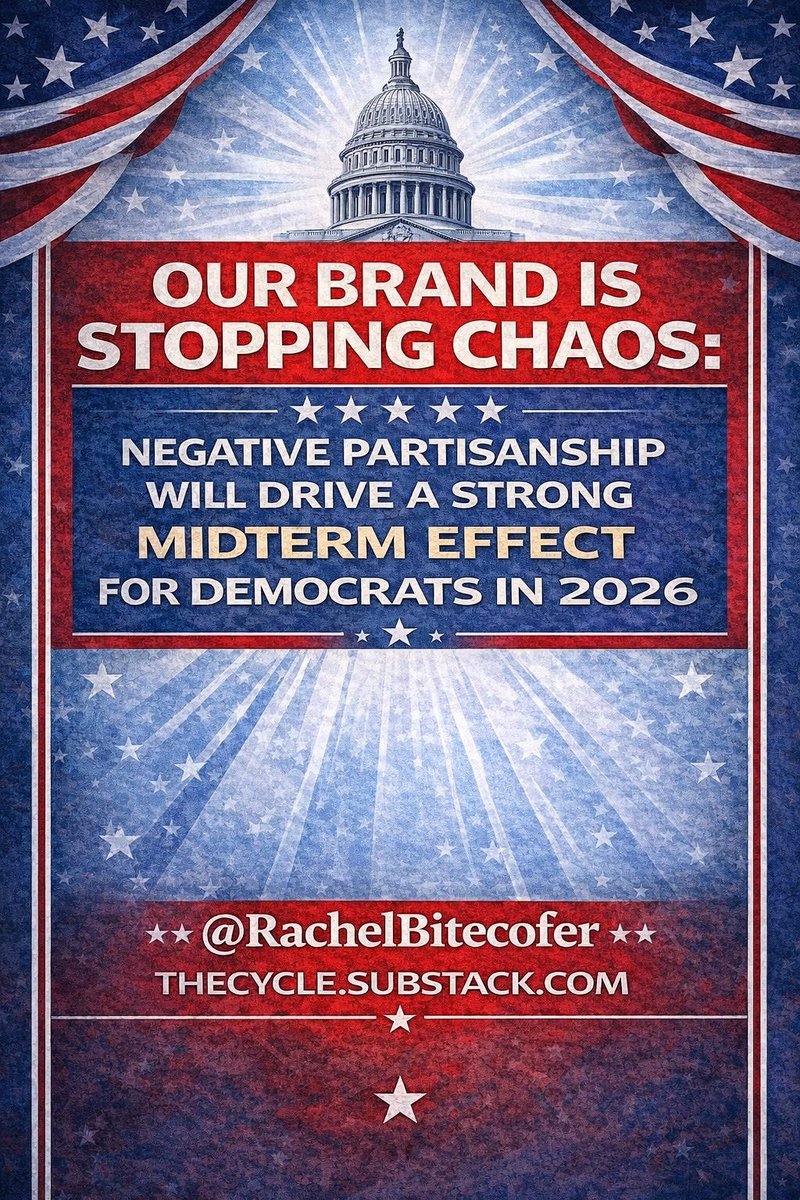
My 2026 Midterm Forecast is out

Our Brand is Stopping Chaos:
Negative Partisanship Will Drive a Strong Midterm Effect for Democrats in 2026

Folks,

For those of you that have been on this roller-coaster ride with me from the bananas beginning will appreciate how we’ve come full circle this year.

Once again we have a madman in the White House and an electorate with serious buyer’s remorse.

Now that Republicans control the White House, negative partisanship once again favors Democrats as the party out-of-power (out party).Image We are now far enough into this shitshow presidency to stop guessing about the 2026 midterms and start measuring them. So I spent this week in deep in data, waiting for the results of an obscure special election for the Texas state senate. There, the Democratic nominee was able to raise $2,000,000 to compete for a long, LONG shot district in Tarrant County (key Republican ground in Texas) that Trump carried by 17pts. This forced the Texas GOP to spend about $200,000 to defend a district they should never have to compete in.
Rehmet gave them a good ole fashioned Texas style ass whoopin’ earning 57% of the vote in that “safe” Trump district against a very attractive Republican nominee.
Jan 10 • 23 tweets • 6 min read
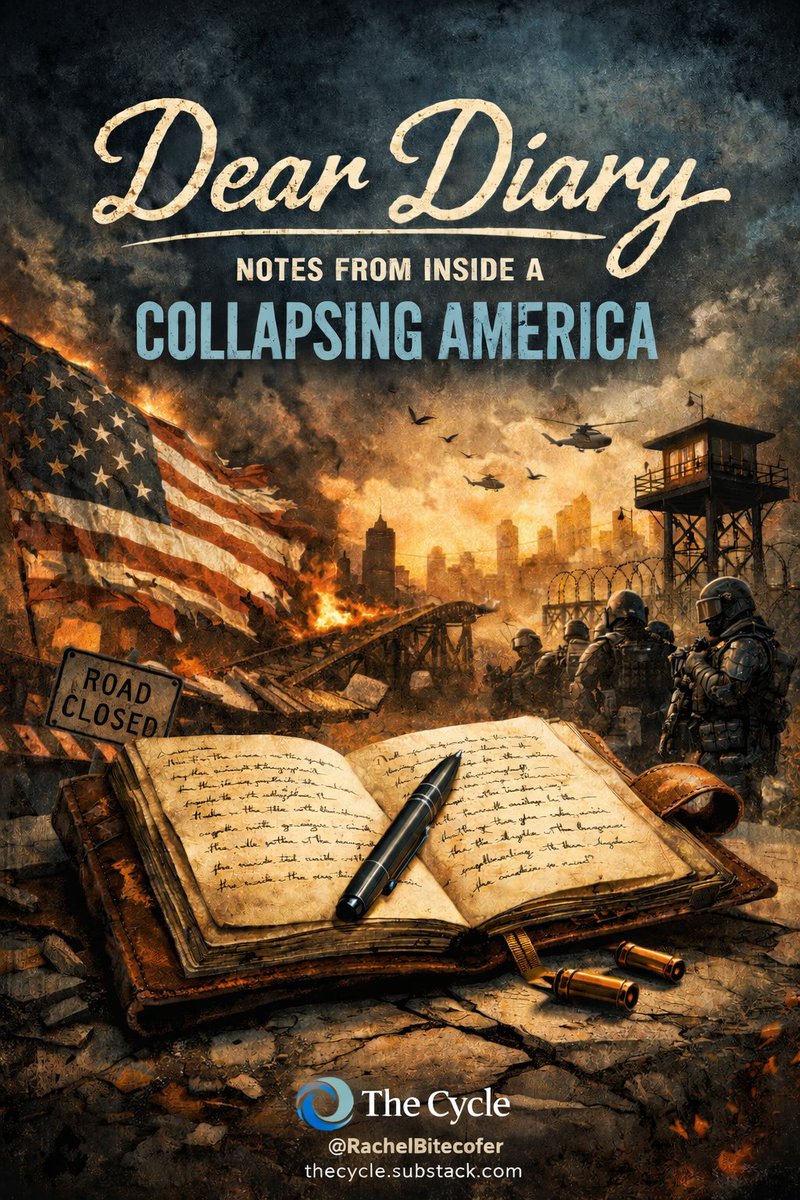
đź§µDear Diary
Notes from Inside a Collapsing America

January 10, 2026

Dear Diary,

I have be honest, those are words I never expected to write, because I’m way too lazy and uninteresting to keep a diary But as most of you guys know, I’ve been reading and researching the Third Reich for about five years now.Image I started off pretty wide, with big books about the developments and details of that eleven-year Reich that we mostly only pay attention to during the war years, even though it came into power in 1933. And it wasn’t long into that research before I started to really appreciate how important contemporaneous diary accounts were.
Dec 14, 2025 • 16 tweets • 5 min read
🧵Living History: Don’t Give Up the Ship with Representative Jason Crow

We are living through a moment future historians will struggle to explain without disbelief. A sitting president has publicly called for the execution of members of Congress. The U.S. military has carried out strikes of dubious legality outside a declared war. Senior commanders have resigned. Others have testified behind closed doors that no one stopped them.

Read and watch the full interview👇
thecycle.substack.com/p/living-histo… And when six members of Congress who are military vets reminded U.S. service members of a principle settled since Nuremberg not to follow illegal orders, the White House responded not with denial or evidence, but with rage.
Dec 8, 2025 • 13 tweets • 3 min read
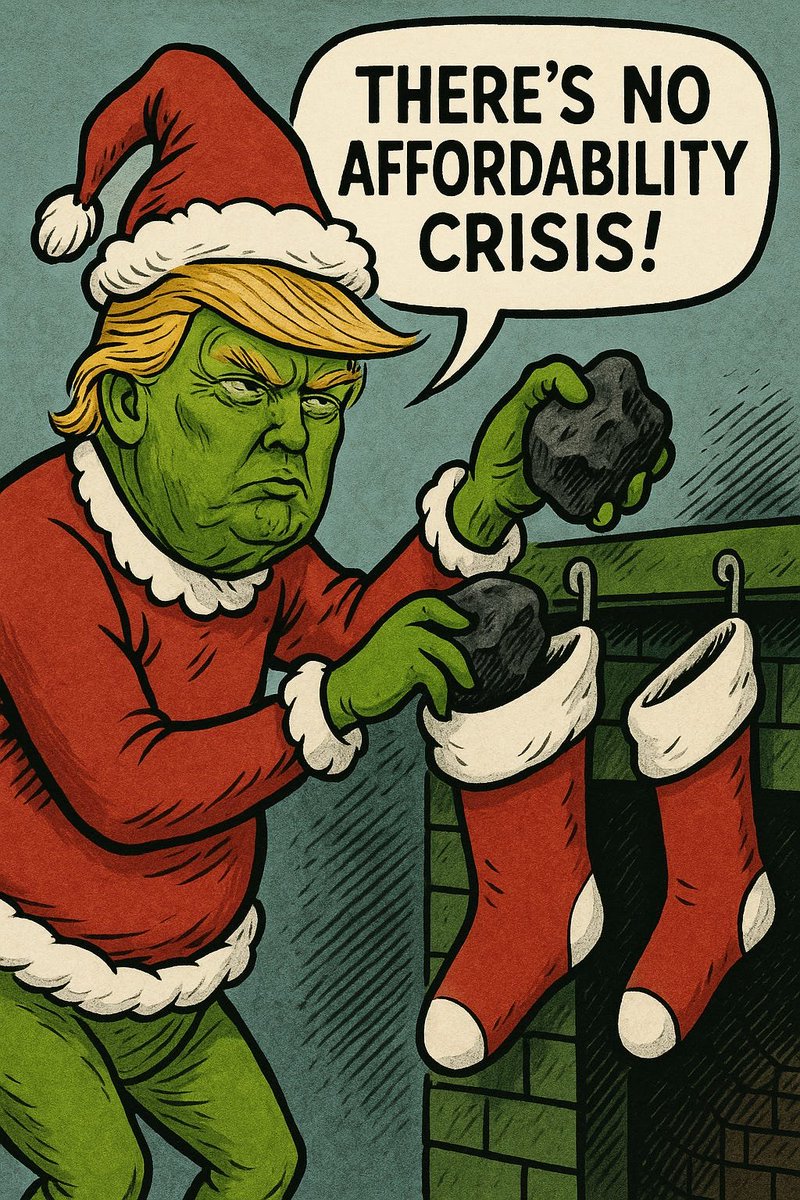
The Trump Who Stole Christmas

(A Holiday Poem for a Country Getting Mugged in Broad Daylight)

Every American down in America

Liked Christmas a lot.

But the Trump, who lived south of sanity,

Most certainly did not.

Trump hated Christmas — not the money of course,

but the laughing, the shopping, it makes him feel worse.Image So deep in his tower, carved out of gold,
He plotted a scheme—

one cruel, dark, and cold.

He’d tried once before to ruin their cheer,

With Big Lies about elections the previous years.

But this time he thought,

with a smirk and a grin,

“I’ll simply raise premiums ’til nobody can win!”
Dec 1, 2025 • 19 tweets • 4 min read
đź§µThe Whole World is Getting Dumber
(And the Smartphone Did It)

How’s this for a gut punch?

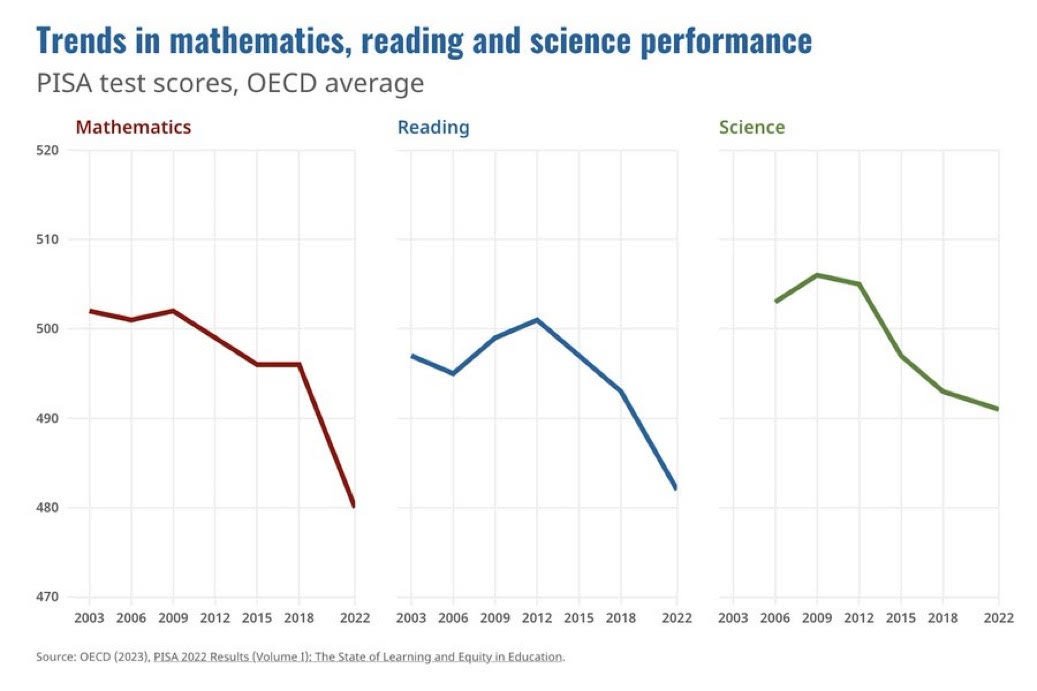
The entire developed world is getting dumber.

Don’t believe me? Check out this graph that shows a world wide “dumbing” across three core cognitive domains—math, reading, and science-that occurs right after the introduction of the smart phone.Image And no, it’s not “woke teachers,” or “lazy kids,” or the Department of Education.
This isn’t even a uniquely American story.

The trends are global. OECD-wide.

Finland to France. Japan to Germany. Australia to the U.S.

Good systems and bad.

Everyone is slipping. Image
Nov 24, 2025 • 19 tweets • 4 min read
🚨🧵Here's part 2 of my Terrible Truths I've Learned About Humanity series, plz RT

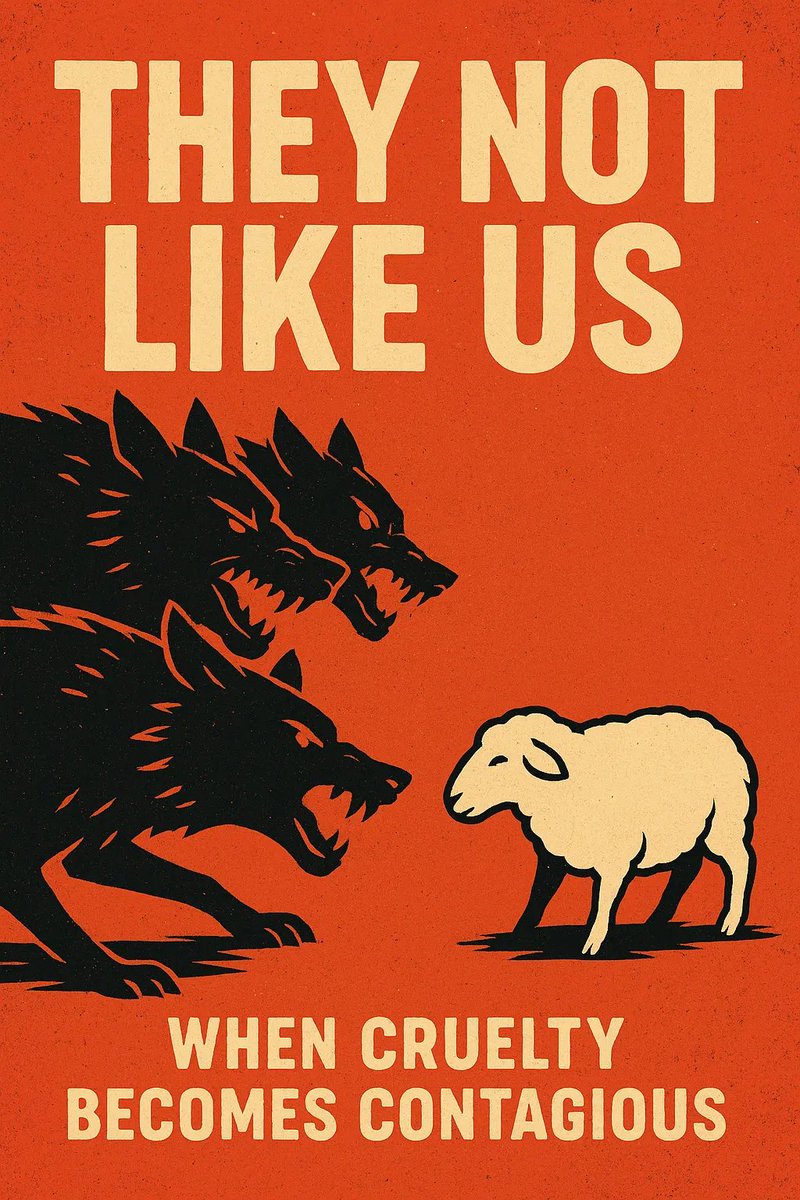
They Not Like Us:
When Cruelty Becomes Contagious

Permission to Be Cruel

There’s a comforting myth that runs deep in American culture, especially among moderates and people who pride themselves on being reasonable.Image It’s the belief that most people are naturally kind, that cruelty is fringe, and that if we just had better manners and calmer politics, things would sort themselves out. It’s a lovely idea. It’s also wrong.

The truth is that cruelty has a constituency. Not a majority, not even close, but a solid, persistent minority — roughly 10 to 20 percent — who exhibit stable personality traits that are callous, aggressive, or outright sadistic.