Rachel Bitecofer 🗽🦆 Profile picture
Nov 4, 2020 13 tweets 3 min read Read on X
1. The hot take that "D's need to learn to talk to the other side of the electorate" is absolutely the WRONG take.

I mean my god. Biden, Lincoln, the outside groups: they threw the best persuasion messaging in the history of persuasion campaigns at them.

What Ds need to do is
2. is come to terms that when it comes to the electorate, the very 1st thing that matters is party ID, and this includes Indie leaners. This data is from June, but last night's results make clear that it reflects the actual results as well. Right leaning Indies- which make up Image
3. a disproportionate share of the overall Indie pool, are closet Reps: they are not persuadable no matter how much you cater to them or whether or not Cindy McCain is on your side. The Biden campaign, all of the Senate Dems, and the House Dem candidates bet their candidacies
4. on a couple of assumptions most imp is that they should focus their arguments on issues & not on nationalized referendum campaigns, which is the way that the GOP runs their down-ballot races. Also, in case you haven't noticed, Trump lies directly to people bc he knows they are
5. stupid & will never find out. Did I state that plainly enough? You want to know why Rs are willing non-college voters? They tell them what they want to hear. The Ds talk to everyone like they have a master's degree. Trump talks to them as they are: Walmart shoppers. I realize
6. that sounds elitist and condensing- its meant to. Some 60+ million of them just cast ballots for Donald Fucking Trump & if you ask them why, probably 40 million of them will tell you reasons that are literally exact opposite truths like "he drains the swamp" or "he's a
7. "successful businessman" or my personal fave, "he's the only honest man in Washington." If Dems want to learn how to "reach voters on the other side" then they need to realize that these people would tell you "yes" they read news & then report "The National Enquirer" as their
8. as their paper of choice. Now, IDK if its just that I'm one of fewer academics that come from the real, unpolished, bottom 50% world, and not the romanticized bullshit painted by J.D. Vance of working-class America- the real one where people have 3 kids from 3 different women
9. and get angry when 1 of them is reticent to let them visit their kid when they get out jail. AGAIN. In THAT working class, sexism, racism, xenophobia, and bigotry run rampant: and not only are these "isms" prevalent, there is a belief that they shouldn't have had to be buried
10. (see how that relates back to their culture war champion?) That the old days were far superior bc they could just call someone a f&g or slap their female co-worker in the ass is they were in the mood. There was a hierarchy, a caste as @Isabelwilkerson notes, and they were at
11. the top of it. Everything else might be a shit sandwich, their job, their house, their marriage, their debt, but that hierarchy & their place at the top of it- as Wilkerson notes in her book, that shit was SOLID.
And now its gone.
And do you know who took it?
The Democrats
12. So, you're not appealing to that. Anyone looking at Maine senate, the state with the most Indies in the nation, but also an electorate that is predominately white and lower educated & thinks we just need a better argument is coming at this the wrong way.

Don't get me wrong-
13. you gotta change the voting behavior of these voters, but you're not going to do it via tweaking issues or talking about this and not that.

Its going to take a complete and total overall of the entire electioneering approach of the party.

• • •

Missing some Tweet in this thread? You can try to force a refresh

 

Keep Current with Rachel Bitecofer 🗽🦆

Rachel Bitecofer 🗽🦆 Profile picture

Stay in touch and get notified when new unrolls are available from this author!

Read all threads

This Thread may be Removed Anytime!

PDF

Twitter may remove this content at anytime! Save it as PDF for later use!

Try unrolling a thread yourself!

how to unroll video
  1. Follow @ThreadReaderApp to mention us!

  2. From a Twitter thread mention us with a keyword "unroll"
@threadreaderapp unroll

Practice here first or read more on our help page!

More from @RachelBitecofer

Jul 15
🧵America's Third Founding:
In the wake of whatever Trump does, America needs to get its constitutional house in order

Americans love to debate how to fix our democracy.

End Citizens United. Abolish the Electoral College. Ban partisan gerrymandering. Expand the House of Representatives. Impose congressional term limits. Prevent another corrupt president from abusing the powers of the office.

One of the greatest failures of American civic education is that we teach people what government does, but rarely how government changes. We memorize the three branches of government and the Bill of Rights, yet few Americans understand the difference between constitutional law and ordinary legislation—or why that distinction determines whether a reform is politically possible.

The United States has already been founded twice.

The first founding came in 1787, when the Constitution established a new system of government unlike any the world had seen. The Bill of Rights soon followed as the political compromise that secured ratification, creating the constitutional framework that has endured for more than two centuries.

The second founding came after the Civil War.

The nation nearly destroyed itself over slavery and secession. Four years of unimaginable bloodshed settled the question of whether the Union would survive, but victory on the battlefield was only the beginning. During Reconstruction, Congress required the former Confederate states to ratify the Thirteenth, Fourteenth, and Fifteenth Amendments before they could fully reclaim representation in the federal government.

Those amendments transformed the Constitution. They abolished slavery, established birthright citizenship, guaranteed equal protection and due process, and prohibited denying the right to vote on the basis of race. The Fourteenth Amendment, in particular, became the constitutional foundation for much of modern American liberty. Many of the civil rights and individual freedoms Americans take for granted today trace directly back to the Second Founding.

Every generation inherits the Constitution, but only one generation has had an opportunity to fundamentally remake it: the Civil War generation.

Today, America faces another constitutional moment, not because states are preparing to leave the Union, but because many of the assumptions built into an eighteenth-century Constitution no longer fit the realities of twenty-first-century politics. Unlimited campaign spending, partisan gerrymandering, an Electoral College that can reject the national popular vote, and growing concerns about presidential accountability have exposed weaknesses the Framers could never have anticipated.

Yet our political debate almost always skips over the most important question.

Can these problems actually be fixed? Some can, most cannot—at least not through ordinary legislation. Congress cannot abolish the Electoral College. It cannot rewrite the constitutional qualifications for the presidency. It cannot simply declare that money is no longer protected political speech if the Supreme Court continues to interpret the First Amendment as it does today.

To do these things the Constitution itself must be changed and the process to do so is arduous- hard to pull off in the best of times and these are not the best of times.

To amend the Constitution you need a 2/3rds vote in both chambers of Congress and ratification by 3/4s of the states. This is why despite passing through both the House and Senate, the Equal Rights Amendment failed to reach ratification.

In a country that can’t even pass a budget through normal legislation those barriers aren’t just hard, they are impossible. The last time we successfully amended the Constitution it was in 1996 and the issue was preventing congress from giving itself current-term pay raises. Hardly controversial.

History teaches us that America’s greatest constitutional reforms have never emerged from ordinary politics. They have emerged from extraordinary crises. The Constitution replaced the failed Articles of Confederation. The Reconstruction Amendments followed the Civil War. Each founding was born from a national reckoning that forced Americans to rethink the rules by which they governed themselves.

If America experiences another constitutional reckoning, we should not waste it. We should already know which reforms would strengthen our democracy—and what it would actually take to achieve them.

That is the purpose of this essay.Image
Reform One: Restoring Political Equality

Democracy rests on a simple promise: every citizen is politically equal.

Not economically equal. Not socially equal. Politically equal.

Every American gets one vote, and every vote carries the same weight. The legitimacy of democratic government depends on the idea that no citizen’s voice should count more than another’s simply because of wealth.

For most of American history, that principle was imperfectly realized but broadly understood. Wealthy Americans have always enjoyed advantages in politics, but there was also broad agreement that government could place reasonable limits on the role of money in elections to protect the integrity of representative government.

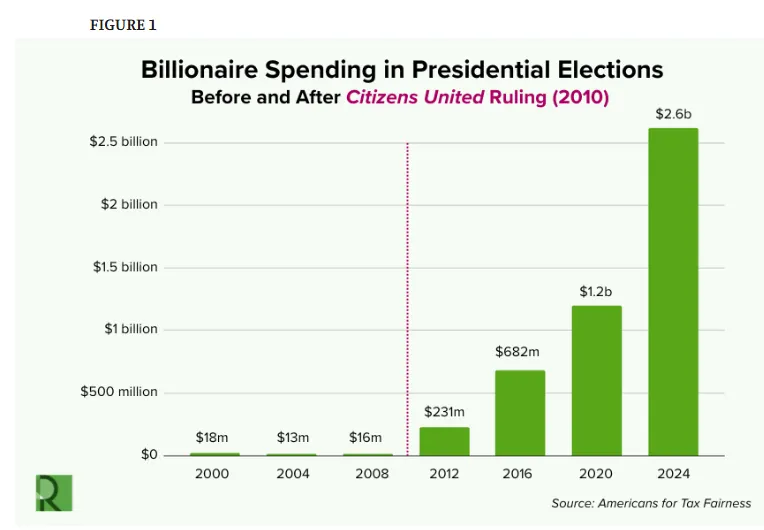
Over the past several decades, however, the Republican-controlled Supreme Court has moved in a different direction. Building on earlier decisions, the Court concluded that spending money to advocate for political candidates is protected by the First Amendment because money enables political speech. That constitutional reasoning reached its most famous expression in Citizens United v. Federal Election Commission.

Its practical effect has been unmistakable.

Modern American elections are now dominated by an arms race of Super PACs, billionaire donors, dark money organizations, and outside spending that would have been almost unimaginable a generation ago. Every citizen still receives one vote, but not every citizen possesses the same political voice. Those with extraordinary wealth can spend virtually unlimited sums shaping campaigns, financing advertisements, and influencing the political conversation.

Many Americans believe that is inconsistent with the democratic ideal of political equality. The question becomes: how do we change it?

There are only two realistic paths.

The first is judicial. A future Supreme Court could reverse or substantially narrow Citizens United and related decisions, concluding that the First Amendment permits greater regulation of money in politics than the current Court recognizes.

The second is constitutional.Image
A Third Founding could amend the First Amendment to make clear that while political speech enjoys the highest constitutional protection, the use of money to influence elections may be subject to reasonable regulation in order to protect political equality and democratic self-government.

Notice what is missing from those options.

Congress alone cannot simply pass a law declaring that money is no longer protected speech. As long as the Supreme Court continues to interpret the First Amendment as it does today, any law fundamentally inconsistent with that interpretation is likely to be struck down.

This is the difference between ordinary legislation and constitutional law. When a reform conflicts with the Constitution as interpreted by the Supreme Court, changing the law is not enough. The constitutional rule itself must change.

If democracy means that every citizen enters the voting booth as a political equal, then restoring that equality should begin by asking whether our Constitution should continue to treat unlimited political spending as indistinguishable from political speech.

And while we’re in there clarifying free speech we should probably find a way to regulate campaigns ads as they are regulated in other democracies. America is the Wild West of elections and the only democracy that allows political ads to openly lie to you.
Read 9 tweets
Jun 24
🚨How Reaganomics Brought Back the Gilded Age:

For half a century, America built the broadest middle class in history. Then came Reaganomics. Forty-five years later, the results are in.

In 1928, on the eve of the Great Depression, the richest 1 percent of Americans collected 23.9 percent of all income in the United States.

Over the next fifty years, that share would be cut by more than half. Through progressive era trust-busting, labor reform, taxation, social insurance, and public investment, Americans built the broadest middle class in the nation’s history. By the late 1970s, the top 1 percent claimed just 9 percent of national income.

Today, that share has climbed above its 1928 level.Image
That fact alone should force us to rethink much of what we’ve been told about the American economy. Because if the richest 1 percent now capture a larger share of national income than they did on the eve of the Great Depression and we have just created the world’s 1st trillionaire, then the obvious question is not whether Americans are unhappy with the economy. The obvious question is how we got here.

To answer that question, we have to understand what the first Gilded Age actually was.
For many Americans, the phrase evokes images of grand mansions, railroad tycoons, and industrial fortunes. For ordinary people, it looked very different. It looked like children working twelve-hour shifts in textile mills and coal mines. It looked like six-day work weeks that routinely stretched to sixty or seventy hours. The five-day work week did not exist. Overtime protections did not exist. Workplace safety protections were minimal or nonexistent.

The conditions for the bottom 50% of Americans were often brutal.

In 1911, 146 garment workers—most of them young immigrant women and girls—died in the Triangle Shirtwaist Factory fire in New York City. Some burned alive. Others jumped from upper-story windows to escape the flames. The factory owners had locked the exits.Image
Read 21 tweets
Jun 3
🚨🧵The Confederacy Lost the War.
It Did Not Lose the Peace.

American defeated the rebellion militarily, but failed to hold its leaders accountable. The result was one of the most successful historical revision campaigns in modern history-transforming traitors into heroes, rebellion into heritage, and defeat into memory.Image
On April 20, 1861, Robert E. Lee resigned from the United States Army.

“Save in defense of my native State, I never desire again to draw my sword,” he would later write in explaining his decision.

It was not a rash choice. Lee had spent more than three decades serving the nation. He graduated from West Point without a single demerit, distinguished himself in the Mexican-American War, and was widely regarded as one of the finest officers in the Army. He had also sworn an oath—not to Virginia, not to Arlington, and not to the South, but to the Constitution of the United States.Image
When Virginia seceded, Lee faced a choice. He loved the Union and opposed secession. He understood that war meant breaking the bonds forged in the blood of their own grandfathers in the American Revolution. Yet, when forced to choose between the nation he served and the state he now considered “his country”, Lee chose Virginia.

Lee was hardly alone. During the American Civil War, 304 West Point graduates rejected their oath of allegiance to the United States and chose to serve in armed rebellion for the Confederate States Army.Image
Read 21 tweets
May 21
🚨🧵Why America Can’t Stop Trump

Donald Trump is broadly unpopular.

That much is true.

His approval ratings are underwater. Independents are fleeing Republicans like they have herpes. The economy is dragging him down. Inflation from his dumbass tariffs are dragging him down. Gas price spikes from the Iran War is dragging him down. His billion dollar ballroom is weighing him down.Image
Democrats are poised to win big in the fall midterms.

And yet none of that changes the central reality of American politics in 2026: America can’t stop Trump.

America cannot stop Donald Trump because he is supported by what amounts to a political cult. Not only would MAGA still support Trump if he shot someone on 5th Avenue, they would pull the trigger for him themselves if he asked them to do it.
Every constitutional mechanism capable of stopping him and holding him accountable requires the support of elected Republicans — and Republicans now operate inside a political system where opposing Trump is political suicide.

Trump’s approval among the MAGA base comes close to 100%.

Think about that. After raising prices he promised to lower on Day 1, covering up for his fellow Epstein cronies, and reneging on his most important brand of “no new wars,” these motherfuckers are like, “thank you sir, may we have another!”Image
Read 15 tweets
May 13
🚨The End of the Second Reconstruction:

Southern Republicans, after claiming they didn’t need a law to respect the rights of Southern Blacks, moved immediately to eliminate Black reps across the South.

Most Americans think this is a fight over a handful of congressional districts.

It is much, much worse than that.

Plz read and share this 🧵Image
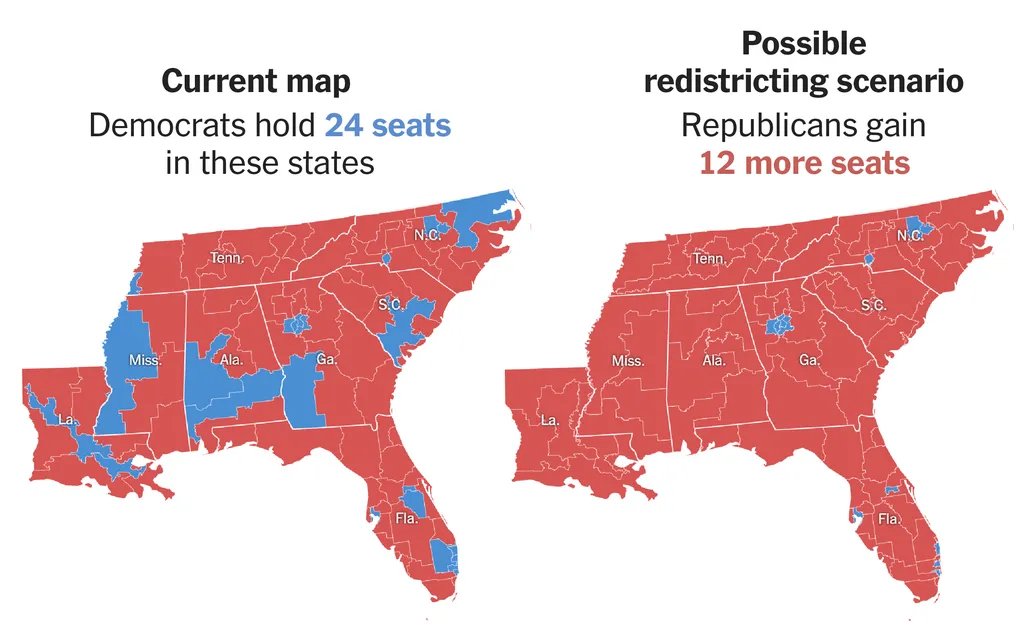
Over the past several days, Southern legislatures have moved with breathtaking speed to dismantle Black political representation across the South after the Supreme Court’s decision in Louisiana v. Callais weakened the Voting Rights Act’s anti-dilution framework.

In Louisiana, lawmakers quickly advanced a map eliminating one of the state’s two Black-opportunity congressional districts. In Tennessee, Republicans finalized a map splintering Memphis and dismantling the state’s only majority-Black congressional district. In Alabama and South Carolina, officials are already preparing new challenges and redraws.

Within a decade the South may look like this:Image
Most people hear “redistricting” and think about Congress. A few House seats. A partisan fight in Washington. But the modern Voting Rights Act did not merely shape Congress. Its most profound transformation occurred at the state and local level throughout the South.

The Voting Rights Act did not simply protect the right to cast a ballot. It protected the ability of Black communities to translate votes into actual representation. That distinction is everything.
Read 19 tweets
Apr 29
🚨Please Stop Trying to Murder Trump
Political Assassination Is the Road to Civil War

One unstable individual commits an act of political violence, and suddenly an entire political coalition gets recast as an existential enemy in the minds of millions of angry people. And once people become convinced their families, their country, their way of life, or their movement is under attack, violence stops feeling offensive to them and starts feeling defensive. Necessary. Patriotic, even.

That is the road to political bloodshed.Image
I need you to understand something very clearly:

The assassination of Donald Trump would be one of the worst possible things that could happen to the United States of America right now.

And I don’t mean morally. I mean strategically, politically, socially, historically. I mean, as someone who studies authoritarianism, democratic collapse, political violence, and mass behavior for a living, the idea of Trump being assassinated is absolutely terrifying—not because Trump himself is good for democracy, he is a threat! Trump has purged democratic institutions, legitimized conspiracy theories, radicalized distrust, and pushed the boundaries of authoritarian politics in ways America has never experienced in the modern era.
But there is something much more dangerous than an authoritarian movement slowly losing public support and that is an authoritarian movement transformed into a martyr cult. And I really do not think enough Americans understand what would happen if Trump were successfully assassinated.

We are already got a preview of it.

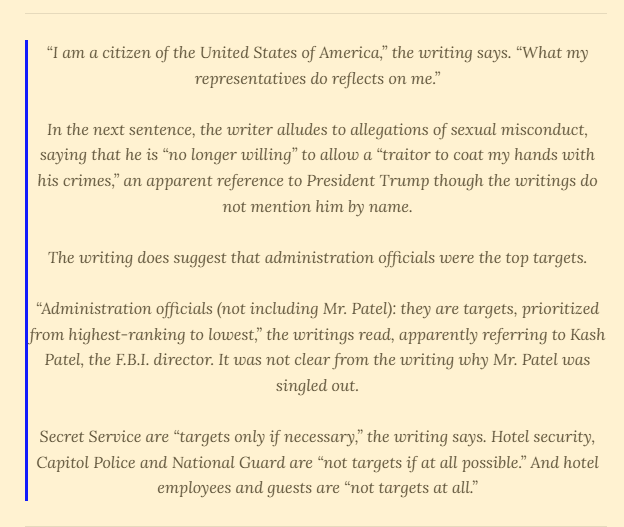
The man accused of murdering Charlie Kirk left behind evidence that made his political motivations crystal clear. And the same is true with this latest suspect. The motives were there. I’m going to include his writing because I’m already watching people pretend this is somehow ambiguous when it really isn’t.Image
Read 13 tweets

Did Thread Reader help you today?

Support us! We are indie developers!


This site is made by just two indie developers on a laptop doing marketing, support and development! Read more about the story.

Become a Premium Member ($3/month or $30/year) and get exclusive features!

Become Premium

Don't want to be a Premium member but still want to support us?

Make a small donation by buying us coffee ($5) or help with server cost ($10)

Donate via Paypal

Or Donate anonymously using crypto!

Ethereum

0xfe58350B80634f60Fa6Dc149a72b4DFbc17D341E copy

Bitcoin

3ATGMxNzCUFzxpMCHL5sWSt4DVtS8UqXpi copy

Thank you for your support!

Follow Us!

:(