

(Republic of Science also came out in 1962. Kuhn knew Polanyi, they debated philosophy of science for years. There was a later debate after both popularised similar ideas, some accusing Kuhn of plagiarism.)
en.wikipedia.org/wiki/Thomas_Ku…
polanyisociety.org/TAD%20WEB%20AR…
en.wikipedia.org/wiki/Thomas_Ku…
polanyisociety.org/TAD%20WEB%20AR…
Kuhn goes on to describe the essential characteristics of scientific communities. This page is well-worth reading. 

Science is an extremely efficient way to maximise the number/precision of problems solved. All paradigms will face threats from enough contact with nature. Science differs from other endeavours in that paradigms must solve new problems but also continue to solve (most) old ones.
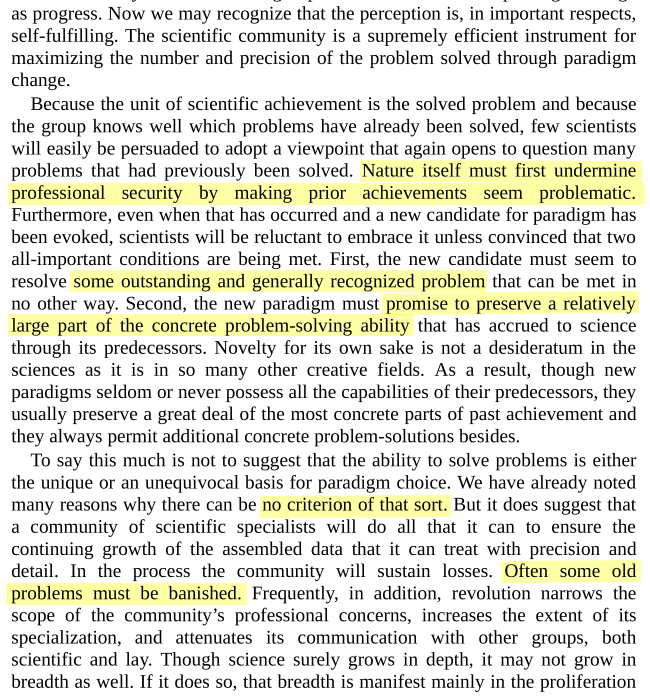
There is no authority higher than the scientific community. But as the above suggests, it is not just authority; theories must make contact with nature.
https://twitter.com/bryankam/status/1321051356065603585
(Remember, there are no bare facts, but this does *not* mean that all theories work equally well.)
https://twitter.com/bryankam/status/1322123866454528000
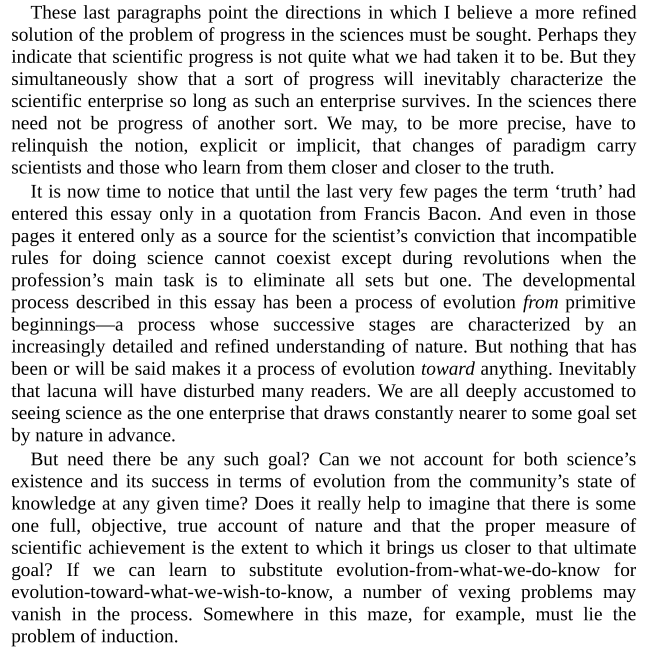
Science definitely progresses, then, at least in depth, and possibly also in breadth, in the numbers of problems it can solve. But here's the clincher...
"In the sciences, there need not be progress of another sort. We may, to be more precise, have to relinquish the notion, explicit or implicit, that changes of paradigm carry scientists and those who learn them closer and closer to the truth."
(!!!)
(!!!)
https://twitter.com/bryankam/status/1306171326999277569
Kuhn now notes that he has only used the word "truth" once in the whole essay, in the quote from Bacon: "Truth emerges more readily from error than from confusion."
https://twitter.com/bryankam/status/1304360028929957889
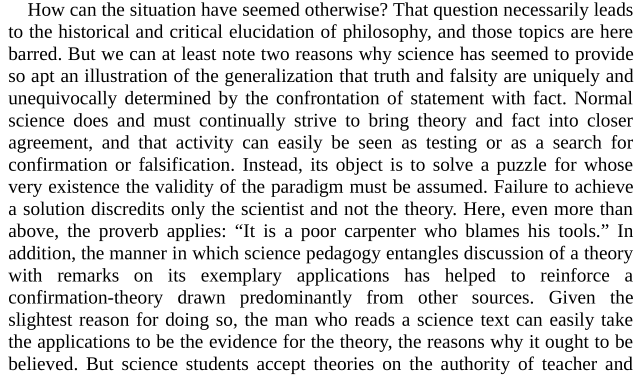
(In fact, he does use it once before, to say that science wrongly assumes it can distinguish truth and falsity by comparing statement with fact... this is in VIII. The Response to Crisis. In other words, here too he disavows the existence of "truth.")
(Oh, and he also quotes Darwin and Planck who use "truth" in XII: The Resolution of Revolutions. But otherwise, Kuhn is right, he _never_ uses the term until this section.)
https://twitter.com/bryankam/status/1322143707924172800
Science proceeds from primitive beginnings. Its progress increases in detail, and refines understanding of nature. However, it does not proceed *toward* anything. We normally associate progress with drawing "nearer to some goal set by nature in advance."
https://twitter.com/bryankam/status/1306171321852801026
But why do we assume that there must be such a goal? "Does it really help to imagine that there is one full, objective, true account of nature and that the proper measure of scientific achievement is the extent to which it brings us closer to that ultimate goal?"
Kuhn advocates thinking in terms of "evolution-from-what-we-do-know" rather than "evolution-toward-what-we-wish-to-know." This is the aforementioned "inversion" which may cause a number of vexing problems to vanish (including, possibly, induction?).
https://twitter.com/bryankam/status/1330842718046720000
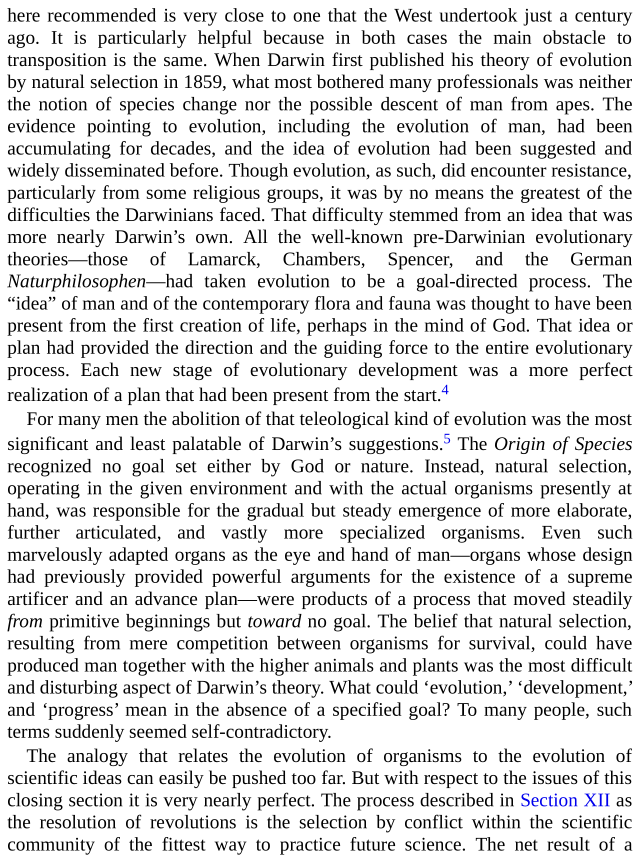
He's written "evolution" several times. Now Kuhn compares his inversion with Darwin's: "What most bothered many professionals was neither the notion of species change nor the possible descent of man from apes."
The evidence for evolution (including man) had been accumulating for decades, and had been widely disseminated. Naturally some religious groups opposed it, but it was going mainstream.
(I was reading about this recently, especially about Chambers...)
plato.stanford.edu/entries/evolut…
(I was reading about this recently, especially about Chambers...)
plato.stanford.edu/entries/evolut…
The opposition Darwin faced was for a *new* idea of his. All previous evolutionary theories (Lamarck, Chambers, Spencer, etc) had assumed that evolution was _goal-directed_, perhaps by "the mind of God". Darwin's provocation, Kuhn argues, is the idea that *there is no goal*.
(Wilson points out that the Epicureans, esp. Lucretius ~55 BC, thought that nature progressed at random as well, but this was repressed by Platonists, and then by Neo-Platonists via Christianity. She thinks Darwin adds variation to Epicurean selection.)
amzn.to/3fqyQPe
amzn.to/3fqyQPe
Biological evolution, then, has no goal. It evolves from simpler forms, but not toward anything. This is against orthogenesis. And it disturbed people: "What could 'evolution', 'development,' and 'progress' mean in the absence of a specified goal?"
en.wikipedia.org/wiki/Orthogene…
en.wikipedia.org/wiki/Orthogene…
Kuhn does not think there is an exact correspondence between the evolution of scientific ideas and the evolution of organisms. But for the issues raised in this chapter, the match is "very nearly perfect."
In fact, Kuhn has already mentioned natural selection, in XII: The Resolution of Revolutions. Now he adds: A new paradigm is adopted as "the fittest way to practice future science."
https://twitter.com/bryankam/status/1322133995262533632
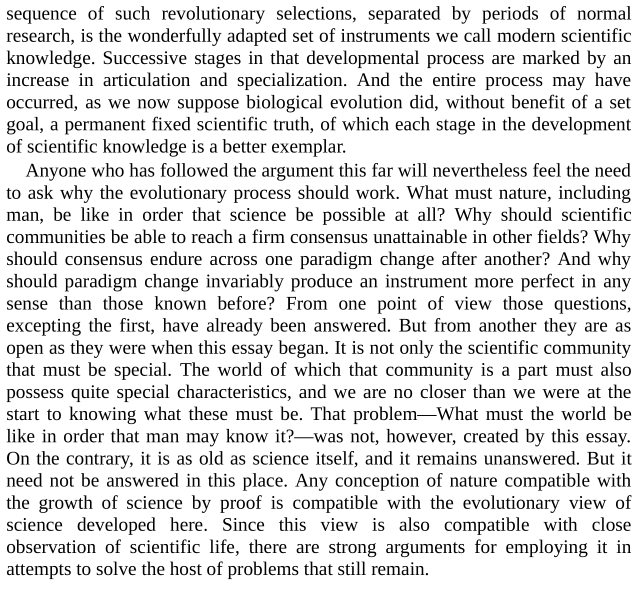
The result of revolutionary selections, "separated by periods of normal research," produces the "wonderfully adapted set of instruments we call modern scientific knowledge."
Scientific progress is discontinuous. It explores, in a burst of debates in (pre-)paradigm crisis, then exploits, in what Kuhn calls "normal science".
(I'm now thinking about the huge influence Kuhn must have had on Gould's punctuated equilibrium.)
en.wikipedia.org/wiki/Punctuate…
(I'm now thinking about the huge influence Kuhn must have had on Gould's punctuated equilibrium.)
en.wikipedia.org/wiki/Punctuate…
His conclusion is incredibly beautiful, and asks one of the oldest questions for science, and one that remains unanswered:
"What must the world be like in order that man may know it?"
"What must the world be like in order that man may know it?"
I won't cover Kuhn's 1969 postscript (it's ~15% as long as the essay). He primarily tries to address confusion and misinterpretations of the 1962 work (which I hope I've avoided). If you want me to treat the postscript, please like this tweet and I'll consider it.
(I've actually seen that @Meaningness preferred Kuhn's 1969 postscript to the 1962 text though, so maybe I should reconsider. But I think in my rendering of Kuhn, above, he does not come off as a relativist — let me know if I'm wrong.)
meaningness.com/eggplant/remod…
meaningness.com/eggplant/remod…
I hope it came through how important I think Kuhn is for thinking about science and epistemology today. I'm new to philosophy of science so I'm excited to read and learn about other views. I know some of his views are controversial but I wanted to learn from the primary text.
I've read a little about the surrounding philosophy here:
plato.stanford.edu/entries/scient…
plato.stanford.edu/entries/scient…
If you want the book, this is the version I used:
amzn.to/2DHz8Th
amzn.to/2DHz8Th
Finally, thank you *so* much for reading! Apologies for taking so long to write it, and for possibly going into far too much detail. For more of my writing, please consider subscribing to my newsletter:
bryankam.substack.com
bryankam.substack.com
This thread was an experiment in working in public, in an interlinked way. I would normally have done this work privately, in my Zettelkasten, which I've written about here:
bit.ly/39a2vLt
bit.ly/39a2vLt
Actually, if you've read this far, could I please ask for a bit more feedback?
Like this tweet if you liked the heavy interlinking in the thread.
Like this tweet if you liked the heavy interlinking in the thread.
Like this tweet if you liked when I paraphrased Kuhn's text.
Like this tweet if you preferred direct quotes from Kuhn.
Like this tweet if you liked the images of the text.
Like this tweet if you liked my (parenthetical) commentary on Kuhn.
Like this tweet if you liked the connections I made between Kuhn and other thinkers or writers.
Like this tweet if you want me to explore Kuhn's influence on Stephen Jay Gould and his idea of punctuated equilibrium in a later thread.
Thank you (slash sorry) to @katebaumli for inspiring this thread and for discussing the idea with me. Here's her thread on Adam Becker's "What Is Real?" which inspired this one.
https://twitter.com/katebaumli/status/1301229690557026304
Thanks for encouraging my Kuhn thread, which I've just finished😅 @nolimits_sagar @colincoulthard @Particle2Wave @AneeshSathe @matthewclifford @TrailMarks @annaeverette16 @dmcdougall @0xLEDev @CFJWilliamson @justanotherlaw @rrana03_ @Alan_Sewell013
https://twitter.com/bryankam/status/1303688412923400192
Thanks for encouraging my Kuhn thread, which I've just finished 😅 @sdcrosby @mn_warsi @TKPullinger @ZarinaMazitova @jamiestantonian @gokulnk @katebaumli @pablomuralo @parikshat7 @11kilobytes @meghafon @heypaulmcgrath @irinimalliaraki @RichardMCNgo
https://twitter.com/bryankam/status/1303688412923400192
Thanks for encouraging my Kuhn thread, which I've just finished 😅 @breitwoman @stubbornfellow @calvinballer72 @orpheaskk @davidavalerio @harry_ramsay
https://twitter.com/bryankam/status/1303688412923400192
• • •
Missing some Tweet in this thread? You can try to
force a refresh


