
As America celebrates its defeat of an authoritarian in the middle of consolidating power, it is critical to stay vigilant.
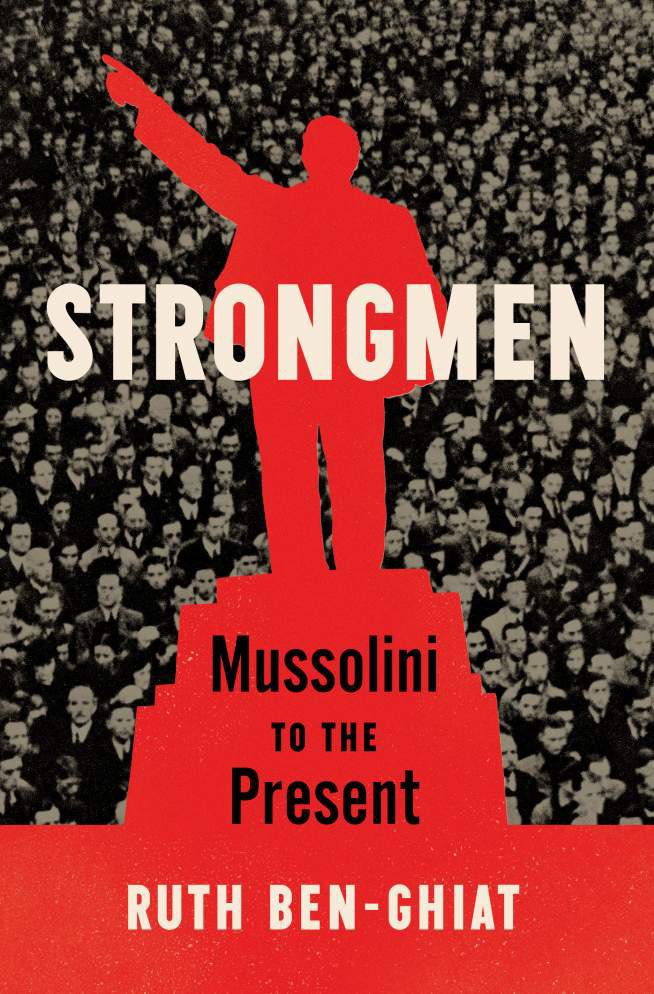
In my @BylineTimes interview with historian @ruthbenghiat she cautions these so-called “strongmen” often remain in the party’s DNA.
bylinetimes.com/2020/12/28/str…
In my @BylineTimes interview with historian @ruthbenghiat she cautions these so-called “strongmen” often remain in the party’s DNA.
bylinetimes.com/2020/12/28/str…
1/ Historian Ruth Ben-Ghiat’s latest book, Strongmen: Mussolini to the Present, details the precise moment in time when fascism was born.
2/ “World War One was this cataclysmic change,” she told Byline Times. “Multiple empires fell, including the Russian Empire, Hapsburg Empire, the Ottoman Empire. It created death on a scale no one had seen before. It created wounds no one had seen before because of new weapons.”
3/ In addition, the Great War led to a profound crisis in maleness.
4/ “It created this entire class of men who were damaged, many were killed, and it created this huge crisis of masculinity,” she said. “So fascist rulers came up during this crisis period of unrest and instability in their individual countries and Italy was first.”
5/ “Italy had this ‘right versus left’ civil strife, and Mussolini appears. And he’s milking this strife, but he’s also saying ‘I can fix it. I can bring order’. And that’s why he got invited into power.”
6/ For Ben-Ghiat, Hitler followed the same pattern a decade later – bootstrapping his way to power using the same post-war dynamics with the addition of economic fears brought about by the Great Depression. Fear is a common tool for manipulation by the well-trained fascist.
7/ “One of the patterns in history is these men are very good at using fear as a way to present themselves as saviours,” she said. “So they manufacture enemies—they present themselves as protectors, and defenders and they become like anchors. This has worked over and over again.”
8/ In her book, the historian reveals patterns that authoritarians have in common and, by doing so, demystifies their allure. Most come to power to obscure their corruption. Truth becomes their mortal enemy and their anger is weaponised.
9/ “Strongmen are brutal and amoral individuals,” she said. “Their anger serves them to get to power, many already had criminal records, and had years of experience in bullying people, or worse, and then intimidation and violence are essential to their exercise of power.”
10/ “They also use their anger as a weapon in their inner circles, making sure no one wants to upset them.”-@ruthbenghiat
11/ A history professor at New York University who specialises in Italian studies, Ben-Ghiat became fascinated with the history of fascist movements as a young girl living in southern California.
12/ “I grew up in an area where a lot of anti-Nazi refugees had settled, such as Thomas Mann, and that’s how I got interested a long time ago,” she explained. “I lived in Italy and studied fascism and, when Trump came on the scene, I turned my expertise to looking at America.”
13/ What she found was a garden variety authoritarian selling fear of a “socialist apocalypse” and rebooting old racist tropes. Strongmen is the first book to put Donald Trump in the historical context of 100 years of authoritarians.
14/ Looking back at his 2016 presidential campaign, Ben-Ghiat believes his “lock her up” rhetoric in relation to Hillary Clinton was a big authoritarian tell on multiple levels.
15/ “First, the sexism, that a woman who was daring to try to be President should be locked up, so she’s safely controlled,” she said.
16/ “And the other thing is it was a sign that Trump was allowing the [Republication Party] to drift further away from democracy and into an authoritarian political culture where, if someone doesn’t agree with you, you don’t respect their opinion. They become a political enemy.”
17/ TRUMP’S PRECURSOR:
Among the authoritarian leaders profiled in Strongmen is Italy’s former Prime Minister Silvio Berlusconi.
Among the authoritarian leaders profiled in Strongmen is Italy’s former Prime Minister Silvio Berlusconi.
18/ “Like Trump, he was treated as a clown, a buffoon, especially because, like Trump, he specialised in outrageous comments,” said Ben-Ghiat. “He would use sexist, racist things to steer media attention away from his corruption, which is what Trump has learned to do very well.”
19/ In addition, Berlusconi bought television networks; aired titillating, distracting content; and orchestrated media coverage of himself.
20/ “He had an authentic personality cult, because he owned TV networks, so he was highly skilled at monopolising the scene,” she added. “He also normalised the far-right, he was the one who brought the far-right into the government, first briefly in the 1990s.”
21/ “And these are people who used to be fascists, so some of them were still neo-fascists. He brought them into the government and shared power with them and Trump did that as well. So a lot of Berlusconi’s moves anticipated the playbook that Trump has used.”
22/ “The other thing he normalised was corruption—and he succeeded more than Trump in one way. He succeeded in having laws changed to accommodate his private situation. So, when he was accused of bribery, he got a law passed by Parliament that made bribery a lesser offence.”
23/ “Trump was not able to do that.”
She said that, among the most important lessons from Berlusconi, is his lasting malignant impact.
She said that, among the most important lessons from Berlusconi, is his lasting malignant impact.
24/ “Berlusconi didn’t really go away, even when he resigned,” Ben-Ghiat added. “He was forced to resign because of a sex scandal and the Euro was in crisis in 2011, so he was barred from personally running for office again.”
25/🚨“But his party, which was under his thumb, continued to do really well. So you don’t really get rid of these people, that’s the problem. They kind of stay in the DNA.”
26/ THE NEW ‘STRONGMEN’ WAVE: At a time when the world is facing real challenges such as climate change, the new wave of global authoritarianism might seem curiously timed on an evolutionary scale. But, to Ben-Ghiat, it fits a pattern.
27/ “Some people date it from the global recession in 2008 and populism on the rise, and that’s true for some of them, like Orban in Hungary, and Erdogan in Turkey,” she told Byline Times.
28/ “They were able to ride this tide of disaffection with establishment politics or with liberalism, people who felt left out. But, one of the rules, the patterns I discovered in my book, is they find favour after periods of great social emancipation.”
29/ “So let’s just take America. You had eight years of Barack Obama, who was never accepted by many Americans… and you had same-sex marriages legalised, racial equity being vastly increased, full gender integration of the military.”
30/ “These are all conditions in which someone like Trump can come and succeed.”
31/ And, once countries begin the fascist embrace, truth becomes very dangerous—particularly for those who tell it.
32/ “For corrupt and criminal leaders, truth is highly dangerous,” said Ben-Ghiat. “They start demonising the press on their way to power, if they’re running for office.”
33/ “When they get into office, and if there’s still democracy enough that people can expose them – prosecutors or journalists, who can expose them – the public has to be already believing that they are partisan hacks.”
34/ “So truth is dangerous if you have secrets to hide. And Trump has many secrets to hide and his life has always been organised around keeping secrets, paying people off, threatening them, tying people to him with non-disclosure agreements, that’s his whole way of operating.”
35/ Authoritarians also use crisis and chaos to consolidate power. In Hungary, she said, Viktor Orban is using COVID-19 to do so: “Orban is a very interesting case because he has managed to consolidate his control without physical violence…”
36/ “...it’s not without violence entirely, but he has also not used mass detention. He’s not poisoning people like Putin, and he’s not sending hundreds of thousands to be arrested like Erdogan does. He’s used the media.”
37/ “Orban used buy-outs, he’s used threats, and he used COVID very effectively because he saw this as a moment to consolidate his power.”
38/ “While I was writing the book, he got Parliament to allow him to rule by decree, so COVID was a moment where some rulers made their moves because they knew that it could hurt them – that mass disease and economic hardship could hurt them...”
39/ “...so they made their moves to go the opposite direction so now no one can remove Orban.”
40/ Russian President Vladimir Putin is another leader making big moves during the COVID crisis. The country’s law has changed to allow him to stay in power until 2036, while legislation offering protection from prosecution if he leaves office has also been pushed.
41/ “Putin fits the profile of using the COVID emergency to do something he’s wanted to do for a long time,” said Ben-Ghiat. “He does these moves when he knows that opposition is rising.”
42/ THE FRAGILITY OF DEMOCRACY: Unfortunately, as we look across the global map, once a country develops a thirst for an autocrat, Ben-Ghiat believes it is very difficult to douse the desire – which is why America should be revelling in the recent victory of Joe Biden.
43/ “We should feel overjoyed that we were able to vote out Trump in the middle of his process of autocratic consolidation because we saw from the great result he had – over 70 million people voted for him – that the thirst is not quenched,” she said.
44/ America’s fascist flirtation, however, revealed the very fragility of democratic freedoms.
“What the Trump years have shown us is how fragile our democracy is and how no country is immune from the temptations of a leader who says ‘I can fix this. I am your voice,’” she said.
“What the Trump years have shown us is how fragile our democracy is and how no country is immune from the temptations of a leader who says ‘I can fix this. I am your voice,’” she said.
45/ The historian said that the UK, with its ongoing Brexit pain, can also learn lessons. Her Scottish mother, who lives in England, was a staunch Leave voter who now regrets this. She said the EU Referendum in 2016 was an example of where “public opinion was manipulated”.
46/ Ultimately, as Mahatma Gandhi once noted, all tyrants fall: “For a time, they seem invincible, but in the end, they always fall.” To determine why they fall, we need to look at their inherent vulnerabilities.
47/ “The common weakness of autocrats is their own personalities, which do them in. They’re paranoid, egocentric, they can’t stand any criticism, so they create these systems of government with the inner circle of their family and flatterers and so they make bad decisions.”-RBG
48/ “Those bad decisions very often come back to haunt them, and that’s what happened with Trump. He mismanaged a lot of things including COVID. He still kept his personality cult, but he didn’t win the election.”-@ruthbenghiat
49/ As Ben-Ghiat writes in her book, Strongmen: “History shows the importance of keeping hope and faith in humanity and of supporting those who struggle for freedom in our own time...”
50/ “...We can carry with us the stories of those who lived and died over a century of democracy’s destruction and resurrection. They are precious counsel for us today.”-@ruthbenghiat ‘Strongmen’
51/ Countering the next strongman on the horizon will take radical love, a willingness to proactively defend democratic freedoms, and to never again assume that it can’t happen here, wherever here may be.
—Heidi Siegmund Cuda is an Emmy award-winning investigative reporter
—Heidi Siegmund Cuda is an Emmy award-winning investigative reporter
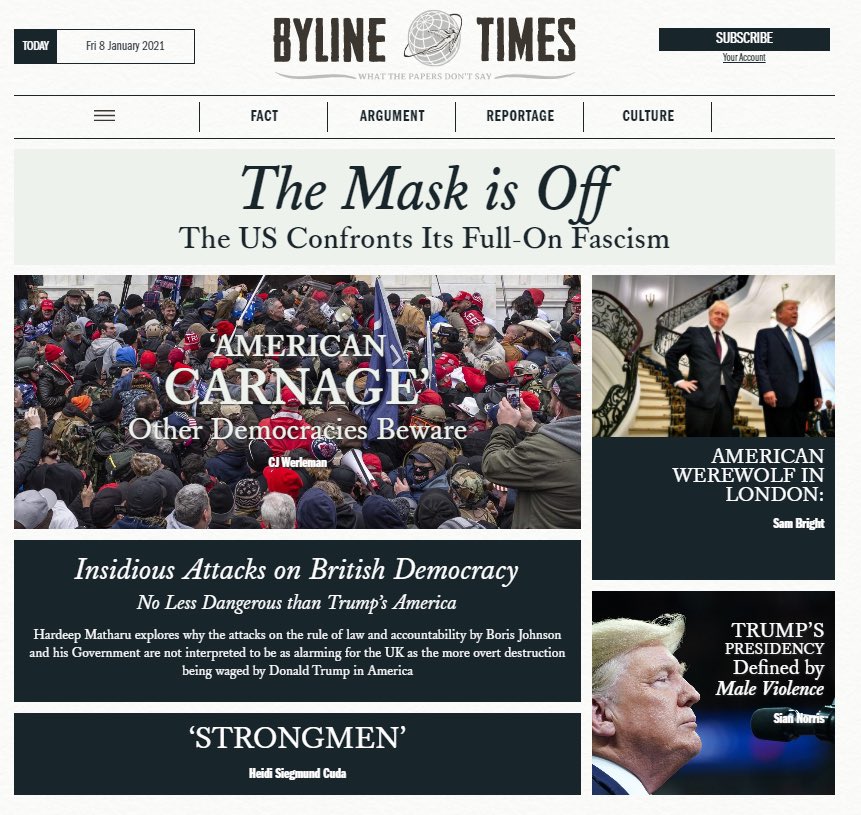
53/ If you appreciate fearless independent investigative journalism, please consider supporting reader-funded @BylineTimes
No ads. No cookies. No tracking.
Subscribe here:
subscribe.bylinetimes.com
No ads. No cookies. No tracking.
Subscribe here:
subscribe.bylinetimes.com
54/ POSTSCRIPT: One important point @ruthbenghiat made in our interview: “Once the bond between leader and follower is consolidated, almost nothing can break it. Even pandemic mismanagement—they don’t care because they bonded to him.”
In WW2, it took the bombs of Allied forces.
In WW2, it took the bombs of Allied forces.
55/ WHAT’S NEXT: More original reporting in @BylineTimes
https://twitter.com/heidi_cuda/status/1337254824220377090
56/ CODA: For more keen insights on the rise of fascism from @ruthbenghiat check out this thread:
https://twitter.com/Heidi_Cuda/status/1275989368209989633
• • •
Missing some Tweet in this thread? You can try to
force a refresh




