
The Soviet Union was collapsing, America had won the Cold War, and a young Attorney General named William Barr, under President George H. W. Bush, decided to repurpose agents away from Russia to focus on the crack cocaine epidemic. 1/
https://twitter.com/BylineTimes/status/1359121896680349696
Twenty-five years earlier, President Gerald Ford had signed the Jackson-Vanik bill into law, which created an immigration pathway for Soviet emigres in exchange for trade relations. 2/
According to “American Kompromat: How the KGB Cultivated Donald Trump and Related Tales..” both these moves created gaping holes in America’s national security that would lead to the greatest intelligence coup in history: the installation of a Russian asset in the White House. 3/
“It is preposterous—the idea of having a Russian asset in the White House and yet it really is true,” said American Kompromat author @craigunger in an interview with @BylineTimes. “That’s what happened..I think if we don’t come to terms with that reality,it will happen again.” 4/
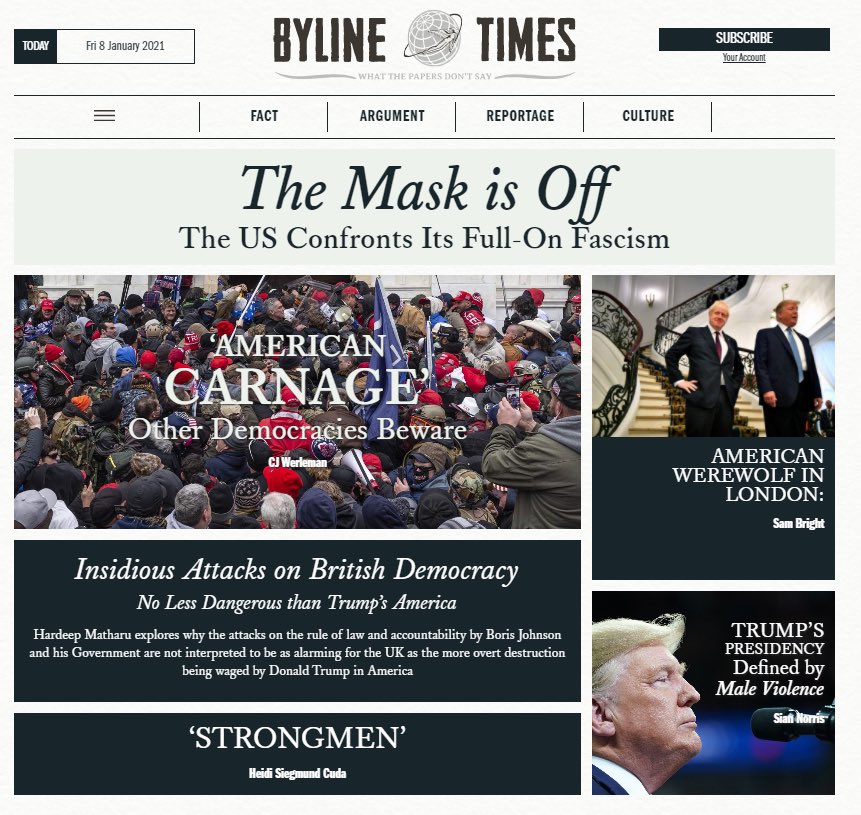
As the former president faces an upcoming impeachment trial in the Senate for his alleged role in inciting a deadly insurrection, Unger said it is important to examine the recent American carnage. 5/
“It’s not over yet,” Unger told Byline Times. “The big thing people don’t see is this is a war. It’s a war without bombs, bullets, and boots on the ground, but it’s with cyberwarfare, it’s with disinformation, and all these bizarre things like QAnon.” 6/
Unger divides American Kompromat into three parts: the KGB’s 40-year cultivation of Trump; the “praetorian guard” of religious zealots who targeted America’s judiciary; and the global operatives whose greed and sexual predilections gave rise to a kompromat state. 7/
“We were triumphant at winning the Cold War, but the KGB didn’t stop,” Unger told Byline Times. “The KGB went into hibernation, and it had very clever ways of resurfacing later on. And it plowed all its money, tens of billions of dollars, into ventures that resurfaced later.” 8/
Unger, a New York-based investigative reporter who also documented Trump’s ties to Russia in his previous book, House of Trump, House of Putin: The Untold Story of Donald Trump and the Russian Mafia, said the KGB played the long game. 9/
Unger delineates how the KGB and its various post-Soviet iterations subverted American institutions through targeting and exploiting campaign finance, the U.S. legal system, social media, the tech sector, K Street lobbyists, corporate lawyers, and the real estate industry. 10/
LEGAL BRIBERY: Thirty years ago, a Harvard friend of Unger’s, political journalist Michael Kinsley, told him: “The real scandal isn’t what’s illegal; it’s what IS legal.” 11/
“We’ve legalized all sorts of forms of crime,” said Unger. “I was interviewing an American businessman who was doing business in Russia in the early days after the fall of the Soviet Union and one of his clients wanted to bribe Tom Foley, who was then Speaker of the House. 12/
He told his Russian friend, ‘No, no, no, you get a lobbying firm on K Street.’ And he explained the whole business and said, ‘You give a million dollars to a political action committee.’ And the Russian guy said, ‘Wow, you’ve legalized bribery. That’s wonderful!’” 13/
Unger documents the white shoe law firms that represent both Putin’s and Trump’s interests.
Among the most scandalous examples is the legal representation of Semion Mogilevich, a reputed Russian mob boss notable for his appearance on the FBI’s Ten Most Wanted Fugitives list. 14/
Among the most scandalous examples is the legal representation of Semion Mogilevich, a reputed Russian mob boss notable for his appearance on the FBI’s Ten Most Wanted Fugitives list. 14/
So who was Mogilevich’s lawyer? William Sessions, former director of the FBI.
“What kind of message does that send to the rest of the FBI,” queried Unger. “They are trying to prosecute these guys, and they see their leader is making a lot of money representing the bad guys.” 15/
“What kind of message does that send to the rest of the FBI,” queried Unger. “They are trying to prosecute these guys, and they see their leader is making a lot of money representing the bad guys.” 15/
In an intriguing turn of events, Trump is watching his legal team disintegrate before his eyes, as the Senate trial looms. In an era where lawyers need lawyers, perhaps the new administration under President Joe Biden is signalling a return to the rule of law. 16/
“For me the most heartening moment in Biden’s inaugural speech is, we want unity, but he made it clear that it was going to require truth,” said Unger. “So I don’t think he’s naive, and I think he’s off to a terrific start and his appointees have been excellent by and large.” 17/
He says Biden’s razor thin majority means America is still on tenterhooks.

“It’s as thin as it can be in the Senate, and it’s not much better in the House,” he said. “It’s very hard to get bills through for him. He’s proceeding in the right order...” 18/

“It’s as thin as it can be in the Senate, and it’s not much better in the House,” he said. “It’s very hard to get bills through for him. He’s proceeding in the right order...” 18/
Unger continued: “The Democrats are more unified than they’ve ever been. You don’t see huge splits within the party at this stage. But the fact that it’s so thin means it’s going to be enormously difficult, and we’ll see what happens.” 19/
A dogged return to objective truth, however, will require sweeping changes in how we police disinformation.
“Technology and social media has to be regulated and no one has even figured out a good way to do it yet,” said Unger. 20/
“Technology and social media has to be regulated and no one has even figured out a good way to do it yet,” said Unger. 20/
“Information is siloed, otherwise you wouldn’t have huge numbers of people believing lies,” said Unger. 21/
A riddle democratic nations must solve is how to ensure truth, which is often paywalled, rises above the clamour of well-financed lies. American Kompromat opens with American’ intelligence agents sounding the alarm about Trump’s Russian ties prior to the 2016 election... 22/
And yet, the warnings were drowned out by made-for-TV stunts, and an epic fail on behalf of the Fourth Estate that had its roots in New York media’s creation of The Donald. 23/
THE FAILURES OF JOURNALISM:
“I was at New York Magazine back in the ‘80s, and I saw his reputation being built up,” Unger told Byline Times. “And I thought it was horrible the way he was puffed up by publications I worked for.” 24/
“I was at New York Magazine back in the ‘80s, and I saw his reputation being built up,” Unger told Byline Times. “And I thought it was horrible the way he was puffed up by publications I worked for.” 24/
Unger said Trump’s rise coincided with the burgeoning era of lucrative sensational journalism.
“While at New York Magazine, the daughter of some mobster was becoming a journalist and everyone thought how cool it was to have her writing for us. People like that...” 25/
“While at New York Magazine, the daughter of some mobster was becoming a journalist and everyone thought how cool it was to have her writing for us. People like that...” 25/
Unger continued: “There’s a certain kind of excitement to it. There’s a tabloid sensibility. And that’s been true of all of American culture. From Vegas to all the crap that’s on TV. People enjoy that.” 26/
This glossing over of hard facts continued decades later and Unger said, we can pin much of the blame on “access journalism.”
“If a journalist has Rudy Giuliani as a source, he’s not going to go after Giuliani,” said Unger. 27/
“If a journalist has Rudy Giuliani as a source, he’s not going to go after Giuliani,” said Unger. 27/
“If he uses Donald Trump as a source, he’s not going after Donald Trump. That is part of the answer for some journalists. We call it ‘access journalism’, and you latch on to one source and that means you’re not going to go after them,” said Unger. 28/
“Roger Stone is brilliant at this,” said Unger. “I interviewed Roger several times, and he’s a barrel of laughs, right. People often fall prey to that, and they’re charmed by that and they don’t want to give it up. And that means they don’t criticize people like Roger Stone.” 29/
MUELLER ‘FAIL’: So softball journalism may have led the way, but according to Unger, the enormous failure of Robert Mueller was a figurative nail in the coffin.
“Very few people seemed to be aware of the fact Mueller was supposed to do a counterintelligence investigation..” 30/
“Very few people seemed to be aware of the fact Mueller was supposed to do a counterintelligence investigation..” 30/
“...and instead he just made it a criminal investigation,” Unger told Byline Times.
In other words, violating campaign finance laws by paying off a porn star is criminal, but huge parts of the intelligence operations are technically legal, said Unger. 31/
In other words, violating campaign finance laws by paying off a porn star is criminal, but huge parts of the intelligence operations are technically legal, said Unger. 31/
“I give the episode of Donald Trump Jr. giving a speech in France at a French think tank and they’re paying for it and all that’s legal,” said Unger. “But the French think tank is really a front for Russian intelligence...” 32/
“...so Don Jr. was pumped full of talking points of what Putin wanted to be our policy in the Middle East and the message was transmitted to Trump who implemented them. That’s an intelligence operation,” said Unger. 33/
As Unger noted in American Kompromat, this Russian messaging family tradition had its roots in the ‘80s, when Trump was taking out full-page ads in major newspapers delivering Kremlin talking points. 34/
Apropos of nothing, Trump had determined he was a nuclear expert, and according to Unger’s source in the book, Yuri Shvets, a former major in the KGB, this was the great opening Russian intelligence sought. 35/
“Yuri said, ‘This is something we can drive a truck through. We encourage Trump to think he is a world thought leader on nuclear arms,’” said Unger. “Trump was so vain and narcissistic, they would tell him, ‘Oh, you have such wonderful unorthodox views...” 36/
“...you have to publicise these in America. You have to get them across.’ So according to Yuri, they would pump him full of all these talking points, and he took out full page ads in NY Times, WaPo and those ads were in fact an active measure that they celebrated in the KGB.” 37/
In American Kompromat, Unger claims this was the same era that Trump was selling condos to Russian oligarchs and doing business with an electronics shop whose co-owner was likely a “spotter” for the KGB. 38/
A minor but odd story in the book about Trump implying he met with Gorbachev on a trip to Russia, which was not true, was an early indicator of Trump’s power trip, “a desire to inflate his reputation,” Unger noted. 39/
The final third of Unger’s book closely examines pedophile Jeffrey Epstein, his incarcerated pal Ghislaine Maxwell, her father Robert Maxwell—noted in his obituary in the Scotsman as the “biggest thief in British criminal history”—and how they all seemed to orbit around Trump.40/
“There’s a lot of similarities between Trump, Maxwell, and Jeffrey Epstein,” said Unger. “Yuri Shvets characterizes Trump as a special unofficial contact, same for Robert Maxwell. I’m not sure Epstein fits in that category, but they all had ties to Russian intelligence...” 41/
“They all had sexual obsessions, there were young girls everywhere. And that’s true for all three of them, and then of course there’s the greed. It was sort of a bottomless pit of greed. Yet they all managed to climb the highest levels of society, both in England and the U.S.”42/
Out of the three men, Trump it appears, is the last man standing. 43/
When taking in the entirety of American Kompromat, the KGB’s 40-year cultivation of Trump, the right-wing remapping of our judiciary, and the opportunists who would be kings, Unger said America will not be able to dust itself off from its recent carnage without prosecutions. 44/
“My view is we have got to prosecute Trump to the fullest extent of the law, otherwise it makes this behavior acceptable,” Unger said. “Where he was brilliant and the Republicans were brilliant was in normalizing one fiasco after another...” 45/
“...The end of the checks and balances, any oversight by Congress, even if you look at the prosecution of (former Trump campaign manager) Paul Manafort. He was convicted of bank fraud and tax fraud but, excuse me, he took $75 million dollars from the Russians...” 46/
“... to implement all their policies, which were completely against America’s interests and he wasn’t prosecuted for that? Doesn’t that make him a spy of some sort? All you have to do is observe the FARA? That makes it legal to do everything on behalf of an adversary?” 47/
So this is where we are, at a dangerous precipice, where the things that are most terrifying in America are legal. The fact that Trump is currently building a post-presidency shadow government is more than alarming. 48/
Byline Times reached out to Trump for comment on his portrayal in American Kompromat but did not receive a response. 49/
“I try to get this story into the national conversation as much as possible,” Unger told Byline Times. “But it’s really hard when you see how fractured the national conversation is...” 50/
“...and it’s very hard to make what I think are the au naturel points front and center before Americans. There are a lot of different reasons for that and we talked about social media and how the conversations are siloed, and I think all of that has to be corrected,” he said. 51/
Clearly, President Joe Biden is aware of America’s problems and is looking to history for inspiration. Upon his first day in office, a massive portrait of Franklin Delano Roosevelt had been hung on the wall across from the desk where he has been signing executive orders. 52/
“I think the optimistic way of looking at it is Biden has a chance of what potentially is a Roosevelt moment, where you can make sweeping progressive changes,” said Unger. “But the margins are so thin, all I can say is, he can’t afford to make mistakes. I hope he succeeds.” 53/
It’s safe to say, so does the rest of the West.
***
Author Heidi Siegmund Cuda is an investigative reporter based in Los Angeles 54/
***
Author Heidi Siegmund Cuda is an investigative reporter based in Los Angeles 54/
If you appreciate fearless independent investigative journalism, please consider supporting reader-funded @BylineTimes
No ads. No cookies. No tracking.
Please subscribe here:
subscribe.bylinetimes.com 55/
No ads. No cookies. No tracking.
Please subscribe here:
subscribe.bylinetimes.com 55/
To learn more about @craigunger and American Kompromat, go here:
penguinrandomhouse.com/books/635379/a…
penguinrandomhouse.com/books/635379/a…
• • •
Missing some Tweet in this thread? You can try to
force a refresh




