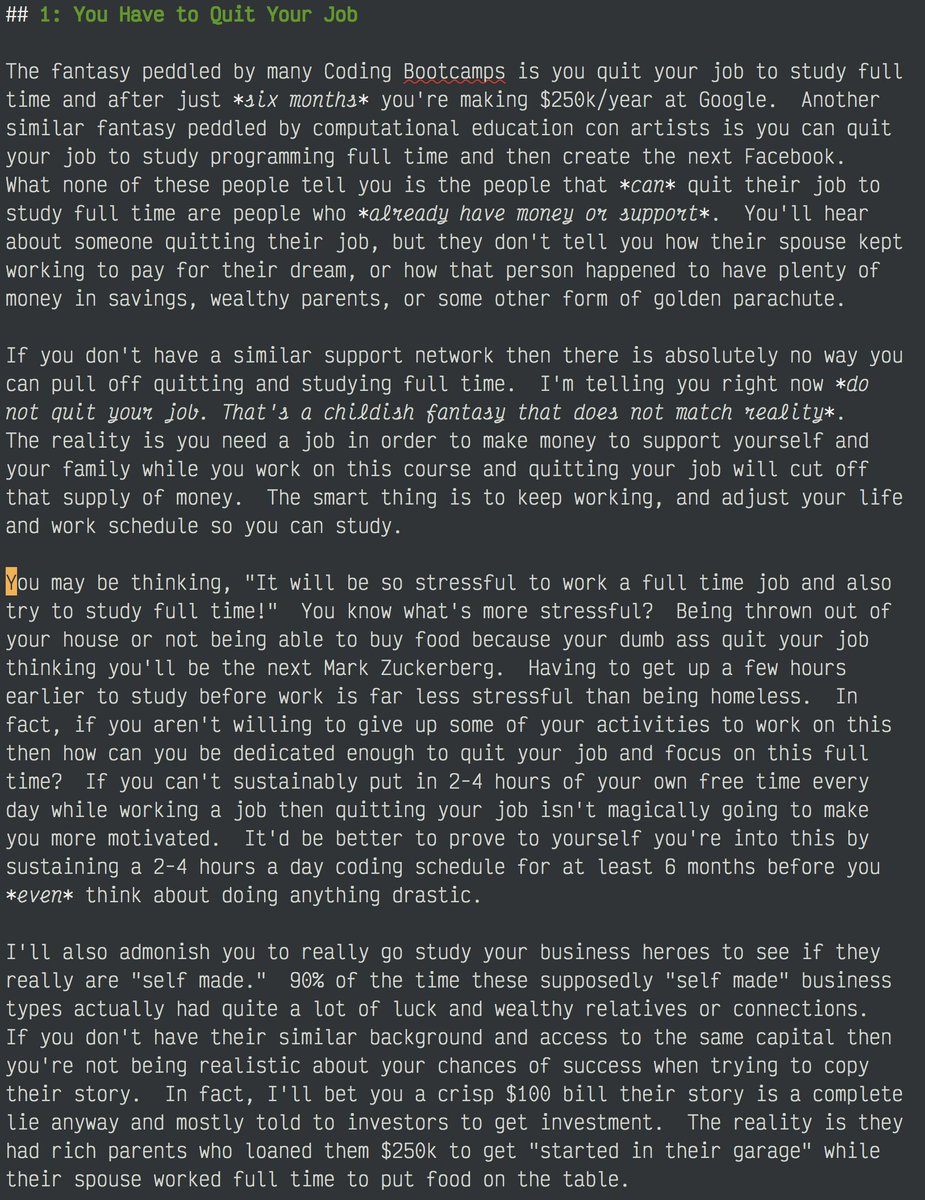
I totally forgot to warn people to not quit their job before joining my course, but I also think I *really* need to make this some kind of digital signature requirement. You agree to not quit your job and submit a photo with the date and your name on a piece of paper for proof.
I'm mostly joking, but the last time I ran a little experimental class I had so many people quit their perfectly good jobs to study and then flame out because they...couldn't buy food. I was horrified and I never told them to do that. Hell no, keep your job people!
I gathered that the only reason "quit your job to become a programmer" was even a fantasy is because programmers are oddly not very honest about how miserable programming is most of the time. It's a labor of love, and has big rewards for the pain, but it is painful.
So I think another reason I'd want people to keep working is so they have somewhere to go find *some* success and a break from the brutality of coding. Go bang your head on a bug then go cook bagels or something for 8 hours and you'll feel better. Trust me.
FYI this is from a section of the course "Common Misconceptions About Programming", so the title is a misconception, not something you should do.
• • •
Missing some Tweet in this thread? You can try to
force a refresh
When you complain about an open source project's management you'll get the reply, "Use something else if you don't like it!" That'd be true except for the tiny problem that *many* projects also strive for complete monopolistic dominance.
Let me tell you about Java in early 2k:
I was programming in Java since it's release, and all through the late 90s into the early 2000s. At first Java was very determined to unseat C++ and it used various propaganda tactics to turn C++ and malloc into a weird enemy for all of us to hate. This worked great!
Everything was fine though because there were plenty of jobs in tech because of the dot-com boom, and then suddenly there were not jobs because of the dot-com bomb.
Overnight it seemed as if the *only* way to get a job was at giant companies, and they *loved* Enterprise Java.
If you give your resume to a recruiter they will spam it to every company possible in an attempt to be the "first" to get you so they get commission. When 2 do it there's a conflict.
The gist is recruiters get paid a finder's fee. Companies then use multiple recruiters and sometimes you'll get 2 recruiting companies submitting your resume without you knowing. The hiring company then disqualifies you rather than deal with the legal hassle of who to pay.
Now, you might be thinking, how is it that two or more recruiting companies are getting your resume? Does that mean you're a dirty cheater who's double dealing?
No. People have a right to find work through multiple avenues, but also *many* recruiting companies scrape resumes.
Every time I read something by a cryptographer claiming to know when people are qualified to attempt cryptography software I go and see if they said *anything* about OpenSSL during the 20+ years it was obviously flawed:
In general nearly everyone who is currently working in cryptography accepted OpenSSL as correctly implemented for decades even though a basic analysis of the C code showed obvious flaws. They not only accepted OpenSSL but repeatedly yelled at people who didn't use it.
If you wanted to study crypto and implemented existing proven algorithms out came the Cryptography Experts yelling at you to "just use OpenSSL". It was *the* only implementation allowed. Then this happened:
I've got an alternative history of Amazon's switch to Linux and creation of AWS that I heard from an open source project they coopted and practically destroyed. Keep in mind this story is 2nd hand and the open source developers were BITTER, but Amazon is famous for this:
I joined this other project that was started by a guy who sold cluster servers to big secret government agencies, and he was working with an open source team that had a project similar to Beowulf en.wikipedia.org/wiki/Beowulf_c… but would be closer to Chef or Puppet.
This project was small, maybe 4 developers, and what they wrote did very nice automated provisioning of machines, which you could then use in a cluster. When I started working with them though they were JEEERRRRKS. Wow, they were absolute turds.
Another element of my "why browsers must die" linked list is how some parts of it assume everything is a flexible rectangular viewport with fixed dimensions, and other parts assume it's an infinite plane with no fixed dimensions.
For example, scroll into view:
If a browser is an infinite plane that you view through a viewport (like a video game), then there *must* be a way to cause interactions when some element of the infinite plane comes into view. Yet, finding an event for this very necessary thing is impossible.
It was asked *11 years ago*, but was active *11 days ago*. It's been viewed 727k times, and has as many possible answers as there are people posting over various years.
Played a little more Subsistence this morning and I'm convinced it's actually a sci-fi game. You wake up in an enclosed part of Alaska, fenced off, and build a base with an electronic unit attached to a wall that generates power and fabricates items from loot you get in bags.
I could see a back story to the game that's similar to The Prisoner, where you have no idea why you're stuck here, but it's some kind of punishment/experiment, and the bags of loot are dropped to see what you'd do. This would also explain to impossible things:
1. That shooting an animal from about 1 mile away lets the animal instantly know where you are and run that 1 mile in 2 seconds to kill you. They *have* to be genetically engineered super wolves and bears, so sci-fi.