

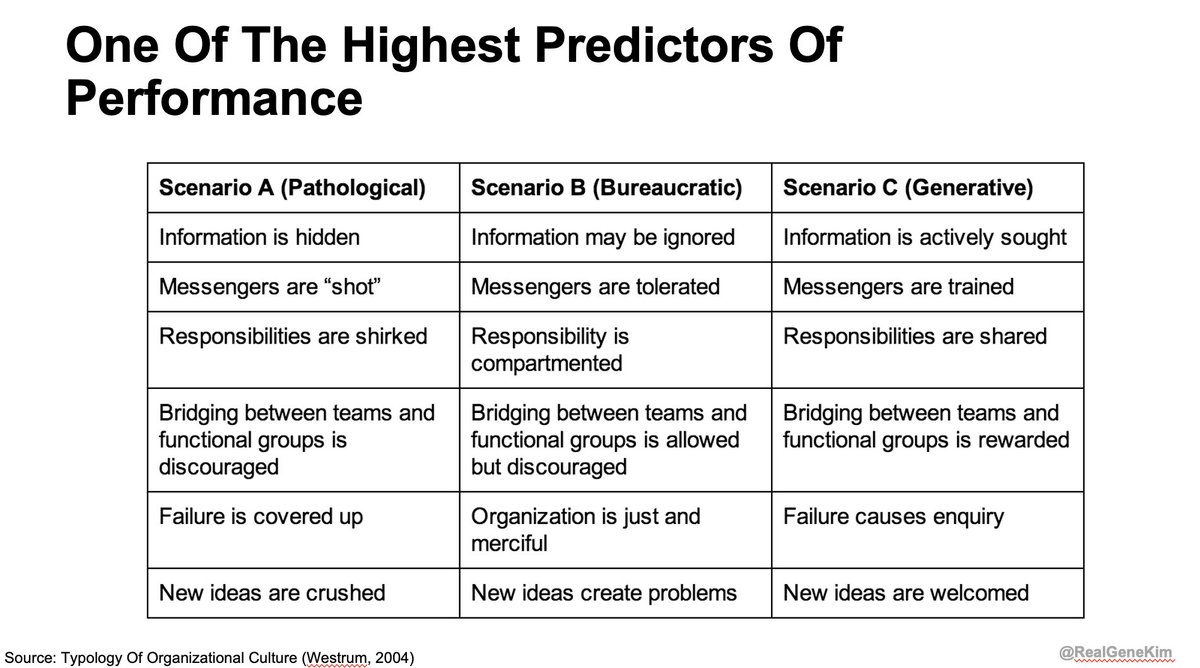
Many of you have seen the famous Westrum Organizational Typology model, so prominently featured in State of DevOps Research, Accelerate, DevOps Handbook, etc.
This model was created Dr. Ron Westrum, a widely-cited sociologist who studied the impact of culture on safety
This model was created Dr. Ron Westrum, a widely-cited sociologist who studied the impact of culture on safety
Thanks to Dr. @nicolefv, I was able to interview him for an upcoming episode of the Idealcast! 🤯
It was a very heady experience, and while preparing to interview him, I was startled to discover how much work he's done in healthcare, aviation, spaceflight, but also innovation.
It was a very heady experience, and while preparing to interview him, I was startled to discover how much work he's done in healthcare, aviation, spaceflight, but also innovation.
@nicolefv I've read 4+ of his papers, so I thought I was familiar with his work. (Here's one paper: researchgate.net/publication/26…)
I was startled to learn he has also studied in depth what enables innovation. He wrote a wonderful book "Sidewinder: Creative Missile Development at China Lake"
I was startled to learn he has also studied in depth what enables innovation. He wrote a wonderful book "Sidewinder: Creative Missile Development at China Lake"
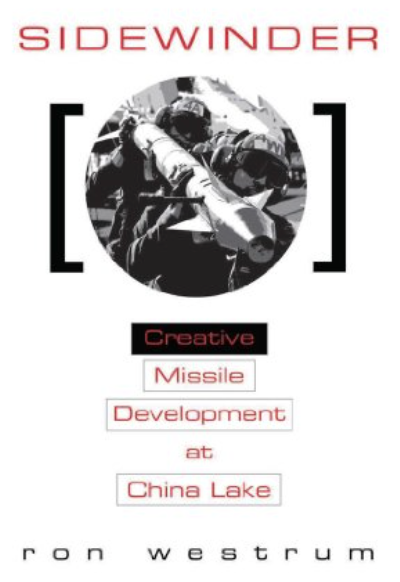
@nicolefv Dr. Westrum writes about China Lake Research Labs: "its design and structure had one purpose: to foster technical creativity. It did; China Lake operated far outside the normal envelope... Sidewinder & others were "impossible" accomplishments, w/aplomb"
amazon.com/dp/B00EXCOIRM
amazon.com/dp/B00EXCOIRM
@nicolefv I love this book because it describes traits of organizations that routinely create and maintain greatness: US space program (Mercury, Gemini, Apollo), US Naval Reactors, Toyota, Team of Teams, Tesla, the tech giants (Amazon, Google, Netflix, Google)
@nicolefv "Research and development is not a business that can be carefully planned and directed, not if you expect to make progress rapidly and economically." Burton Klein, Economist, 1958.
"What is the underlying science [and theory]?
"What is the underlying science [and theory]?
@nicolefv "What accounts for successful innovation? What role do leadership and organizational design play?" What incredible questions!
"Today Rabinow, professional inventor w/230+ US patents, an advisor to NIST: 'all inventors come up w/many idea; you must know that most are trash."
"Today Rabinow, professional inventor w/230+ US patents, an advisor to NIST: 'all inventors come up w/many idea; you must know that most are trash."
@nicolefv One aspect Westrum hints at is need for constraints & scarcity. One factor for Sidewinder success is that it was hidden as an official program for years, classified as "fuse research," which could be easily classified.
This prevented expansions in budget, oversight, meddling
This prevented expansions in budget, oversight, meddling
@nicolefv Counter-examples at this time were the Falcon (which became Phoenix), and Sparrow, both of which underperformed for years, unable to hit their targets.
Dr. Bill McLean is the center of the narrative, Ph.D. from Caltech, who led the program, and eventually China Lake
Dr. Bill McLean is the center of the narrative, Ph.D. from Caltech, who led the program, and eventually China Lake
@nicolefv One dynamic with China Lake (let's call it CL) was minimum of organization and hierarchy: the important point: "Each person did the job for which they were best fitted. One day they'd be directing associates. Next day, it could be other day around."
@nicolefv In the interview, Dr. Westrum suggested that this is the opposite of a hierarchy, where managers tell workers what to do — instead, you want an org that give the job who can best do it.
That could be answering a question, dictating what the work should be, or doing the work.
That could be answering a question, dictating what the work should be, or doing the work.
@nicolefv Aside: that sounds kind of obvious, right? But contrast this to how many orgs actually work. This is about whether or not the organization respects knowledge.
"Lockheed Skunk Works shared many similar traits... Director "Kelly" Johnson promised P-80 Shooting star in
"Lockheed Skunk Works shared many similar traits... Director "Kelly" Johnson promised P-80 Shooting star in
@nicolefv "...in 180 days; his hand-picked team did it in 141 days." Skunk Works was a small team, but China Lake had figured out how to scale this dynamic to thousands of employees
@nicolefv "Merle Tuve, maestro in charge of developing the proximity fuse in WWII, once said: "I don't want any damn fool in this laboratory to save money. I only want them to save time."
(Also resonates w/me. As @chawlady wrote: we stopped optimizing for cost, and optimized for speed)
(Also resonates w/me. As @chawlady wrote: we stopped optimizing for cost, and optimized for speed)
@nicolefv @chawlady "Management theorist Deborah Dougherty argued successful products generally come from orgs whose design, mfg, sales, & marketing depts focus on meeting customer’s carefully studied needs.
@nicolefv @chawlady "Getting these four departments to focus on a common, well-chosen goal is the secret to success. What is remarkable about McLean is that he combined in a single person all these activities."
Dr. Westrum says that the literature calls this the "technical maestro"
Dr. Westrum says that the literature calls this the "technical maestro"
@nicolefv @chawlady "In conceiving his missile, McLean determined to use “the minimum amount of garbage you had to hang on the rocket in order to make it home.” Experiments would tell him just how much garbage this was.."
(other missile programs burdened with lots of premature requirements)
(other missile programs burdened with lots of premature requirements)
@nicolefv @chawlady The dynamics of large, public, official missile programs (not Sidewinder): "years of effort go into preparing the systems, and often tests went badly. Millions of $$, and in some cases, fate of whole business divisions rode on the outcomes... Raytheon had 6K engrs on Falcon
@nicolefv @chawlady "...emotions ran high in the control room, and a man could break into tears when his missile failed." (painting the high-stakes dynamics in these massive programs that prematurely created rigid boundaries)
@nicolefv @chawlady Okay, taking a break. Will continue soon. I feel like I highlighted the entire book — I'm writing up my notes to clarify my own thinking on this. (thank you @RoamResearch)
...also, in addition to @nicolefv, while I'm thinking about it, my thanks to @jezhumble who first introduced me to Dr. Westrum's work, as it appeared in Lean Enterprise, and @allspaw, who sent me two of his papers over the years!
More to come later...
More to come later...
Okay, I'm resuming note taking on Dr. Ron Westrum's fantastic book "Sidewinder: Creative Missile Development at China Lake", where he studied what factors led sustained greatness and innovation, outperforming almost every other air to air missile program at the time.
I'm resuming the thread I started here — and I finished the book just now. I ended on how he observed how important scarcity & constraints were, but something Dr. Westrum talks about considerably is the need for prototyping, just one way to get early, fast and frequent feedback
In contrast was Falcon missile program at Hughes: He writes: "Nichols suspected Hughes Falcon inferior reticle was attributed to their long cycle of design and testing: 'if we worked like them, it'd be like wearing boxing gloves; we had it in palm of our hands..."
"...[in contrast], we had the whole thing in the palm of our hands." This refers to how cross functional teams had machinists/technicians able to create parts within hours or days, so that ideas could be prototyped, tested, improved or discarded quickly.
Another hallmark of the China Lake way was long hours: everyone, whether military or civilian, lived on base, and work happened at work, but also at home; neighbors all were working on same thing, dominating all aspects of life.
McLean was working weekends & night with the teams
McLean was working weekends & night with the teams
"There was a feeling, not that you worked at a big naval test station, but that you were part of a close-knit group, a university-like atmosphere.. Communication between higher- and lower-levels of of community was very good."
(Interestingly, decades later, as China Lake continued to grow, more housing moved off-base, and by all accounts, this atmosphere was lost. He writes later about the decline of this cultural aspect. Thought-provoking around physical proximity and WFH.)
One of the early killer Sidewinder demos that seemed to wow everyone, especially people who mattered (admirals, important people approving funding, skeptics) was the "cigarette demo."
Everyone was skeptical that infrared (IR) could track planes...
Everyone was skeptical that infrared (IR) could track planes...
...People walking into the lab would see a table where something that looked like a small radar dish (that fit in missile nose cone). Then someone would walk back and forth in front of it with a lit cigarette, and the dish would track them.
What an incredibly convincing demo!
What an incredibly convincing demo!
Part of the CL way was the notion of a "gestation period," where there were lots of consultation, discussion, peer reviews and tests. McLean believed it was dangerous to start too fast.
"The emergence of solution triggered Phase 2, when focus shifted to key dependent subsystems
"The emergence of solution triggered Phase 2, when focus shifted to key dependent subsystems
"...One identified critical problems, ones that would hold up progress of the entire system if not solved. These critical areas of ignorance then became the focus of Phase 2, which operated at a brisker pace."
(I love the word "ignorance", so widely used by Dr. @StevenJSpear)
(I love the word "ignorance", so widely used by Dr. @StevenJSpear)
@StevenJSpear "Once there was a clear idea of the problem, McLean moved rapidly. China Lake culture was to proceed at breakneck speed once the goal was clear. In this rapid experimentation phase, his primary method was 'idea-building' was to construct and test prototypes.
@StevenJSpear "Reading was good, but when one reached the point where others had failed, it was time to test... he insisted on not getting too much data. The universal anxieties felt by all engineers cause them to overspecify their data requirements. McLean recognized this downside...
@StevenJSpear "...the time and money wasted gathering all the data. The emphasis was gathering just enough data to see where one should zoom off to next, an approach heavily depended on McLean's intuition."
"An R&D gruop, he believed, did not have leisure of a complete picture of reality..
"An R&D gruop, he believed, did not have leisure of a complete picture of reality..
@StevenJSpear Westrum remarks on the above: "relying on intution to this degree was not an approach for the faint of heart." :)
McLean often would recommend: "wire around the problem: don't solve problems you don't need to solve. Get to a working product, don't struggle against nature
McLean often would recommend: "wire around the problem: don't solve problems you don't need to solve. Get to a working product, don't struggle against nature
@StevenJSpear "McLean hated formal requirements prior to development. What was going to work could seldom be known in advance. Only when labs could experiment freely did they arrive at the best solutions to technical problems. Requirements are appropriate only when system had been proven"
@StevenJSpear "Ordinary R&D work goes step-by-step. Mclean, however, took giant steps, landing far ahead of where routine development would have gotten him. The ability to make such intuitive leaps and test them thru prototypes was key to rapid development of Sidewinder.
@StevenJSpear "While no critical steps were skipped, very unnecessary steps were taken."
@StevenJSpear "McLean, educated as a physicist and by nature a systems thinker, paid no attention to traditional boundaries between engineering disciplines."
"He reserved special contempt for computer programmers: their programs often left out things inconvenient to calculate." 😂
"He reserved special contempt for computer programmers: their programs often left out things inconvenient to calculate." 😂
@StevenJSpear ^^ that's super interesting. I read something on this very recently. Apparently one of the big mysteries it took so long for ozone hole at South Pole to be detected.
Reason was because scientists assumed NASA satellites would detect it, sensor analysis models rejected it!
Reason was because scientists assumed NASA satellites would detect it, sensor analysis models rejected it!
@StevenJSpear I.e., the ozone hole was so anomalous that it was rejected by model, and never reported or acknowledged! This bias was built into the sensor analysis program. Similar criticisms have been made about ML models, where racial biases is built in (profiling, facial recognition, etc)
@StevenJSpear Another aspect of McLean process: competitive groups working on problem.
"At least four groups worked on Sidewinder seeker. Parallel teams approach provided 'strategic flexibility,' a phrase borrowed from Arty Fry, co inventor of the Post-It Note.
"At least four groups worked on Sidewinder seeker. Parallel teams approach provided 'strategic flexibility,' a phrase borrowed from Arty Fry, co inventor of the Post-It Note.
@StevenJSpear "Strategic flexibility meant the program would not be forced into a corner or become locked too early into a single approach."
Side note: I read the entire book, and the 1000+ endnotes. This is one freaking superbly researched book. # of first-hand interviews is stunning.
Side note: I read the entire book, and the 1000+ endnotes. This is one freaking superbly researched book. # of first-hand interviews is stunning.
@StevenJSpear ...Westrum talked with Art Fry (inventor of Post-It Note), interviewed and met with Admiral Thomas Moorer (a key member of China Lake staff who then became Chief of Naval Operations [CNO], the top uniformed officer in the US Navy), and so many other senior people.
@StevenJSpear ^^ and what a strange coincidence! I just interviewed for Idealcast Admiral John Richardson, who served as CNO for four years from 2015-2019, and who previously led the famous US Naval Reactor division, as famously studied by Dr. @StevenJSpear
en.wikipedia.org/wiki/John_M._R…
en.wikipedia.org/wiki/John_M._R…
@StevenJSpear Okay, back to notes: on "strategic flexibility" & competition for solutions between teams. Westrum writes: "Openness means willing to consider alternative courses of actions."
(Interestingly, in Dr. Carliss Baldwin talk, she described economic value of creating options!)
(Interestingly, in Dr. Carliss Baldwin talk, she described economic value of creating options!)
@StevenJSpear ^^ to channel Dr. Baldwin: architecting work in a way that enables options can create an order of magnitude more value, because it enables fast and frequent experimentation.
In computer industry, she cited 25x more value creation, which was enough to "blow an industry apart"
In computer industry, she cited 25x more value creation, which was enough to "blow an industry apart"
@StevenJSpear On China Lake organization: "McLean knew how to build a team. He would start an interesting project, then tempt others to join. He said little, but his vision was compelling.
"CL was a 'matrix' organization, where project teams like Sidewinder borrowed expertise from...
"CL was a 'matrix' organization, where project teams like Sidewinder borrowed expertise from...
@StevenJSpear "borrowed expertise from departments, such as research, engineering, and test, which constituted the basic hierarchical structure of the naval base.
"The departments controlled pay and promotion, but the projects, on and off base, drew from them. They were temporary networks of
"The departments controlled pay and promotion, but the projects, on and off base, drew from them. They were temporary networks of
@StevenJSpear "..personnel that shifted over time, while departments were permanent structures.
"A matrix org inevitably generates tension between its projects and its disciplinary departments. Functional depts deliver expertise; project groups deliver prototypes.
"A matrix org inevitably generates tension between its projects and its disciplinary departments. Functional depts deliver expertise; project groups deliver prototypes.
@StevenJSpear "^^ and both are likely to see themselves as primary." 😂😂😂
"Two reporting systems create two sets of loyalties. Projects and departments struggle over funds and prerogatives... who gets credit when a project succeeds is also a problem. Functional work yields contributions to
"Two reporting systems create two sets of loyalties. Projects and departments struggle over funds and prerogatives... who gets credit when a project succeeds is also a problem. Functional work yields contributions to
@StevenJSpear "...systems that later may be hard to identify. But projects represents free-standing systems whose success will clearly reflect on the team creating it.
"Matrix orgs are inherently unstable that require utmost judgement from top management."
"Matrix orgs are inherently unstable that require utmost judgement from top management."
@StevenJSpear Okay, break time... More to come soon!
• • •
Missing some Tweet in this thread? You can try to
force a refresh


