In the context of Boris now arguing that the £70m hardship fund is now also for "lost learning" I wanted to run a short thought experiment on lost learning. A thread.
I talk a lot - as do OIA and OfS - about lost learning both in terms of "outcomes" and "opportunities". Important difference is that some in sector want to maintain that "outcomes" unaffected this year...
but as I always say - students cant be paying for outcomes, because it has to be possible to pay in full and also fail. They're paying for a set of facilities and services that include a series of learning opportunities.
In my view both OfS and OIA disproportionately focus on "course" components (the "hour of teaching" or the "placement") which is a problem -
- as it loads disproportionate importance onto synchronous encounters over facilities/services in the learning process, esp for some students on some courses (ie creative arts).
"As a practising artist, the piece of paper at the end is not why I’m here. I came here to develop and grow and I haven’t been able to do that in my bedroom. I need a studio and facilities that I just don’t have at home.” theguardian.com/education/2021…
Nevertheless there's been a disproportionate focus on components of courses that offer hands on, practical experience not being (able) to be delivered like placements. But what about examples at the other end of the spectrum - the good old fashioned seminar?
I could read a lot of material (including from regulators) that as long as a humanities/social sciences seminar has still run online, that would probably be regarded as a reasonable alternative. But is it?
This is typical of what a university says a seminar is for. 
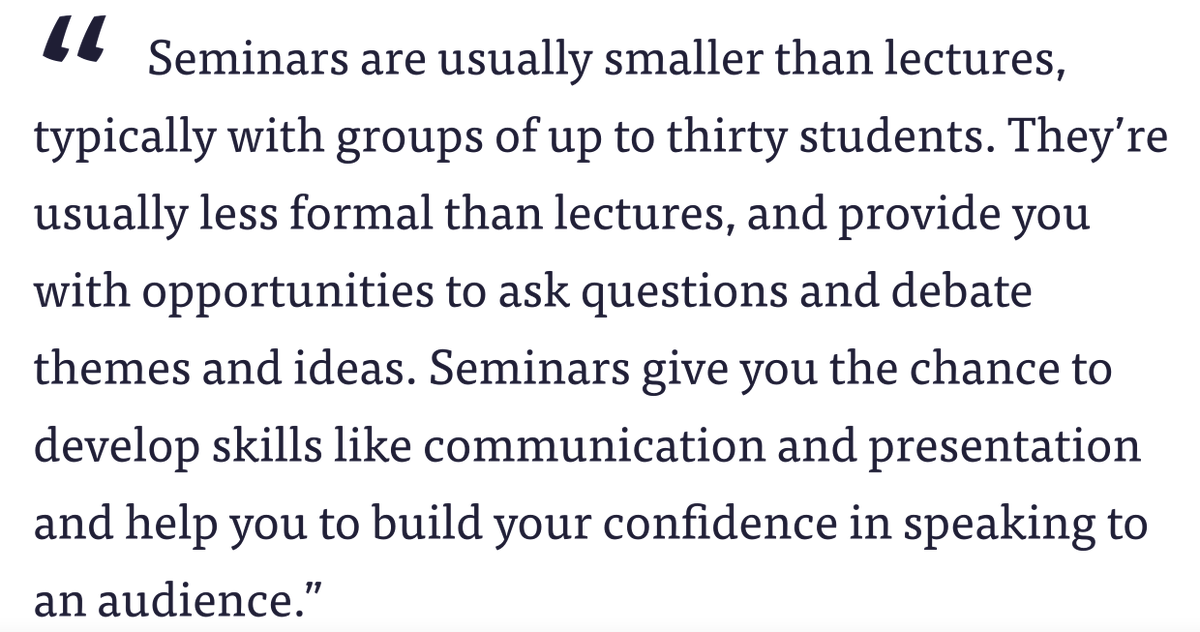
So let's say a student is on a humanities course where the teaching four modules running concurrently - and there's a lecture and seminar every week for each module. The lecture is recorded, the seminar on Zoom or Teams.
Then let's say that that seminar - for all sorts of reasons - is covering the history or sociology or English curriculum, but is not doing the other things suggested. Imagine there's almost no opportunities to ask questions, debate ops are thin...
...and you're consistently getting no "skills" like communication and presentation as described. I'm not saying that's true of all online teaching - but let's say that's happening to you for whatever reason.
In theory the university says that that replacement is good enough, and of sufficient quality. That involves academic judgement, and students can't challenge or complain about academic judgement. So complaints fall at the first hurdle.
But on the other hand, the service is delivering neither the learning "opportunity" nor the learning "outcome" described - which they've been promised.
A lot of complaints/appeals fail because students don't reach a particular learning outcome and are unhappy, but the opportunity was provided and sufficient quality. But when the opportunity is manifestly not as described is that something students can, or can't , complain about?
The idea that 12 months into this crisis we still don't know the answer to that question is just utterly unacceptable.
• • •
Missing some Tweet in this thread? You can try to
force a refresh