

George Bell spent 24 years in prison because Queens prosecutors withheld evidence tying other men to the murders he was accused of—@QueensDAKatz calls the prosecutors' conduct "inadvertent"+ does not plan to review their other cases. This is Bell's story:
gothamist.com/news/he-spent-…
gothamist.com/news/he-spent-…
2/On Christmas eve in 1996, George Bell was just another 19 year old from Corona. By day, he folded clothes at Old Navy. By night, he pursued his real passion—DJing at local parties +going to shows to pass out his mixtapes. It was a golden age of hip hop in Queens. He wanted in.
3/ But that night, NYPD officers showed up to his house and dragged him to a nearby precinct. The teenager was handcuffed to a wall for hours by himself, then at around 4:30 am detectives took him to a room where they began a 5 hour interrogation. They chose not to record.
4/ Suddenly Bell, who had no criminal record, was being asked questions about a double murder from days earlier. A crew of gunmen had tried to rob a check cashing store in East Elmhurst and fatally shot the store owner and an off-duty police officer, Charles Davis.
5/ In response, the NYPD questioned hundreds of residents. One of them, a petty dealer, who suffered from hallucinations of his dead mother, was questioned over two days. Eventually, he claimed George Bell, someone he knew from the neighborhood, helped carry out the attack.
6/ So now Bell was in this precinct house interrogation without a lawyer and nothing being recorded. He says at first he denied any involvement, but that was not good enough for the two detectives in the room.
7/According to accounts he later gave his attorneys, one detective screamed, “You know you did it,” before punching him in the head and knocking him out of his chair. Bell says he pleaded for the detective to stop, but instead the older man pounded him again.
8/ Bell said he appealed to the other detective in the room, whom he remembers sitting there, having a smoke: “Isn’t this police brutality?” he asked. “No, it isn’t,” the man replied.
Bell said the first detective hit him again, shouting more questions.
Bell said the first detective hit him again, shouting more questions.
9/ That’s when Bell says he finally broke. He said he was there. He said he did the shooting. And every time he refused to say something or said something they didn’t like, Bell says, the detectives were there to prompt or assault him.
10/ There were problems with the confession. Bell said he shot the store owner 3-4 times in the chest. Autopsy showed he died of a single shot. He said he + his co-conspirators' getaway car was burgundy. Witnesses said it was blue/green. Regardless, police had their confession.
11/ Police called a Queens prosecutor in. Now, they were ready to take a videotaped statement. In the video, you can see Bell's braided hair appears to be unraveled. The detective he later accused of abuse was siting there monitoring what he said. 

12/ In the video, Bell also makes troubling statements. At one point, he asks the detective (who he later accused of abuse) if he "did good"? At another point, he mumbles "being framed." Watch for yourself:
13/ Despite Bell’s comments on video + the subsequent abuse allegations, which police denied, then Queens DA Richard Brown pushed the case forward + sought the death penalty. At a hearing announcing the charges, a crowd of NYPD officers cheered:
villagevoice.com/2007/09/04/nam…
villagevoice.com/2007/09/04/nam…
14/ The tabloids of the time plastered George Bell's face on their front pages too:

15/ 4 months after his arrest, news broke in another case that Bell’s defense team thought could help clear their client. Another off-duty officer in Queens had been shot in a robbery, this time of an armored car.
16/ Critically, the NY Daily News reported that two gang members under arrest for the armored car heist were also suspects in the check-cashing robbery for which George Bell and his co-defendants were now facing charges.
17/ Naturally, their attorneys asked the Queens DA what it knew about these other suspects. The DA denied having any evidence pointing to any other, uncharged suspects in Bell’s case. This was false.
18/ Before Bell’s trial, prosecutors had received a police report about this very gang, a ring of stickup artists called “Speed Stick.” The report implicated the gang’s leaders, including 1 of the two men named by the Daily News, in the planning of the check-cashing store robbery
19/ Charles Testagrossa himself, the man who would later prosecute Bell, debriefed a detective who detailed the Speed Stick gang’s potential role in the check-cashing store murders. He took his own his handwritten notes about that conversation, entitled “Speed Stick Notes."
20/ In the notes, the prosecutor Testagrossa jotted down that a key Speed Stick member “was driver in Davis homicide,” referring to the off-duty officer, Charles Davis, killed in the check-cashing store. This was never turned over to Bell's defense at trial.

21/ The jury had to find George Bell and his alleged accomplices guilty beyond a reasonable doubt. And information about other credible suspects being investigated by the NYPD could have raised concerns for some for jurors.
22/ They would have had to weigh whether George Bell + his co-defendants were as likely to have carried out the armed robbery as a crew of seasoned robbers. Bell had no record, came from a stable family living in their own brownstone + was described by relatives as a "mama's boy"
23/ But the jurors never got to. Whenever Bell’s attorneys tried to learn about or raise the issue of the NYPD’s other suspects, prosecutors Charles Testagrossa and Brad Leventhal objected, telling the judge they knew for a fact that these inquiries were not relevant.
24/ These "vociferous denials" as a judge would say decades later were "completely false."
25/ Prosecutor Charles Testagrossa told the judge there was “no connection” between the armored car and the check-cashing store robberies. His handwritten from two years earlier suggested otherwise.
26/ When the defense sought information on an NYPD fingerprint test probing another suspect, Leventhal said it was “irrelevant.” Yet that suspect was the very Speed Stick gang member mentioned in Testagrossa’s handwritten notes as the driver in the check-cashing store murders.
27/ In lieu of physical evidence tying Bell to the check-cashing store, prosecutors relied on his confession, an eye witness who ID'd Bell after seeing the crime from 60+ yards away, + a jailhouse snitch who claimed Bell had admitted to the murder at Riker’s Island.
28/ The jailhouse snitch later likely secured a generous sentencing recommendation. After his release, the snitch killed a bank manager in Long Island. Bell meanwhile was convicted and sentenced to life without parole.
29/ Afterwards, Bell's attorney went into the cell in court to see him. The young man, he says, threw up. After his conviction Bell was given a chance to plead guilty to avoid the death penalty. Still, he refused. The jury declined to impose death, hence the life sentence.
30/ The prosecutorial misconduct in the case of George Bell + his co-defendants was hardly an aberration for the Queens DA’s office. Between 1985 and 2017, judges admonished Queens prosecutors for misconduct more than one hundred times, according to an analysis by one attorney.
31/ Much of this misconduct took place after the tough-on-crime DA Richard Brown took power in 1991. Newly-obtained evidence shows that less than a decade into his tenure, Brown was well aware of at least some of the misconduct happening under his watch.
32/ In 1998, after another Queens conviction was reversed due to an appellate finding of prosecutorial misconduct, Brown scribbled a note to one of his executives, which was found attached to the court’s decision.
33/ “Jack – Let’s discuss how to handle – I think we’ve been getting away with this kind of stuff for a long time,” District Attorney Richard Brown wrote.
34/ The note was finally released to Joel Rudin and several other attorneys last month as part of a lawsuit over prosecutorial misconduct that began nine years ago. The City is currently fighting to block the release of DA Brown's note to the media.
35/ DA Brown may have been aware of misconduct but his administration did little to formally punish those prosecutors whom courts admonished for breaking the rules at trial.
36/ A Gothamist/WNYC investigation last year identified 10 high-ranking Queens prosecutors who were criticized by courts for serious misconduct but had no documented discipline in their personnel files.
gothamist.com/news/top-queen…
gothamist.com/news/top-queen…
37/ Among them: the junior counsel at the George Bell trial, Brad Leventhal.
38/After Bell’s conviction, Leventhal became lead prosecutor in the cases against his 2 co-defendants. Attorneys assert that Leventhal committed further misconduct by allowing the mentally-ill drug dealer, who helped police break open the case, to give false/misleading testimony.
39/ Both men, Gary Johnson and Rohan Bolt, got 50 years to life. On the day of Bolt’s sentencing, personnel records indicate an elevation in Leventhal’s title from Assistant District Attorney to Deputy Chief of the office’s Career Criminal Major Crimes bureau.
40/ The personnel records also note that the prosecutor received a $6,000 pay raise the next day. (More on those personnel records here)
gothamist.com/news/top-queen…
gothamist.com/news/top-queen…
41/ Gary Johnson and Rohan Bolt with their families:
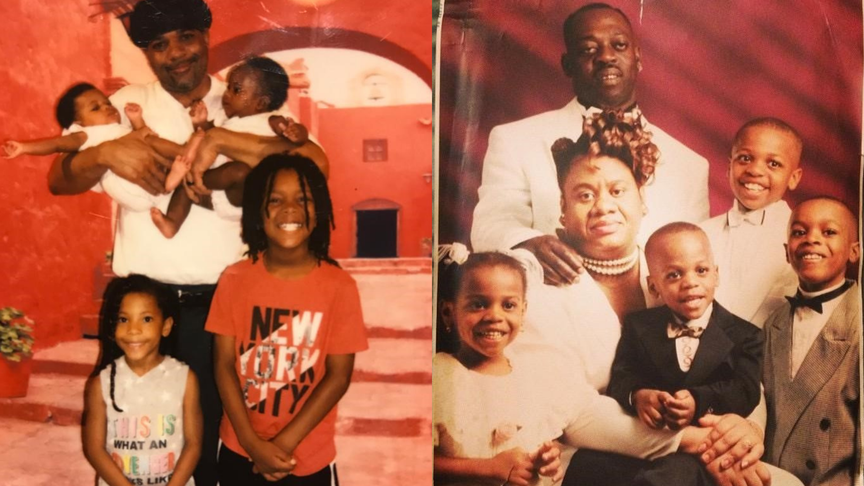
42/ From there, Leventhal rose to become Chief of the Homicide Trial Bureau. Just 4 months into his promotion, an appellate court reversed one of his convictions in an attempted murder case, citing “repeated instances of prosecutorial misconduct."
43/ But Queens DA Richard Brown allowed Leventhal to continue supervising junior prosecutors’ cases, several of which also resulted in misconduct findings. The veteran prosecutor on Bell's case, Charles Testagrossa, also continued to earn promotions.
44/ Testagrossa became an executive in the Queens DA's Office, then took another executive position in the Nassau County DA's Office. As the prosecutors climbed the career ladder, George Bell tried to find his own way forward in prison.
45/ He had to give up his dreams of a musical career. Survival was now his main goal. “Everybody wakes up in there every day, they just say, ‘Ok from sunup to sundown, let me just make it out of my cell or make it back,’” he says.
46/ After his sentencing, Bell’s mother vowed she would stick by him, but she worried he would not be strong enough to survive prison. But Bell says his amiable disposition, which his family fretted over, proved to be a survival skill.
47/ “They say sometimes when you’re in prison, the weak doesn’t survive, and in a sense that’s true. But sometimes to be a strong person doesn’t mean you have to do physical or heinous acts," he said. "Sometimes being strong could just mean just walking with an upstanding manner"
48/ Despite his life sentence, Bell found ways to move forward. He became a power-lifting trainer, completed his G.E.D., and eventually received a degree in Family Law from Lehman College.
49/ His resolve was strengthened by visits from his family. Lance Bell, George’s younger brother, has childhood memories of visiting prison: his older brother coming into the visitors’ room beaming and asking him about how school was going.
50/ But then, he says, towards the end of each visit, the mood would change. As they got their last drinks and sandwiches from the vending machines, the younger brother would start crying, wondering why his older brother George was not coming back to Queens with them.
51/ As he got older, Lance Bell says, his older sibling tried to maintain their relationship. He encouraged Lance's interest in poetry and would share his own rhymes from prison, even performing them through the phone.
52/ The younger Bell says it took years for him to appreciate how motivated his brother was to fight in his case: “He was in that law library studying the law, don’t know nothing about the law, don’t know nothing about anything that had to do with courts."
53/ But not everything on the outside was in his control. The Queens DA continued to deny it had anything to disclose. Meanwhile, DA Richard Brown continued to lead the office, where he refused calls to form a conviction integrity unit unlike many of his peers across the country.
54/ The grandmother Bell lived and grew up with in Corona passed away. He attended her funeral in shackles and was not allowed to stand close to his family.
55/ His little brother Lance was now grown up. Between his job as a construction driver in Brooklyn and the two kids he had to look after, he had less time to give George.
56/ Finally, 2 decades after he went to prison, Bell’s attorneys got a break. In response to a wrongful conviction challenge in another case, the Queens DA unwittingly disclosed two police reports which revealed they had been sitting on evidence favorable to Bell the whole time.
57/ Specifically, the evidence tying suspects from the Speed Stick gang to the check-cashing store murders for which Bell, Johnson and Bolt were now serving time.
58/ Earlier the same year, Queens' longstanding DA Richard Brown had passed away. Attorneys for Bell, Johnson and Bolt waited till a new DA took office in 2020. It turned out to be Melinda Katz, who ran on a reform campaign and promised to create a Conviction Integrity Unit.
59/ The men's attorneys then submitted a request that the convictions be overturned. Katz’s new unit began a review, which turned up many more undisclosed records, including Testagrossa’s handwritten notes implicating a Speed Stick member in the check-cashing store robbery.
60/ After many months, and some back-door lobbying to the DA's office (credit to @DavidFBrand's reporting), Katz, who had kept on many office veterans including Brad Leventhal, eventually agreed to vacate the convictions.
queenseagle.com/all/behind-the…
queenseagle.com/all/behind-the…
61/ Queens Judge Joseph Zayas also agreed and went further than Katz. He said the prosecution team “completely abdicated its truth-seeking role" and found that they had "hid evidence" and hid "the truth."
62/ In the aftermath of his blistering decision, Bell's prosecutors, Charles Testagrossa and Brad Leventhal, resigned. The decision also meant that Bell, Bolt, and Johnson would finally after two decades be released to their families.
63/ Bell remembers being taken downstairs by guards and chuckling as he examined the bag he had been sent with a suit inside for him to put on.
64/ “The officer was looking at me and I couldn’t even open up the bag because the bag looked so different from what I'm used to using all the time. And I just sat back and I just kept laughing myself,” he said.
65/ After putting his black jacket and dress pants on, Bell followed the guards to the entrance with Johnson and Bolt. For the first time in two decades he could now walk forward without anyone there to tell him otherwise.
66/ “When I finally got a chance to take a walk, I just felt like all the emotional stress, the shackles that I had on me,” he says. “It's like each step that I took, every shackle and things that I went through was falling down and leaving a dirty path behind me.”
67/ As he stepped outside, Bell remembers looking up at the sky, which was clear and blue outside the Green Haven Correctional Facility that day. “I felt so at peace that day,” he says. “God was shining down on me. And I said to myself, ‘Brother. you made it.’”
68/ Bell’s “strange odyssey,” as he calls it, is not yet over. District Attorney Katz says her investigation into the case is ongoing. She has until June 4th to decide whether to retry the case or drop the indictments against the three men.
69/ Then there is the question of what happens to the trial prosecutors, Brad Leventhal and Charles Testagrossa, who both resigned following the conviction vacations.
70/ In court, the Queens DA has said Testagrossa and Leventhal's false denials blocking the defense from learning about the alternative suspects were made in “good faith.” And thus far, Katz has not acceded to public calls for a review of their other cases and convictions.
71/ @charleslinehan, a former Manhattan prosecutor who investigated the case for Bell’s team, says even if they were initially in the dark about the alternative suspects, once the defense repeatedly asked about it at trial, they had an obligation to seek and then tell the truth.
72/ “And as a prosecutor and an officer of the court, you can’t just make stuff up. It has to be grounded in the truth, especially where your representations are relied upon by the court. Here, they had the effect of sending a man to prison for a crime he didn’t commit," he says.
73/ Queens Councilmember @IDaneekMiller says DA Katz needs to review these prosecutors' other cases. He believes a review could call decades of work into question. “You'll see that this is just a pattern of how they do business. Right?” he said. “That they create cases.”
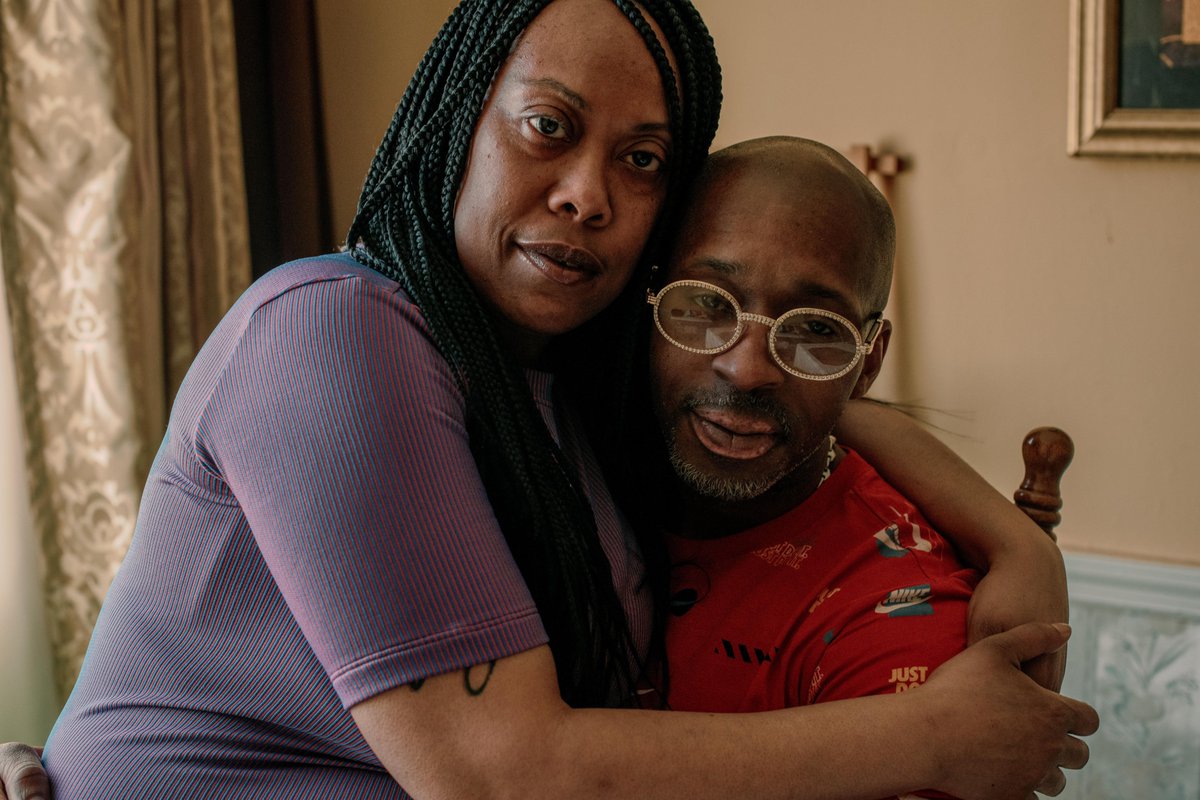
74/ George Bell did not return to Corona, Queens after his release. He is now living on Long Island with his fiancée, Burnette Nay Green. The two first started dating in high school and stayed in touch throughout his time in prison.
75/ If Melinda Katz dismisses his indictment in June, Bell hopes to start a career in public speaking and criminal justice reform. He is also looking forward to starting a family of his own.
• • •
Missing some Tweet in this thread? You can try to
force a refresh


