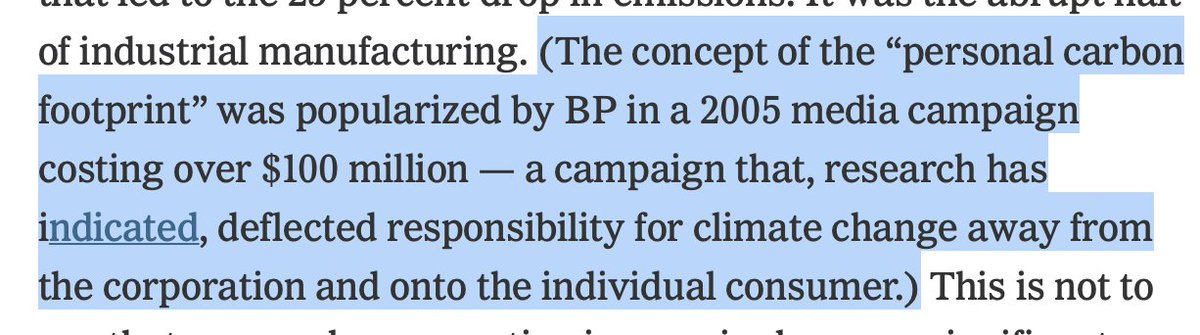
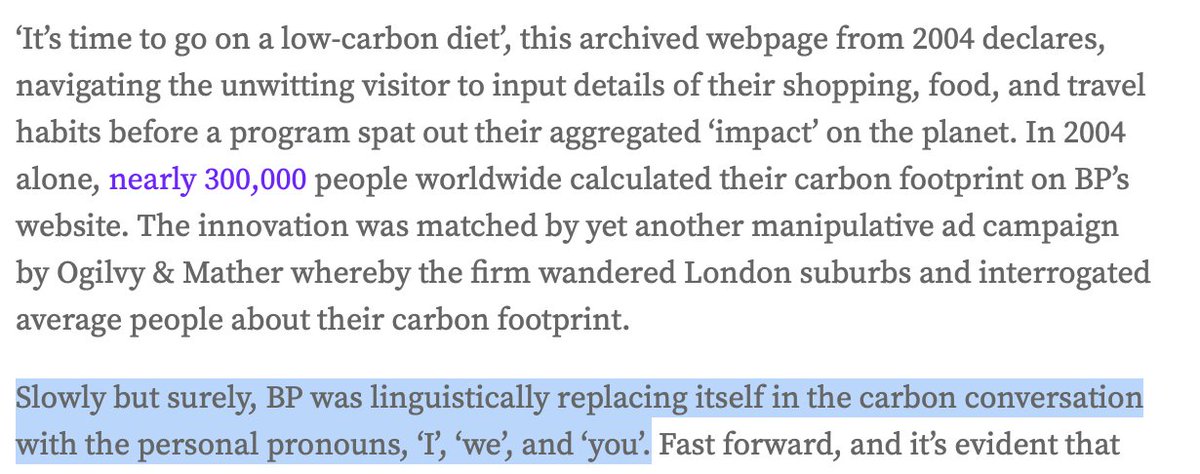
Here's your reminder that the whole idea of a personal carbon footprint was a targeted BP media campaign in 2005 and it worked so well that it seems like we've all forgotten this researchgate.net/publication/30…
"These patterns mimic the tobacco industry's documented strategy of shifting responsibility away from corporations—which knowingly sold a deadly product while denying its harms—and onto consumers." cell.com/one-earth/full…
• • •
Missing some Tweet in this thread? You can try to
force a refresh

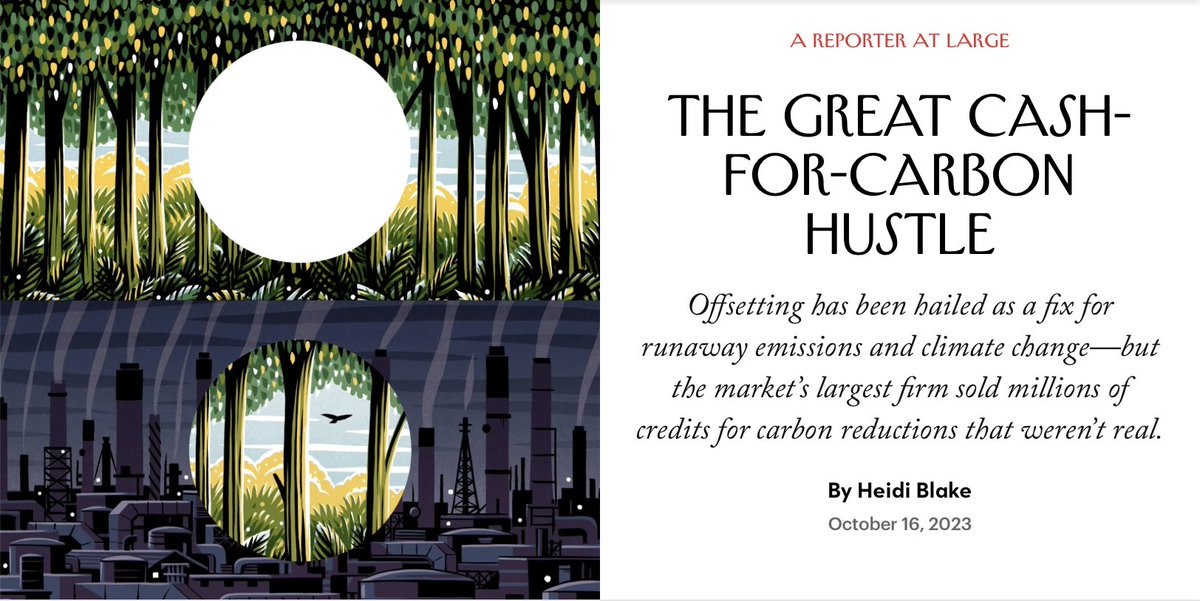
1/ A lot to learn from this story, including some interesting carbon market history on how the Kyoto Protocol laid a (fundamentally flawed) foundation for voluntary carbon markets.
The structural problem is simple: the business model of traditional offsets is false equivalency.
The role of carbon markets should be to enable payment for the service of directly removing carbon: actually touching the carbon cycle. The sketchy accounting and tactics described here are made possible by paying for something very abstracted from the underlying carbon cycle.
False equivalency is the load-bearing lie that breaks the system. Much of what's been sold as an environmental benefit is worthless or damaging, but the traditional carbon brokers and registries can't acknowledge that: doing so would remove their justification for existence.
An idea re carbon removal MRV: the community is confused right now partly because there's no market-legible price of MRV that expresses the uncertainty of a given approach as an actual dollar amount.
Breaking out the MRV "cost" from the removal price might be a good step.
Doing this would enable the MRV itself to have a initial price and (hopefully) a cost curve that can (and will!) move based on different factors than the "bundled" CDR price that's reported today.
Then, we as a community can focus on bringing MRV itself down the cost curve.
This could create a more honest stratification between "closed systems" like DAC where MRV looks like "put a meter on a CO2 pipe" and "open systems" like enhanced weathering or ocean akalinity enhancement which require baselining and modeling of a differential between (cont..)
A weird property of the frontier: finding the edge forces a realization that there’s very few people there, the others who’ve found it are tightly clustered and therefore quite happy to see you, and you all can’t help but ask “where is everybody?” in escalating confusion
This, combined with the fact that the distance to the frontier is surprisingly short, is a giant mindwarp that might be the strangest thing so far in learning about climate
Anyone have similar experiences in other fields? It’s been difficult for me to articulate
Erika's thread is excellent -- she's one of few who's seen this in multiple fields (and has shaped a lot of my thinking on it!)
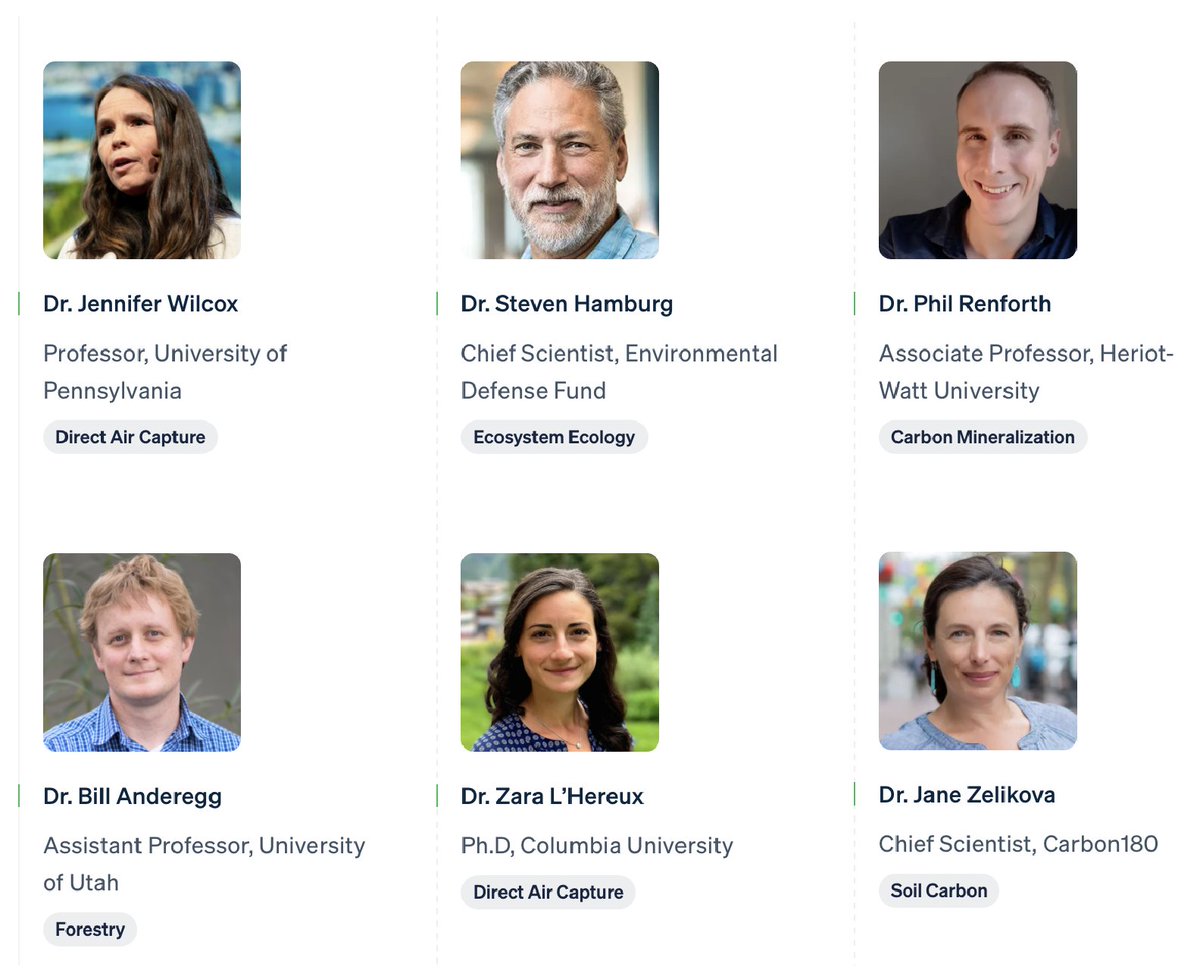
When we made our first carbon removal purchases earlier this year with the help of our scientific advisors (stripe.com/blog/first-neg…), we asked carbon removal projects what one thing would most supercharge their progress. The vast majority listed “recurring demand”.
Without a committed purchaser, these approaches *won’t magically get cheaper*. In the absence of gigaton-scale federal carbon removal procurement, private companies must step up to help these technologies scale.
1/ This field is diverse, approaches vary from reforestation and improving soil carbon storage to direct air capture, and speeding up the earth’s natural weathering process.
Basically, there are a handful of ways to take CO₂ out of the air and a handful of places to put it.
2/ As we met projects and learned more, one thing became clear: while solutions that store carbon in the biosphere are necessary and important, they won’t be sufficient on their own to remove as much CO₂ as we’ll need to.