1/ The average American adult has 16 friends, recent polling showed. Only eight are people they would actually hang out with one-on-one. Just three are “friends for life.”

So how can you find true and lasting friendships? @arthurbrooks explains:
theatlantic.com/family/archive…

2/ First, think about what function your friendships perform. Who are your work friends? Who are the people you hang out with because you just enjoy their company? Is there anyone you spend time with for no reason at all?
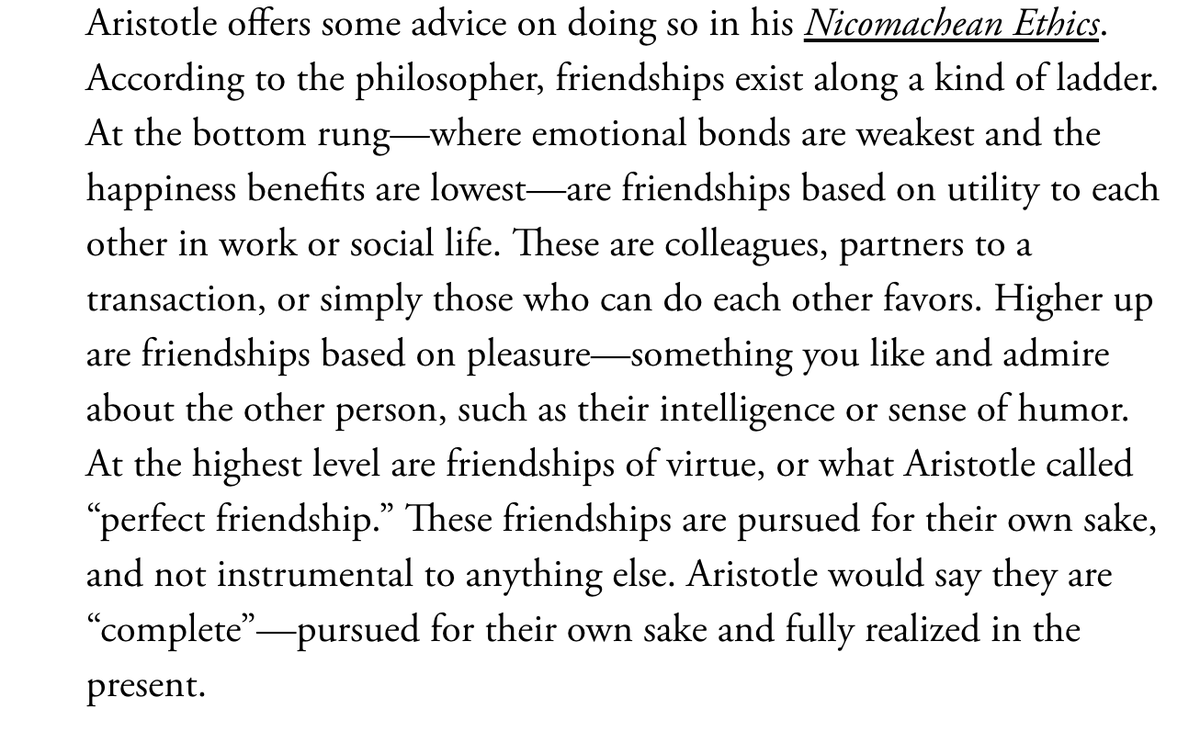
3/ If it feels like no one really knows you well, you can take a few steps, @arthurbrooks writes. Have deeper conversations with your existing friends. Show up at places unrelated to your worldly ambitions. Strike up a friendship with someone who can do nothing for you.
4/ Our most transcendental need is for people who, in a worldly sense, we do not need at all, @arthurbrooks writes. If you are lucky, and do the work, you’ll find that you have a real friend or two to whom you can pay the highest compliment: “I don’t need you—I simply love you.”
5/ How many friends for life do you have?
6/ Who are the friends you value most? What makes them good friends?
7/7 Want to hear more from @arthurbrooks and other experts about what it takes to be happy? On May 20, join Atlantic staff and special guests for a daylong exploration of the pursuit of happiness. Register here: pursuitofhappiness.theatlantic.com/?utm_medium=so…

• • •

Missing some Tweet in this thread? You can try to force a refresh
 

Keep Current with The Atlantic

The Atlantic Profile picture

Stay in touch and get notified when new unrolls are available from this author!

Read all threads

This Thread may be Removed Anytime!

PDF

Twitter may remove this content at anytime! Save it as PDF for later use!

Try unrolling a thread yourself!

how to unroll video
  1. Follow @ThreadReaderApp to mention us!

  2. From a Twitter thread mention us with a keyword "unroll"
@threadreaderapp unroll

Practice here first or read more on our help page!

More from @TheAtlantic

11 Mar
1/8 In our April 2021 cover story, @caitlinpacific picks apart the features of private schools that help breed entitlement and entrench inequality: theatlantic.com/magazine/archi…
2/8 “The inescapable truth is that money guides all sorts of decisions at these schools,” @caitlinpacific writes. Private-school parents are “consumers of a luxury product.” theatlantic.com/magazine/archi…
3/8 Surely there should be something to show for a $50,000-a-year education: “Parents want teachers, coaches, and counselors entirely focused on helping them create a transcript that Harvard can’t resist.” theatlantic.com/magazine/archi…
Read 8 tweets
4 Mar
1/ With AI, China’s government could soon achieve an unprecedented political stronghold on more than 1 billion people, @andersen reports. (From 2020) theatlantic.com/magazine/archi…
2/ The emergence of an AI-powered authoritarian bloc led by China could warp the geopolitics of this century. It could prevent billions of people, across large swaths of the globe, from ever securing any measure of political freedom. theatlantic.com/magazine/archi…
3/ The Uighur population has already been denied such freedom.

In 2014, more than 1 million Uighurs were forced into concentration camps. Those who were spared the camps now make up the most intensely surveilled population on Earth.
Read 8 tweets
28 Feb
1/ The Golden Globes are tonight. Before the show, go behind the scenes of some of this evening’s nominees:
2/ The original screenplay for “Mank,” which leads tonight’s nominations, was written by David Fincher’s father and took nearly 30 years to make into a feature film. Read more from David Sims: theatlantic.com/culture/archiv…
3/ The titular character in “Ted Lasso,” up for Best TV Comedy or Musical, is based on a 2013 NBC Sports Network promotion. Read Megan Garber on why the character exemplifies what it means to fail up: theatlantic.com/culture/archiv…
Read 6 tweets
2 Feb
1/ One hundred ninety-three people have been charged in connection with the Capitol riot. Robert A. Pape and Keven Ruby, of the Chicago Project on Security and Threats, reviewed court documents and media coverage of the arrestees. Four findings stand out: theatlantic.com/ideas/archive/…
2/ First, they write, the attack on the Capitol was unmistakably an act of political violence, not merely an exercise in vandalism or trespassing amid a disorderly protest that had spiraled out of control.
3/ Second, a large majority of suspects in the Capitol riot have no connection to existing far-right militias, white-nationalist gangs, or other established violent organizations.
Read 6 tweets
31 Dec 20
1/ Our understanding of COVID-19, its long-term health effects, and how to curb its spread have evolved and advanced since the virus first began to spread across U.S. communities early this year.

Here’s a look at the key moments of the pandemic:
2/ In February, @jameshamblin wrote that the coronavirus was likely to be widespread: “COVID-19 must be seen as everyone’s problem.”

“I think a lot of people thought the article was sensationalism,” Hamblin says now. “I wish it had turned out to be.”
theatlantic.com/health/archive…
3/ Before disruptions to daily life became widespread in March, @juliettekayyem warned that the United States was far less prepared for a pandemic than other democratic nations experiencing outbreaks of the novel coronavirus. theatlantic.com/ideas/archive/…
Read 10 tweets
11 Dec 20
1/ This is the worst week of the pandemic yet. The United States set records in all three metrics that gauge severity, including a total of 1.4 million new cases and 15,966 deaths as of Wednesday. And it could get worse, writes @COVID19Tracking. theatlantic.com/health/archive…
2/ The virus has torn through long-term-care facilities. The number of deaths jumped 27 percent the week of December 3. States reported the highest number of new cases—51,574—in these facilities since @COVID19Tracking started collecting these data in May: theatlantic.com/health/archive…
3/ As COVID-19 has overwhelmed hospitals, the lack of clear bioethical guidelines has forced doctors to make wrenching life-and-death decisions on the fly. The result has been chaos and unnecessary suffering, @jordan_kisner writes.
theatlantic.com/magazine/archi…
Read 7 tweets

Did Thread Reader help you today?

Support us! We are indie developers!


This site is made by just two indie developers on a laptop doing marketing, support and development! Read more about the story.

Become a Premium Member ($3/month or $30/year) and get exclusive features!

Become Premium

Too expensive? Make a small donation by buying us coffee ($5) or help with server cost ($10)

Donate via Paypal Become our Patreon

Thank you for your support!

Follow Us on Twitter!