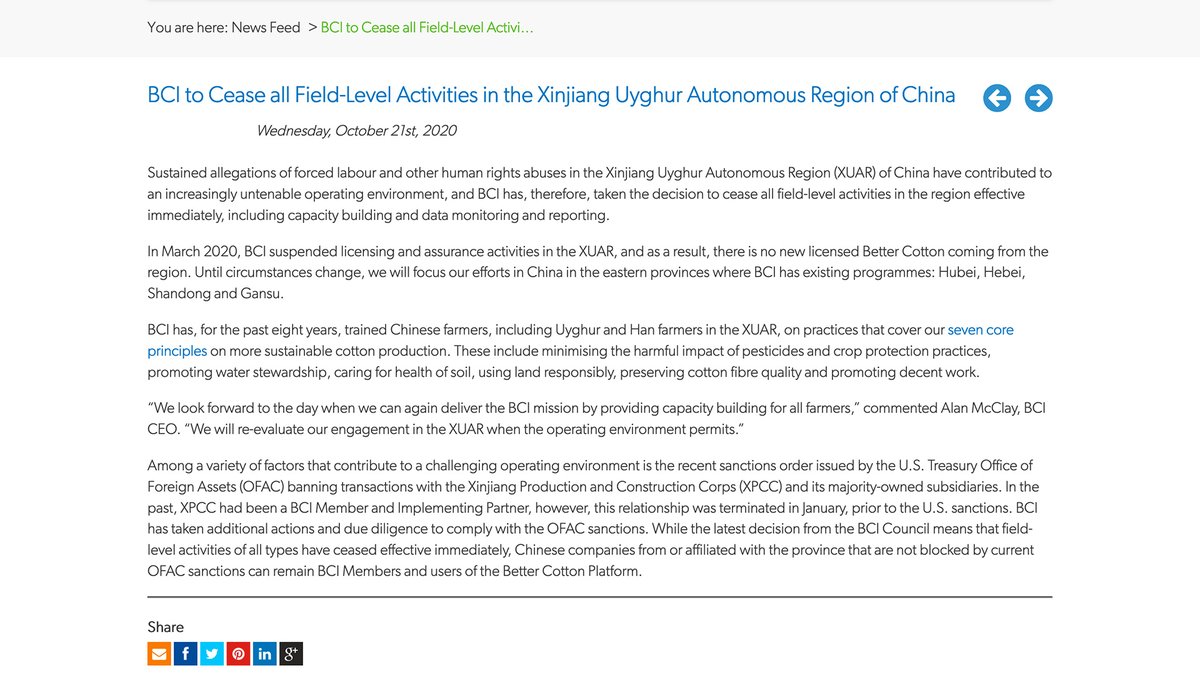
"We will not be providing input on this at the moment," BCI spokesperson Joe Woodruff told me in an email.
When I sent him a follow-up email asking if BCI believed there was forced labor in Xinjiang cotton, and if BCI would resume operations there, he did not reply.
For more background on the BCI's operations in Xinjiang, read my article from January.
Of note: Until Oct 2019, BCI had an XPCC affiliate as one of its official implementing partners.
XPCC now under US and EU sanctions for complicity in forced labor.
New: I interviewed Lithuania's deputy foreign affairs minister Mantas Adomėnas about withdrawing from the China-led 17+1 summit. He said the 17+1 was "always on the initiative and terms and agenda proposed by China" and lacked "mutuality."
Adoménas also criticized China's refusal to allow the 17+1 to discuss human rights, and he is opposed to China's insistence on separating economics/development discussions from human rights.
Adoménas cast China's rise & the pressure it puts on global democratic institutions as a near-existential struggle for Lithuania.
"As Lithuanians, we see our survival as conditional on the international order based on the rule of law and seeking for the increase of democracy."
This is why the question “why don’t Muslims care about what’s happening to the Uighurs” often bothers me. It depends who is asking and why. I’ve seen this question asked too many times by people whose implicit answer is “because Muslims are subhuman.”
(The answer to the question is that Muslims who know about Uighur repression do care! And those who live in countries with political freedoms show it through their speech and actions).
The useful question to be asking is, why doesn’t the Saudi government et al criticize China for its Muslim genocide? The answer is that autocratic governments of Muslim-majority populations pretty much all have close ties to the Chinese govt.
NEW SCOOP from @zachsdorfman: China's Ministry of State Security has demanded that private Chinese companies, including Baidu and Alibaba, help them process stolen U.S. data, such as from the OPM hack, U.S. intelligence officials believe.
Zach writes, "In what amounts to intelligence tasking, China’s spy services order private Chinese companies with big-data analytics capabilities to process massive sets of information that have intelligence value, according to current and former officials."
“Just imagine on any given day, if NSA and CIA are collecting information, say, on the [Chinese military], and we could bring back seven, eight, 10, 15 petabytes of data, give it to Google or Amazon or Microsoft, and say, ‘Hey, we want all these analytics," said one official.
Aaron Shen (沈岳 in Chinese) sent me a request to connect on LinkedIn. He claimed to be the assistant director of international liaison at the China Center for Contemporary World Studies — the in-house think tank of the International Department of the Chinese Communist.
He and I exchanged messages for a couple of weeks. During that time, I saw his list of LinkedIn contacts grow from 55 to 72. The list included political risk analysts, a current U.S. Defense Department employee, a top exec at the US-China Business Council, and similar people.
HUGE scoop from @zachsdorfman: Remember how people speculated that China's hack of the Office of Personnel Management might allow China to identify and track CIA operatives abroad?
Starting around 2013, one year after the US govt became aware of the OPM hack, the CIA became aware that undercover CIA personnel, flying into countries in Africa and Europe for sensitive work, were being rapidly and successfully identified by Chinese intelligence.
U.S. officials believed Chinese intelligence operatives had likely combed through and synthesized information from these massive, stolen caches to identify the undercover U.S. intelligence officials, @zachsdorfman reports.
The suspected operative, a Chinese national named Christine Fang, enrolled as a student at Cal State East Bay in 2011.
Fang’s friends and acquaintances said she was in her late 20s or early 30s, though she looked younger and blended in well with the undergraduate population.
She was the president of the Chinese Student Association and the campus chapter of APAPA, an Asian American civic organization. She was really, really good at running these clubs, and held a flurry of events that raised their profile -- and hers.