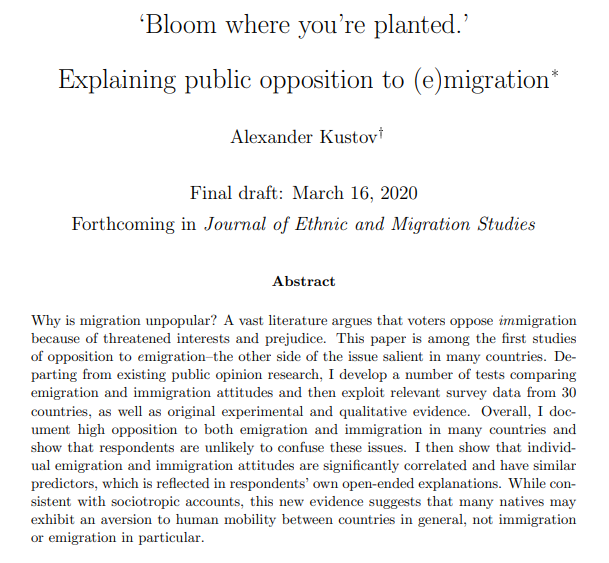
Our paper (w @laaker_dillon/@CassidyReller) documenting the remarkable stability of individual immigration attitudes is forthcoming @The_JOP! This is perhaps the research I'm most proud of, both in terms of the amount of work involved and its implications papers.ssrn.com/sol3/papers.cf…
Why is it important to know whether attitudes are stable? Any understanding of immigration politics must make an assumption about the underlying stability of people's preferences, but the evidence so far has been rather inconclusive 
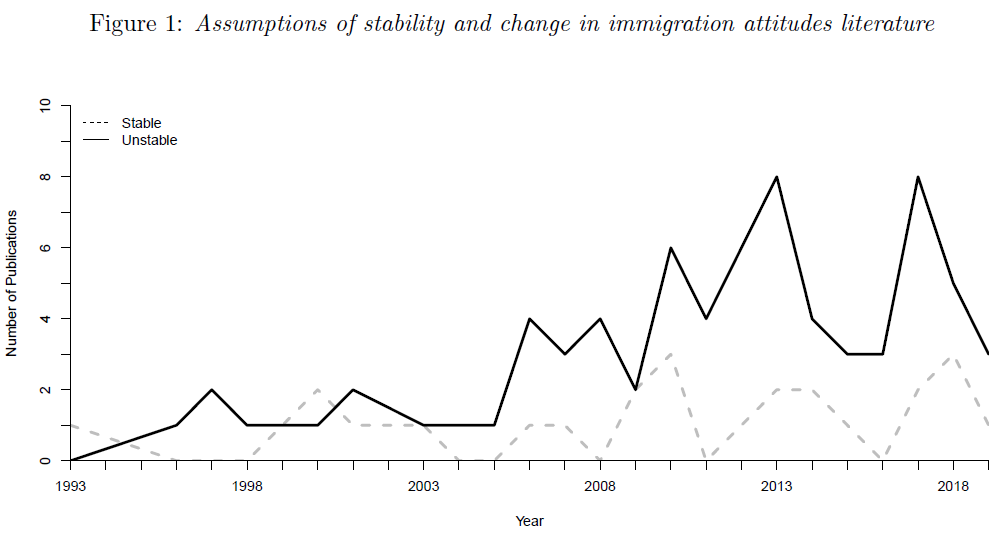
Empirically, our findings generalize recent studies that show information cues, refugee crises, and economic shocks often do not substantially affect individual immigration preferences (incl. the excellent work by @MigrationNerd, @dhopkins1776, @johnmsides and others)
Importantly, these results indicate that changing immigration attitudes cannot explain the recent rise of populist parties. Rather than changing immigration preferences, exogenous shocks such as a refugee crisis may simply increase the issue importance of immigration to voters
While our main contribution is the use of longitudinal data, our conclusions are in line with the previous great work based on (repeated) cross-sections by @AndrewPGeddes & @JamesRDennison who explicitly connect populist voting to immigration salience doi.org/10.1111/1467-9…
Of course, there are many high-quality studies finding that some shocks can change people's mind on immigration (incl. my own work!).
But as panel data show, these changes are small (esp. after considering measurement error) & people often revert back to their initial positions
But as panel data show, these changes are small (esp. after considering measurement error) & people often revert back to their initial positions

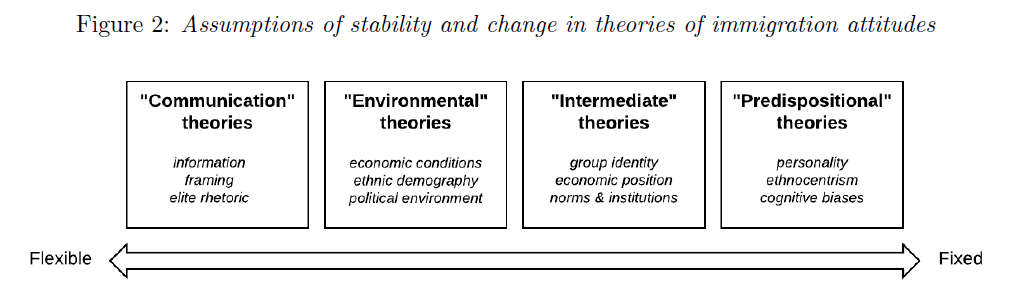
In other words, our analysis highlights the importance of specifying & testing the lasting temporal implications of existing immigration theories, including those based on economic & non-economic causes (incl. informational, environmental, demographic, & institutional vars.)
More practically, we identify all major publicly available high-quality panel surveys with migration items. While panel data is still underused in the field, we hope our work will help more migration scholars to theorize/examine both temporal & cross-sectional opinion differences
• • •
Missing some Tweet in this thread? You can try to
force a refresh