
0/ $BNB and $FTT have had a phenomenal price run this year, outperforming DEX tokens like $UNI and $SUSHI.
In my latest report for @Delphi_Digital , I looked at the functionalities and value accrual mechanisms across a few exchange tokens.
delphidigital.io/reports/exchan…
In my latest report for @Delphi_Digital , I looked at the functionalities and value accrual mechanisms across a few exchange tokens.
delphidigital.io/reports/exchan…
1/ Token Utility: @binance and @HuobiGlobal , the two largest exchanges by volume, have launched EVM-compatible public blockchains for dapps while $FTT's use case is primarily confined to its centralized @FTX_Official's platform.
2/ All 3 CEX tokens employ a discount token model, which entitles holders of $BNB, $FTT, $HT to trading discounts based upon the number of tokens they hold and volume traded.
Check out some of the other benefits token holders receive 👇👇👇👇
Check out some of the other benefits token holders receive 👇👇👇👇
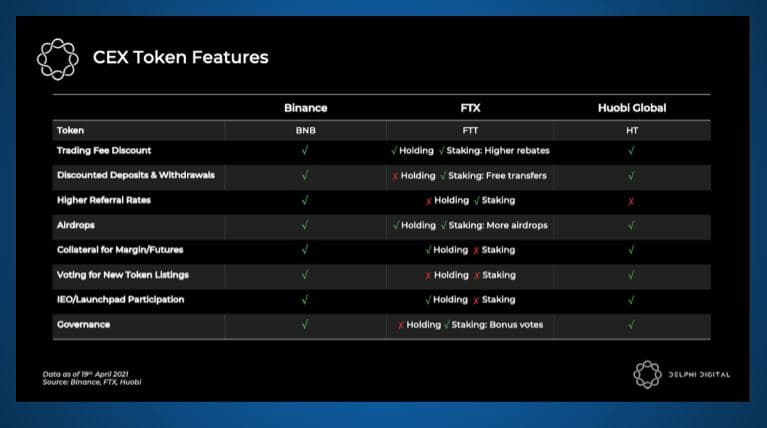
3/ Value Accrual: Exchange tokens have been evolving from the role of providing utility to incorporate more equity-like characteristics, like cash-flow based token burns. Linking the cash flow of the business to the token strengthens the token’s value accrual.
4/ However, unlike equity, tokens do not have ownership rights or legal rights to cash flows. CEXs may therefore have to juggle competing shareholder and token holder interests. 🧐🧐🧐
5/ DEXs do not share this problem because they are not owned by a centralized party, but by the network. For @SushiSwap and @0xProject, holders that stake their $SUSHI / $ZRX tokens are entitled to a share of the protocol's fees.
Another TLDR comparison of token econ here👇👇👇
Another TLDR comparison of token econ here👇👇👇

6/ Relative Valuations
I used a few ratios to compare the valuation across different exchange tokens. This is expanded upon in the full report.
Note: Refer to main report for assumptions made
I used a few ratios to compare the valuation across different exchange tokens. This is expanded upon in the full report.
Note: Refer to main report for assumptions made

7/ If you aren't a member already, subscribe below!!!
delphidigital.io/subscription-p…
As always, none of this is investment advice :)
delphidigital.io/subscription-p…
As always, none of this is investment advice :)
• • •
Missing some Tweet in this thread? You can try to
force a refresh