In a new working paper, @ellliottt, @matteopins, @sergallet, and I examine the role of Fox News Channel on U.S. Elections. We show that Fox has helped Republican candidates in elections across levels of U.S. government over the past decade. papers.ssrn.com/sol3/papers.cf…
To approximate a natural experiment where some counties are randomly exposed to more Fox News, we focus on variation in the channel number -- i.e., when it has a lower number (e.g. 20), people watch Fox more often than when it has a higher channel number (e.g. 80).
Consistent with prior work on Fox News (e.g. @gregmartinphd), we find that Fox boosted Republicans in recent presidential elections. A one SD decrease in FNC channel position increased Trump's vote share by .6 percentage points in 2016/2020 (enough to tip several close states).
We also examine the effect of Fox on Senate, House, and governor elections. The effects in down-ballot elections are increasingly similar to those in presidential elections. These down-ballot effects likely reflect the growing nationalization of U.S. elections.
The uniformity of Fox New’s effect on elections across offices suggests that it is not simply influencing views about particular candidates. Instead, the mechanism for Fox's electoral effects appears to at least partially be that it is shifting American's Party ID & ideology.
Feedback welcome!
• • •
Missing some Tweet in this thread? You can try to
force a refresh

Dynamic Democracy is officially out today! In this book, @DevinCaughey and I show that state governments respond incrementally to public demands, with the effect that most state policies eventually fall into alignment with public opinion. (1/n) press.uchicago.edu/ucp/books/book…
We think that American democracy is far from perfect, and responsiveness can be painfully slow and halting, but over the long term the public exerts a powerful influence over government policies. (2/n)
In Chapters 2-3, we measure the ideological and partisan preferences of the mass public in each state over the past 85 years. We document how state partisanship has gradually aligned with state ideology, with the former largely following the latter. (3/n)
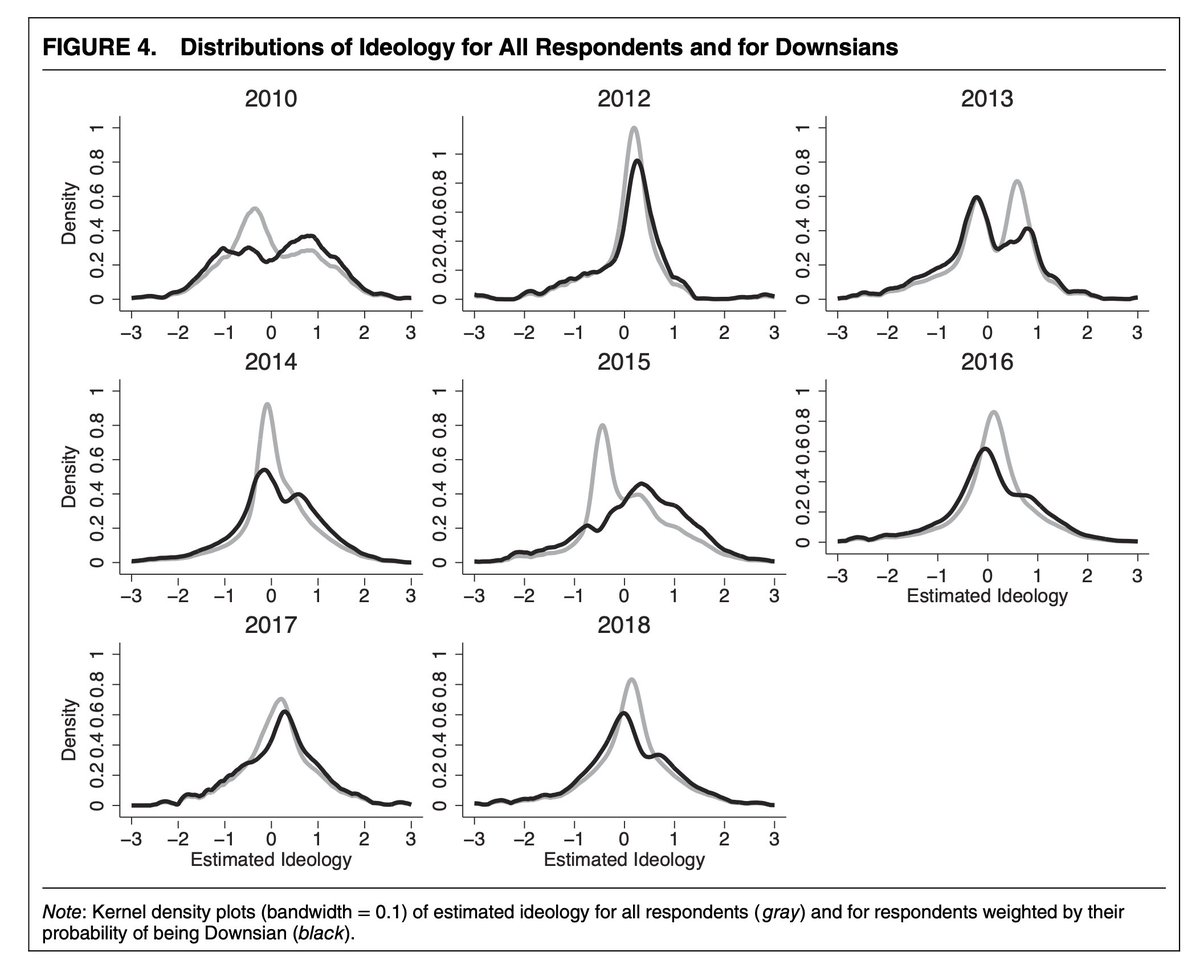
Our paper "Moderates" is out in FirstView in the @apsrjournal. We show that many Americans hold genuinely moderate policy positions. These voters are especially consequential for electoral selection and accountability.
In this paper, we develop a new measurement model to distinguish people having genuinely moderate views across issues, being inattentive to politics or political surveys, or holding views poorly summarized by a single liberal–conservative dimension.
We estimate that about 73% of CCES respondents have positions that are well described by a single spatial dimension. Many of these Americans have preferences near the political center.
Really enjoying listening to @joshclinton discuss the @AAPOR Task Force's preliminary findings on the performance of polls in the 2020 election.
Unlike in 2016, polling errors not driven by education weighting, late deciders, or likely voter models. The report strongly suggests partisan non-response within demographic strata is driving polling errors. Also could be partisan non-response concentrated among new-voters.
But the report also notes that polls that weighted on partisan didn't do much better than polls that did not. The explanation is probably that it's really hard to know population targets for partisanship. I.e., there's a reason surveys usually haven't weighted on partisanship.
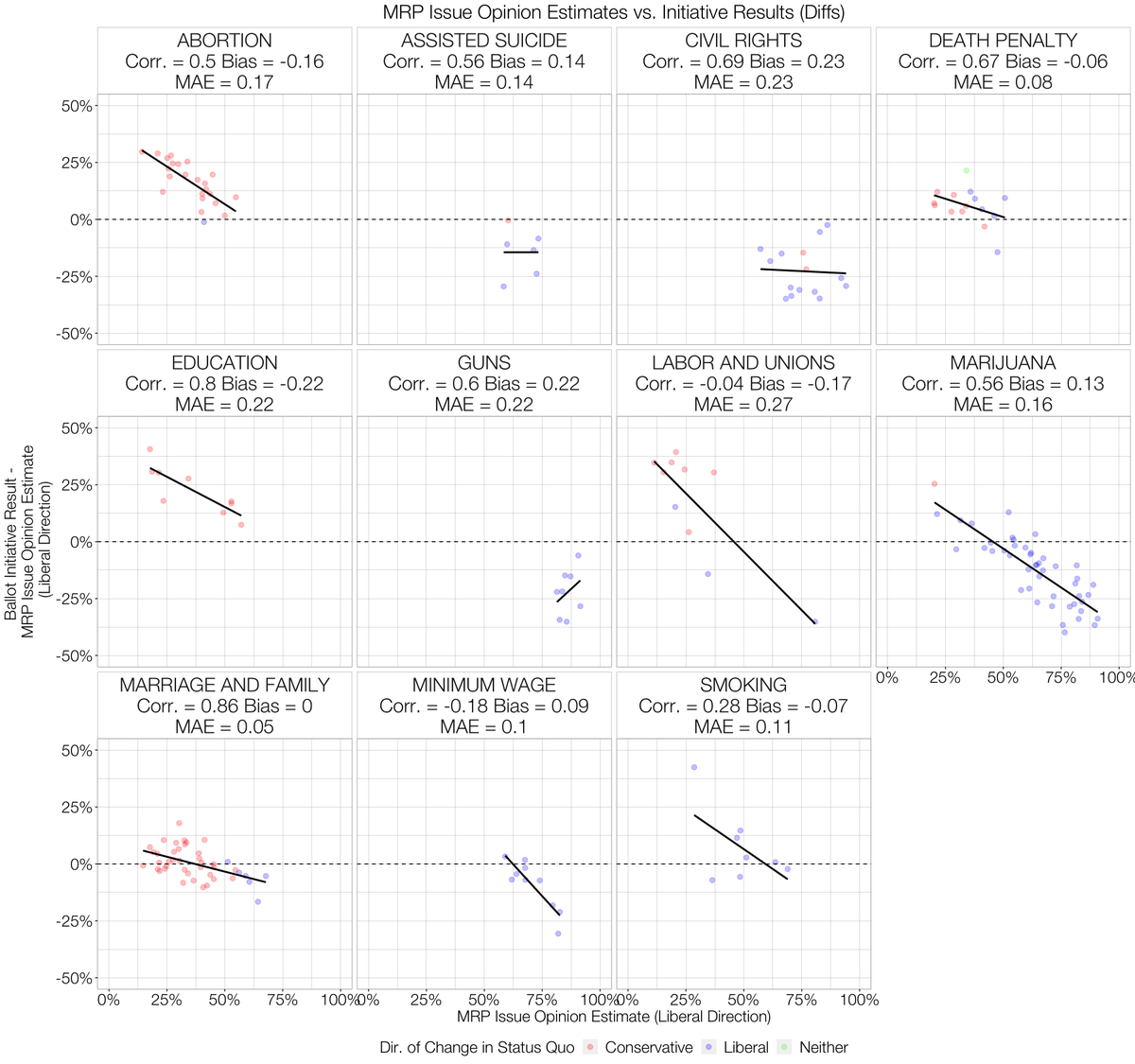
Excited to attend my first AAPOR conference. @jon_m_rob, @johnmsides, & I are presenting on link between ballot initiatives and poll-based estimates of public opinion. We think this both validates polls & shows important gaps between polls/initiatives. dropbox.com/s/zn2uf6kyv8id…
We paired estimates from dynamic-MRP models of issue opinions with 200 ballot initiative results in 11 areas, including marijuana, min. wage, same-sex marriage & guns. We found a strong correlation between mass opinion and initiatives at both global level and within most topics.
But both popular liberal and conservative policies tend to underperform at the ballot box. The reason appears to be that voters systematically prefer the "no" option on ballot initiatives. This status-quo bias tends to make most initiatives much closer than they look in polls.
Some quick high-level thoughts on the election: 1) WTF happened with the polls. This is a serious issue for our democracy that scholars across social sciences should work on addressing. Polls provide crucial information about the public's preferences and we need to get it right.
2) Elections are nationalizing (ht @dhopkins1776). But still lots of spread btw Pres/Downballot in some states - ME, MT, KS, NH, etc. Suggests moderation & candidate quality still net a few percentage points on margin. Just not enough for Dems to win in places like KS.
3) Gerrymandering is really, really bad. It's undermining the fabric of our democracy. GOP gerrymanders in places like MI, NC, and WI withstood a full decade of elections.