Bloomberg CityLab Profile picture
Apr 30, 2021 13 tweets 5 min read Read on X
1/ When people moved out of expensive cities, where did they go?

A year of migration data reveals trends and interesting surprises: bloom.bg/3xCC4YB
2/ After much speculation about emptied downtowns and the prospect of remote work, a year of @USPS data gives the clearest picture yet of how people moved.
3/ There is no urban exodus — perhaps it's more of an urban shuffle.

Despite talk of mass moves to Florida and Texas, data shows most people who did move stayed close to where they came from.
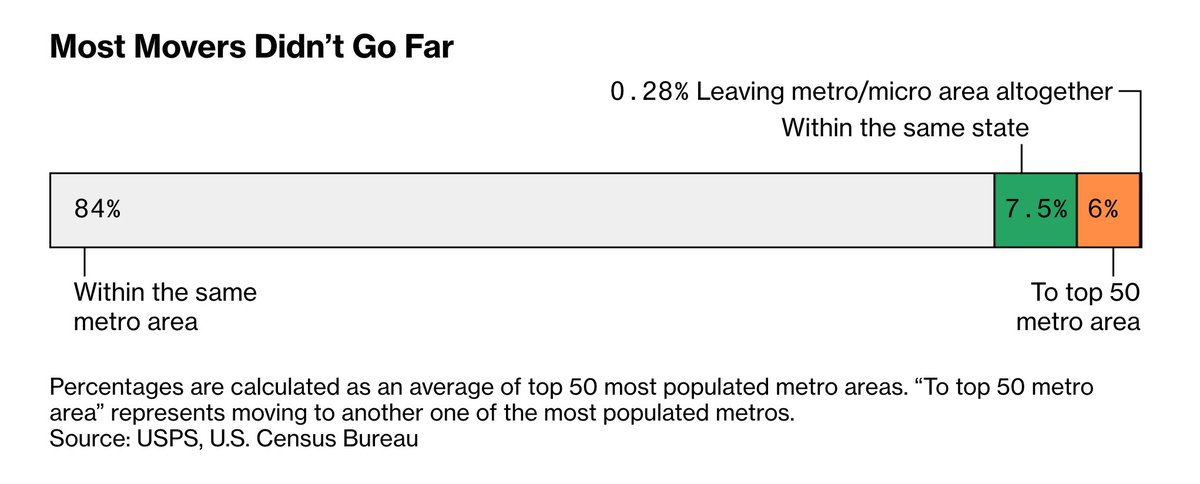
4/ Across the U.S., the number of people making moves that they defined as permanent was up a modest 3% between March 2020 and February 2021.

But zoom in to a few of America's densest and most expensive metro regions and the picture is more dramatic.
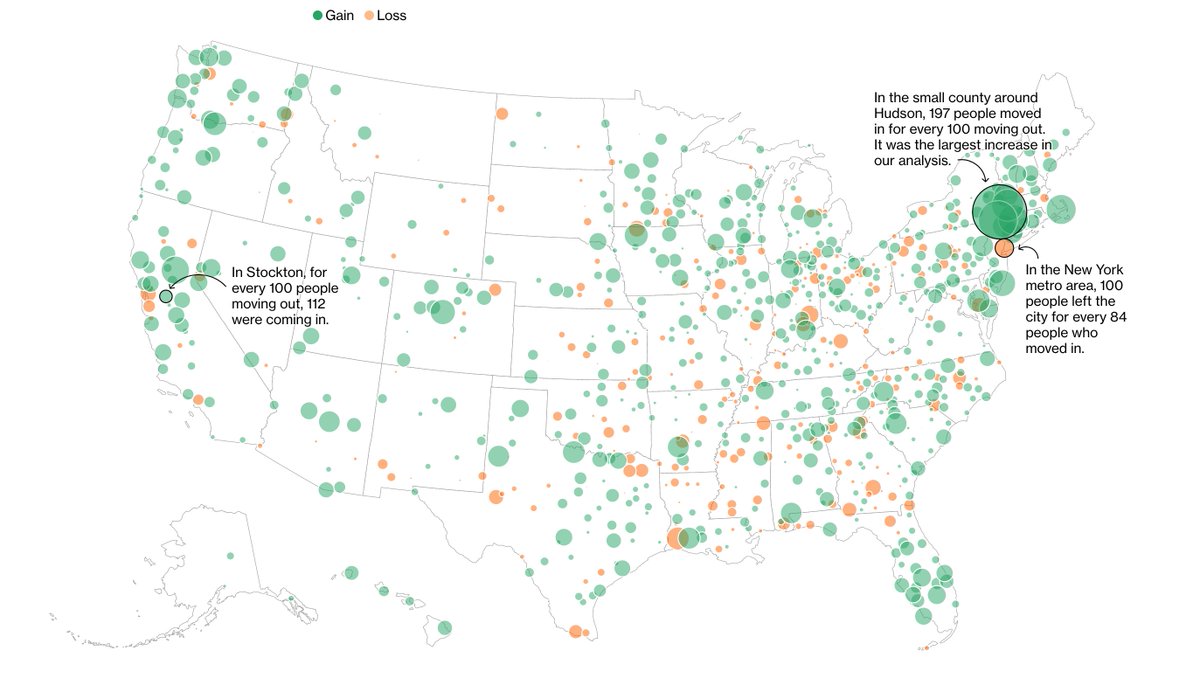
5/ "The phrase or the concept of urban exodus, that really only applies to New York and San Francisco," says Stephan D. Whitaker, a policy economist at the Federal Reserve Bank of Cleveland, who has been analyzing migration patterns during the pandemic.
6/ Those Americans who did move accelerated a trend that predates the pandemic: People moved outward.

Outward to the suburbs of their core metro area, but also farther out, to satellite cities or other major urban centers that might still give people proximity to their region.
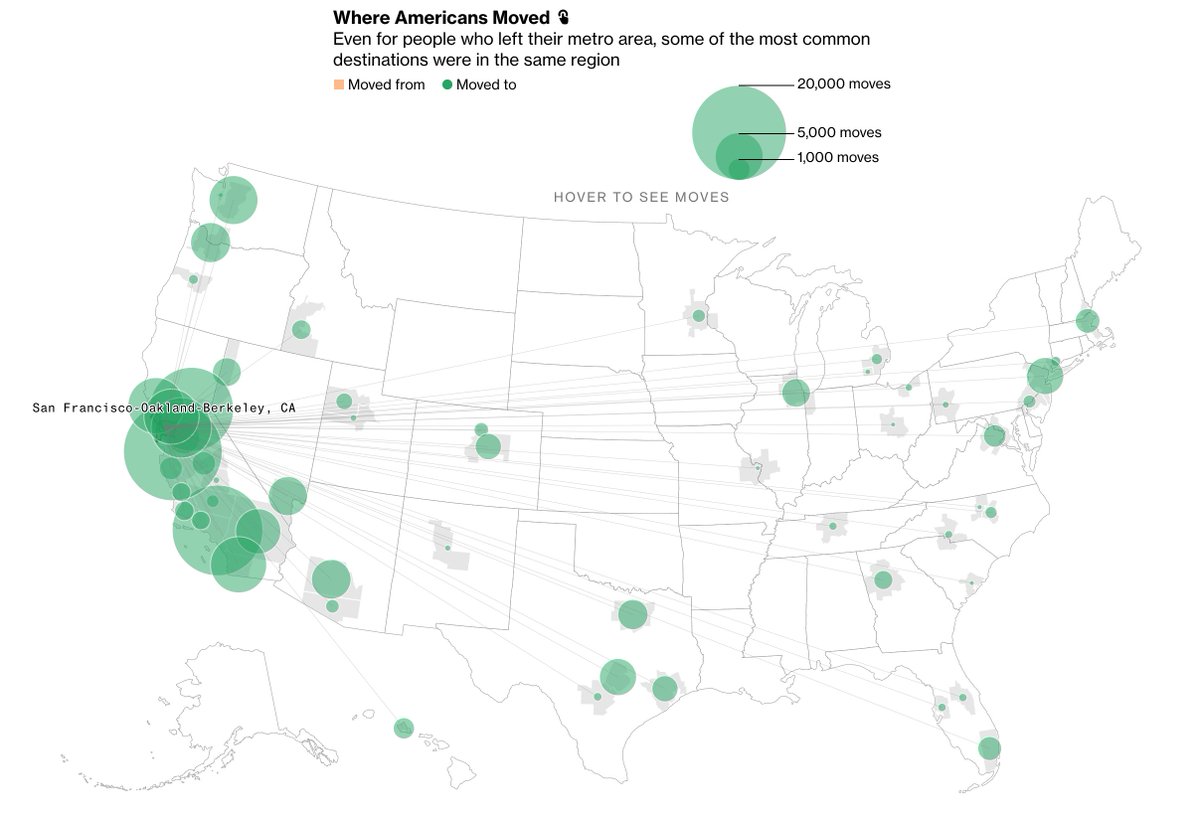
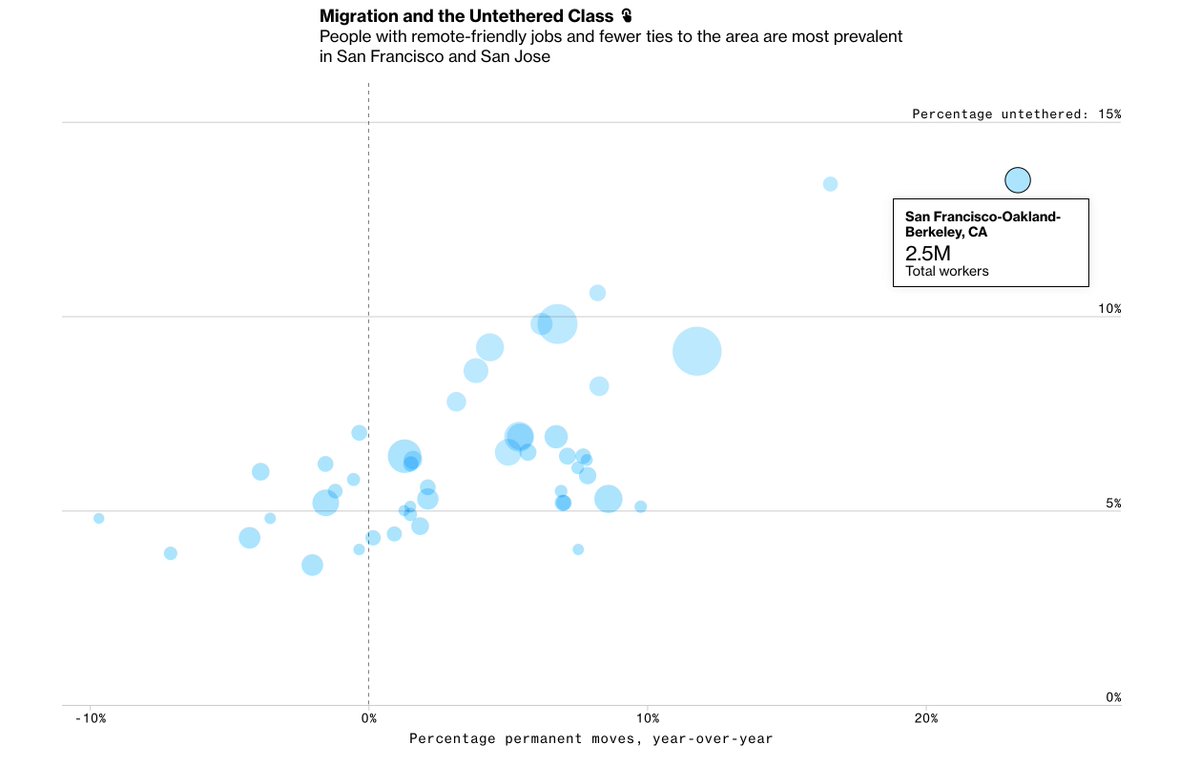
7/ The regions around San Francisco and San Jose, two of the country's most expensive housing markets, saw the greatest increase in rates of permanent moves.

And compared to other metros, a far greater percentage of people left the Bay Area — moving to other California cities.
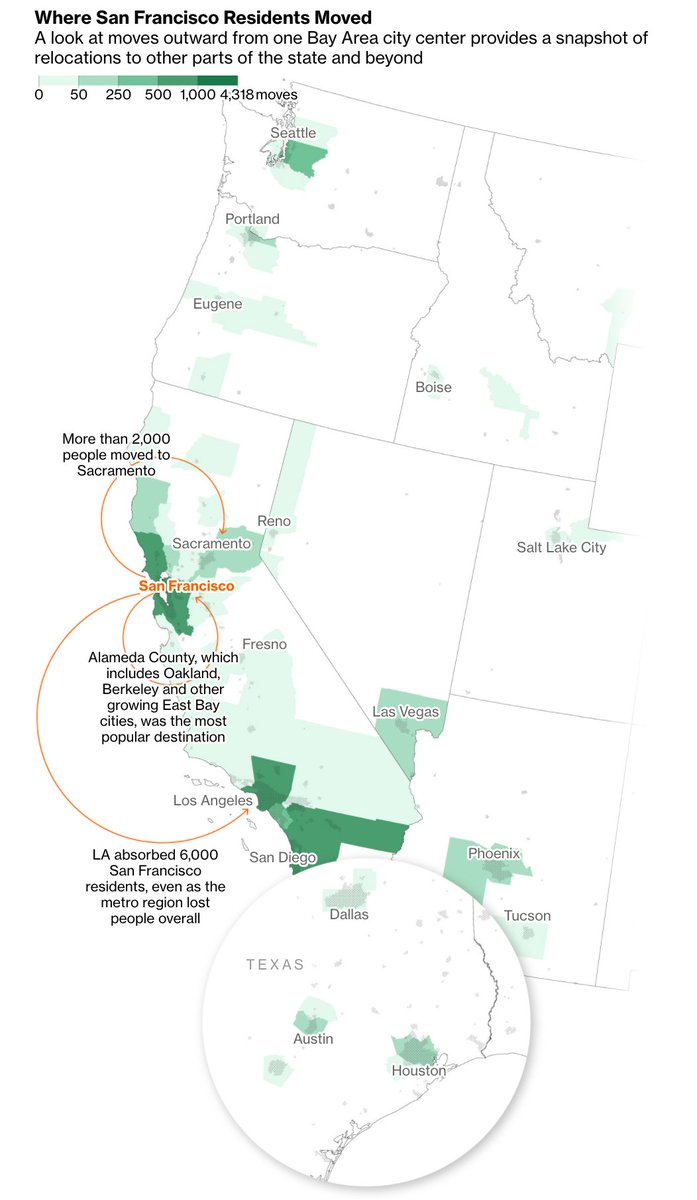
8/ One potential explanation for the Bay Area's movement is its high proportion of residents in what's called the "untethered class."

These are renters with remote-friendly jobs and no kids whose life circumstances make it easier to move around.
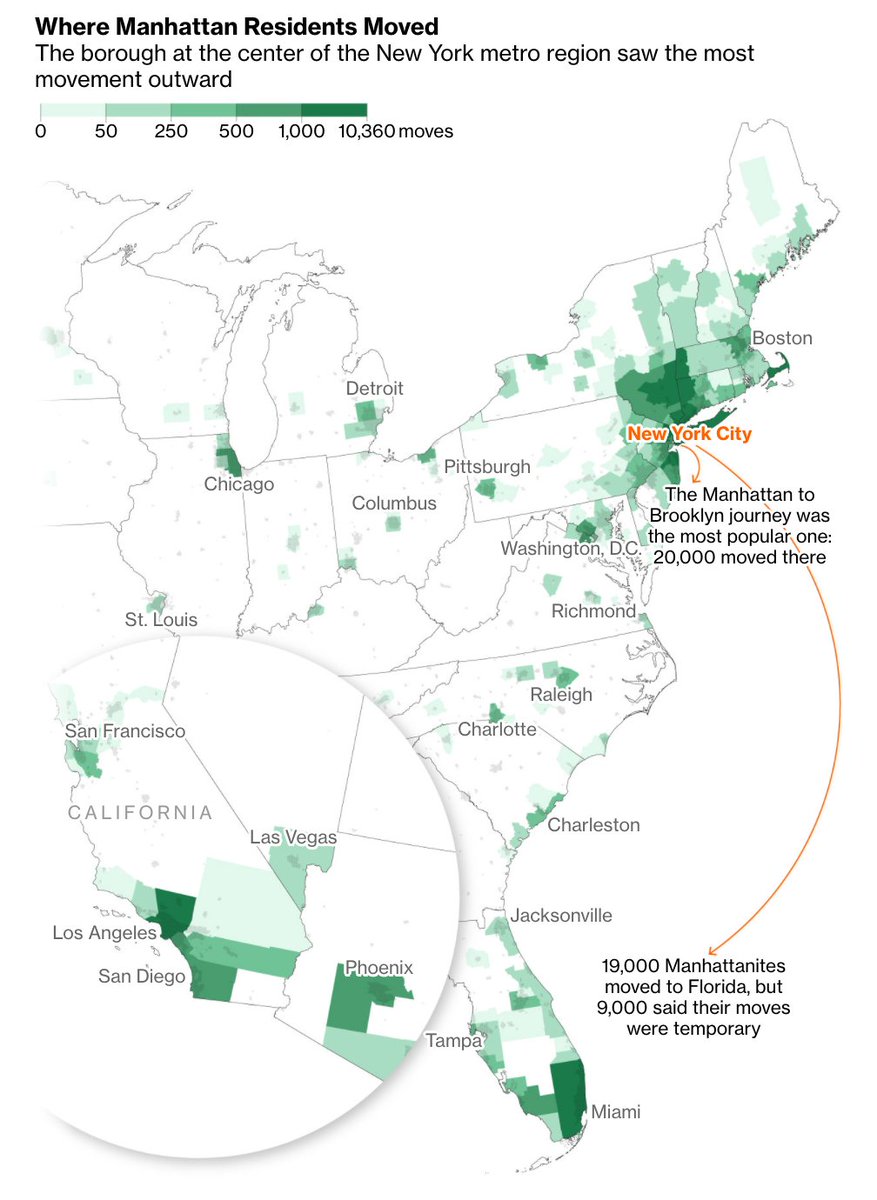
9/ In the New York City region, many people who moved during the pandemic migrated to as close as the next block or the next borough over.

More Manhattanites moved to Brooklyn than moved to the entire state of Florida.
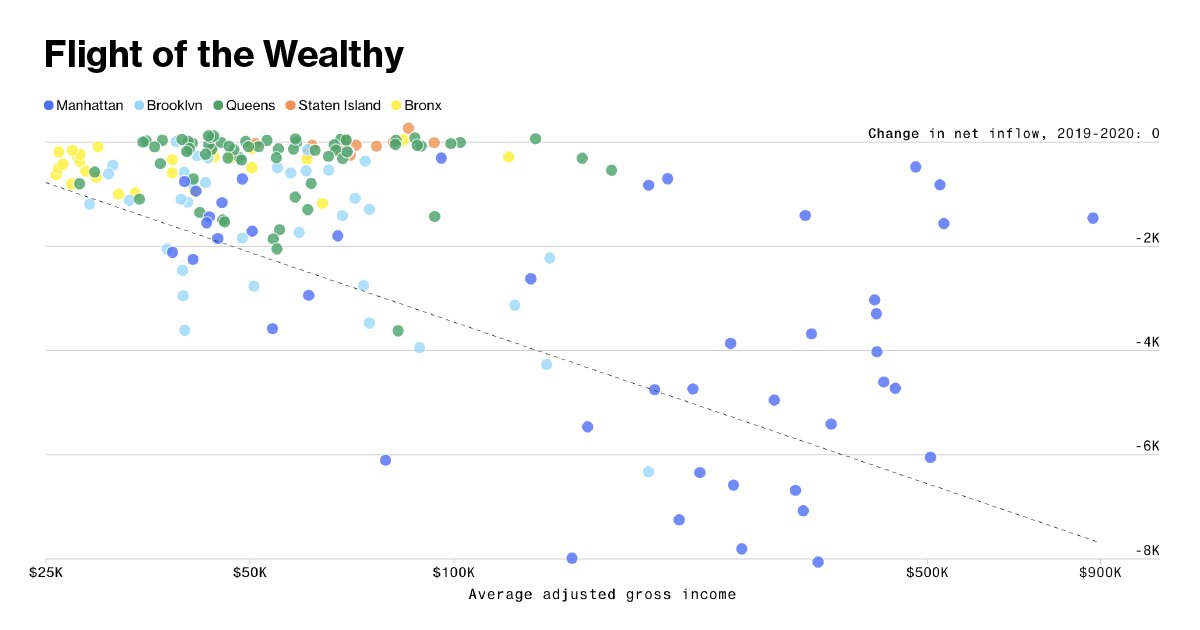
10/ The data analysis revealed that people in New York City's higher-income zip codes were more likely to move.
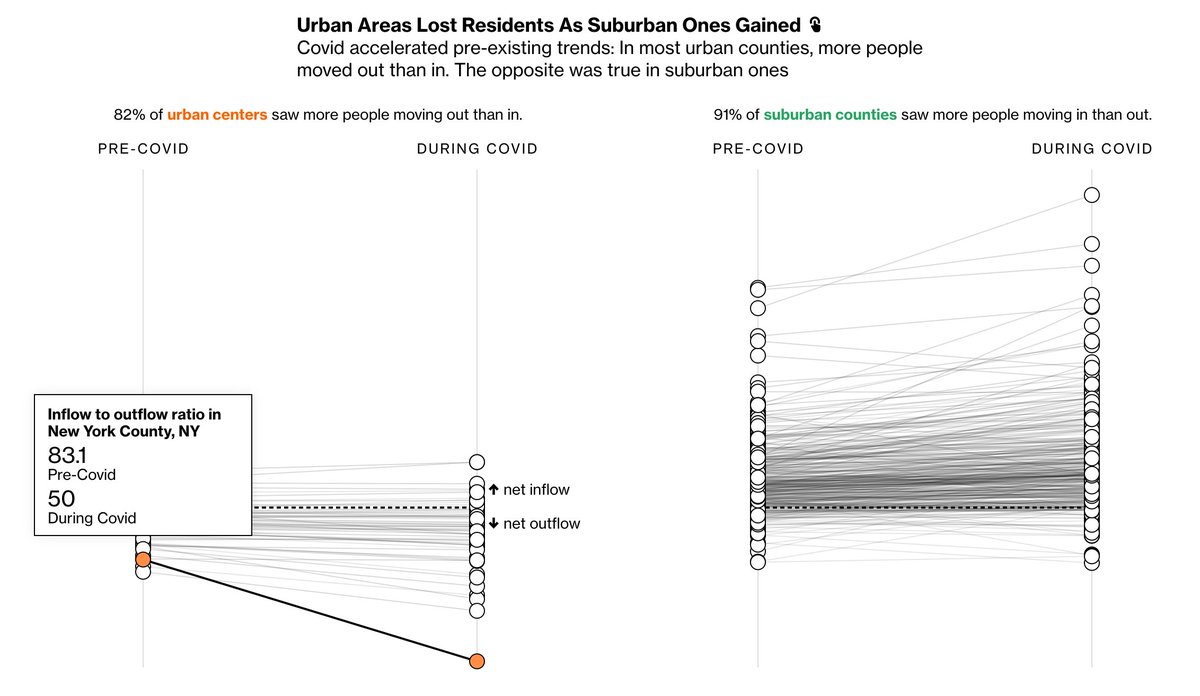
11/ But urban dwellers also moved outward.

One of the clearest trends in New York and across the U.S. is one that predates the pandemic: Core urban areas lost movers while suburban ones gained.
12/ One of the dominant reasons for movement out of expensive urban areas is housing costs.

But while some people with remote-friendly jobs may have the opportunity to find cheaper housing elsewhere, most Americans don't have that option.
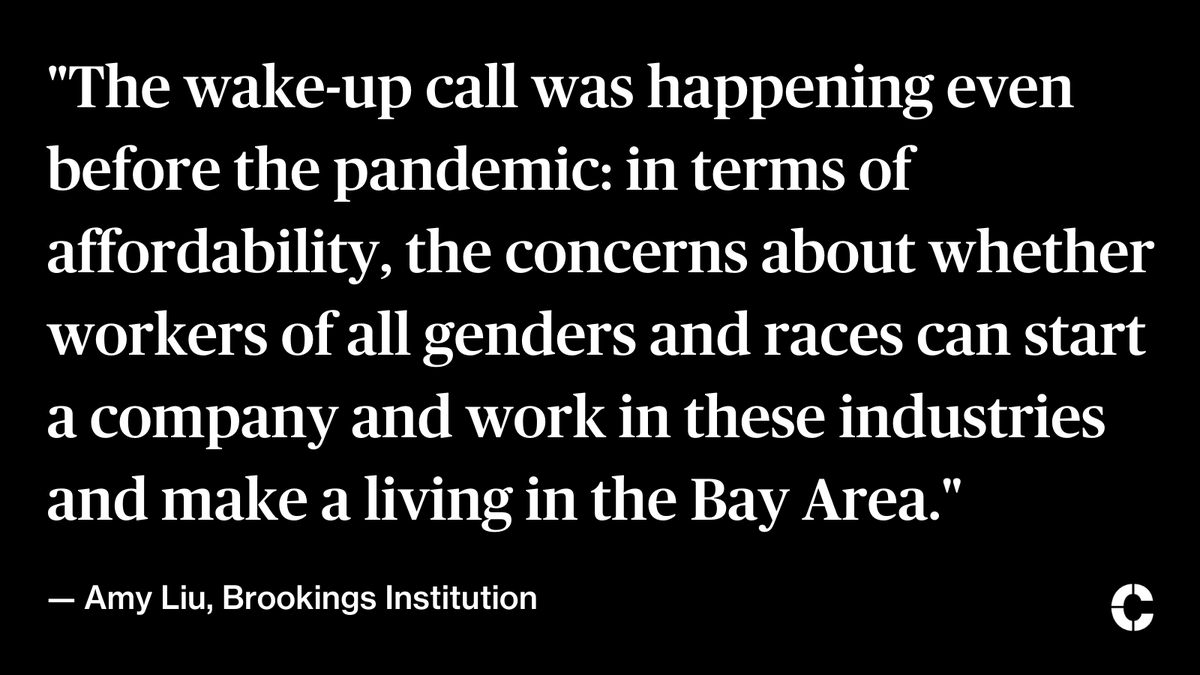
13/ These trends matter to cities as they reckon with the pandemic's economic fallout.

Migration patterns can affect housing prices, tax revenue, jobs and cultural vibrancy.

Explore this interactive map to see where people moved to and from your region: bloom.bg/3xCC4YB

• • •

Missing some Tweet in this thread? You can try to force a refresh

 

Keep Current with Bloomberg CityLab

Bloomberg CityLab Profile picture

Stay in touch and get notified when new unrolls are available from this author!

Read all threads

This Thread may be Removed Anytime!

PDF

Twitter may remove this content at anytime! Save it as PDF for later use!

Try unrolling a thread yourself!

how to unroll video
  1. Follow @ThreadReaderApp to mention us!

  2. From a Twitter thread mention us with a keyword "unroll"
@threadreaderapp unroll

Practice here first or read more on our help page!

More from @CityLab

Mar 8, 2022
Protesters against gender violence have left their imprint on Mexico City's streets and monuments.

On #InternationalWomensDay, they are expected to do it again.

@riostlorena reports: trib.al/9GobLCW Image
Last September, in the middle of a roundabout along Mexico City's Paseo de la Reforma, feminist activists installed a wooden carving of a woman raising her fist to the sky.

Around it are the names of victims of Mexico's epidemic of violence against women Image
La Glorieta de las Mujeres que Luchan, or the Roundabout of the Women who Fight, is what activists now call this prized location.

It has become a flashpoint in the ongoing feminist uprising that has transformed the Mexican capital Image
Read 10 tweets
Feb 4, 2022
The U.S. housing market shifted into overdrive during the pandemic, with more than 6 million homes selling in 2021 despite skyrocketing prices in many cities.

In early 2022, there's no sign that cutthroat bidding and rising prices won't continue trib.al/nS39ovW
"It's uniquely challenging for first-time buyers, since they're not benefitting from the increase in home prices," said Realtor.com chief economist Danielle Hale, who predicts more record-high home prices this year trib.al/91fVwCS
"If you're the type of person who falls in love with a house, this is not your market," says Candace Evans, a Redfin team manager in New York.

"Buyers should anticipate that they may not win a house until their sixth or seventh bid." trib.al/GlEuiul
Read 10 tweets
Feb 1, 2022
Homes are taxed as a function of their market value across much of the nation, but New York City's process is more complicated and problematic than most.

Hundreds of residents last year implored a special city commission to change the law: trib.al/ilH8H40
The 40-year-old state law that created the system was built to favor single-family homeowners over renters or commercial buildings.

It often hurts the low- and moderate-income owners of condos and co-ops
Spiraling home prices have magnified inequities as residents face shocking property tax bills.

It's a reality forcing some longtime city residents into debt or to consider moving away.

Eric Adams, the new mayor, has vowed to prioritize the issue trib.al/6n6t8mH
Read 12 tweets
Jul 28, 2021
Take any major U.S. city and you're likely to find a historically Black neighborhood demolished or cut off from the rest of the city by a highway.

The legacy of this racist transportation policy continues to define urban landscapes. [THREAD] bloom.bg/3zJrbo2
This map shows the Rondo neighborhood in St. Paul, Minnesota.

In the first half of the 20th century it was home to most of the city's African American residents.

It was a key area to do business, meet, shop and socialize during segregation and the Jim Crow era.
Construction of I-94 through Rondo began in the mid-1950s.

"As someone who was there ... it was a surreal experience to see it street by street. It's something I've never forgotten," said Marvin Anderson, a Rondo resident and co-founder of ReConnect Rondo.
Read 18 tweets
Jul 27, 2021
The massive Art Deco "Guardians of Traffic" sculptures are the inspiration for Cleveland's new baseball team name.

What's the backstory? [THREAD] bloom.bg/2WgGIx5
Why name a sports team after sculptures on a bridge?

It's not completely unprecedented for a ballclub to look to transportation infrastructure for inspiration — see, most famously, the Brooklyn "Trolley Dodgers." bloom.bg/376ELFE
The late 19th century dawn of professional baseball, and Cleveland was an emerging U.S. transportation and industrial hub.
Read 8 tweets
Mar 15, 2021
1/ Flooding is a rising threat across the United States, with homeowners facing as much as $19 billion in damages every year.

What puts a neighborhood at high risk? Geography is key, but new data reveal another factor, too: race.

Read the report: bloom.bg/38HXubN
2/ When appraisers mapped cities for the federal Homeowners' Loan Corporation in the 1930s, they assigned grades to neighborhoods based on several factors, race high among them.

Black and immigrant neighborhoods were deemed undesirable, marked by yellow or red lines.
3/ These historically redlined neighborhoods suffer a far higher risk of flooding today, according to new research from @Redfin, the Seattle-based real-estate brokerage.
Read 12 tweets

Did Thread Reader help you today?

Support us! We are indie developers!


This site is made by just two indie developers on a laptop doing marketing, support and development! Read more about the story.

Become a Premium Member ($3/month or $30/year) and get exclusive features!

Become Premium

Don't want to be a Premium member but still want to support us?

Make a small donation by buying us coffee ($5) or help with server cost ($10)

Donate via Paypal

Or Donate anonymously using crypto!

Ethereum

0xfe58350B80634f60Fa6Dc149a72b4DFbc17D341E copy

Bitcoin

3ATGMxNzCUFzxpMCHL5sWSt4DVtS8UqXpi copy

Thank you for your support!

Follow Us!

:(



