

For those who still use "drop in birth rate" as a "proof" of "genocide", does this data mean anything to you? (Note: Fertility Rate = Birth per 1,000 Women aged 15–44) 

Data: cdc.gov/nchs/data/nvsr… table 1 & cdc.gov/nchs/data/nvsr… table 1
Fertility rates of a population can be affected by many factors, like shift in cultural traditions, economic development, urbanization and easy access to birth control. XJ is going through a rapid developing phase, with significant improvements in all these aspects.
Here I'll discuss the influence of maternal education, which plays an important role in the drop in birth rate.
After free & mandatory education is expanded into 12 years, the highschool enrollment rates of the four Southern XJ (Uighur majority areas) regions bumped from 38% in 2009 to 84% in 2014. xinhuanet.com//politics/2015…
This graph shows a year-by-year increase of education availability in XJ. Note: Enrollment rate = (# students enrolled in HS) / (population aged 15 - 18). Admission rate = (# students entering HS) / (# students graduated from middle school)
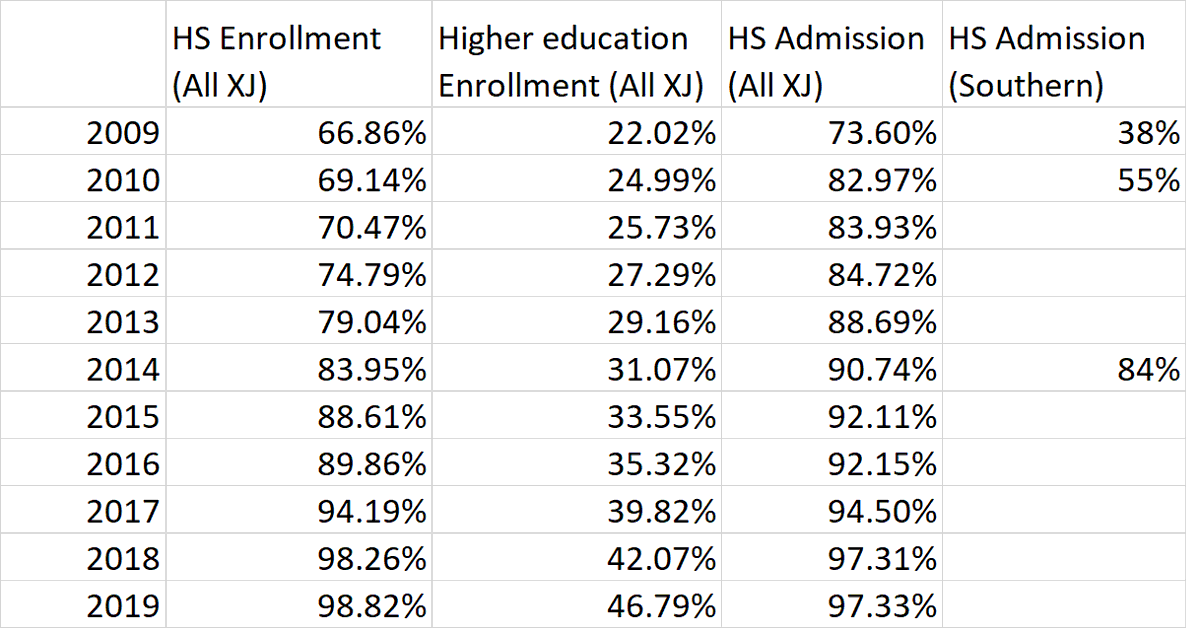
Today the nearly 99% HS enrollment rate is much higher than national average 91%. This is because HS was made free in three Southern XJ prefectures (Kashgar, Hotan & Aksu), then in all 4 Southern XJ prefectures in 2014, and free & required for all students in XJ province in 2017
In a 2016 report from Porf. Li Jianxin, he demonstrated the obvious influence of maternal education on fertility rate based on 2010 Census data. web.archive.org/web/2020033114…

For Uyghur women attended high school or above, only 7.28% of them had three or more kids (versus 20% for those who didn't). This number is even lower for Han women (1.61%). Similar research results can be found about other population all around the globe.
But according to 2010 Census, 87.36% Uyghur people (92% for women) finished only middle school or below, with 45.29% finished only primary school. Only 8% women of childbearing age completed high school or higher.

“(In Southern XJ), young couples usually marry very early under the arrangements of parents. After 9 years of mandatory education, most families do not let their daughters continue school. Parents marry them out as soon as they graduate from middle school at 15 or 16.”

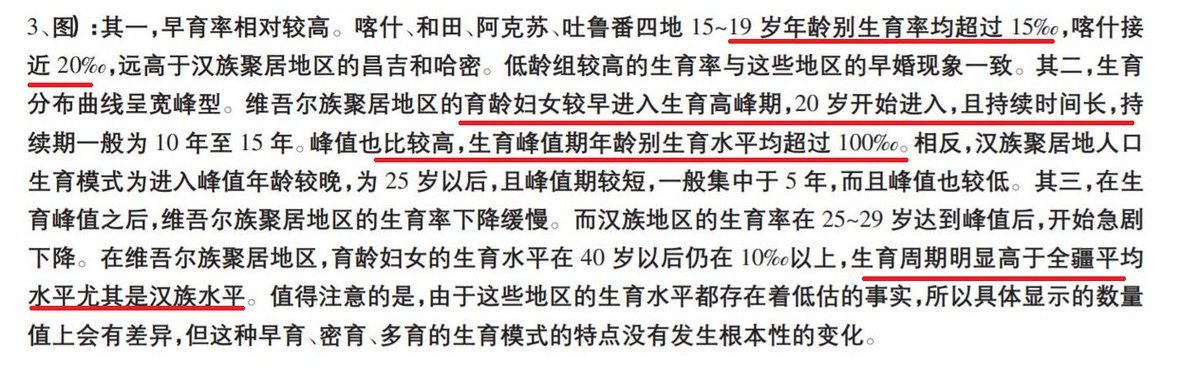
“As long as women start their marriage, bearing children becomes the most important ‘career’ of their lives.” 2010 Census shows that women in (Uyghur majority) Southern XJ prefectures had children much earlier, and their childbearing years lasted much longer.
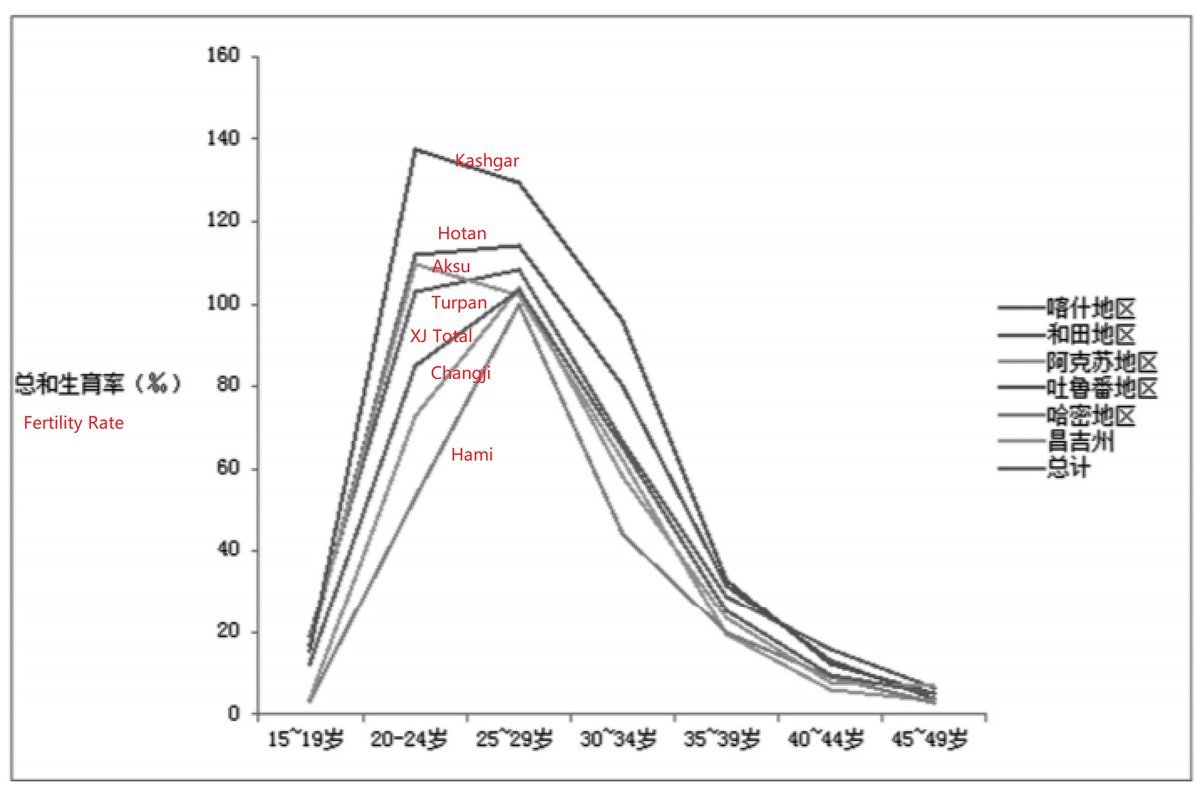
The birth rates of 15-19 age group in Kashgar, Hotan, Aksu & Turpan are over 15‰ (20‰ for Kashgar), much higher than Changji & Hami, which have more Han population.
“I investigated an all Uyghur town in Southern XJ with 309 married women. Most of them only finished primary or middle school. Only 1% finished HS or higher. They are mostly peasants or homemakers.

Their average first marriage age is 18.07, with 56.66% married between 15 and 19 … further analysis shows that the first marriage happens averagely at 17 for those born before 1980, and 19 for those born after 1980. There is no substantial difference (between generations).”
Another investigation of a local People’s Representative Hanmin Hou in 2015 confirmed this pattern. “In rural villages many young men and women get married before legal marriage age (20 for men and 18 for women for minorities) and host their weddings without legal registration.

I investigated 500 women from the two villages in Kashgar, and found that 50% of them had their first marriage before 18. There is a 34-year-old woman who already had a grandchild … Many girls married early under the pressure of parents.” china.huanqiu.com/article/9CaKrn…
“Underaged marriage is a threat to women rights protection.” Hou expressed her concerns, “it damages young women's health and limits their opportunities for personal development.

(Underaged illegal marriage) prevents women from effectively protecting their rights in family and marriage under the law. Many women suffer from domestic violence. ”
As a result of prevailing early/underaged marriages, the Uyghur population maintained a consistently high birth rate of over 15‰ from 1978 to 2016, with as high as 18‰-25‰ for many years in some Southern XJ prefectures.

This resulted in a total Uyghur population growth of 25.04% from 2010 - 2018. fmprc.gov.cn/mfa_eng/wjbxw/…
But this is no longer the case today. According to Prof Li's 2020 report, “(for women in Southern XJ), after graduating from middle school at 15, high school education puts an immediate postponement of their first marriage and childbearing age.” shehui.pku.edu.cn/upload/editor/…

Most importantly, “high school education directly shifts young people’s perception about childbearing.” Girls now have opportunities to go to college, look for jobs, and pursue successful careers in their lives rather than being enslaved as childbearing machines at an early age.
Another factor is the family planning policy for Uyghur couples since 2017. It's important to mention that this policy encourages Uyghur couples to have 2-3 kids, which is NOT DIEFFERENT from the population's current total fertility rate.

The application of such policy has two immediate effects. 1) it further cracks down on illegal underaged marriage. “Fertility rates dropped significantly within the 15-19 age range.”
2) many couples who already had their kids when they were underaged decide to not have kids as they would, in order to get family planning rewards or avoid fines.
People like Adrian Zenz want to label such financial regulation policies as “forced sterilization”, but using the same logic, child tax credit or baby bonus in some other countries will be labeled as “forced fertilization”, which is obviously as absurd as it sounds.
For anyone who has the tiniest sympathy towards women rights, if they have visited Southern XJ and see with their eyes those girls bearing a second child before turning adult, they would agree that there is absolutely no way that such high birthrate “norm” should be maintained.
Right now, these girls can go to high school, avoid getting married at 15 like their mothers did, find a job and escape the intergenerational cycle of poverty, just like girls of other ethnic groups in XJ and across the country have been doing.
But in the eyes of radical religious conservatives like Zenz, who are known to be extremely biased against women equality and birth control, a teenage girl living in a backward developing country does not deserve to modernize:
She should drop out of school, stay ignorant, get married under parents’ arrangement and become a child bearing machine for her husband at 15.
if she decides to go to high school, postpone marriage, bear less children, and make an independent living for herself, it is “undermining God's unique but different role assignments for men and women”.
https://twitter.com/zhang_yx_/status/1392095942493487109
So when the current better-educated child-bearing generation of Xinjiang stop marrying underaged and bearing 4 kids like their parents did, they cannot accept this shift and painted it as a "forced sterilization" and “genocide”.
Here I want to emphasize that I didn't intend to indicate that underaged marriage is specific to any religious or ethnic group. In fact, similar practices also exist in other ethnic groups (including Han) in other provinces, and in other countries as well.
Underaged marriage is common in rural areas in extreme poverty where education accessibility still needs to be improved. This is what the poverty elimination program is about. XJ (especially Southern XJ) used to be one of the poorest region in the country.
Today, XJ is the only province where education is required and free for 12 years. It's still 9 years in other provinces. There are also good affirmative action and scholarship policies for minority groups, including Uyghurs, to support them going to college.
• • •
Missing some Tweet in this thread? You can try to
force a refresh



