Forget snakes on a plane. How about a robot snake in a pool?
Carnegie Mellon roboticists approximated the biomechanics of a serpent—then loaded the thing with propellers. The result is a bot the US Navy might use to inspect ships and submarines 1/ wired.trib.al/csEMNB7
Unlike a sea snake, which uses its whole sinuous body to swim, this robot uses modular pieces of itself to maneuver. Its aft thruster produces forward movement while its lateral thrusters offer stability control. Also unlike a sea snake, it has a camera on its face 2/
At the moment, the robot’s swimming isn’t particularly sophisticated, but the team’s idea is to refine the algorithms that control its movement by using machine learning: By building a digital version of the robot in simulation, an AI can try many ways of swimming 3/
Through trial and error, it will land on the most efficient kind of locomotion. Since the robot is modular, the team can swap in more thrusters to make the machine more powerful, or remove thrusters to help it fit into smaller spaces 4/
If you're watching these GIFs and thinking: What self-respecting robot still has a tether in 2021? In this case, it’s actually a design choice. It’s both a communications link and a kind of leash. If there’s ever a problem, the snake can be pulled back onboard 5/
To review:
Butt-thrusters ✅
Modular ✅
Camera face ✅
Future-proof yourself. Subscribe to WIRED for less than $1 per month and get unlimited access our longform features and tech news 7/ wired.trib.al/BMxcvqp
• • •
Missing some Tweet in this thread? You can try to
force a refresh

Meta’s former chief AI scientist has long argued that human-level AI will come from mastering the physical world, not language. His new startup, AMI, plans to prove it. wired.com/story/yann-lec…
“The idea that you’re going to extend the capabilities of LLMs [large language models] to the point that they’re going to have human-level intelligence is complete nonsense,” Yann LeCun said in an interview with WIRED. wired.com/story/yann-lec…
The financing, which values the startup at $3.5 billion, was co-led by investors such as Cathay Innovation, Greycroft, Hiro Capital, HV Capital, and Bezos Expeditions. wired.com/story/yann-lec…
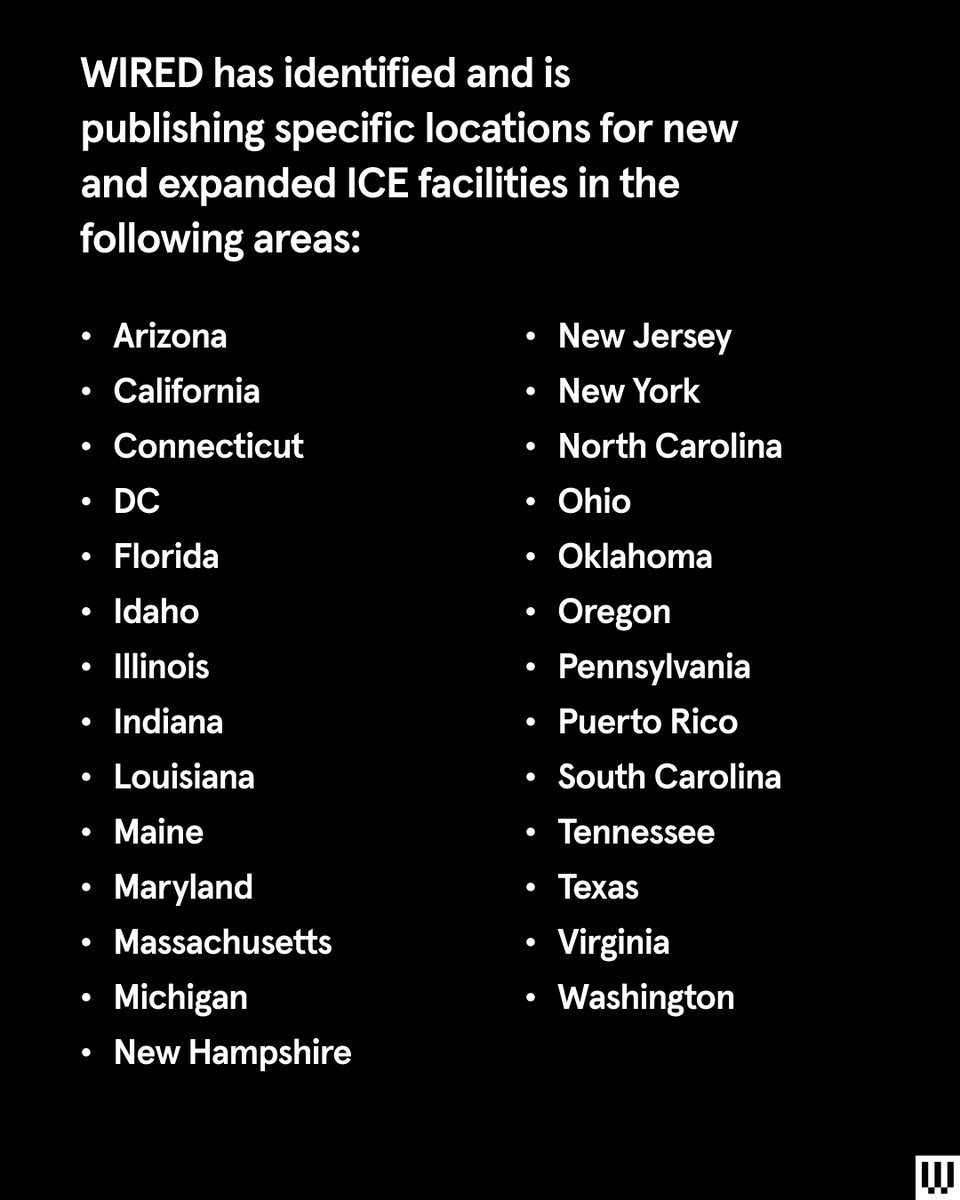
Last week, we reported that Immigration and Customs Enforcement (ICE) and the Department of Homeland Security (DHS) have carried out a secret campaign to expand ICE’s physical presence across the US. wired.com/story/ice-expa…
Documents show that more than 150 leases and office expansions have or would place new facilities in nearly every state.
This gives us a clear picture of where ICE is going next in the US: Everywhere.
NEW: Workers at the Social Security Administration have been told to share information about in-person appointments with ICE agents, in a move that goes against decades of precedent and puts noncitizens at further risk of immigration enforcement actions. wired.com/story/social-s…
“If ICE comes in and asks if someone has an upcoming appointment, we will let them know the date and time,” an employee with direct knowledge of the directive says. wired.com/story/social-s…
SSA has been sharing data with ICE for much of president Donald Trump’s second term, but this order to share information marks a new era of collaboration between SSA and the DHS, ICE’s parent agency. wired.com/story/social-s…
Two agents involved in the shooting deaths of US citizens in Minneapolis are reportedly part of highly militarized DHS units whose extreme tactics are generally reserved for war zones. wired.com/story/ice-cbp-…
The units include ICE’s two Special Response Teams (SRT), CBP’s one SRT, and the Border Patrol Tactical Unit (BORTAC). wired.com/story/ice-cbp-…
The tactics used by SRT and BORTAC vastly differ from those of local police or sheriffs. They use explosives to breach the doors of homes, and team members are equipped with full tactical gear, assault rifles, and heavy-duty crowd-control weapons. wired.com/story/ice-cbp-…
Since last year, we’ve been reporting on ICE extensively. But every week brings new information, and it’s getting harder to keep track of what’s happening, let alone remember what’s already happened.
So here’s a quick thread to help.
Back in June (we know, it honestly feels like a lifetime ago), WIRED obtained hundreds of emergency calls from ICE detention centers. wired.com/story/ice-dete…
The data showed that at least 60 percent of the centers analyzed had reported serious pregnancy complications, suicide attempts, or sexual assault allegations. wired.com/story/ice-dete…
Criminals posing as US immigration officers have carried out robberies, kidnappings and sexual assaults in several states, warns an FBI bulletin to law enforcement agencies issued last month. wired.com/story/fbi-warn…
Citing five 2025 incidents involving fake immigration officers, the bulletin says criminals are using ICE’s heightened profile to target vulnerable communities, making it harder to distinguish between lawful officers and imposters. wired.com/story/fbi-warn…
Federal rules require immigration officers to identify themselves and state the reason for an arrest “as soon as it is practical and safe to do so.” The standard has not changed since it was codified, yet advocates say it is increasingly ignored. wired.com/story/fbi-warn…