

A heavy industry🏭 deep dive into the @IEA Net Zero 2050 report. Industrial emissions fall by 93% by 2050 relying on a mix of material efficiency, energy efficiency, electrification, H2 and CCUS. THREAD 1/n 

There’s a welcome focus on #circulareconomy as a key lever for industrial decarbonisation: Material efficiency alone reduces demand for cement and steel by 20% in 2050. The steel pathway foresees a major shift towards scrap-based EAFs 2/n
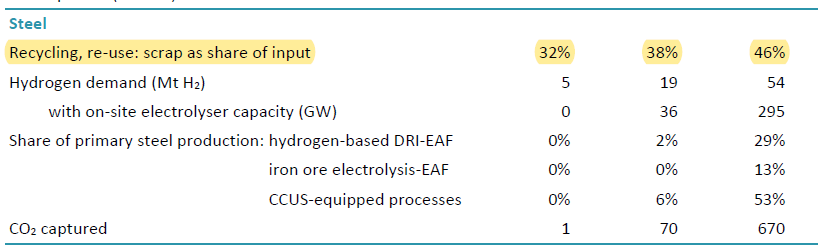
But there’s little in the way of a concrete call to action on this lever & I’m curious to hear what others @MaterialEcon @bataille_chris think on whether this truly pushes the boundary on reductions in material consumption? 3/n
CCUS still does a lot of heavy lifting in the industry pathway in the NZE, in particular for the cement sector accounting for 55% of reductions in 2050 relative to today. After a decade of false starts on CCS, this will understandably raise eyebrows. 4/n e3g.org/publications/e…
The NZE also pins hopes on a set of newer technologies making the leap to large-scale deployment: Almost 60% of emissions reductions in 2050 rely on technologies under development today including H2 DRI. A clear call to ramp up RD&D investment to bring down costs globally. 5/n
The NZE also addresses the lack of progress on industrial decarbonisation to date, identifying 2 key challenges: 1⃣Competitiveness: industrial materials are globally traded under harsh price competition2⃣Long-lived assets: ~40 year lifetime of industrial equipment
6/n
6/n
There is a clear call to action for policymakers to address these challenges at home & abroad
✅⬆️R&D funding
✅Prepare strategies for shifting industrial assets to clean processes
✅Rollout key infrastructure
✅Pursue🌍 agreement on trade in cleaner industrial materials 7/7
✅⬆️R&D funding
✅Prepare strategies for shifting industrial assets to clean processes
✅Rollout key infrastructure
✅Pursue🌍 agreement on trade in cleaner industrial materials 7/7
• • •
Missing some Tweet in this thread? You can try to
force a refresh



