

1/ The markets chose violence this weekend.
Terra's honeymoon phase is over. The platform's stability mechanism was not merely tested... the market tried to destroy it. Terra survived.
And now we're more confident than ever that building on Terra is the right move. Here's why:
Terra's honeymoon phase is over. The platform's stability mechanism was not merely tested... the market tried to destroy it. Terra survived.
And now we're more confident than ever that building on Terra is the right move. Here's why:
2/ Building Mars Protocol around an algorithmic stablecoin requires trust in the mechanism, but building around a centralised stablecoin requires trust in the company that runs it.
This goes against our core principles of permissionlessness and decentralization.
This goes against our core principles of permissionlessness and decentralization.
3/ Regulation, state-level attacks or negligence by stablecoin issuers can lead to assets being frozen and/or significantly devalued.
This is not trivial.
Any DeFi protocol that relies on centralised stablecoins as part of liquidity pools or as collateral could face insolvency.
This is not trivial.
Any DeFi protocol that relies on centralised stablecoins as part of liquidity pools or as collateral could face insolvency.
4/ Algorithmic stablecoins remain an experiment.
But unlike others before it, Terra has shown the ability to build real demand for its stablecoin, first via Chai and now through a thriving DeFi ecosystem.
But unlike others before it, Terra has shown the ability to build real demand for its stablecoin, first via Chai and now through a thriving DeFi ecosystem.
5/ Even during the worst of the sell-off, $UST TVL on @anchor_protocol kept increasing, showing many already see $aUST as their “safe haven” asset. 
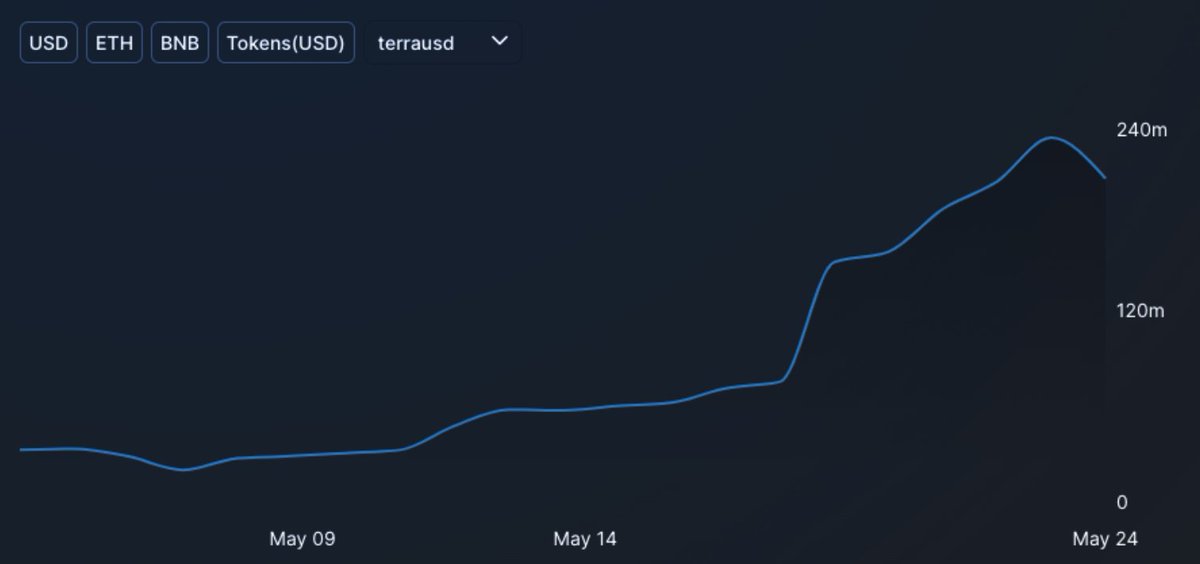
6/ This weekend we saw $UST returning to peg after cascading liquidations, widespread FUD and some of the worst market conditions we've ever seen.
This only solidifies our faith in the mechanism going forward as it has shown it can function as intended.
This only solidifies our faith in the mechanism going forward as it has shown it can function as intended.
7/ However, there are lessons to be learned:
* The way liquidations are done on Anchor can improve.
* Dependence on $bLUNA in Anchor can be mitigated (e.g. adding other assets like $bETH and $bSOL).
* The way liquidations are done on Anchor can improve.
* Dependence on $bLUNA in Anchor can be mitigated (e.g. adding other assets like $bETH and $bSOL).
8/
* More on-chain liquidity for $LUNA, which will help $UST maintain its peg despite volatility.
* Adoption of Proposal 90, which will increase the amount of UST that can be minted/burning in a day… and much more.
* More on-chain liquidity for $LUNA, which will help $UST maintain its peg despite volatility.
* Adoption of Proposal 90, which will increase the amount of UST that can be minted/burning in a day… and much more.
9/ All these can and will be fixed, as evidenced by the lucid response by the Terra team
https://twitter.com/terra_money/status/1396780917314621444?s=20
10/ Existing proposals from the user Jump Trading would also address many of the issues encountered this weekend.
agora.terra.money/t/liquidity-pa…
agora.terra.money/t/liquidity-pa…
11/ Our conviction and belief in @terra_money as a fundamental piece of the future of the entire industry is unshaken.
We built throughout the weekend and we continue to build today.
We built throughout the weekend and we continue to build today.
12/ Tomorrow, we’ll ship our litepaper, and lay out our vision for the first and most powerful money market in the Terra ecosystem.
And that will just be the beginning… come what may.
And that will just be the beginning… come what may.
• • •
Missing some Tweet in this thread? You can try to
force a refresh





