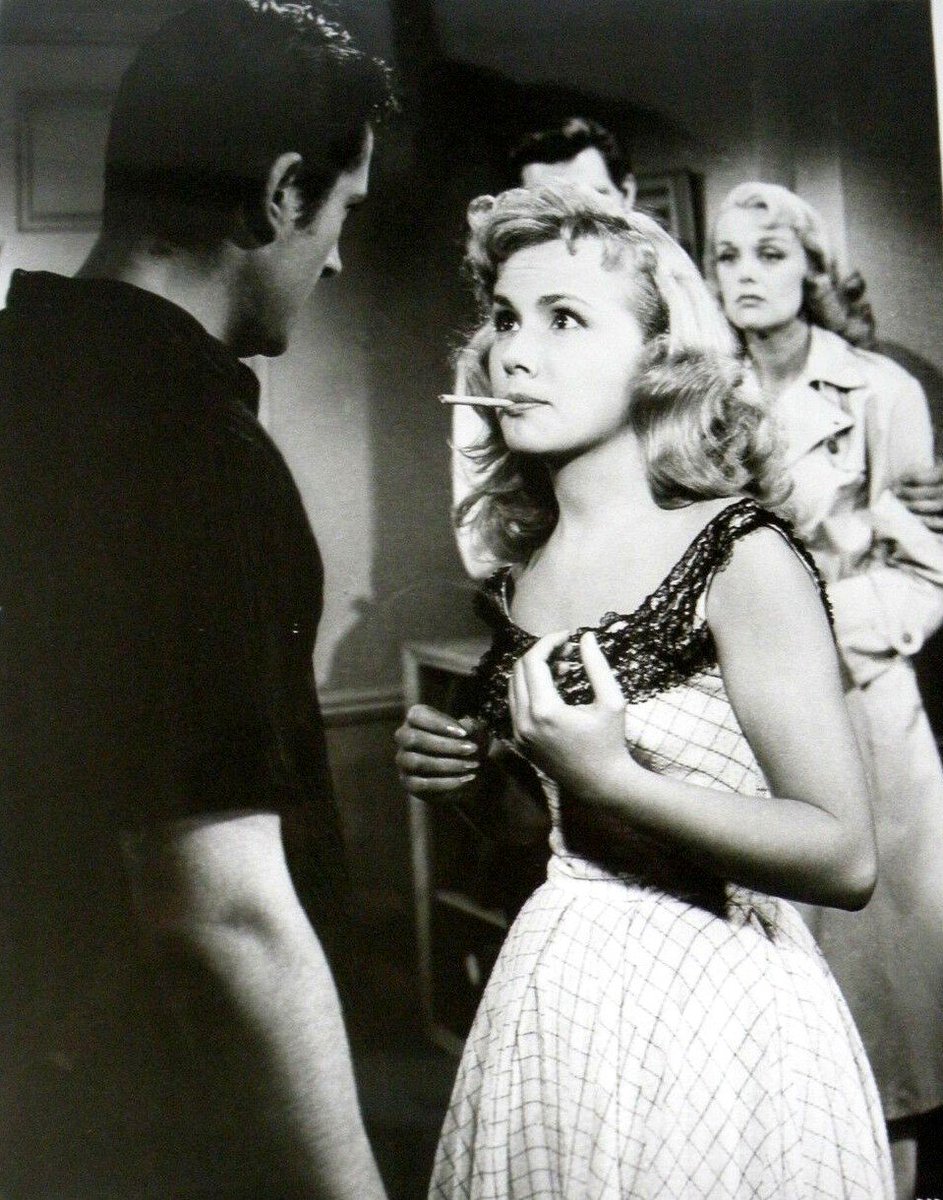
My new favorite movie of all time: High School Confidential (1958). It has EVERYTHING: switchblade fights! Mamie Van Doren! Reefer addicts! Jerry Lee Lewis! Midnight hot rod races! Vampira beatnik poetry! And non-stop hep cat lingo galore, daddy-o!
I literally can't believe I never saw this movie before last night on TCM. Should be available on TCM on demand soon
Plus it has my late great pal Norm Grabowski (uncredited) as one of the Wheeler Dealers, the hoodlum gang that runs the reefer biz at 35-Year Old Student High School
And Michael Landon as head honcho of the Rangers, the high school's top hot rod club
And Charlie Chaplin Jr as undercover narc busboy at the beatnik jazz club owned by local reefer kingpin "Mr A" played by Jackie Coogan - whose movie career started as child costar of Charlie Chaplin Sr in "The Kid" and later became Uncle Fester on The Addams Family
And two chopped lead sled 48 Chevy coupes built by George Barris. Note: no one will be seated during the shocking lead sled flip scene
In short: this is not a movie, it is a 1 hour 25 minute xray of my brain
Footnote: here's a Jackie Coogan tangent I went off on, prompted by a car ID request
Happy Indianapolis 500 Day to all who celebrate from Dave's Car ID Service! Today we pay homage to Indy's "Junk Formula" Era of 1930-37.
Why celebrate a formula for junk? Let me give you some context. At its inception Indy featured some cars that were pretty much stock. In that first 1911 race, the 5th place finisher was a stripped-down but otherwise complete stock Marmon 32 passenger car that was street-driven to the track. It was in the realm of possibility for a regular upper-middle class Joe with cojones and a dream to participate.
That all changed quickly, especially after WW1. By then it was strictly a rich man's sport, dominated by very exotic and expensive specialized racing machines, primarily Millers and Duesenbergs. Rules demanded smaller and smaller engine displacement. Until 1922 cars were limited to 3 liters (183 cubic inches), then from 1923-25 2 liters (122 ci) and starting in 1926, 1.5 liters (91 ci). The reduction in displacement was to curb speeds in an age where death on the track was common, but also to spark innovation.
Those rules worked almost too well. Geniuses like Harry Miller and the Duesenberg brothers figured out ways to coax ever more power out of ever smaller engines: overhead cams, integrated head-engine block casting, arrays of carburetors, exotic superchargers.
Those cars, to me, are the Sistine Chapel of American car racing. But they were incredibly expensive, and you had to have one if you wanted to be competitive at Indy. This all but closed off the field to anyone who didn't have cubic buttloads of cash.
That was okay for a while. During the Roaring Twenties there were plenty of high-living Gatsbys who wanted to sink some mad money into the exciting glamorous world of big time auto racing.
But then came October 29, 1929.
The Black Tuesday stock market crash wiped out a good number of those Indy-curious Gatsbys, kicking off what would soon become the Great Depression.
Enter Eddie Rickenbacker.
Best known as a World War I fighter ace, Rickenbacker was already famed as a successful racing driver for Duesenberg before the war. In 1927, the war hero had enough financial backing to buy Indianapolis Motor Speedway. Less then two years later he was faced with a grim reality: there were probably not going to be enough entries in the 1930 race to fill the 33-car grid. The economy's impact on ticket demand meant that the total prize purse for 1930 would be reduced from $98,000 to $54,000, and the winner's share from $50,000 to $18,000. Which made it even harder to attract entrants, etc. A vicious cycle that threatened to end the Indy 500 for good.
In response, Rickenbacker announced a new set of rules for 1930: displacement up to 6 liters (366 cubic inches) was allowed, supercharging was banned, there would be a return to Indy's mandatory ride-along mechanic rule 1911-22, and the field was expanded from 33 to 38.
This rule was derided by the high-dollar Miller and Duesenberg teams as the "Junk Formula," because it meant there'd be cars in the field with unsophisticated stock block engines. But that was sort of the point. It gave quasi-regular Joes and backyard mechanics a fighting chance to field a car at Indy, powered by a big modified Buick or Studebaker engine.
It didn't end the dominance of Miller & Duesenberg, who created their own bigass engines under the new rules, and no true "Junk Formula" car ever one. But helped keep Indy alive during 1930-37, amid the darkest days of the Great Depression.
The first Indy Junk Formula cars of 1930 were a bit ungainly compared to the supersleek Millers of the day, but had some success.
#1 here is Rollie Free piloting the Slade Special, powered by a Chrysler Model 70 engine. Free would go on to become a motorcycle legend, photographed in the 1950s planking in a Speedo on his Vincent Black Shadow across the Bonneville Salt Flats en route to a motorcycle land speed record.
#2, the Buick Fireball 8-powered Butcher Brothers Special. That's Harry Butcher behind the wheel with brother Jimmy as ride along mechanic. Just a couple of bros with a dream.
#3, The Romthe Special, driven by J.C. McDonald. Powered by a Studebaker engine, and you can see the stock Studebaker hood sides.
#4 Chester Miller behind the wheel of the Fronty Special. Believe it or not, the engine block is a stock Ford Model A 4-banger, but with a Frontenac (aka "Fronty") overhead cam conversion. Frontys were popular at lower classes of racing, and designed by the Chevrolet Brothers.
As the Depression deepened, so increased the number of Junk Formula cars at Indy. And they became more beautiful and sleek.
#1 Studebaker's stable at the 1932 500, with their wonderfully Art Deco grilles.
#2 Al Miller in the Hudson Special.
#3 Phil "Red" Shafer of Des Moines in his Buick Fireball 8-powered Shafer Special.
#4 Chet Miller in the Bohnalite Special, the first Ford flathead V8 to race at Indy.
Today's Dave's Car ID Service pays homage to the General Motors Technical Center in Warren Michigan, which held its grand opening May 16, 1956. The absolute pinnacle of postwar Detroit style, confidence, and power, and a fitting showcase for a 1956 Cadillac Coupe de Ville.
The shot of the Caddy was merely the lobby of the Design Center. The technical center itself is a huge 320 acre campus, built around an artificial lake, with office space originally designed for 5,000 workers - engineers, designers, researchers, GM's brain center. At the time of its opening 70 years ago it had a reported price tag of $100 million, about $1 billion in 2026 money.
Internal discussion of the project began in 1944, when GM car production was still shut down for war production. GM Chairman Alfred P Sloan and Research Director Charles Kettering (of Sloan Kettering cancer hospital fame) presented the proposal with early design layouts to the GM Board that December. It was approved, and the first 100 acres of farmland were purchased outside the then-tiny town of Warren, north of Detroit.
Neither Sloan nor Kettering really cared for architectural flourish, but GM's chief of styling Harley Earl argued that an architecturally distinct working environment would spur creativity and innovation. The earliest design by Finnish-American Eliel Saarinen were in a Streamline Moderne style, similar to the GM Pavilion building at the 1939 New York World's Fair. In 1948 GM again hired Saarinen, Saarinen & Associates to revise the plans. It was assigned to Eero Saarinen, Eliel's son. It would be his first solo project as an architect. Saarinen's revised design was in the International Style, influenced by Mies van der Rohe's IIT campus in Chicago. The landscape architecture was handled by Thomas Church.
It took 8 years to complete, and the Finnished product (pun intended) is among the most stunningly beautiful examples of Midcentury Modern architecture ever built. Subsequent expansion of the campus to accommodate 20,000 workers, and $1 billion renovation/restoration completed in have adhered to that style. It was truly "Where Today Meets Tomorrow."
Imagine going to work every day here. I don't know about you but I wouldn't need to set my alarm clock.
I've attempted to get into the GM Technical Center for a tour and looky-loo, only to get the bum's rush from the gate guards. Very hush hush place with high security.
In case anybody from General Motors reads this, could I prevail upon you to take pity on this old car & architecture nut and request a guest pass on my behalf? I will be in Detroit later this year, and honestly I'm fairly harmless.
Players earning money, out in the open, in a free market
Historically bad program winning a championship
Teams with gigantic spending failing terribly
10-15 programs with a legitimate chance at a title
End of the ESPN-SEC 1000 year reich
What's not to like?
Iowa has about the lowest transfer turnover in the country. Because they recruit underrated 2-3 stars with chips on their shoulders who remain loyal. Pay $2 million for a 5-star, don't be surprised when he considers the deal purely transactional.
Say what you want about Chicago, but its skyline is a 140 year long group project masterpiece. Unequaled on Planet Earth, go talk to a wall
Honestly outside a few notable buildings Manhattan architecture is decidedly mid. Like a movie trailer that shows you a few highlights but the rest is just boring
A very happy 150th birthday to the Otto Cycle internal combustion engine from Dave's Car ID service! Revealed May 9, 1876, it was the first practical example of a gasoline powered 4-stroke (a/k/a Otto Cycle). Or as we gearheads say, "suck squeeze bang blow."
German Nicolaus Otto invested 14 years of research, trial and error, and help from his employees Gottfried Daimler and Wilhelm Maybach into creating it, but reportedly had zero interest in transportation applications; his were all designed as huge stationary engines for industrial or agricultural jobs. When it debuted, it claimed the "day of steam was at end." Not a correct forecast as it turned out, but it carved out a niche in the light industrial market. I've seen a working Otto engine from the early 1880s.
In any event, the potential of Otto's engine for transportation didn't escape his employees Daimler & Maybach, who pioneered the earliest days of automobiling with scaled down, more efficient versions of Otto's 4-stroke. It wasn't the invention of the car, but it made the invention of the car possible.
Technically the Otto engine was not the first internal combustion engine. Otto was inspired to create his design after seeing Jean Lenoir's IC engine in 1862. He built a replica but noted it was noisy, inefficient, and had an unfortunate tendency to BLOW THE HELL UP.
The key insight he derived was that compression mattered. Though it had a piston, Lenoir's design did not compress the fuel, it simply ignited and returned to TDC where it received the next fuel charge. It worked, but not for long due to the stress on the cylinder and piston. Otto's experiments proved fuel compression was more efficient and resulted in more power and durability.
Unlike Otto, Lenoir *was* interested in transportation. He powered a boat with one of his engines in 1861, and built his "Hippomobile" (2) in 1862. Petroleum powered, it made a 7 mile trip around Paris in 1863 at about 1.8 MPH. Arguably the first gasoline powered car, beating the Benz Patent-Motorwagen by over 20 years.
So was Lenoir's the first internal combustion engine? Like the debate over the "first car," therein lies a definitional rabbit hole. The answer is no; in 1851 Italian mathematics professor Eugenio Barsanti and engineer Felice Matteucci patented a hydrogen-burning IC with free floating pistons (a replica in #1).
And WAY before that, French-Swiss artillery officer and inventor Francois De Rivaz received an 1807 patent for a gravity piston & ratchet wheel hydrogen IC design that he completed in 1804-05 (2). He even made a vehicle with one (3) in 1807.
To dive even deeper in the IC rabbit hole, the Niépce brothers received a 1807 patent for their "Pyréolophore," an internal combustion engine for boats. The fuel? A mixture of finely crushed coal dust and lycopodium powder.