A now thread in the 4 interactive graphs we produced for this article. In this thread I provide quick videos introducing each of them. I wanted to hire Sean Connery to narrate, but then I learned the sad (old) news he passed away, so you'll have to bear with my dreadful voice 😊
The first graph provides a big picture view of NFC debt, considering NFCs as ultimate issuers (that is, including issuance done by affiliates of said NFC which may not be NFCs themselves). It is a movie of amounts outstanding over time & you can select/unselect country groups 2/
The 2nd graph gives a time series of net issuance of IDS & amounts outstanding, split between "onshore" & "offshore" (more info in Box A in article). Again you can dynamically select/unselect stuff & a drop down menu allows you to choose country aggregates & lots of countries 3/
The 3rd graph allows you to see how debt gets reallocated by sector, eg how much of the debt of NFCs as ultimate issuers is actually done through say NBFI affiliates. Again, a dropdown menu allows you to select country (groups) & hovering over the graph gives more details 4/
The 4th graph is all about offshore debt; it allows you to see where do NFCs headquartered in different country groups (& for selected EMEs & AEs) issue offshore (data as of end-Q1 2021). It combines a movie with a drop down menu, and provides more info when hovering over it. 5/
To close: you can download all the data underlying these interactive charts! Make sure to also visit the BIS website where much more data can be obtained! This can be of interest as well for academics working and teaching on related topics (@m_maggiori@helene_rey@skalemliozcan)
• • •
Missing some Tweet in this thread? You can try to
force a refresh

Views on stablecoins are a kind of Rorschach ink blot test that reveals unconscious monetary priors: SC are like MMFs, casino chips, wildcat banks, ETFs, currency boards. Our own conscious monetary priors are those of the money view & that leads us to analogize SC w/ Eurodollars
For us, on-chain is like offshore: each term identifies a particular institutional boundary. Payment on either side of that boundary is comparatively easy; moving funds across the boundary—back off-chain, or back onshore—is comparatively difficult.
The difficulty is par.
Eurodollars are offshore private dollar deposits; SCs are on-chain private dollar deposits. By “deposit” we mean a form of credit, proximately a promise to pay dollars, onshore or off-chain dollars respectively, and ultimately a promise to pay liabilities of the Federal Reserve
🚨New @bis_org WP out!🚨
*Non-bank lending during crises*, joint with Sebastian Doerr and @Haonan_Zhoubis.org/publ/work1074.…
tl;dr: non-banks curtail credit by significantly more than banks during crises & the value of lending relationships explains most of the gap
👇thread
We first establish that non-banks reduce their credit to non-financial firms by substantially more than banks when faced with a financial shock in the borrower country. By how much? Non-banks cut lending by about 50% more than banks.
We observe this ‘lending gap’ after controlling for time-varying lender heterogeneity through lender parent∗year FEs, which absorb differences in lenders’ funding models, ie NBs’ stronger reliance on wholesale funding , which could contribute to greater lending cyclicality
A thread with links to academic work on the role of the dollar done by Hyun and coauthors in recent years.
In addition, there is a wealth of work done by others, at the BIS (including yours truly especially on dollar funding - see eg pinned tweet) & externally of course as well
First, two seminal papers by V. Bruno and @HyunSongShin:
Cross-border banking and global liquidity (academic.oup.com/restud/article…), highlighting the bank leverage cycle as the determinant of the transmission of financial conditions across borders through banking sector capital flows.
and "Capital flows and the risk taking channel of monetary policy" (sciencedirect.com/science/articl…), with evidence of monetary policy spillovers on cross-border bank capital flows and the US dollar exchange rate through the banking sector.
New @BIS_org Statistical Release with data on cross-border banking and global liquidity indicators as of end-June 2022 bis.org/statistics/rpp…
Short thread below 👇
International banks' XB claims expanded 8% yoy, driven by an outsize rise in the market value of derivatives (+$515 billion), especially those reported by banks in the euro area, against the backdrop of elevated uncertainty and market volatility.
At $100 billion, the Q2 expansion in cross-border bank credit (ie bank loans plus holdings of debt securities) was much smaller than that in claims overall. Credit was driven by greater interbank positions, mainly denominated in euros and yen.
New @BIS_org statitical release wih banking data as of the end of 2021 bis.org/statistics/rpp…
Short thread with key takeaways 1/
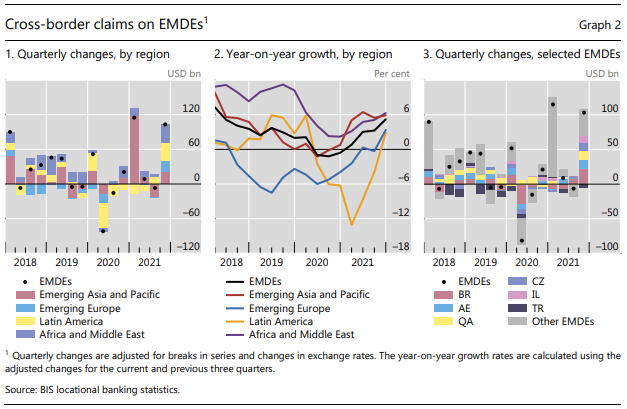
Internationally active banks’ outstanding claims amounted to $35 trillion at end-Q4 2021, virtually unchanged from the previous quarter on an exchange rate-adjusted basis (up only 1.6% on YoY basis)
This masks some underlying shifts across geography and sectors. Claims on EMDEs rose substantially ($103 billion) while those on AEs and OFCs declined. Claims on unrelated banks were lower, but rose on related offices and on non-financial borrowers. Also up fo USD, down for EUR
Attention dollar funding geeks!!
We have uploaded a substantially revised version of the paper "Global banks, dollar funding, and regulation"
--> bis.org/publ/work708.p…
tl;dr: establish bargaining frictions as an
important driver of price dispersion in USD funding markets🧵
US dollar funding is the lifeblood of international banking, and non-US global banks have a very
large footprint in dollar banking despite their restricted access to core dollar deposits and central bank backstops.
We show that pricing in the very deep & liquid market for dollar funding where global banks source dollars from US MMFs is far from competitive. We first document persistent and significant price dislocations in these wholesale dollar funding markets.