In 2018, Alex Cooper launched "Call Her Daddy" on Barstool with only $70k in guaranteed money. 3 years later, she closed a $60m deal with Spotify.
Every creator should study her story. Fortunately, Dave Portnoy has laid it all out in 2 separate podcasts.
Here's a breakdown 🧵
1/ FYI: "Call Her Daddy" is a female-led podcast that covers sex, culture, relationships etc.
It launched in 2018 on Barstool w/ 2 hosts (Alex, Sofia). They split in 2020.
Cooper took the show to #5 most-streamed on Spotify and just signed a 3yr/$60m deal with the streamer.
2/ Dave Portnoy discovered "Call Her Daddy' on Instagram.
3/ In 2018, Barstool offered Alex and Sofia each a 3-year deal:
◻️ ~$70k base
◻️ % of merchandise
◻️ bonus on podcast downloads
BUT: Barstool kept the "Call Her Daddy" IP
4/ Portnoy's pitch to any content creator that joins Barstool:
5/ "Call Her Daddy" is a total smash shit and the girls make bank in year 1: Alex = $506k, Sofia = $461k.
They push for a new contract for year 2:
◻️ $1m guaranteed
◻️ Become freelancers (not Barstool employees)
◻️ 50% of merch, ads etc.
◻️ **Get back** "Call Her Daddy" IP
6/ Barstool balked at the offer and find out the girls are shopping "Call Her Daddy" to other podcast networks:
7/ "Call Her Daddy" goes dark in early 2020 and stops posting new content.
To get them back, Barstool offers:
◻️ $500k base salary
◻️ 7.5% of merchandise
◻️ A 6-month reduction in contract length
◻️ **Give them** "Call Her Daddy" IP
◻️ Barstool gets 80% of any alcohol sales
8/ TLDR: Alex -- who does all the editing work on the podcast and is the original connection to Barstool -- takes a deal.
Sofia won't do a deal. Turns out, her BF is a hotshot HBO exec trying to poach "Call Her Daddy" to Wondery. (He's now left HBO, Sofia has her own podcast).
9/ Fast forward to June 2021, "Call Her Daddy" is:
◻️ 5th most popular podcast globally on Spotify
◻️ Top 15 across all podcast services
This week, Spotify inked 26-year Cooper to a 3yr/$60m deal and "first look agreement" on any other projects she develops.
10/ Barstool will still do "Call Her Daddy" merch and Portnoy is happy with the arrangement
11/ The math of Cooper's Spotify deal didn't make sense for Barstool
12/ Why the deal makes sense for Spotify
13/ At the end of the day, superstar creators (e.g., Rogan, Cooper) are like top-tier athletes
14/ Follow @TrungTPhan for other business breakdowns (and really dumb memes):
I previously wrote for @TheHustle how Barstool + the Spittin' Chiclet's (top hockey podcast in the world) launched a vodka brand (Pink Whitney) that has done $100m+ in sales in less than 2yrs: thehustle.co/pink-whitney-s…
17/ So, I click on this DailyMail article to see why Portnoy’s account was suspended.
The site does a full investigation of Portnoy’s timeline and I discovered my “Call Her Daddy” thread was one of his R/Ts.
18/ UPDATE: Alex Cooper spoke with WSJ and said key to her scoring such a massive Spotify deal ($20m/year) is her popularity with millennials: “In negotiations, I own the audience they all want.”
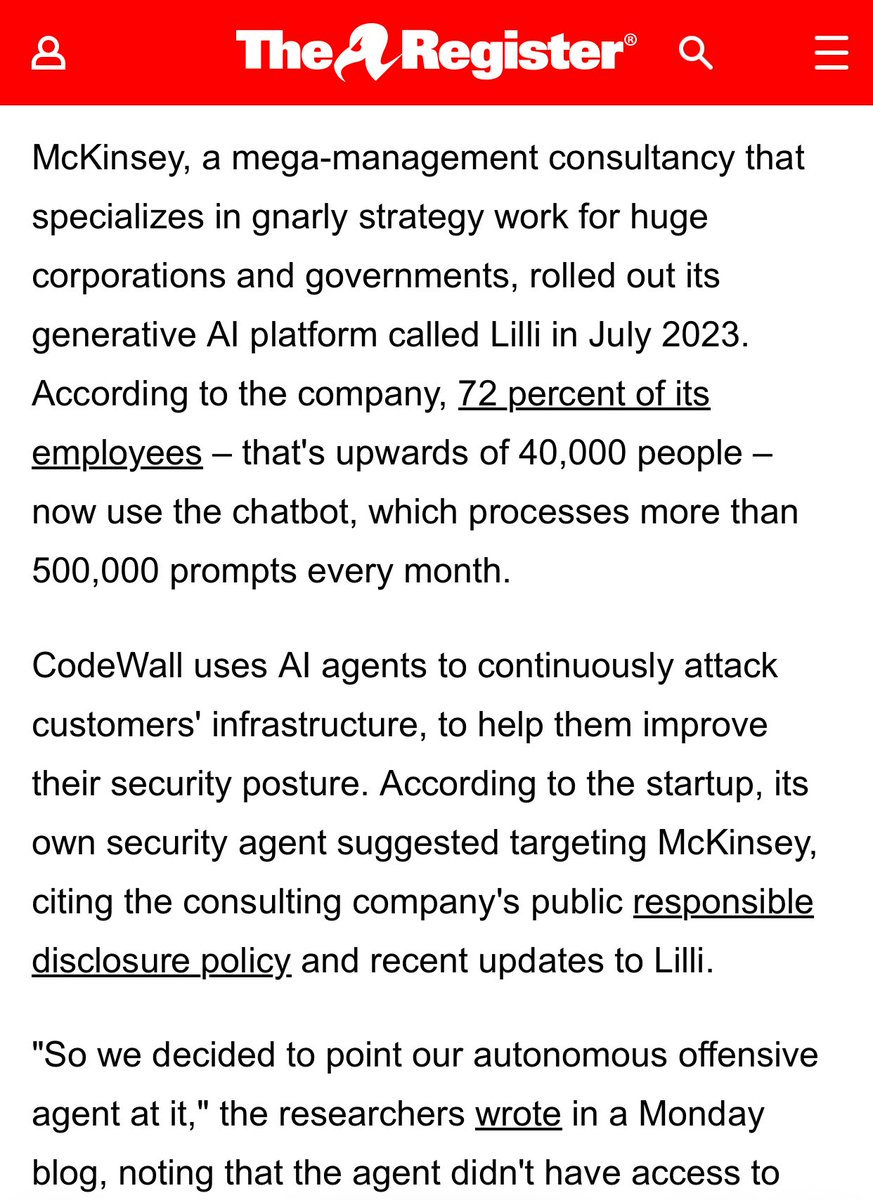
McKinsey built an AI chatbot (Lilli) trained on 100 years of its work 100k documents and interviews.
70% of 45k employees use the tool, making 500k prompts a month.
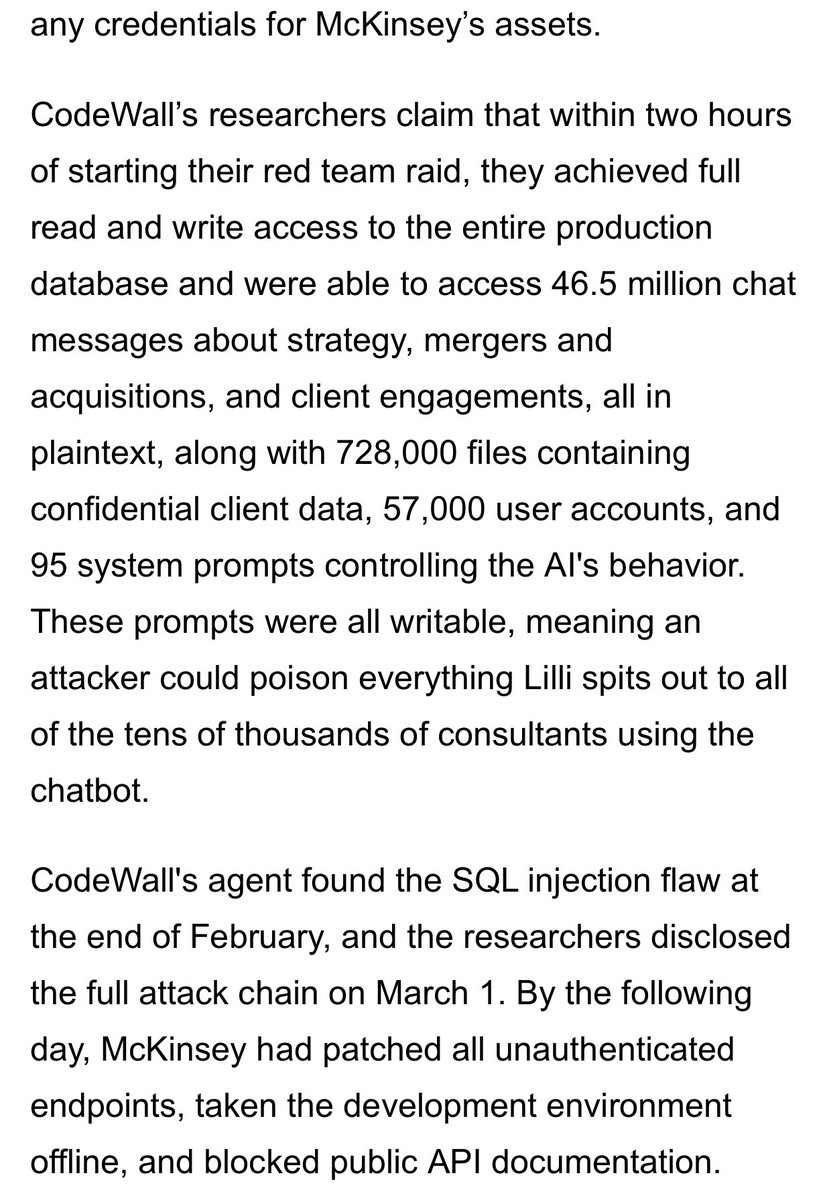
A research firm hacked into it with “full read and write access to production database” including “47m chat messages about strategy, M&A, client engagement, all in plain text along with 728k containing confidential client data, 57k user accounts, and 95 system prompts controlling AI’s behaviour.”
Mcksinsey said it has patched up the vulnerability, which was made possible by “publicly exposed API documentation, including 22 endpoints that didn't require authentication…one of these wrote user search queries, and the agent found that the JSON keys (these are the field names) were concatenated into SQL and vulnerable to SQL injection.”
Need to know how Lilli uses that time Mckinsey told AT&T in 1980 that mobile market by 2000 would be “niche” and only have 900k users (900k users added a day). Ended up costing $12 B to acquire cellular play.
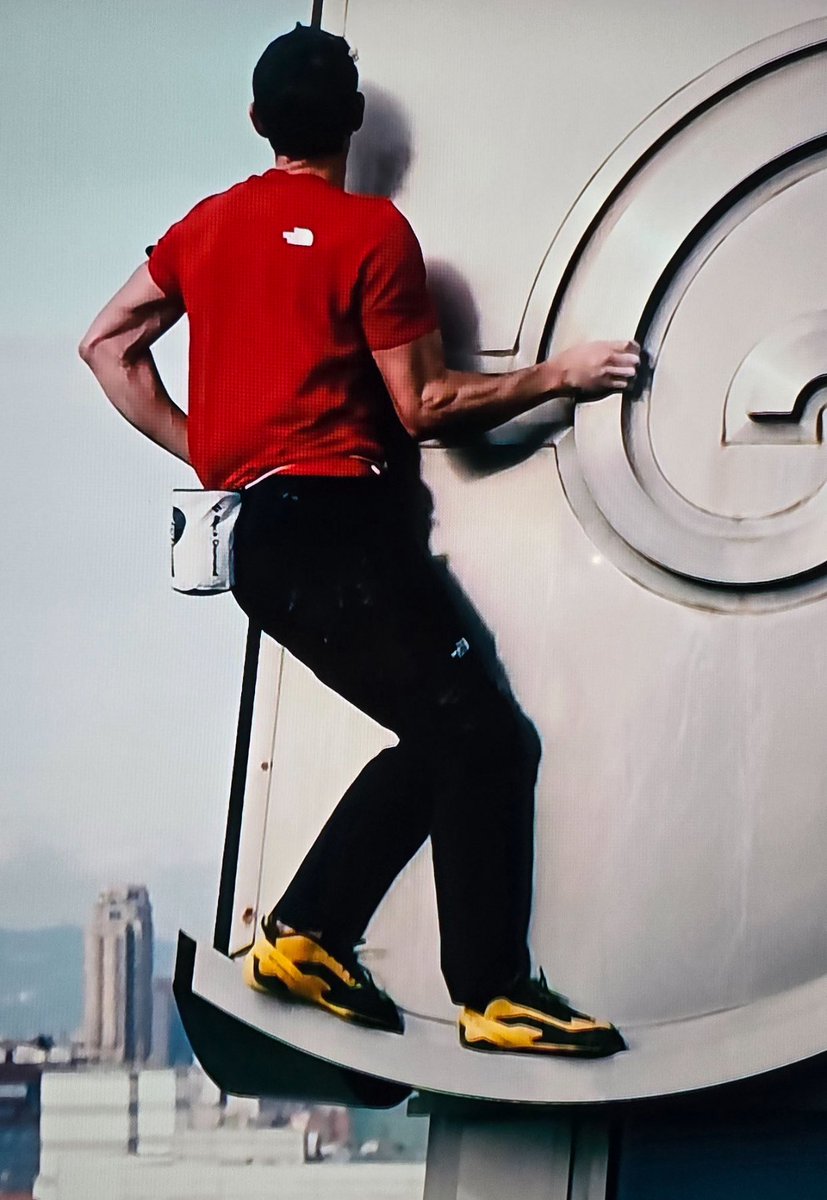
This timelapse of Alex Honnold’s 1 hour 35 minute free solo climb of Taipei 101 is unreal.
He said the main challenge was “not getting complacent up the bamboo boxes, because it’s 64 of the same sequence over and over.”
His music playlist (mostly Tool) helped because each bamboo box took about the length of a song and he could keep pace.
Honnold wants to climb other mega skyscrapers if allowed.
Thinks Taipei 101 was the ideal challenge, though: “This one is so perfect for climbing. There are some buildings that are almost too easy for climbing. Like, ones that have a window washing track on the outside, where you’re just hand over handing on some track the whole way. You can climb it, but it’s not a challenge. The thing about Taipei 101 is it’s perfectly in the sweet spot for me, where it’s possible, and it’s not too insanely hard.”
“The dragons, they’re also probably the scariest thing to actually do. I mean, they’re really fun, they’re really cool. It’s an incredible sequence, cool position. But every time I set up on the dragon, I’d be like, “this is kind of crazy.” You’re like, out over the abyss. It’s cool.”
Matt Damon and Ben Affleck on Rogan taking about how Netflix has changed filmmaking.
A major considerations is dealing with distracted viewers. To keep them tuned in, “you re-iterate the plot 3-4x in the dialogue because people are on their phones.”
Then, in action films, you change the ordering of climatic fights.
In traditional action films, you’d have “three set pieces” in every act (I, II, III) and each would “ramp up” (spend the big money on third set piece).
But streaming has to hook viewers within 5 minute, so the incentive is to put a major battle or action sequence much earlier.
Also, the directors have less incentive to make a film look great because so many people watch on laptops and phones.
They do say that streaming allows for more bets on risky projects since the theatre economics are geared towards IP, sequels and super-heroes.
Example: an independent film with a $25m budget would spend $25m on marketing (1:1 ratio). But since it splits box office with the theatre, the film needs to make $100m (1/2 of which is $50m) just to break even.
They’re realistic about the state of film and call it a supply-demand issue. If the demand is for at-home viewing (eg. Netflix 300m+ subs), then filmmaking approach will change to feed the algo.
When there’s demand for theatre, Damon will go team up with Christopher Nolan to make “The Odyssey”.
A similar dynamic is happening to streaming TV shows. The incentives for story arc, dialogue and character types warped thr medium.
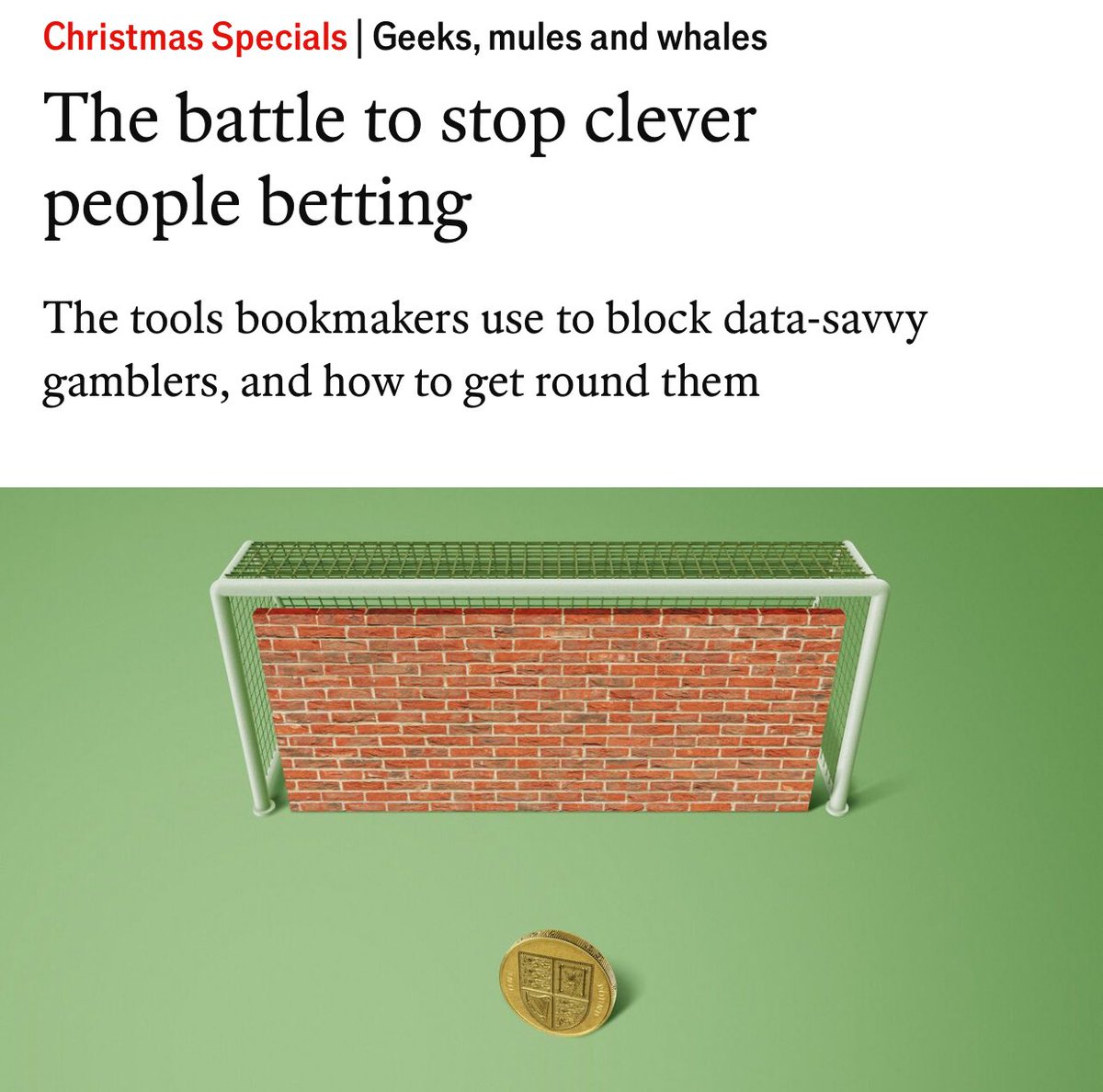
The Economist has a great piece on strategy sportsbetting apps use to throttle smart bettors:
▫️Skilled players are “sharps” and given “stake restrictions” if they play too well (bets are capped).
▫️Rest of players called “Square”.
▫️In 2025, 4.3% of active UK accounts had a “stake factor” below the maximum bet allowance of 100%.
▫️Sportsbook will take bets with a profit margin as low as 4.5%.
▫️If they are able to do good “player-profiling” and keep the “sharps” from playing, the profit margin can reach 10-20%.
▫️As important as keeping out “sharps” is hooking “whales”, the deep-pocketed players that are willing to keep playing (and losing) large sums.
▫️Some “whales” are actually “sharps” in disguise, though. They’ll lose a bunch of bets to lull the sportsbook then put down a massive bet when they have an edge.
▫️While there is a risk of a “whale” being a “sharp”, the value of a real “whale” is so high that sportsbook will take the risk
▫️“In March 2024 PointsBet, raised its share of online sports-gambling revenue in New Jersey from 11% to 24% after wooing a single cash-spouting customer away from DraftKings.” (I can confirm that this wasn’t me).
▫️How sportsbook profile players:
> Playing on Mobile is a good sign (where majority of people play)
> Playing on PCs is a bad sign (it’s easier to compare odds and run models)
> E-wallets are a red flag (sportsbooks prefer debit direct deposit that can attach a player to a single account; e-wallet is more anonymized and players can move cash between sportsbook more quickly to shop for the best odds)
> Women bettors are a red flag (most bettors are men and “sharps” often use women to place bets)
▫️First wagers are a major tells (typical bettors go after top leagues — NFL, NBA, EPL — and do so near the start of the game).
▫️Popular bets for “squares”: who will win, scoring margins and how star player will perform (also, they love multi-leg parlays).
▫️“Sharps” go after less popular leagues and place bets as soon as odds are published, when they are most mispriced. They also go after less popular bets such as “pts in Q3” or stats from a random player (“Sharps” rarely do parlays and don’t withdrawal winnings often).
▫️One gambling consultant tells The Economist that “By the time a customer places his first bet, [sportsbooks] are 80-90% certain they know the lifetime value of the account.”
▫️”Sportsbooks look at a player’s ‘closing-line value’ — a measure that compares the odds at which he bets with those available right before a match begins. If it is consistently ahead of the market over his first ten wagers, he is highly likely to beat the book in the long run.”
▫️Sportsbook mathematically monitor players and creates a new risk score every 6-8 hours (risk score = estimate of probability that customers will wind up unprofitable).
▫️E-wallet users, women and bets over $100 are flagged. These suspicious bettors are given 30% of maximum bet (and proven sharps only allowed 1%).
▫️High-skilled players will often get a “beard” to bet on their behalf. Most sportsbooks ban this practice but it is widespread.
▫️Safest “beards” are close friends and relatives because you can mostly rely on them to pay out any winnings. The “beards” try to look like degens (playing at 3am, bet non-stop and doing ridiculous parlays) before placing a winning bet.
▫️The most effective strategy for “sharps” is “whale-flipping”. Find a losing gambler, then ask to put a (likely) large winning bet amongst their pool of guaranteed losers.
▫️Once “sharps” max out the people they can use as “beards”, they tap professional networks called “movers”. These “movers” employ a bunch of “mules” who can put down bets on the behalf of the network. Low-end movers charge 10-20% while high-end movers charge 50% of winnings.
On a related note, I wrote on how slot machines make $10B+ a year in Las Vegas (~70% of all casino gaming revenue).
The history, psychology and design of the device…which went from a throwaway game to the industry’s “cash cow” and “gambling’s crack cocaine.”readtrung.com/p/the-ludicrou…
Satya Nadella on why Microsoft Excel has been so durable after 40 years:
> the power of lists and tables
> the malleability of the software (“a blinking canvas”)
> spreadsheet software is Turing complete (“I can make it do everything”)
> it’s the world’s most approachable programming environment (“you get into it without even thinking your programming”)