I am pleased to introduce the Chinese Invisible Cities Index (CICI) - some Friday fun. 😏
These aren't the smallest or poorest cities. These are the cities with the least aura vs. their population.
They make you say: "wait, I've never heard of it and it has HOW many people?"🧵
My methodology for the CICI was as follows:
Start with a normalized value for their registered hukou population (户籍人口), not current inhabitants (常住人口). That's considering the entire prefecture population, not just the metro downtown, because anyone or any part of a prefecture can contribute to reputation creation.
After that, subtract for anything that gives the prefecture city aura, name-recognition, any kind of notability at all. That includes things like:
- being a provincial capital
- having famous tourist attractions (esp. 5A)
- having a national brand headquarters
- having historical or cultural significance
- famous cuisine/dishes
- any memes associated with the city
- being the site of a major disaster or scandal (negative reputation is still reputation)
- having anything else that people think of when you mention it
The highest scores after subtracting become the leaders on my CICI. This methodology allows me to find not just the small and obscure cities, but specifically *cities that are far less famous than their population suggests they should be.* The data part of this was AI-assisted.
I haven't been to most of the places on this top 15 list - because I'd typically travel to places that have notable economic or touristic activity - which by definition perform worse in the CICI. 🤔
And look, I know almost every city has a bit of *something*, or else there wouldn't be be a city there at all. It's all relative, and subjective, and for fun, so if you want to disagree with the list, just be nice about it.
A clean example of a low-aura city. Has a *bit* of stuff going on (natural gas, Han ruins, a canyon) but nothing at a national presence level. Population not enormous, but very little happening to associate with the name.
China's 15th Five Year Plan on Energy - Summary and Commentary Thread
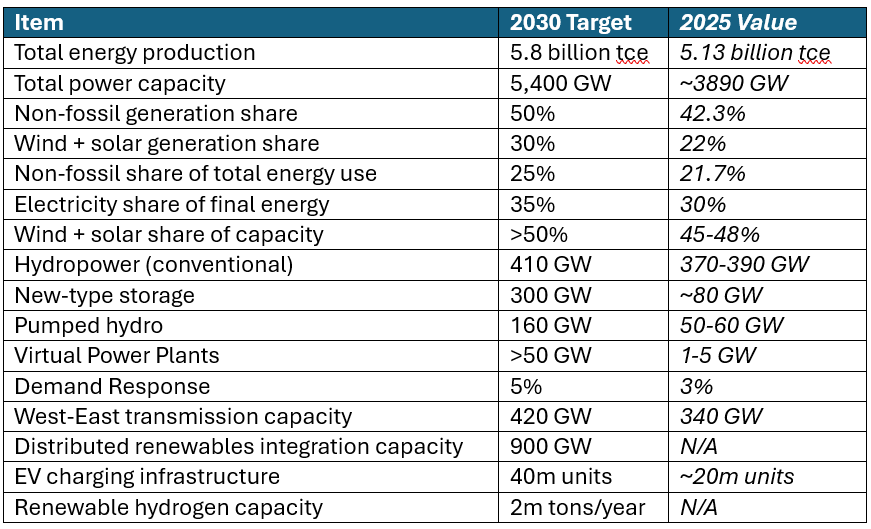
On 25 June, the NDRC and NEA issued the 15th Five Year Plan (FYP) on Construction of a New Energy System. This is the key energy-related supplement to the main FYP released (in draft) back in March. 🧵
(LinkedIn repost btw)
The 15th Energy FYP lays out China’s energy objectives for 2026-2030, with emphasis on how the energy system will be structured around growth in end-user electrification, flexibility assets, and higher shares of clean energy before the 2030 carbon peak.
A few comments on the installed capacity numbers:
It looks like a big deal to add 1500 GW of capacity, but it's less stunning when you remember that most of it will be solar. In fact, the total wind + solar capacity growth needed to meet the targeted rise in wind + solar generation share is fairly modest, assuming annual power generation growth remains in the ~5% range annually.
It's notable to see hydropower projected to rise another 20-40 GW before 2030. There are no large-scale hydropower facilities under construction right now that will be complete before 2030, so this implies 10+ medium-small hydropower stations, which is remarkable considering the already high saturation level.
The planned expansion in flexibility assets is the most notable item here though. New-type battery storage is set for 4x growth (this will be mostly batteries but also a bit of CAES and thermal/gravity/other oddities) and pumped hydro is set to 3x (there are a stunning number of pumped hydro stations under construction across the country right now). Finally, VPPs are expected to grow from a negligible/pilot level of deployment in 2025 to 50 GW of flexible dispatchability by 2030, which looks like a big opportunity, but a very complicated one, for some bold developers and asset operators.
Finally, West-East transmission capacity set to grow by 80 GW...that means UHV lines - probably roughly 10 more of them, based on their average carrying capacity. I don't have a recent update to my UHV line database, unfortunately.
Had an educational conversation with a farmer last week in the Shanghai suburbs. He approached me while I was relaxing next to one of the canals and asked me if I had ridden my bicycle there (I had). We then started chatting about agriculture in SH.
"Where are you from?"🧵
"I'm from Anhui."
"Of course, Anhui. Maybe of the people working fields in the suburbs in Shanghai are from Anhui. I noticed before all of the strawberry greenhouses have Anhui people."
"It's not just strawberries. Almost all the agricultural work in Shanghai is done by outsiders. There are many of us from Anhui. Also some Henan, but mostly Anhui."
"So do you rent the land?"
"A big boss rents the land from the Shanghai people, then they divide it into smaller plots and rent it out to us."
"Where is the big boss from?"
"Also Anhui."
"Okay, so the big boss comes in, negotiates many land lease agreements with the Shanghai people here who don't want to farm the land anymore, and then makes a business renting that last back out to you. Do you live here all year round?"
"No, we go back between planting seasons."
"Do you still have fields back in your hometown?"
"We do, but most of them are rented out to big companies, to do large-scale farming."
"So you rent our your fields back home to big companies to do large-scale farming, and then you come here to the Shanghai suburbs to do small-scale farming?"
"Yes, that's right"
"Why?"
"Because the large-scale farming requires knowledge of modern machinery that we don't have. You have to learn how to fly drones, understand new technology. People like me, more than 50 years old with low education level, we can't learn those things fast enough, so the large-scale agricultural companies don't hire us. We can only come to Shanghai for this kind of small-scale farming."
"I heard something before...I don't know it it's true. Someone told me people like you people from other provinces farming for Shanghai residents like to maintain their own, secret vegetables?"
"Haha, that's true. We keep our own vegetable fields here, and don't put pesticides on them, for our own consumption."
"That's funny. Shanghai has these farming areas in the suburbs to ensure its vegetable supply, but except the elderly Shanghai locals, there's no one willing to work in the fields, so they have to bring farmers from Anhui. But those farmers prepare their own organic vegetables in Shanghai fields...for themselves."
"haha, it's ironic isn't it?"
This Economist article on China's solar industry has some problems.
I won't waste ink getting all hyperbolic about it. I'll just highlight the places where I think a healthy copy-edit could have helped the piece a lot. 🧵
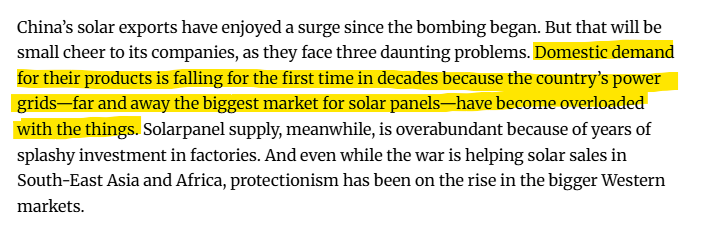
It is a major oversimplification to say Chinese domestic demand for solar panels is falling "because the country's power grids have become overloaded with the things".
The real challenge right now is developers and banks still figuring out how to finance and build projects without policy-backed revenue guarantees.
Domestic demand was shored up in past years by a generous feed-in-tariff (FiT) scheme that ensured stable and predictable revenues. Following the the longstanding policy trend toward liberalization, last year solar generators were shifted out of FiTs and into a Contract-for-Difference (CfD) scheme. Guaranteed CfD volumes have quotas, with non-CfD volumes expected to find customers via open markets (i.e. merchant exposure). The piece acknowledges the policy change from last year, but doesn't seem to recognize the importance.
New solar capacity growth will likely be flat or even decline YoY in 2026 because generators and financiers are still inexperienced with merchant risk and renewable consumption quotas aren't quite high enough yet to drive more long-term renewable power contracting demand (which financiers rely on).
Yes, low prices in daytime spot power markets reflect temporal oversupply, but that's largely irrelevant for investment decisions, which are built around long-term contracts, not spot markets.
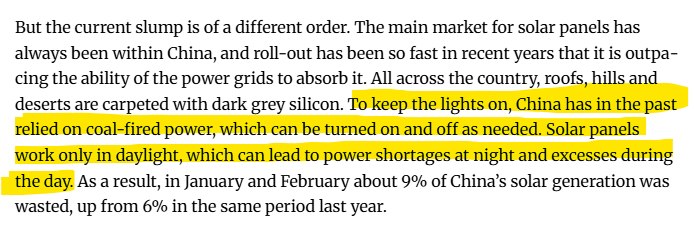
The cause-and-effect relationships in this paragraph are backwards.
If you're explicitly trying to build a low-carbon grid, solar curtailment is better seen as a problem of insufficient flexibility (via storage or conventional generators), not "too much solar."
Conventional coal typically can't ramp up or down quickly...in many cases in takes hours, sometimes the better part of a day for older plants. It is the lack of flexible coal plants that leads to curtailment of assets you ideally don't ever want to curtail like renewables.
When solar performance peaks at noon, you need other assets to be able to rapidly ramp down to make room. Not incidentally, the new Chinese coal plants being built these days are capable of flexible operations, and older plants are being retrofit to do the same.
Finally, there are no "shortages at night" because of solar only working during the day. System operators plan for the sun not shining...
This post got me thinking about the interesting way small Chinese cities self-identify vs. the city that governs them.
The Yangtze River Delta is full of small cities with strong cultural and economic identities that have weak or zero feeling of kinship with their parent... 🧵
I've mentioned before in other essays how discussions of Chinese cities are usually focused on prefecture-level cities (地级市).
There are 337 prefecture-level cities in China, but IMO it's more appropriate to mentally organize them as "prefectures" in English (that is, an administrative tier smaller than a province and larger than a city).
For ease of governance purposes, many cities and counties in China are grouped together into "prefectures" in ways that aren't linguistically, historically, or culturally coherent; often they are simply geographically adjacent.
In this example, Robert was visiting Fenghua, which until 2016 was a county-level city governed by Ningbo (it is now a full district of Ningbo).
If we look at the administrative map below, we can see the denser urban area of what most people would recognize as "downtown Ningbo" (Jiangbei and Zhenhai) along with a large halo of suburban and exurban regions also governed by Ningbo. This is why I prefer a word like "prefecture" to translate 地级市. These areas not continuous urban agglomerations.
This thread is a deliberately nerdy look at Chinese administrative geography, but I think the outcome is helpful for understanding why people from small cities like Yuyao might not answer a simple question the way outsiders expect, and how we can think about these cities from a development perspective when we visit.
The small city of Yuyao (population ~1.3 million) in the northern part of Ningbo prefecture, is a particularly vivid example of strong place-identity. Just south across Hangzhou Bay from Shanghai, Yuyao's downtown is physically separated from Ningbo proper by about 70 kilometers. So...it is "part of" Ningbo?
*deep breath*
The modern-day prefecture-level city immediately west of Ningbo is Shaoxing (best known today for Shaoxing cooking wine). In pre-modern times, Yuyao (余姚) was governed as a county under Shaoxing - whether as Shaoxing Prefecture or the Shaoxing Circuit, depending on the era - during the Song, Ming and Qing Dynasties. During the Republican era (1911-1949) it belonged to various Zhejiang provincial offices, but *never* to one headquartered in Ningbo.
After the Communist victory in 1949, Yuyao became part of Zhejiang’s Second Special District, which had its administrative seat in Ningbo. It held that status from 1949 to 1964, before once again being reassigned to Shaoxing, this time under the Shaoxing Special District. When modern administrative reform began in 1983, Yuyao was transferred to the newly established prefecture‑level city of Ningbo, arguably the first time in its history that it was formally "part of" Ningbo (or perhaps the second, if one counts 1949–1964).
Following the sustained economic growth in the area (Yuyao is one of the ten richest county-level cities in China) the county was upgraded in 1985 to county-level status, This concluded Yuyao's long historical evolution to its current position: a county-level city administered by Ningbo.
Compared to Ningbo, Yuyao maintains a distinct history, economy, culture, and even dialectal markers. Yuyao and Ningbo speak mutually intelligible varieties of Taihu Wu, but Yuyao's speech is considered by locals as being closer to Shaoxing than Ningbo.
All of that makes the answer to the next question more obvious: If you ask someone from Yuyao "are you from Ningbo?" what answer do you think you're going to get...?
I rented a place for 5 days in this lovely seaside apartment complex in Bo'ao, Qionghai City, Hainan.
The same housing complex also had 12 lovely, unsold luxury villas, facing the ocean.
They were obviously abandoned and unlocked, so I gave myself a tour...😁
A fun thread. 🧵
As you can see, these units were designed to be quite fancy, with 4-5 bedrooms, pools, balconies facing every direction, a vaulted ceiling in the living room, even an elevator...
This complex was completed in 2013. The apartments all sold alright. But not a single villa...
After my self-guided tour, I walked back into the inhabited part of the complex and bumped into an middle-aged man from Beijing (maybe 65ish), energetically doing his morning stretches while listening to a program on a portable radio at roughly 1000 decibels. I decided to ask if he knew what's up.
"HELLO SIR GOOD MORNING!"
"GOOD MORNING!"
"CAN I ASK YOU SOME QUESTIONS?"
He blessedly turned down the radio to a more humane level. "Sure. What about?"
"You live here, right? Do you know what's the deal with these villas? Are they all empty?"
"Yes, they're all empty. No one lives there. I've stayed here the last few weeks. We are traveling up the coast from Sanya, trying out the different areas to see where we would like to buy a property"
Image: Beijing uncle in his natural element (calisthenics and deafening radio)