In 1968 the Tanzanian Youth League launched Operation Vijana. Their target: women who wore miniskirts. Wigs, dyed hair & tight bellbottoms were also abolished. Here's a @Reuters clip from Dar es Salaam.
'It is foolish to wear clothes that show legs,' Nyerere declared. 1/3
Here's a TYL poster from 1968 illustrating 'appropriate' styles of attire.
For several months TYL 'Green Guards' roamed the city's streets, defrocking women found wearing clothing they deemed inappropriate. Also abolished: soul music from the United States.
3/3 By 1970 the campaign had largely run out of steam. Female students @UdsmOfficial organised marches defending miniskirts, routing the TYL with a chant of 'Get lost'. Girls at a youth hostel unanimously voted that 'men should not decide what women will wear'.
@UdsmOfficial There is some really great scholarly work about the cultural politics of Nyerere's Tanzania. My favourites: Andy Ivaska's terrific @DukePress book _Cultured States_ & Laura Fair's _Reel Pleasures_, a brilliant study of cinema & urban life @OhioUnivPress.
Today @RuhakanaR--Uganda's PM--handed over his office.
Dr. Rugunda has been a constant presence in public life. He first appears in the archival record in 1969, when--as VP of the Nat Union of Students @Makerere--he visited the US ambassador.
Here's the diplomat's report. 1/
2/ Rugunda was a high school student, about to enter university. The subjects of their discussion: the US's dismal treatment of black Americans & the ongoing war in Vietnam.
Two weeks later Rugunda was back at the US embassy with further criticism of the US war in Vietnam.
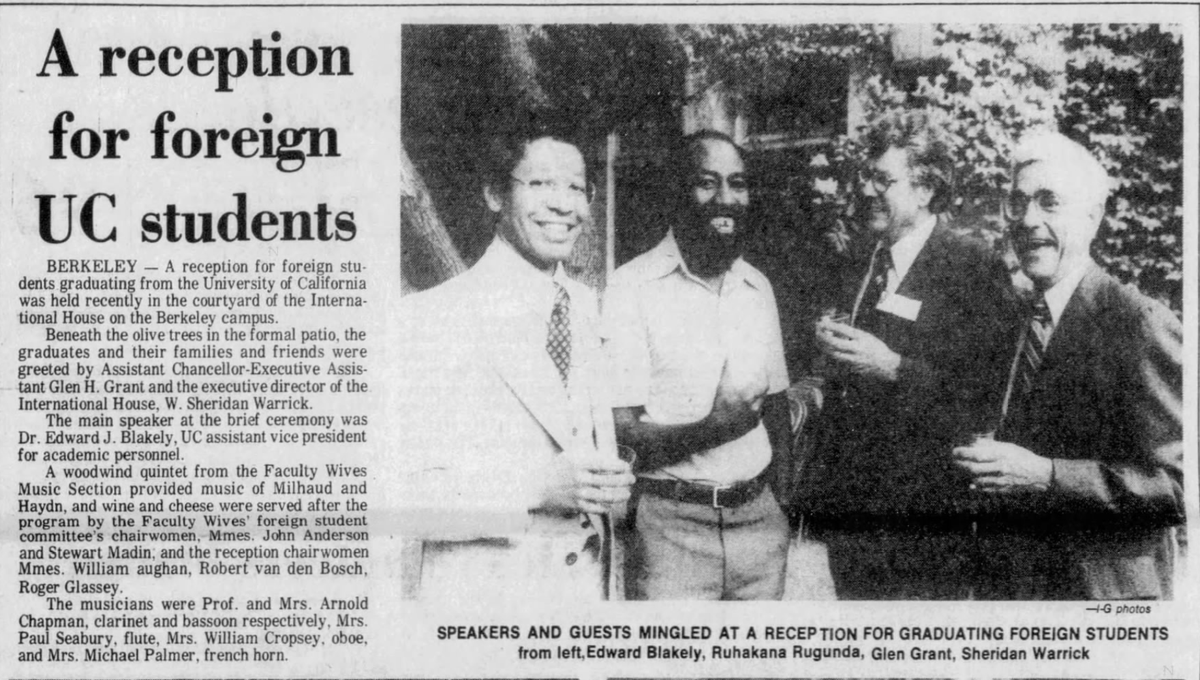
3/ After Idi Amin came to power many NUSU leaders went into exile. Rugunda went to @UCBerkeley, where he did an MA in Public Health. Photo below from 1978.
At 3 am on 1 Aug 1982 soldiers from the Kenya Air Force launched a coup against the gov't of Daniel arap Moi.
The airmen seized Eastleigh airbase & the Voice of Kenya in Nairobi. They called themselves the National Redemption Council.
Clip below from the morning after. 1/4
2/4 In an announcement--read by VoK's Leonard Mambo--they accused Moi of carrying out 'ruthless repression reminiscent of colonial days ... Moi's bandit gang is gone. People can now breathe'.
There was a great deal of looting in the CBD. Here's the cleanup the morning after.
3/4 Moi was in Kabarnet at the time of the coup, & much of the army leadership was in Lodwar.
A small group of officers stormed the VoK, & then the army fanned out in Nairobi, searching for Air Force men. At least 3,000 people were arrested; 100 soldiers were killed.
Today, 20 Jan., is the anniversary of the assassination (in 1973) of Amilcar Cabral.
Cabral was the key figure in the independence struggle of Guinea-Bissau & one of the great theorists of African politics.
Below: youth in Dar es Salaam protest Cabral's assassination. 1/
2/ Cabral led the Partido Africano da Independência da Guiné e Cabo Verde. The party went to war against the Portuguese in 1956.
Here's Cabral in Dakar, May 1969. By then the PAIGC had freed 2/3 of the country. Cabral introduced civilians who'd been injured by Portuguese bombs.
3/ Cabral's PAIGC established schools in liberated zones & provided free education. They offered health care with the help of Cuban doctors; and PAIGC soldiers gave peasants training in agriculture, too.
The TAZARA railway was built btwn 1970 and 1975. It was to connect Zambia's copper mines to the port at Dar es Salaam.
The funds--over $400 million--came from Mao's China. It was China's largest aid project to date.
Here's Nyerere & Kaunda at the groundbreaking, Oct. 1970. 1/
2/ Nyerere & Kaunda hoped the railway wld help create economies freed from the control of the racist regimes of S Africa & Rhodesia.
By Aug. 1973 50,000 workers had laid 600 miles of track. Here's the ceremony when the workers reached Tunduma, at the border between TZ & Zambia.
3/ Here's Nyerere in 1970 defending his government's willingness to work with China.
When the skeptical interviewer asked about Mao--who had said that Africa was 'ripe for revolution'--Nyerere replied that 'I, too, say Africa is ripe for revolution'.
Today is the 60th anniversary of the assassination of Patrice Lumumba.
In Dec 1964 Jomo Kenyatta opened the Lumumba Institute on a 20-acre plot off Thika Road. Maurice Lumumba--brother to Patrice--was there for the opening.
2/ Building the Institute cost $140,000. Funds came in large part from the Soviets. It was headed by Bildad Kaggia, independent Kenya's most radical politician, who can be seen in the clip.
It was meant for the training of KANU party cadres. @guardian report here.
3/ There were two Russian teachers on the Lumumba Institute's teaching staff.
Here's Oginga Odinga receiving equipment from the Soviets for the Institute, Feb. 1965. There were a number of radio sets, and two Russian-made loud-hailing trucks.
In March 1909, at the end of his term as President of the US, Theodore Roosevelt departed for East Africa. He & his party traveled through Kenya, Uganda, the Congo & Sudan, arriving in Khartoum in 1910.
Below: 'Roosevelt in Africa', shot by Cherry Keaton w/ a hand-crank camera.
Roosevelt's trip was financed by the Smithsonian Institution. Altogether they killed or trapped 11,397 animals, most of which were pickled & sent back to Washington for display at the new Museum of Natural History.
The 'Zulu' dancers shown here were Masai, not Zulu.
The trip was a sensation in the American press, and even in the smallest newspapers there was a constant stream of coverage. It was the first time that most white Americans had reason to think about Africa.