A thread on the snippets (paragraphs & quotes) from the book ‘Why We Sleep’ by Matthew Walker 💤
One third of our lives, better read about it.
This thread will be updated as I read further & further.
1/ “Two-thirds of adults throughout all developed nations fail to obtain the recommended eight hours of nightly sleep.”
Imagine if you don’t have that rare ‘short sleep’ genes 🧬 that allows you to do will less than 5 hours of sleep 🛌.
2/ It’s going to get ugly.
3/ Pandemic.
4/ Why to learn about sleep.
5/ ‘Are there any biological functions that do not benefit by a good night’s sleep? so far, the results of thousands of studies insist that no, there aren’t.’
Nature, the most magnificent architect.
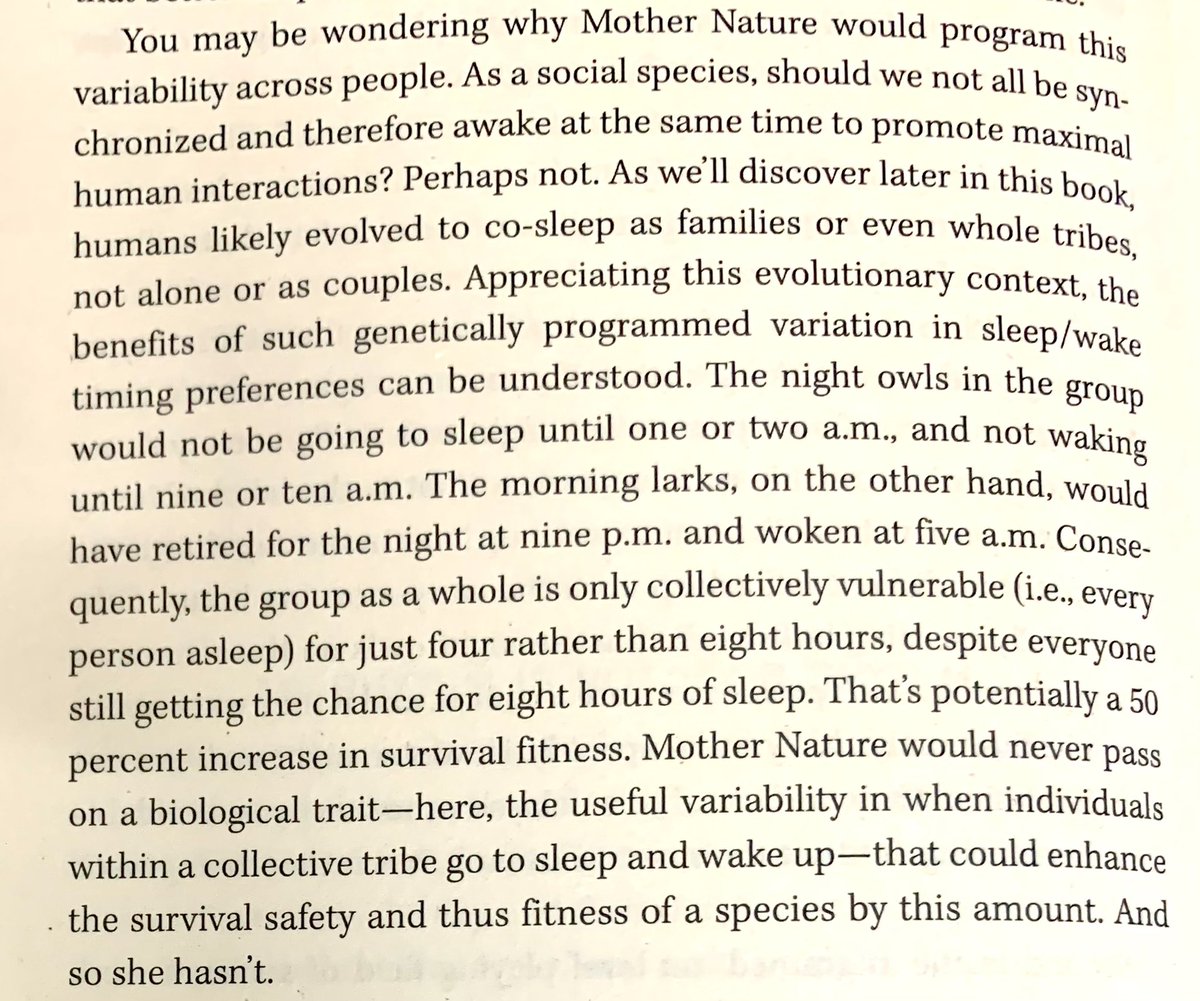
6/ Morning Larks & Night Owls 🦉
7/ The evolutionary reason for ‘6/‘
8/ The most widely used (& abused) psychoactive stimulant in the 🌎
9/ Are you in a state of chronic sleep deprivation?
10/ The sleep cycle, each is 90 mins.
REM sleep aka Rapid Eye Movement sleep aka Dream sleep.
11/ Which came first? Sleep 🐓 or wakefulness 🥚
12/ Which type of sleep- NREM or REM sleep is more important?
13/ There is a simpsons episode where dolphins 🐬 take over the world. Why it’s possible 👇
14/ How do birds sleep during transoceanic migration?
15/ Afternoon nap is biologically ingrained.
16/ Be kind to teenagers.
17/ The Trillion $ Drug.
18/ Macbeth: Act two, scene two (1611)
Shakespeare prophetically states
“Sleep that knits up the raveled sleave of care,
The death of each day’s life, sore labor’s bath,
Balm of hurt minds, great nature’s second course,
Chief nourisher in life’s feast.”
In simpler words:
Sleep that soothes away all our worries. Sleep that puts each day to rest. Sleep that relieves the weary laborer and heals hurt minds. Sleep, the main course in life’s feast, and the most nourishing.
19/ Why All-nighters before exams never work.
20/ Practice is not enough to reach perfection.
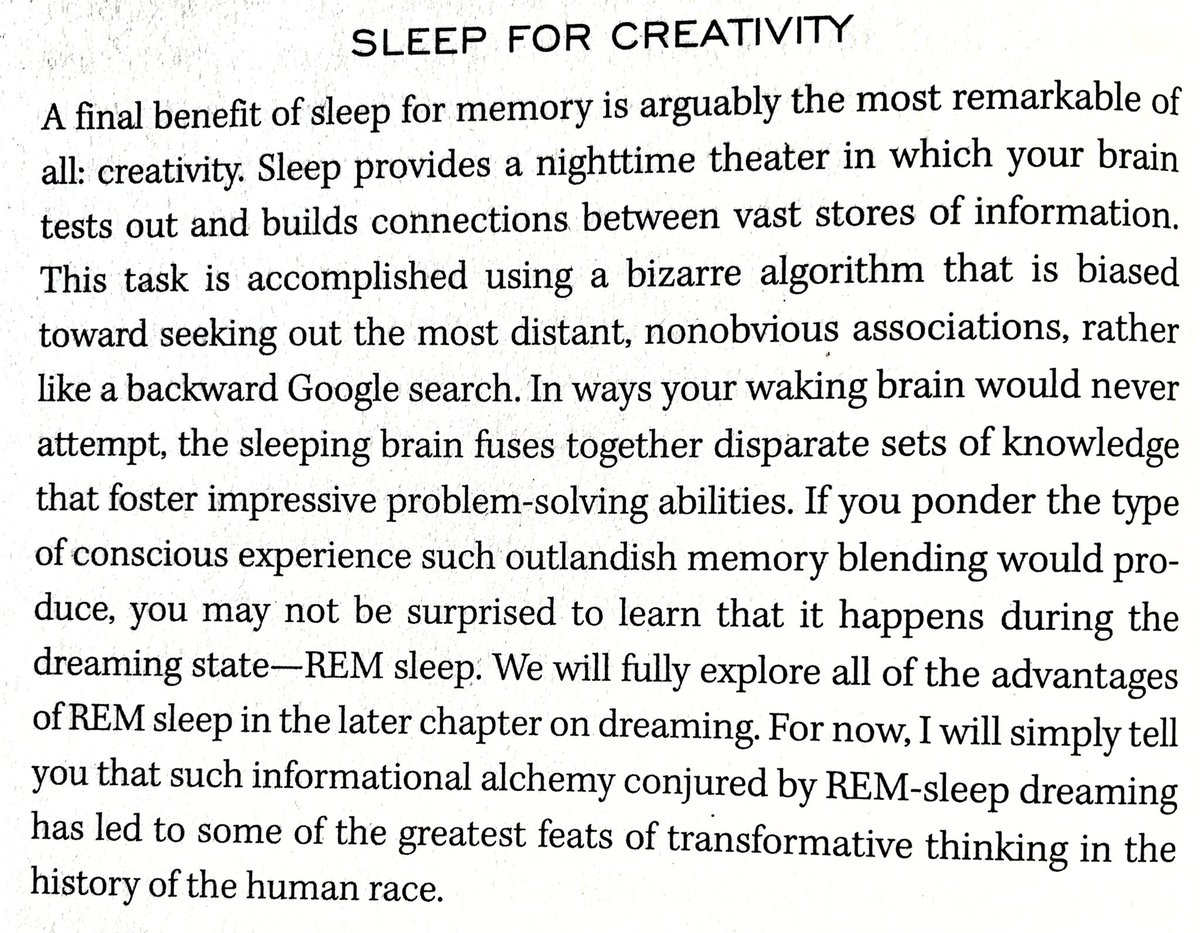
21/ Google in your 🧠 ?
22/ Guinness 📚 of 🌎 records.
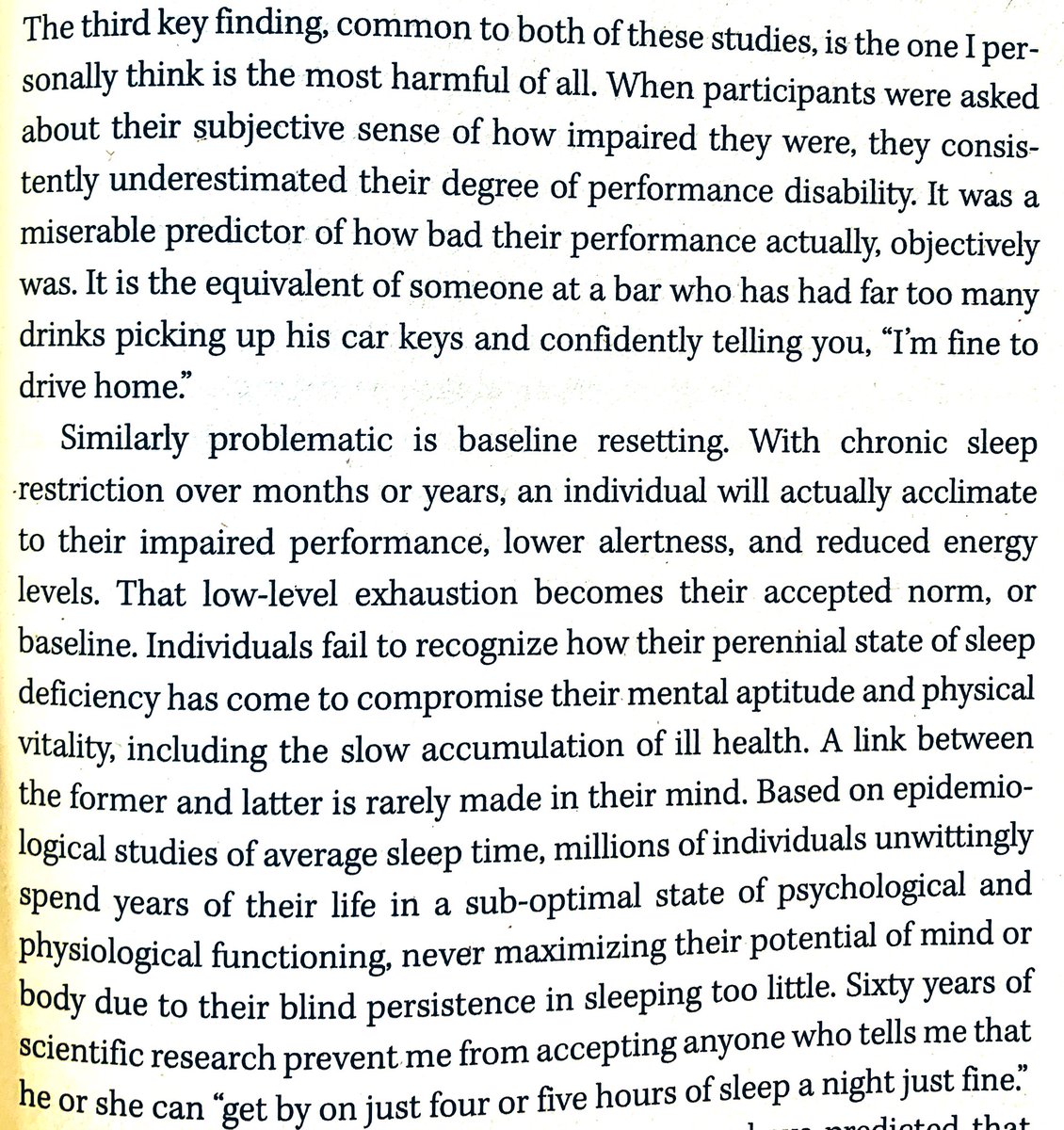
23/ YOU DO NOT KNOW HOW SLEEP-DEPRIVED YOU ARE WHEN YOU ARE SLEEP-DEPRIVED.
24/ In USA, Vehicles accidents (12 lakhs per year) caused by drowsy driving exceed those caused by alcohol & drugs combined 🤯
25/ A terrible story that could have been avoided
26/ “The recycle rate of a human being is around sixteen hours. After sixteen hours of being awake, the brain begins to fail. Humans need more than seven hours of sleep each night to maintain cognitive performance.”
27/ Remember the movie ‘Ghajini’
28/ A 5x increase in the getting of cardiac arrests.
29/ Afraid of gaining weight? 😴
30/ 🍁 (this leaf, but in green)
31/ How to loose weight effectively.
32/ On Testosterone.
33/ On Vaccines 💉
34/ Dreaming provides closure.
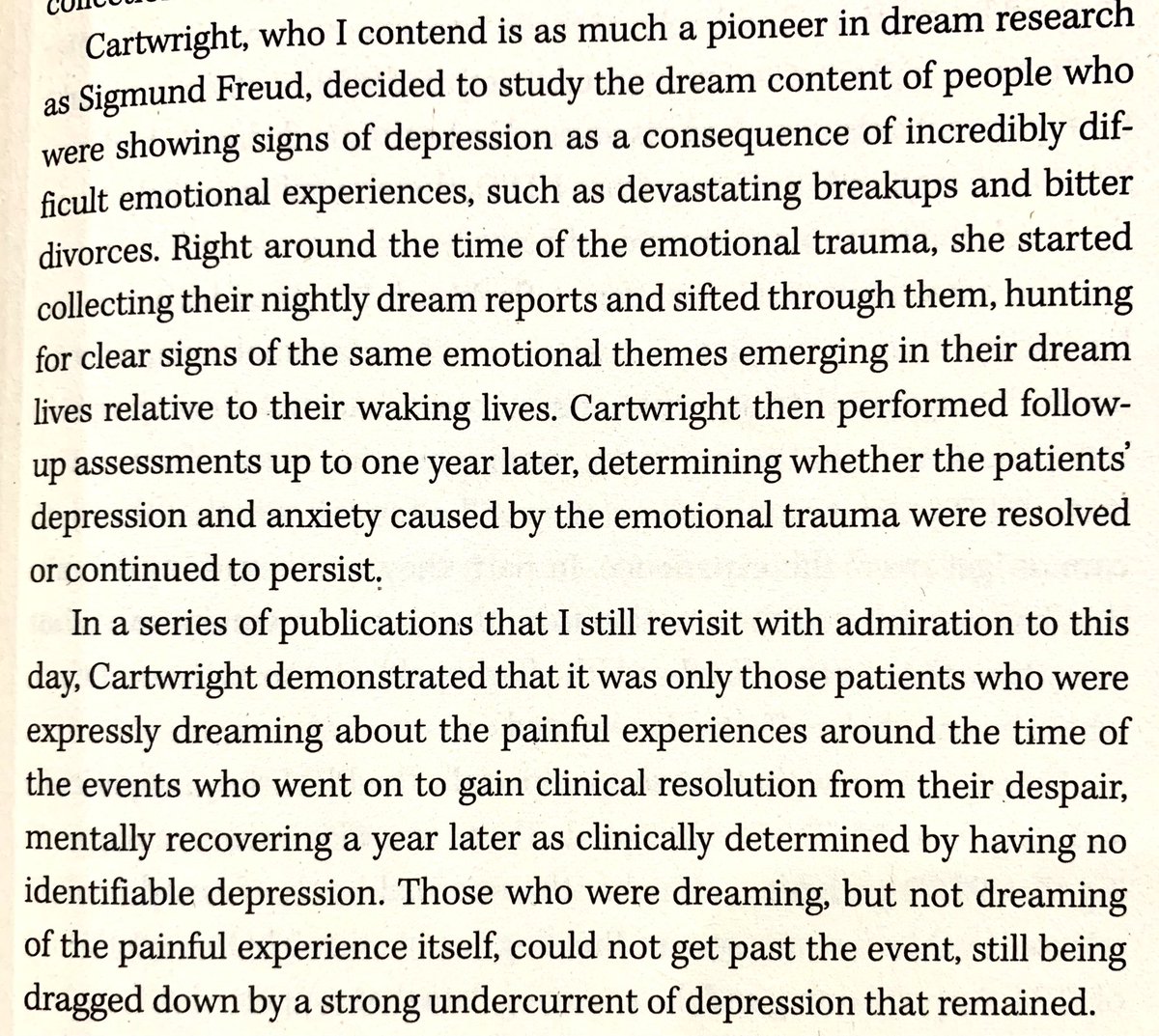
35/ Creativity via dreaming.
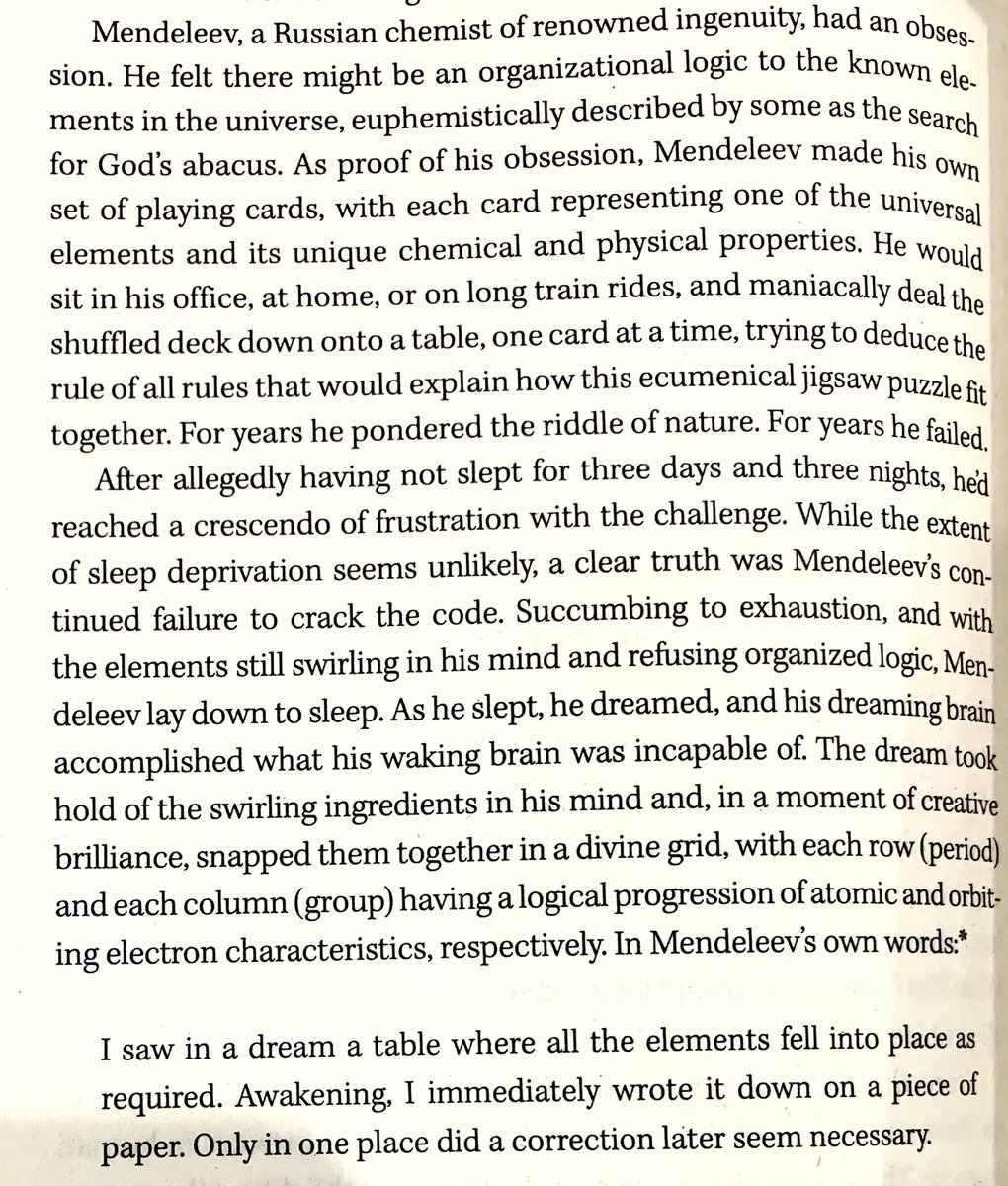
36/ He saw that in a dream.
37/ 2 of the best Beetles songs.
• • •
Missing some Tweet in this thread? You can try to
force a refresh

If you're under 53 years old, you have never once been alive while a human was farther than 250 miles from Earth. Tonight, four astronauts are heading 252,000 miles out. That's a thousand times farther than any person has gone in your lifetime.
The 250-mile ceiling is where the International Space Station floats. Every astronaut since December 1972 has been stuck in that zone. Spacewalks, science experiments, cool photos from orbit, sure. But nobody left the neighborhood.
The last crew to go farther was Apollo 17. December 1972. Nixon was president. The internet didn't exist. Cell phones were 11 years away. The youngest member of that crew is now 90 years old.
The farthest any human has ever been from Earth is 248,655 miles. The Apollo 13 crew set that number in 1970, and they didn't mean to. Their oxygen tank blew up, and the emergency route home took them farther out than anyone before or since. Tonight's crew will break that record on purpose.
And the crew itself. Victor Glover becomes the first Black astronaut to leave Earth's neighborhood. Christina Koch becomes the first woman. Jeremy Hansen, a Canadian fighter pilot, becomes the first non-American to do so. When they come home, they'll slam into the atmosphere at 25,000 mph, faster than any human has ever traveled.
The Moon's south pole has ice. Water ice, sitting in craters so deep that sunlight hasn't hit them in billions of years. A 2024 NASA study found way more of it than anyone expected. You can split water into hydrogen and oxygen, which gives you rocket fuel, breathable air, and drinking water, all made on the Moon instead of hauled up from Earth. George Sowers at Colorado School of Mines calculated that Moon-made fuel could shave $12 billion off a single trip to Mars. The Moon is a gas station on the road to Mars.
NASA Administrator Jared Isaacman announced last week a $20 billion plan to build a permanent base at the South Pole over the next seven years, with landings every six months. China is developing its own lunar lander and spacesuit, aiming for a crewed landing by 2030. The Artemis program has burned through $93 billion so far, and the first actual surface landing is penciled in for 2028. There's a real question of who gets there first this time around.
Harrison Schmitt walked on the Moon in December 1972 as part of Apollo 17. He's 90. Asked about it this week, he sounded pretty relaxed. "Mars is attainable," he said. "We're humans. That's what we've always done."
The science behind this is wild. Your face has over 300 tiny filters sitting just under your skin. They’re called lymph nodes. Your entire body only has 400 to 800 total. And the drainage system connecting them has no pump at all, which is why a brush can do what you just watched.
I looked into this. Your lymphatic system is your body’s sewage network. It collects about 3 liters of leaked fluid from your blood vessels every single day and routes it back through those nodes for cleaning. But unlike blood, which has the heart forcing it around, lymph fluid moves using muscle contractions and breathing. That’s it. No backup system.
Because the vessels sit right under your skin, even light pressure from a brush or your fingertips can physically shove fluid toward the nearest node. So the de-puffing in this video is real. You’re watching fluid get pushed out of tissue in real time.
But the research gets weird. A 2025 study out of Seoul put 34 women on gua sha or facial rollers for 8 weeks. Both tools visibly slimmed the face by over 2mm (the point where you can actually tell with your eyes). The two tools work through totally different biology, which I didn’t expect. Gua sha loosens up tense facial muscles. The roller makes the skin itself bouncier, about 8.6% more elastic. Same visible result, two completely different paths to get there.
A Japanese team in 2022 took CT scans of 5 people before and after 2 weeks of daily facial massage. The cheek tissue got thinner and shifted upward on the scans. Wild result. But 5 people and no control group, so I’d slow down before calling that proof of anything.
The honest part. UCLA Health looked at all the evidence in January 2026 and concluded: if your lymphatic system already works fine, there’s no real proof this helps it work better. An anatomist at the Medical University of Innsbruck told National Geographic the same thing. Healthy lymph nodes don’t need the help.
That sculpted jawline you see in before-and-after clips lasts 1 to 8 hours, according to a certified lymph specialist. It’s a temporary fluid shift, and the fluid comes right back. The brush is also doing nothing your own hands can’t do. A lymphatic therapist told National Geographic straight up: you don’t need any tools, just your fingers.
The unsexy answer to long-term lymphatic health is exercise and drinking water. Your muscles are the pump this system was built to run on.
I write deep dives like this daily, @anishmoonka. Part 2 below.
Your skull is shrinking right now. By the time you’re 70, your eye sockets will be 15 to 20% wider, your upper jaw will have lost up to 15% of its height, and your jawbone angle will have opened by 3 to 7 degrees. None of this shows up in a mirror until it’s already happened.
Part 1 covered why lymphatic drainage works (300+ nodes, no pump, brush moves fluid). But fluid is temporary. The structural changes happening to your face over decades are way more interesting, and no brush addresses them.
Your face is built on three layers: bone, fat pads, skin. All three are falling apart at different speeds and making each other worse.
The bone layer. Your skeleton replaces itself roughly every 12 years. But after 35, the cells that break bone down start winning against the cells that build it back up. The damage hits three spots: your eye sockets (they widen, making your eyes look sunken), the upper jaw (it recedes, pulling your cheeks flat and deepening the nose-to-mouth creases), and the chin (where a dip forms that lets jowls pool). A 2010 University of Rochester study confirmed this using 3D CT scans of 120 adults grouped by age.
Then there’s the fat. Your face has at least 14 separate fat compartments, and they don’t age together. The deep ones (behind your cheek muscles, around your eye sockets) deflate first, and the shallow ones slide downward as they lose support from below. That downward slide is what creates jowls and deeper nose-to-mouth folds, starting in the mid-30s.
And on top of all that, the skin itself is thinning. After your mid-20s, you lose about 1% of your collagen per year. Collagen makes up about 80% of your skin’s dry weight, so by 60, roughly a quarter of what keeps it firm is gone. For women, menopause makes it worse: up to 30% disappears in the first 5 years after estrogen drops. The skin just drapes over whatever’s left underneath.
The part that stuck with me: a Smithsonian anthropologist told NPR that baby boomers, thanks to better dental care and fluoride, have skulls that look significantly younger than their grandparents did at the same age. Keeping your teeth matters. When you lose teeth, the jawbone absorbs the empty sockets and the shrinking speeds up.
One study found facial muscle exercise reduced facial bone loss by 25%. So the stuff that actually slows structural face aging is the same boring list from Part 1: exercise, keeping your teeth, calcium, vitamin D, sunscreen. The brush routine makes you look different for a few hours. This stuff changes how you look for decades.
A Danish scientist counted bugs on the same windshield, same road, same conditions, every year for 20 years. By year 20, 80% of the insects were gone.
In Germany, a group of volunteer bug scientists did something even bigger. They set traps in 63 nature reserves, not farms, protected land, and weighed everything they caught. Same traps, same method, 27 years straight. The total weight of flying bugs dropped 76%. In midsummer, when insects should be peaking, it was 82% gone. A follow-up in 2020 and 2021 checked again. No recovery.
In the UK, they literally ask drivers to count splats on their license plates after a trip. The 2024 count came back 63% lower than just 2021. Three years.
A 2020 study pulled together 166 surveys from 1,676 locations around the world. Land insects are disappearing at roughly 9% every ten years.
Here’s where it hits your plate. About 75% of the food crops we grow depend on insects to pollinate them, everything from apples to almonds to coffee. One 2025 study modeled what a full pollinator collapse would look like: food prices jump 30%, the global economy takes a $729 billion hit, and the world loses 8% of its Vitamin A supply.
Birds are already feeling it. North America has lost 2.9 billion birds since 1970. A study from just weeks ago found half of 261 bird species on the continent are now in serious decline, and the losses are speeding up in farming regions. The birds that eat insects lost 2.9 billion. The birds that don’t eat insects? They gained 26 million. That ratio tells the whole story.
One of the German researchers behind the 27-year study drives a Land Rover. He says it has the aerodynamics of a refrigerator. It stays clean now.
Almost every corn seed planted in America comes pre-coated with a pesticide called a neonicotinoid. Think of it as nicotine for bugs. It gets baked into the seed, and as the plant grows, the poison spreads through the whole thing, stems, leaves, pollen, nectar, all of it. About half of soybean seeds get the same treatment. In total, these pesticides cover around 150 million acres of U.S. farmland every year. That’s roughly the size of Texas.
Here’s the part that got me. The plant only absorbs about 2% of the pesticide on the seed. The other 98% washes off into the soil and water. A Penn State study found that 40% of farmers don’t even know their seeds are coated with it. The EU looked at the science, found “high acute risks” to bees, and banned three of the main ones from outdoor use in 2018. The U.S. still hasn’t. The neonicotinoid market hit $5.5 billion globally in 2023.
Pesticides aren’t the only problem. Streetlights are killing bugs at a scale nobody expected. UK researchers compared moth caterpillars near lit and unlit roads and found 47% fewer caterpillars near the lights. One German estimate puts the toll at 100 billion insects killed by artificial light per summer. And the new LED streetlights cities are installing to save energy? Worse for insects than the old yellow ones.
Then there’s the land itself. North America has lost 90% of its native grasslands. What replaced them is mostly single-crop farms stretching to the horizon, corn or soy with nothing else growing. For insects, that’s a desert with poison in it.
The EU banned the pesticides. The U.S. still sprays them across an area the size of Texas every planting season.
Part 3. The rare good news in all of this: bugs bounce back fast when you stop killing them.
Four years after the EU banned those seed-coating pesticides, French researchers checked 57 bird species across 1,900 sites. Insect-eating birds were already recovering, up 2-3%. Small number, but the lead researcher said it matches what happened after DDT was banned decades ago. Full recovery took 10-25 years then. The clock just started.
In areas where farmers planted wildflower strips along their fields, insect numbers came back by 30%. Where European countries rewilded degraded land, insect species variety jumped 20%. Butterfly and moth populations rose 40% in restored grasslands and meadows. These aren’t projections. This is measured data from programs already running.
So the fixes work. The problem is scale.
Now the other side. At the current rate of decline, roughly 2.5% of total insect mass disappearing per year, researchers writing for the UN warned that insects could functionally vanish within a century. A 2019 review in Biological Conservation estimated 40% of all insect species are headed toward extinction, with insects going extinct eight times faster than mammals, birds, or reptiles. A 2018 study in Science calculated that at 2 degrees Celsius of warming, 18% of insect species lose more than half their geographic range. At 3.2 degrees, that jumps to nearly half of all insect species.
And these losses stack. When bugs disappear, the animals that eat them starve. Insect-eating birds in Europe dropped 13%. Bats lost up to 50% of their nightly food. Soil insects that break down dead plants and recycle nutrients fell 40% in affected areas, slowing the decomposition that keeps farmland fertile.
The EU looked at the data and acted. Recovery started within four years. The U.S. still coats 150 million acres in the same chemicals the EU banned. Every planting season, the clock runs a little further in the wrong direction.
Went down the rabbit hole on this. Your brain treats a physical book like a landscape. It builds a spatial map of the text, the same way it maps trails, rooms, and city blocks. When you scroll on a phone, that map breaks apart.
Seven large-scale research reviews and direct brain scans confirm what you already feel.
A 2023 study in PLOS ONE attached brain-activity sensors to children’s heads while they read the same text on paper and on screen. Paper reading produced fast brain waves, the pattern linked to focused attention. Screen reading shifted the brain into slow waves, the pattern linked to mind wandering and daydreaming. Same kids. Same words. Measurably different brain states.
A separate 2022 study from Showa University in Japan scanned the front of the brain, the area that manages focus and comprehension, during phone versus paper reading. Smartphones sent that region into overdrive, meaning the brain was straining just to keep up with basic processing. Paper reading produced a moderate load that triggered natural deep breathing, which helped regulate brain function and sustain focus. The phone suppressed that breathing pattern entirely.
Since 2017, researchers have published seven major reviews combining hundreds of individual studies. Six of seven reached the same conclusion: people understand less on screens. A 2018 review of 54 studies and 170,000+ participants, literally titled “Don’t throw away your printed books,” found paper outperformed screens across the board for non-fiction. A 2024 follow-up with 49 more studies confirmed it. The gap has grown steadily every year since 2001. Being a “digital native” doesn’t help.
The best explanation is how your brain tracks where you are. Your short-term memory can only juggle about 7 things at once. A physical book gives you constant location cues: the weight shifting from right hand to left, where a paragraph sits on the page, how thick the remaining pages feel. Your brain hands off the “where am I in this text?” job to those physical signals, leaving more room for actually understanding what you’re reading. On a phone, every screen looks identical. Your brain has to track position and process meaning at the same time, and something gives.
A Norwegian eye-tracking study analyzing 25,000+ individual eye movements found screen readers processed text more shallowly. The students had no idea they were reading differently.
In 2019, nearly 200 reading scientists from 30+ countries signed an open letter warning that screen reading was degrading deep comprehension. Since then, Scandinavian countries, among the most digitized school systems on Earth, have started putting physical books back in classrooms.
Part 2. The weirdest part of this research might be that your phone lies to you about how much you understood.
A university in Israel ran a clean experiment. People read the same text on screen and on paper, then guessed how well they’d do on a test about it. Paper readers nailed their predictions almost perfectly. Screen readers overestimated by about 10 points. Every time. They walked away feeling like they got it. They didn’t.
That fake confidence is the real problem. Your brain uses that “I’ve got this” feeling to decide when to stop reading. If the feeling kicks in too early, you put the phone down before the information actually sticks. Paper keeps you honest. Screens don’t.
Here’s where it gets wild. A team in Norway gave 50 people the same 28-page mystery story. Half got a pocket paperback. Half got a Kindle. Same page layout, same words, same font, everything identical except what they were holding. After they finished, researchers asked them to arrange 14 events from the story in the right order. Paperback readers got the sequence mostly right. Kindle readers scrambled it. The researcher behind the study, Anne Mangen, thinks the answer is literally in your hands: when you read a physical book, you feel the pile of unread pages shrinking on the right and growing on the left. That’s a built-in progress bar your body tracks without thinking about it. A Kindle weighs exactly the same on page 3 and page 280. Your hands get nothing.
And this part is a little unsettling. Maryanne Wolf, a brain scientist at UCLA who has spent decades studying how we read, says the damage doesn’t stay on the screen. The fast, shallow skimming you train yourself to do on your phone starts showing up when you read paper too. Your brain gets so used to scanning that scanning becomes the default. Even with a paperback in your hands. Wolf argues that schools now need to teach deep, focused reading as its own separate skill, the same way you’d teach a kid a second language, because the phone habit is taking over.
Maybe the most telling data point of all: when you ask people in surveys which format they prefer for serious reading, 80 to 90% say paper. Your body figured this out before the research did.
Part 3. So where do audiobooks fit in all this?
UC Berkeley put people inside brain scanners, had them listen to stories from a popular podcast, then come back and read those exact same stories. When scientists compared the brain maps from both sessions, they were almost identical. The areas that lit up when someone heard the word “bear” were the same areas that lit up when they read the word “bear.” The lead researcher said she expected differences. She didn’t find any. Your brain processes meaning the same way whether the words come through your eyes or your ears.
That sounds like audiobooks should be equal to reading. But here’s the catch.
A study from the University of Virginia gave students a podcast version of a lesson and gave another group the same lesson printed on paper. The readers scored 28% higher. That’s the gap between an A and a D. Same content. Same amount of time. Massive difference in what stuck.
The problem isn’t your ears. The problem is control. When you read, you set your own pace. You slow down when something is confusing. You re-read a sentence without even thinking about it. You pause at the end of a paragraph and your brain has a fraction of a second to file the information away. With an audiobook, the narrator keeps going whether you followed or not. You can rewind, but almost nobody does, because it breaks the flow. And if a section is dense or unfamiliar, the words just wash over you.
Then there’s the multitasking problem. People don’t listen the way they read. Reading demands your full visual field. You can’t read and scroll Instagram at the same time. But audiobooks? A University of Virginia psychologist found that most people who listen to books are doing something else at the same time: driving, cooking, exercising, browsing their phone. One study found 67% of listeners couldn’t go 10 minutes without switching to another task. The information that gets lost in those moments doesn’t come back.
There is one area where audiobooks actually win. A narrator gives you tone. When someone says “what a great party,” a skilled voice actor makes the sarcasm obvious. On paper, you have to figure that out from context alone. For fiction, especially dialogue-heavy fiction, that voice performance adds a layer of meaning you don’t get from printed text. Shakespeare performed out loud lands differently than Shakespeare on a page, and that’s by design.
So the honest answer: for a novel you’re reading for fun, audiobooks are close to equal. Your brain processes the story the same way. For anything you need to actually learn or remember in detail, reading on paper still wins, because your brain needs control over the pace and the ability to go back. And if you’re listening while doing something else, you’re getting maybe half of what you think you are.
Went down the rabbit hole on this. A Nobel Prize-winning immunologist noticed in 1907 that Bulgarian peasants were living past 100 at unusually high rates. His explanation: they ate yogurt every day. His name was Élie Metchnikoff, and he ran the Pasteur Institute in Paris.
His lecture made front-page news. Parisians lined up to buy Bulgarian curdled milk. Drugstores across Europe and the US started selling Lactobacilline tablets, basically the world’s first probiotics. But his original theory was partially wrong. The specific bacteria in yogurt (Lactobacillus bulgaricus) don’t actually survive in the human gut. A Yale researcher proved that in 1921.
Should’ve been case closed. It wasn’t.
In 2021, Stanford ran a clinical trial published in Cell with 36 healthy adults over 10 weeks. One group ate about 6 daily servings of fermented foods (yogurt, kefir, kimchi, kombucha). The other ate high-fiber foods. The fermented food group saw their gut bacterial diversity increase, which is one of the strongest predictors of overall health, and 19 inflammatory proteins in their blood dropped. Including interleukin-6, a protein tied to Type 2 diabetes, rheumatoid arthritis, and chronic stress. The high-fiber group? Zero of those 19 proteins decreased.
That same year, a Keio University and Broad Institute team studied 160 Japanese centenarians (average age: 107) and published in Nature. These centenarians had gut bacteria producing a bile acid called isoallolithocholic acid, basically a natural antibiotic so new to science it had never been described. It kills drug-resistant bacteria, including C. difficile, a gut infection that hits roughly 500,000 Americans a year.
A 2023 Nature Aging study of 1,575 people in China, 297 of them centenarians, found the oldest participants had gut microbiomes that looked younger than people decades below them. More bacterial diversity, more beneficial species, fewer harmful ones.
The yogurt meta-analysis data across 12 cohort studies: each additional daily serving is linked to 7% lower all-cause mortality and 14% lower risk of dying from heart disease.
Metchnikoff called it 119 years ago. Fermented foods reshape your entire gut ecosystem, increasing the diversity of bacteria living in your intestines, lowering chronic inflammation, and building a biochemical environment where your body fights off disease on its own.
Part 2. Your gut is physically wired to your brain. And fermented foods hack the connection.
There’s a nerve called the vagus that runs from the base of your skull all the way down to your stomach and intestines. Think of it like a phone line between your gut and your brain. It carries signals both ways, all day, without you knowing.
In 2011, researchers gave mice a type of bacteria commonly found in yogurt and kefir. The mice became calmer. Their stress hormone levels dropped. And when researchers examined their brains, they found that the receptors for a chemical called GABA had physically changed. GABA is basically your brain’s off switch for anxiety, the same thing that drugs like Valium activate. Then the researchers cut that nerve, the phone line between the gut and the brain: same bacteria, same gut. Every single brain effect disappeared. No connection, no signal.
Sit with that for a second. A bacterium living in the gut was changing the brain’s chemistry. And it was doing it through a physical wire.
Here’s another one most people don’t know. About 95% of your body’s serotonin, the “feel good” chemical that regulates mood, sleep, and appetite, is made in your gut. Not your brain. A 2015 Caltech study showed that gut bacteria are required for this. Mice raised in completely sterile environments with no gut bacteria had dramatically lower serotonin levels. When researchers added about 20 species of bacteria back into their guts, serotonin production came right back.
UCLA tested this in people. Women who ate probiotic yogurt (yogurt with live bacteria) twice a day for four weeks showed different brain activity on brain scans compared to women who didn’t. When both groups were shown pictures of angry and scared faces, the yogurt group’s brains reacted less. They were measurably calmer. The group that ate no yogurt showed zero change.
Scientists now call foods that affect your mood through your gut “psychobiotics.” A 2024 review from University College Cork found three ways this works: gut bacteria help produce mood chemicals like serotonin and dopamine, they lower the same inflammation proteins that dropped in the Stanford study from Part 1, and they dial down your body’s stress alarm system.
The Turkish grandma eating yogurt every day was sending chemical signals along a physical nerve to her brain, changing which mood chemicals were produced at every single meal.
Every additional minute your toddler spends on a screen, they hear about 7 fewer words from you. By age 3, they also make 5 fewer attempts to talk back and lose one back-and-forth exchange with a parent. That’s from a 2024 JAMA Pediatrics study that put speech-recognition recorders inside actual homes across Australia.
The 49% stat in this tweet is real. It comes from a 2017 study at SickKids Hospital in Toronto that tracked 894 children aged 6 to 24 months. For every 30 minutes of handheld screen time per day, the risk of a child being slow to form words and sentences increased by 49%. But only the speech output was affected. Gestures, body language, and social interaction were all fine.
The mechanism is displacement. A toddler’s brain learns language through something researchers call “serve and return”: baby babbles, parent responds, baby tries again. That loop is how the brain’s language wiring gets built. When a screen is on, that exchange drops off.
And we can now see it on brain scans. A 2020 JAMA Pediatrics study at Cincinnati Children’s Hospital scanned the brains of 47 kids aged 3 to 5. Kids with more screen time had weaker white matter, the insulation around nerve fibers that helps different parts of the brain talk to each other. The weak spots were in the exact areas that control language and early reading.
A 2023 study at Tohoku University in Japan followed 7,097 children from birth. More screen time at age 1 was associated with higher rates of communication delays at ages 2 and 4. Each additional hour widened the gap.
The AAP recommends zero screen time for children under 18 months, except for video calls. The average child under 2 already gets over an hour a day. But a 2023 systematic review found that when kids with speech delays stopped using devices for six months, 36.7% showed measurable improvement. The word in the tweet is “destroys.” The data says it’s closer to “delays,” and in many cases, delays that respond when the screens come off.
Part 2 on this because some of the other research is worse.
The “educational app” defense doesn’t hold up. children under 3 have what researchers call a “transfer deficit,” their brains cannot take something learned on a flat screen and apply it in the real world. A 2015 study at Georgetown and Binghamton gave 2.5 year olds a puzzle to solve, once on a touchscreen and once on a physical board. Same puzzle and live instructor both times. The kids who learned it on the screen couldn’t do it with their hands. That gap doesn’t close until around age 4.
So when an app says “educational” on the label for your 18 month old, there’s no regulatory body checking that claim. anyone can slap “educational” on a toddler app. A Penn State study found most top-downloaded kids’ learning apps scored low on actual educational quality, with free apps scoring even worse.
And it’s not just the kid’s screen that matters. background TV, the kind that’s just on in the room while nobody’s really watching, wipes out adult speech around the child. A Seattle Children’s Research Institute study put recorders on 329 kids aged 2 months to 4 years. every hour of audible television meant 770 fewer words from the adults in the room. The lead researcher, Dr. Dimitri Christakis, said adult speech was “almost completely eliminated” when the TV was on. 30% of American households report having the television on all day.
Separate study from Kathy Hirsh-Pasek’s lab: when a parent answered a phone call during a word-learning session with their toddler, the child learned zero of the new words. Same session and words, but the parent who didn’t pick up the phone, their kid learned them all. One interruption could lead to total wipeout.
Scale this up. The Australian LENA study found that at 36 months, based on the average screen time in their sample (just under 3 hours a day), kids were missing roughly 1,139 adult words, 843 of their own vocal attempts, and 194 conversational exchanges. Every single day.
If you like breakdowns like this, I regularly do deep dives into interesting topics. Follow along → @AnishA_Moonka
Attaching all links, if you'd like to dive deeper →
1. Birken et al. 2017 SickKids Toronto, 894 children, 49% speech delay per 30 min screen time sciencedaily.com/releases/2017/… 2. Brushe et al. 2024 JAMA Pediatrics, LENA recorders in Australian homes, word loss per minute of screen time pmc.ncbi.nlm.nih.gov/articles/PMC10… 3. Hutton et al. 2020 JAMA Pediatrics, Cincinnati Children’s MRI study, screen time and white matter integrity jamanetwork.com/journals/jamap… 4. Takahashi et al. 2023 JAMA Pediatrics, Tohoku University Japan, 7,097 children, dose-response communication delays jamanetwork.com/journals/jamap… 5. Christakis et al. 2009 Archives of Pediatrics, 329 kids, 770 fewer adult words per hour of audible TV sciencedaily.com/releases/2009/… 6. Moser et al. 2015 Journal of Experimental Child Psychology, transfer deficit from touchscreen to real world pubmed.ncbi.nlm.nih.gov/25978678/ 7. PMC 2023 systematic review, speech delay and smart media, six-month abstinence recovery data pmc.ncbi.nlm.nih.gov/articles/PMC10… 8. Children and Screens guide, Hirsh-Pasek phone interruption study and transfer deficit explainer childrenandscreens.org/learn-explore/…



