Little Ruicheng 芮城 lies north of the Yellow River, amid loess plateaux and a painfully long drive from nearest train station.
But a worthwhile trek is met by Daoist Yongle Palace 永乐宫, one of China’s most rewarding temples… 1/
Eagle eyed will tell from the gatehouse the temple is old - roof style with Chiwen dragons is classic Yuan, built shortly after Kublai’s invasion of China.
Incredibly, including gatehouse, Yonglegong has *four* buildings of this pedigree - unparalleled.
But look inside…. 2/4
…where this Daoist landmark truly blew my mind is its almost totally intact interiors.
Particularly the two main halls are smothered in frescoes (based on Tang archetypes), with fully painted caisson ceilings and sunken zaojing 藻井 inverted domes.
What more can I say? 3/4
The temple has another amazing secret - for in the late 50s it was painstakingly moved, piece by piece, from a site ~50km lower down the Yellow River valley to build the Sanxiamen reservoir.
Astonishing craftwork going into the operation is documented at an on-site museum. 4/4
PS just to south - walls of a city of the state of Wei 魏国; and a Song pagoda.
Elsewhere Ruicheng has a famed Song building dedicated to its city god 城隍庙, but closed at time of visiting; and I learn later from database @xujnx shared also a small Tang shrine.
Next time!
• • •
Missing some Tweet in this thread? You can try to
force a refresh

I’d sworn off Twitter, but this most recent trip deep into the Lusosphere just has to be shared…
Via some torturous flight connections, we’ve ended up in the tiny equatorial country of São Tomé and Príncipe - a rocky volcanic outpost of the Portuguese language in Africa 🧵 /1
Portuguese sailors discovered the main island, São Tomé, on its eponymous saint’s day - 21 December 1471.
With an almost perfect climate, the Portuguese soon began to haul slave labourers from nearby continental Africa - making the colony a hub of the Atlantic sugar trade /2
The Portuguese began their colonisation in 1491 with, remarkably, arguably* the first church to be built in sub-Saharan Africa - through a serious of rebuildings becoming today’s cathedral of São Tomé, clad in imported azulejo tiles
To see the oldest European footprint in the Americas, you can’t do much better than Santo Domingo - founded a mere four years after Columbus first set foot on Hispaniola.
So I go stumbling around the colonial city to see some of the oldest buildings on the continent… /1
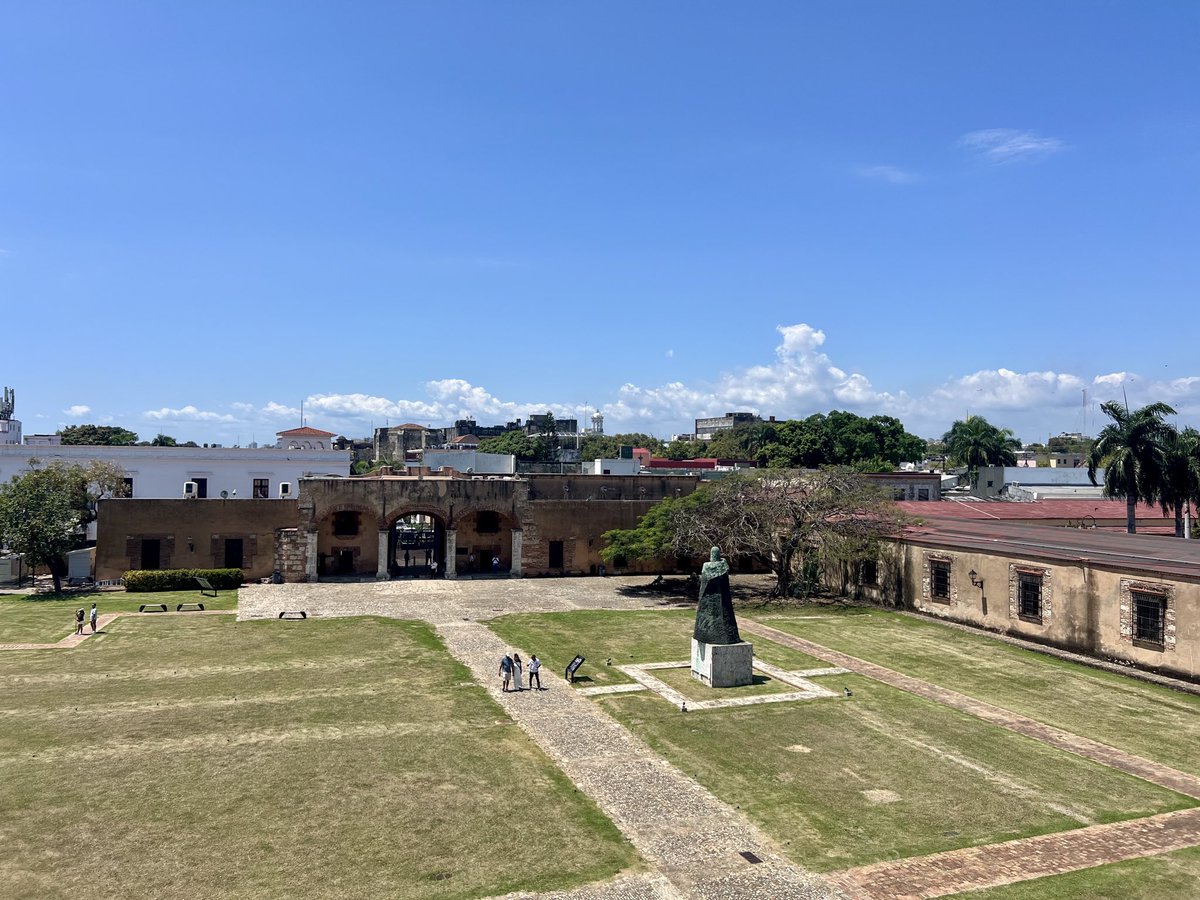
The Ozama fortress, raised by Nicolás Ovando between 1502-8, was to serve as the lynchpin of the city’s defence - built in the style of Castilian fortresses from Spain it overlooks the Ozama river and docks from a cliff, although would be taken by Sir Francis Drake in 1586 /2
Behind this, the Spanish laid out the first planned street in the colony which, remarkably, is still lined largely by the houses, convents, and palaces which date to this initial flurry of construction by Ovando and his several thousand colonists /3
The modern Turkish town of Milas a the Carian capital of Mylasa - conceals some interesting historical vestiges - a monumental Roman gate and an aqueduct among them.
But one massive masonry terrace wall holds something much more elusive, and only recently excavated… /1
Now crossed by a later Roman road, this terrace was once the ceremonial heart of the Achaemenid and Hellenistic Kingdom.
Indeed, the road cuts through an altar related to something quite a bit older… /2
For here was the tomb of Hekatomnus - Persian satrap of Caria, founder of the eponymous dynasty, and the father of a certain Mausolos.
Mausolos would go on to ape his father in having his tomb - his now lost wonder of the world, the Mausoleum - be modelled on this archetype /3
Miletos - Minoan colony then Mycenaean base against the Hittites; cradle of Greek philosophy; Ionian thorn in Persia’s side; Seleukid then Ptolemaic gem; Roman city and site of Paul’s missions; Byzantine fort and Seljuk port - few cities are quite so historically rich 🧵 /1
The Romans dug a huge theatre into Miletos’ prehistoric hill, where once sat a Minoan cult temple and the fortress which sheltered the rebel Piyama-Radu in his pro-Achaean revolt against the Hittites.
Once the tiered seats afforded spectators views over a now silted harbour… /2
As at Priene across the former bay, the Meander’s alluvial silt did pay to the waters which once surrounded Miletos and its international ports.
Here is the old quayside with a ruined harbour monument - perhaps the site of Paul’s conversation with the Ephesians at Acts 20:17 /3
Another fantastic site at the famed city of Laodicea on the Lycus, founded by Antiokhos II on the borders of Lydia and Caria.
Frequently mentioned in the New Testament as a seat of early Christianity, there are tremendous ruins here for those willing to brave the heat… /1
There are few cities of this scale where the layout of the central streets is quite so apparent - here with the well preserved pavement and central covered drain, lined by porticoes to protect against rain and sun, and with shops, fountains, and temples lining the sides /2
In the city’s huge 35,000m2 agora - still partially unexcavated - an entire back wall, stretching 100m, has been preserved with extensive frescoes in situ.
It’s often hard to imagine how colourful
Roman cities were - imagining this replicated across the city gives some idea /3
The next stage of our Anatolian adventure starts in Izmir, the Turkish for Smyrna Σμύρνα, an ancient port city which has presided over the Aegean coast for the best part of three millennia - with, right up until the 1920s, one of the region’s largest Greek populations /1
Founded on a hill north of today’s centre and colonised by Greeks in the archaic period, Smyrna was reestablished by Alexander the Great and his successors around Mt Pagos and the coast below it - growing throughout the Hellenistic and Roman periods into a prosperous port /2
The vaults beneath the Roman basilica - once home to shops, latterly drains and cisterns, and finally abandoned - are impressive reminders of this prosperity.
In some, phantom doorways open onto foundations - entrances to former Hellenistic shops closed up by the Romans /3