What most traders don't realize is that they pay a good chunk of their capital as costs. If you add impact costs, the minimum return an active trader should generate to break even yearly on their portfolio is usually well above 20%. Yep, that high and that tough.
1/4
Costs include
Statutory costs like STT, Stamp duty, GST
Impact costs or slippages (while this doesn’t even seem like a cost, it adds up quickly. Especially when buying options, will have a post on this soon).
Trading costs like brokerage and exchange charges. 2/4
This breakeven % is a high hurdle as most traders take largest possible positions every trade with their capital without considering costs
The way to reduce the impact of costs & increasing the odds of winning is by reducing the trading size (% of capital deployed per trade) 3/4
At Zerodha the statutory costs incurred are more than trading costs
~20% of active traders incur ~80% of total costs. This must be similar to most brokerage firms
Trivia: STT + Stamp paid by our customers is more than the Income tax paid by the 25th largest company in India. 4/4
• • •
Missing some Tweet in this thread? You can try to
force a refresh

We @zerodhaonline are stoked about the new tagging feature on Console. Tagging your trades and maintaining a trading journal can help you become a better trader and also help you track your investment goals. zerodha.com/z-connect/cons… 1/5
You can't become a better trader if you don't learn from your mistakes. But in order to learn, you need a proper journal of all your trades and the reasons you took the trades. You can then look back, review, and do more of what is working & less of what isn't. 2/5
Most traders don't maintain a journal because it takes some effort to tag trades, take notes & track P&L. This was a personal problem for me back when I was trading. So I'm super excited to announce the launch of Console tags which helps you easily journal your trades. 3/5
I’m surprised by the unwanted noise around this whole salary news of @nikhilkamathcio, Seema (my wife), & me. The headlines are misleading. We are a private company & no obligations to clarify, but we thought maybe we should, as there are folks who are misinterpreting this. 1/7
Firstly the reported figure isn’t the actual salary being drawn. This is an enabling resolution that allows us as working promoters to draw salaries up to the number in case of liquidity requirements. Didn’t anticipate that this would get this much attention. 2/7
Running a business is like trading, you can be up or down very easily. It is important to take liquidity out when you are “up” to de-risk. We have always done this, ~15% of profits. This also helps us in supporting our personal investments in small businesses & social causes 3/7
Last 2 years have been spectacular for @zerodhaonline. Lucky to be at right place right time, ready with products & initiatives when there was a surge in retail participation. With success, what I say gets valued more 😬Here are a few questions that we get asked frequently 1/11
Why haven’t we raised any external capital, especially at times like these when we could get some crazy valuation?
Why do very few startups bootstrap (not raise funding)?
While the obvious answer might be the easy availability of risk capital today that can help a business grow fast. But there is another reason why startups focus on growth & valuation rather than profits - Taxation. 3/11
About intraday leverages being further reduced to a Max of 5 times for stocks & minimum SPAN+Exposure for F&O from Sep 1st 2021, ANMI (NSE member association) has created a presentation requesting for this to be reconsidered.
Here are the arguments being made
1/8
Margin calculation logic (SPAN or VAR) doesn’t differentiate between intraday and overnight positions. Margins are collected to cover for risk. Intraday positions carry a much lower risk than overnight, so ideally the margin requirement should also be lesser. 2/8
SPAN calculation methodology changed in 2020. Volatility measure increased to 6 sigma from 3.5, SPAN margin period of risk(MPOR) covers for 2 days. Exposure margins to cover risk beyond 2 days.
Our margin requirement structure now is maybe among the toughest in the world. 3/8
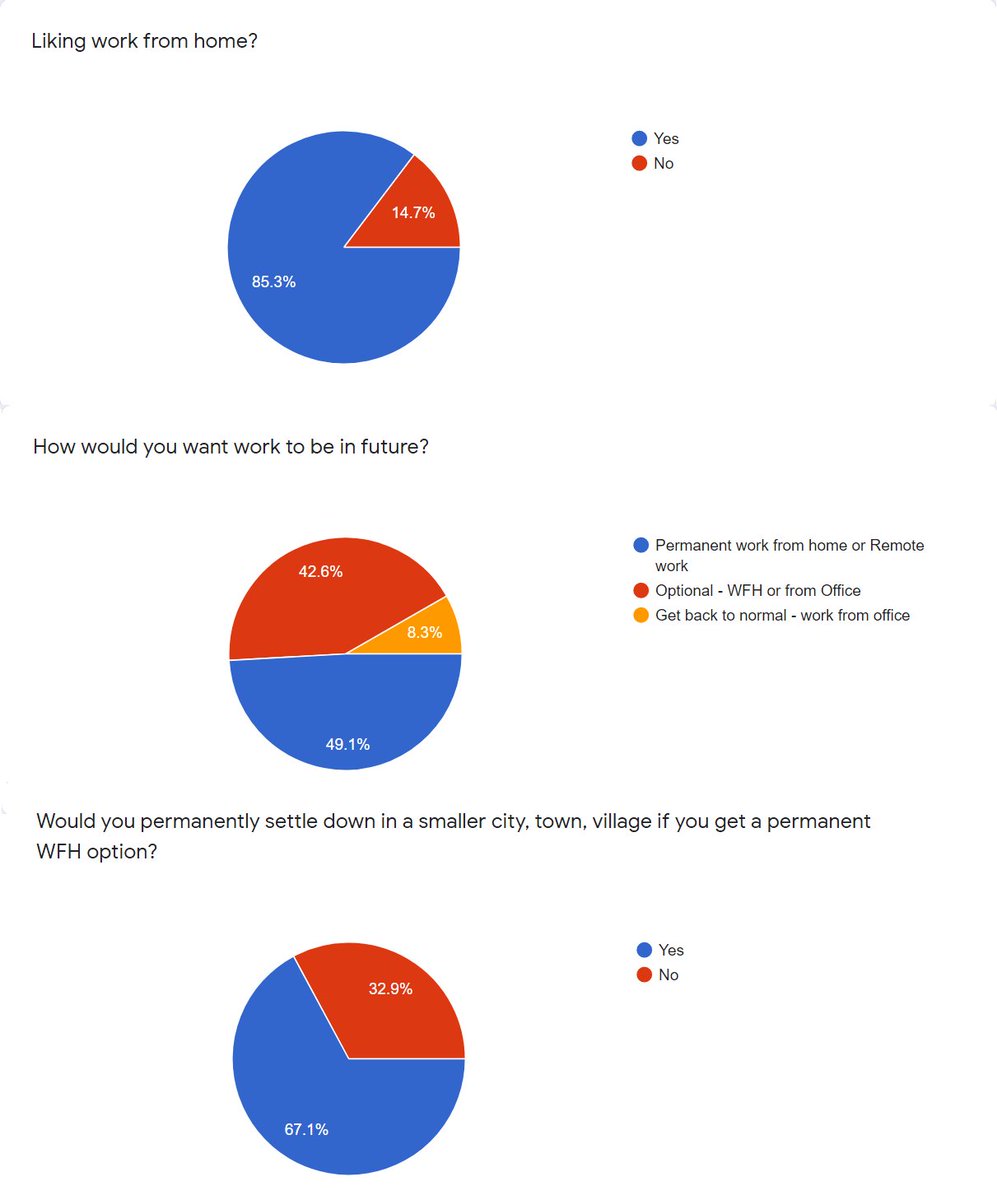
While we all work together to figure out what we can do to help in the current situation, I think the only long-term fix is for as many of us to move away from large cities. This is the answer to many of India’s problems. And now is probably the right time to work towards it. 1/5
Large cities are choking & will continue to break down every time we're tested, COVID today, could be water shortages, pollution, floods, etc. Moving to smaller towns & villages will also create livelihoods there & reduce carbon footprint. Also a much better quality of life. 2/5
The silver lining in these trying times is that people are more open than ever to move out of large cities. This (image) is from the latest survey we just had with our team at @zerodhaonline . 3/5
Every time we share a post on zerodha.tech/blog/, we get a lot of love from the tech community, but also questions like - Why FOSS? Why be so transparent? No security concerns sharing all this info? So yeah, answers from the man behind the scene - Dr. K 1/4
Why Free & Open source software?
1. Superior utility: Pretty much everything in the known universe uses FOSS, from the Mars rovers to our phones to washing machines.
2. Philosophy: Self-reliance, freedom, public good, collective innovation & growth.
3. Cost.
2/4
Why be so transparent & make it easy for competition?
If everyone thought this, there’d be no open internet or widespread innovation, or Zerodha! We take from FOSS & give back as we can. If talking about tech is a concern for a company, they've bigger issues. 3/4