Suomen epidemia 28.6.2021: tartuntojen kasvu kiihtyy edelleen, 11 päivää sen jälkeen kun noin 2100 rajanylittäjää päästettiin Venäjältä Suomeen ilman testausta. Kasvu on nyt 7.8 prosenttia päivässä (tällä vauhdilla 9.5x kuukaudessa). 1/x
Nyt nämä luvut rupeavat taas päivittymään kesken päivän. Viimeksi näin kävi maaliskuussa. 2/x
Kasvu nousi 7.9 prosenttiin päivässä, eli tällä vauhdilla tartuntojen määrä 9.5-kertaistuu kuukaudessa. Tuleva uusi Pietarin reissu tulee todennäköisesti ylläpitämään tartuntojen kasvua edelleen. 3/x
Tänään THL ilmoitti 84 tartuntaa, ei poistanut yhtään, ja tunnettu raportoinnin viive kasvoi 78 tartunnan verran. Muuttumattomalla viiveellä laskettu uusien tartuntojen määrä on 84+0+78=162 (punainen viiva). 4/x
Suomen epidemia on 43 päivää englannin epidemiaa jäljessä, ja koulut avataan 44 päivän päästä 11. elokuuta. Oxfordissa koronaa löytyi 34 prosentilla testatuista (21-.25.6.2021). 5/x
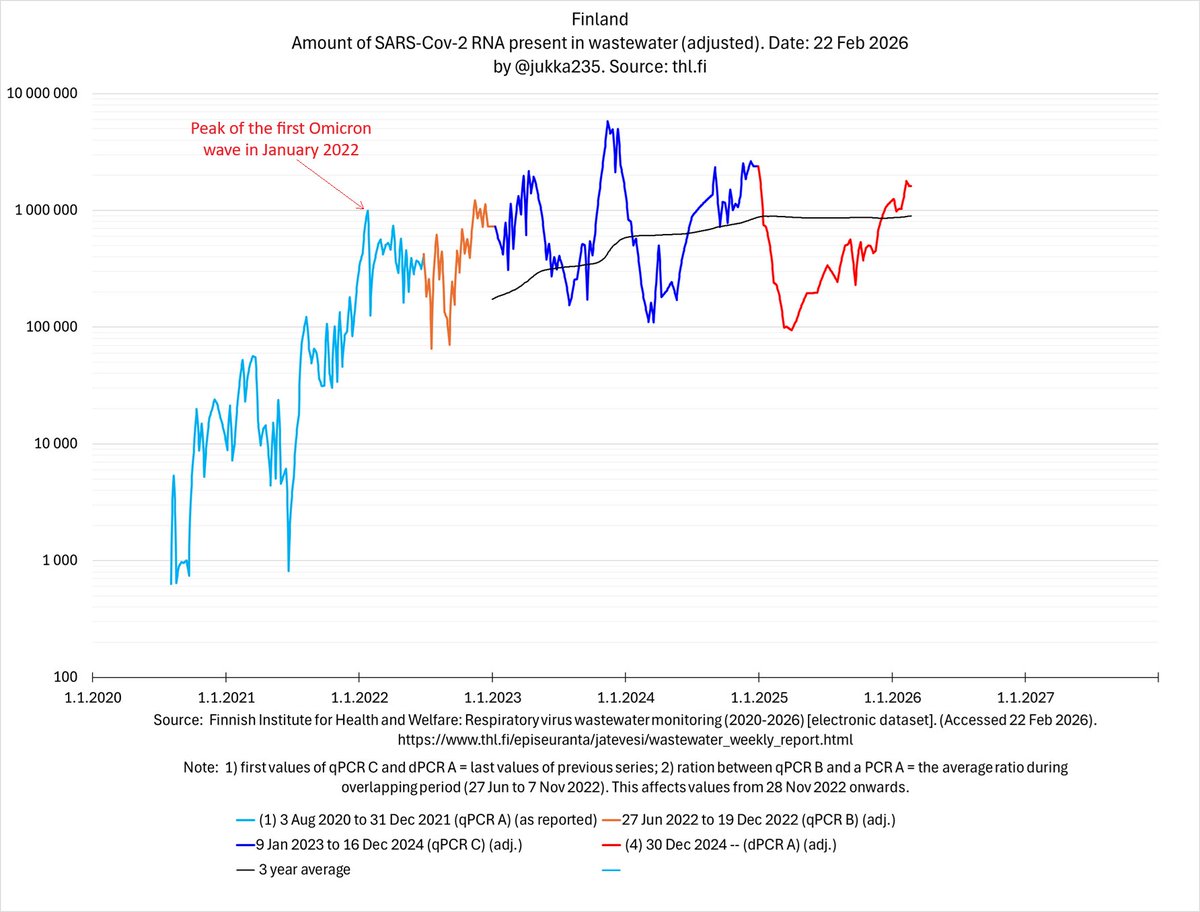
Finland's epidemic 23 Dec 2025: amount of virus in wastewater appears to have risen above the first Omicron wave. Post-Omicron baseline is permanently higher than pre-Omicron; repeated waves are showing no diminishing. 1/x
Post-Omicron baseline is permanently higher than pre-Omicron
- before late 2021, levels were mostly 10³–10⁴.
- from 2022 onward, even troughs sit around 10⁵, or 10-100x higher
- C19 has become endemic
- constant background transmission, even outside waves 2/x
Repeated large waves in 2023–2024, not diminishing. Notable peaks:
- Apr 2023
- Nov 2023 (highest for the entire pandemic)
- Dec 2024
These peaks are:
- comparable to or higher than Omicron 2022
- evidence against a simple “each wave gets smaller” narrative 3/x
Congenital malformations, deformations and chromosomal abnormalities. For 1-6 year olds,
- the condition showing largest increase since 2022 is Down's syndrome (Q90)
- the condition showing fastest growth since 2022 is Congenital malformations of great arteries (Q25) 1/x
1-6 year olds / chromosomal abnormalities (Q90-Q99).
- Down's syndrome (Q90): average patient growth (2022-2025e) 14% per year = 10x in 18 years)
- fastest growing condition: other sex chromosome abnormalities, male phenotype (Q98), up 150% in 2025e 2/x
<1 year olds / chromosomal abnormalities (Q90-Q99):
- Down's syndrome (Q90) is the most frequent diagnosis 3/x
Intellectual disabilities (F70-F79): <1 year olds are leading in terms of y/y growth. Ten percent of <1 year olds will have an intellectual disability diagnosis in 14 year's time (2039), if current growth rates continue. 1/x
The rise in intellectual disability among <1 year olds also shows in number of diagnoses: up roughly 11 times in 4 years. Also note the rise among 1-6 year olds. 2/x
7-14 and 15-24 year olds are showing the highest levels of intellectual disability. If current growth rates continue, 5 percent of 7-14 and 15-24 year olds will have an intellectual disability diagnosis by 2048 (24 years from now). 3/x
In 30 years from now, 5 percent of 1–6 year olds and 8 percent of 25–49 year olds will be walking with white sticks, if current growth trends continue.
Here is the graph for all age groups, all of which are showing quite uniform y/y growth. Patients / public outpatient healthcare. 2/x
For total population, visual disturbances and blindness have doubled since the onset of the pandemic. There has been no letup in recent years. Average growth rate is power(1.97, 1/5) = 14.5 percent per year (= 10x every ln(10)/ln(1.145)= 17 years). 3/x