Sharing our updated pre-print on Delta Variant and emergence, replication and immune evasion properties. We previously reported partial evasion of neutralising antibody responses following vaccination and breakthrough in vaccinated health care workers. biorxiv.org/content/10.110…
We now further define Delta immune evasion using a panel of 38 monoclonal antibodies, showing significant loss of potency of NTD and RBD targeting antibodies. Imdevimab, part of the REGN2 dual monoclonal antibody cocktail is compromised by Delta.
We also show loss of activity for casivirimab, part of the Lily dual therapy cocktail. These dual therapies could be less effective against Delta particularly in the setting of immune compromise could lead to escape variants emerging/ transmitting.
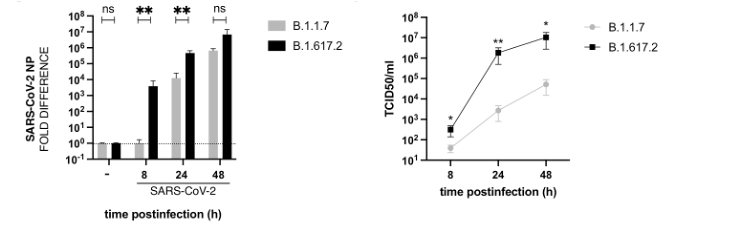
Taking replication we originally showed increased growth of Delta virus in vitro using airway organoids compared to Alpha. Now we show increased virus production in two other systems: Calu-3 epithelial lung cell lines (shown here) and airway epithelial cells (@wendybarclay11)
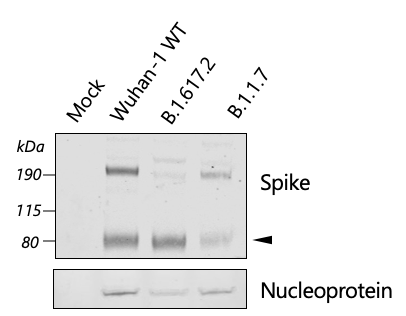
We also found that the Delta virus appears to be in a predominantly cleaved form as compared to Alpha. This may suggest that each virus particle is more infectious in addition to more virus particles being produced
These properties likely explain vaccine breakthrough. We provide data on 132 Delta infections in partially/fully vaccinated hospital staff (25% non-Delta and 75% Delta). We found ChAdOx-1 efficacy to be lower against Delta compared to non-Delta in those who received two doses.
• • •
Missing some Tweet in this thread? You can try to
force a refresh

One of the major issues as we move through the pandemic is how we approach vaccination in the elderly, given severe outcomes are still occurring in this group. We have found that SARS-CoV-2 neutralisation following third dose is impaired in the elderly. medrxiv.org/content/10.110…
Surprisingly, the impaired neutralisation was despite similar levels of anti spike IgG antibody concentrations in the blood when younger participants <70 were compared to those >70. This means that somehow younger people are making better antibodies and not simply more of them
When we looked more deeply at the B cells that make antibodies we found using single cell sequencing and flow cytometry that atypical spike specific memory B cells expressing surface markers CD11c and FCRL5 were significantly higher in the >70 population.
Moving back to molecular virology, thrilled to be communicating our new paper on a topic close to our hearts: the virus-host interaction and involvement of cell cycle associated proteins. embopress.org/doi/abs/10.152…
We found that productive SARS-CoV-2 infection induces cell cycle arrest and depletes cyclin D from infected cells. Surprisingly, cyclin D3 degradation induced by SARS-CoV-2 promoted infection not via cell cycle arrest, but by relieving cyclin interference with virion assembly.
Firstly, we found that following infection, Cyclin D1 and D3 translocated from nucleus into the cytoplasm for proteasomal degradation whilst cyclin A2 remained unaffected. Proteasome inhibition stabilized D-cyclins in and prevented relocalisation of cyclin D3 to the cytoplasm.
Our paper on NTD's role in TMPRSS2 usage/cell-cell fusion is out! N terminal domain is the interface for MERS CoV and its receptor. SARS-CoV-2 uses the receptor binding domain to bind ACE2 and the role of SARS-CoV-2 NTD is unclear. cell.com/cell-reports/p…
We had previously reported that the H69V70 deletion found in Alpha NTD increased spike mediated entry, and that Alpha was highly dependent on this deletion for infectivity and cell-cell fusion efficiency. cell.com/cell-reports/p…
We were interested in why Delta (B.1.617.2) outcompeted Kappa (B.1.617.1), given Kappa showed more immune evasion than Delta (nature.com/articles/s4158…). We made a spike bearing Delta NTD in Kappa spike, and this increased entry in TMPRSS2 expressing lung cells and airway organoids
COVID-19 vaccine elicited immune responses in Africa are understudied. We teamed up with The Nigerian Institute for Medical Research (NIMR) to examine AZ vaccine responses in the context of background prior infections and breakthrough infections. citiid.cam.ac.uk/wp-content/upl…
We first measured baseline SARS-CoV-2 seroprevalence prior to vaccination using flow cytometry methods for binding antibodies to nucleocapsid (N), coupled with virus neutralisation approaches for protective neutralizing antibody responses to VOC (January 2021)
In 140 participants, we found a high level - 62/140 (44%) of participants were previously infected with SARS-CoV-2 as evidenced by presence of Nucleocapsid (N) antibodies in early 2021 (N is absent from vaccines used in Nigeria, therefore presence indicates a past infection).
Our paper on HIV-1 intrahost evolution under antiviral therapy out after >5 years in the making. @steveo_kemp R Goldstein, A Derache, @Tuliodna D Martin @CollinsIwuji ANRS TasP. Major implications for SARS-CoV-2 and resistance to therapeutics : journals.asm.org/doi/full/10.11…
Here we wanted to study HIV-1 evolution within individuals who were unable to suppress the virus with antiretroviral therapies. This was mainly due to sub optimal adherence to treatment, as drug levels in blood were measured and often low. Main findings:
1. Over periods of a year or more we observed significant changes in viral populations, with large fluctuations in synonymous and nonsynonymous variant frequencies despite stable viremia.
Quick explainer on some of the key findings in our recent paper. nature.com/articles/s4158…. We find Omicron spike binds ACE2 better than Delta. Both variants replicate similarly in nasal cell cultures, but in airway cells high in TMPRSS2 there was significant impairment for Omicron
Spike cleavage by furin proteases during virus production in cells allows spike to use TMPRSS2, a cell membrane protease. Omicron (grey) is impaired in cell entry relative to Delta (orange) and Wu-1 (black) when TMPRSS2 (T2) overexpressed; ACE2 (A2) levels impact effect size (R)
We found that consistent with impaired use of TMPRSS2, the Omicron spike was inefficiently cleaved (as shown by the ratio of S2:full length spike). This came as a surprise because Omicron has three mutations around the polybasic cleavage site.



