Andreas Fulda 🇺🇦 🇹🇼 Profile picture
Jul 26, 2021 18 tweets 7 min read Read on X
With their cynical approach to the People's Republic of China 🇨🇳 the four chancellors Schmidt (1974-82), Kohl (1982-98), Schröder (1998-2005) and Merkel (2005-21) have done Germany 🇩🇪 a disservice. There is much to be learned from their leadership failures. A short thread 🧵 /1 Image
Chancellor Helmut Kohl is best known for his role in Germany's re-unification. Yet he also helped normalising the Chinese Communist Party (CCP) after the 1989 Tiananmen massacre. In 1995 he was the "first Western leader to visit a Chinese military base" /2 nytimes.com/1995/11/09/wor…
Kohl's visit to the People's Liberation Army 196 Infantry Division outside Tianjin was highly symbolic. It was a clear signal to the Chinese Communist Party that the atrocities of 1989 were no longer an obstacle to western business engagement with China /3 scmp.com/article/138269…
Under Kohl German China policy was increasingly driven by mercantilist considerations. Kohl helped to "[convince] a generation of German political and business elites that China held the key to Germany’s long-term prosperity." /4 politico.eu/article/german…
Kohl's successor Chancellor Gerhard Schröder went further. He relegated human rights concerns to a toothless 'dialogue'. In 2005 he lobbied to lift the European arms embargo, which he saw as an obstacle to deepening Germany's commercial ties with China /5 dw.com/en/schr%C3%B6d…
Schröder admired former Chancellor Helmut Schmidt. Despite retiring from front-line politics in the early 1980s, Schmidt exercised very problematic intellectual leadership in the early 2000s. Time and again Schmidt argued against China's democratisation /6 spiegel.de/politik/deutsc…
Schmidt argued that "in China all the prerequisites for a democracy were missing, there were no democratic traditions in Chinese history (author's translation)". He exaggerated the importance of Confucianism in Chinese political thought and practice /7 handelsblatt.com/meinung/kommen…
The German journalist Erling has portrayed Helmut Schmidt as part of the 'sceptic generation': Schmidt had grown up in the Third Reich; he was disillusioned, displayed a cynical attitude; rejected political visions and advocated pragmatism /8 welt.de/politik/auslan…
Erling critiqued Schmidt as an "authoritarian character dressed in the cloak of the sceptic. And therefore an admirer of all authoritarians in this world as long as they have power; and a despiser of anti-authoritarian democracy (author's translation)" /9
During a talk in 2012 "the former chancellor expressed his doubts about the export of Western democracy to the People's Republic". Gu Xuewu disagreed and told Schmidt that "a free system was always a better option than the naked exercise of power" /10 dw.com/en/magnet-chin…
Sieren has argued that "Germans should think hard about how to address [Schmidt's] legacy". Yet Schmidt's view of China was very problematic. He portrayed it in culturally essentialist terms. He also frequently gave the CCP the benefit of the doubt /11 dw.com/en/sierens-chi…
Following Schröder's election defeat in 2005 Angela Merkel began her long reign as chancellor. U-turn after u-turn revealed her lack of leadership. First she was in favour of nuclear energy, only to change her mind after Fukushima /12 dw.com/en/opinion-ang…
Merkel initially was critical of China and even met the Dalai Lama in 2007. Yet her biggest legacy will be the ill-considered Comprehensive Agreement on Investment #CAI. Merkel prioritised the bottom line of German conglomerates over any other concerns /13 spiegel.de/international/…
Under Merkel German China policy was effectively outsourced to the private sector. This opened the flood gates to corporate propaganda. In their blind pursuit of short-term profits economic elites distorted the German public discourse about China /14
Let me conclude with a brief summary. When the four chancellors exercised leadership they either normalised the CCP (Kohl), made the case against China's democratisation (Schmidt), or prioritised commerce over other enlightened values and interests (Schröder and Merkel) /15 Image
There is now a lot to unlearn. Myths about the importance of China's market and misunderstandings about China's political system need to be busted. Academics and think tankers should help to inform a more critical public debate about China. Germany needs a reality check /16 Image
The SPD foreign affairs spokesperson Schmid is right when arguing that “[we] need a real foreign policy for China — not just a business-oriented policy (...) We need to decouple our foreign policy from the commercial interests of big business” /End ft.com/content/0de447…
If you found the thread 🧵 about the four German chancellors’ cynical approach to China thought provoking please consider this thread from September 14, 2020. Here I write about the pitfalls of Germany’s single-minded pursuit of foreign trade promotion (Außenwirtschaftsförderung)

• • •

Missing some Tweet in this thread? You can try to force a refresh

 

Keep Current with Andreas Fulda 🇺🇦 🇹🇼

Andreas Fulda 🇺🇦 🇹🇼 Profile picture

Stay in touch and get notified when new unrolls are available from this author!

Read all threads

This Thread may be Removed Anytime!

PDF

Twitter may remove this content at anytime! Save it as PDF for later use!

Try unrolling a thread yourself!

how to unroll video
  1. Follow @ThreadReaderApp to mention us!

  2. From a Twitter thread mention us with a keyword "unroll"
@threadreaderapp unroll

Practice here first or read more on our help page!

More from @AMFChina

May 28
Ich habe mir immer große Gedanken zu meiner Positionalität in der Chinaforschung gemacht. Dass #Heberers Maoismus in der Sinologie zwar bekannt war, aber nicht ausreichend problematisiert wurde, halte ich für einen Skandal. Journalisten sollten ihn auf den #KBW ansprechen /1 Image
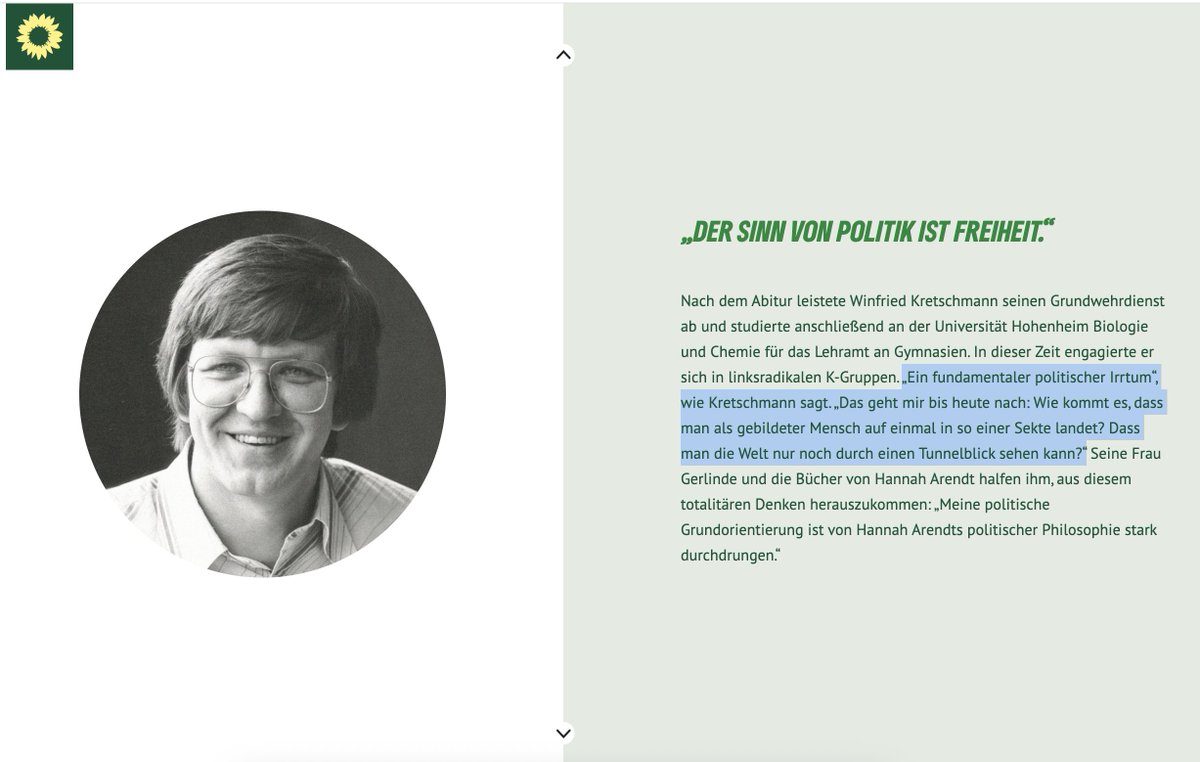
Es geht auch anders. Der Ex-Maoist und spätere Ministerpräsident von Baden-Württemberg Winfried #Kretschmann hat sich eindeutig von seiner früheren Mitgliedschaft im Kommunistischen Bund Westdeutschland #KBW distanziert. Damit hat er selbstkritische Reflexivität bewiesen /2 Image
Eine vergleichbare öffentliche Distanzierung von seiner maoistischen Vergangenheit hat Heberer meines Wissens nie geleistet. Ich halte das gerade im wissenschaftlichen Bereich für inakzeptabel. Im Folgenden möchte ich erklären, warum dieses Versäumnis von hoher Relevanz ist /3
Read 9 tweets
May 23
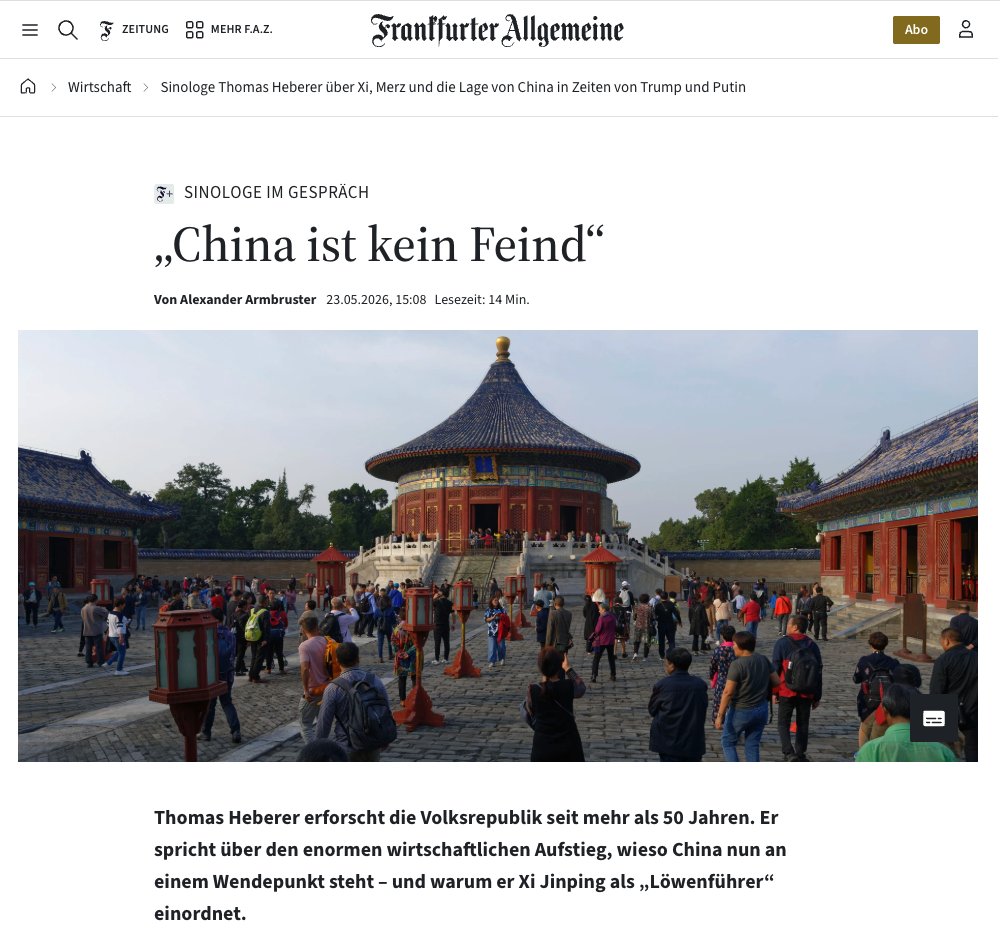
Ein ausgesprochen problematisches Interview ist in der Frankfurter Allgemeine Zeitung erschienen. Alexander #Armbruster lässt den umstrittenen Sinologen Thomas #Heberer seine fragwürdigen Thesen ausbreiten, ohne mal kritisch nachzuhaken. Ein kurzer 🧵/1 faz.net/aktuell/wirtsc…Image
Besonders schlimm ist der Titel des Interviews: „China ist kein Feind“. Freund/Feind-Kategorieren sind uns im demokratischen Diskurs fremd. Wenn überhaupt wird die Kommunistische Partei Chinas im deutschen Diskurs als Bedrohung bezeichnet /2
Sehr problematisch finde ich an diesem Framing auch, dass hier keinerlei Unterscheidung zwischen dem politischen Regime und der chinesischen Bevölkerung vorgenommen wird. Letztere hat aber keinen Einfluss darauf, wie das Land regiert wird /3
Read 15 tweets
May 19
Wie kommt es, dass in Deutschland so viele Menschen die Schattenseiten von Autokratien nicht sehen wollen - oder schlimmer noch - als gegeben hinnehmen? In diesem 🧵 geht es um deutsche Befindlichkeiten: von Lebenslügen über Selbstzensur bis hin zu Selbstvasallisierung /1 Image
Um zu verstehen, wo Deutschland falsch abgebogen ist müssen wir uns mit dem Architekten der Autokratieblindheit beschäftigen: Egon Bahr. Der Berater von Willy Brandt hatte eine sehr eigenwillige Theorie des Wandels, die er 1963 in seiner Tutzinger Rede wie folgt beschrieb: /2 Image
"Das Vertrauen darauf, daß unsere Welt die bessere ist, die im friedlichen Sinn stärkere, die sich durchsetzen wird, macht den Versuch denkbar, sich selbst und die andere Seite zu öffnen und die bisherigen Befreiungsvorstellungen zurückzustellen.” /3 Image
Read 19 tweets
Mar 21
Eine neue China-Kommission des Bundestages soll "möglichst im Konsens" prüfen, wie die deutschen Energie- und Rohstoffimporte verbessert werden können und ob Änderungen im Außenwirtschaftsrecht notwendig sind. Aber kann das klappen? Ein kurzer 🧵 /1 bundestag.de/dokumente/text…ALT-Text: Der Vorsitzende des Wirtschaftsausschusses des Bundestages, Christian Freiherr von Stetten (vorne in der Mitte), zusammen mit Mitgliedern der neuen China-Kommission nach deren Konstituierung. (© DBT/Stella von Saldern)
Auffällig an der Gesamtzusammensetzung ist, dass der Schwerpunkt deutlich stärker auf Akteuren aus den Bereichen Wirtschafts- und Handelspolitik (BDI, DIHK, IW Köln, IfW Kiel, DIN, DGB) liegt als auf Experten für Sicherheit, Menschenrechte oder Politikwissenschaft /2
Zwar sind auch Wissenschaftsinstitutionen (Leopoldina) und Think Tanks dabei (DGAP, MERICS, SWP, IISS), aber Diaspora-Organisationen wie Freiheit für Hongkong e.V. sucht man vergeblich (die 2024 eine kritische Studie zu ‘De-Risking’ veröffentlicht hat) /3 freiheithk.de/report_towntwi…
Read 12 tweets
Dec 11, 2025
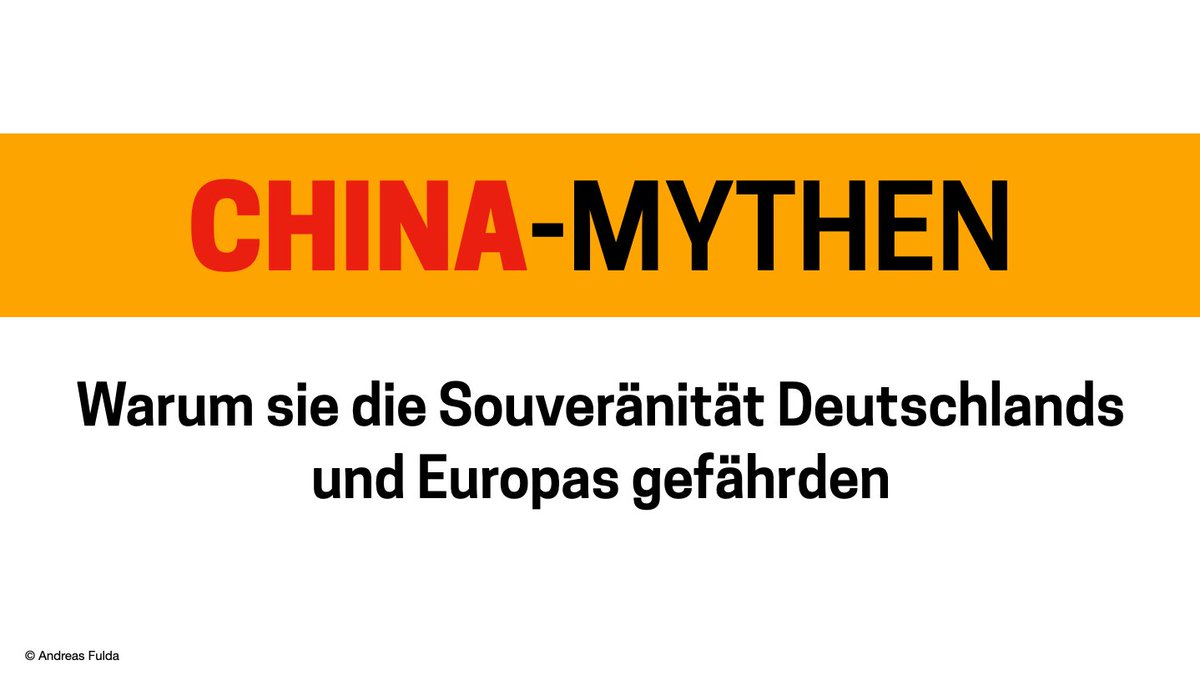
Überzeugungstäter, Unterinformierte und China-Experten: diese Dreifaltigkeit hält in Deutschland China-Mythen am Leben, die einem Fakten-Check nicht standhalten. Ein kurzer 🧵zu meiner neuen Serie /1 Image
Beim Thema 🇨🇳 verstricken sich 🇩🇪 Eliten immer wieder in einem Netz aus Profit und Eigennutz. Bei ihren Äußerungen spielen Ideologie, Interessen oder Identitätsfragen häufig eine zentrale Rolle. China nutzt die Naivität, Selbstgefälligkeit und den Egoismus deutscher Eliten aus /2
Trotz unfairer Handelspraktiken und transnationaler Repression wird 🇨🇳 von ihnen weiterhin als verlässlicher #Partner bezeichnet. Die Kosten für unsere Sicherheit, unseren Wohlstand und unsere Freiheit werden ignoriert. Durch Trump II erhält Anti-Amerikanismus weiter Auftrieb /3
Read 10 tweets
Nov 1, 2025
Der China-Experte #Sandschneider wettert gegen Wadephul - gleiche Appeasement-Logik wie bei #Mützenich. Fehlschlüsse ohne Ende. Warum diese merkwürdigen China-Debatten? Ein kurzer 🧵/1 thepioneer.de/originals/othe…Image
Sandschneider benutzt ein falsches Dilemma: "Die Politik muss sich ... entscheiden: zwischen Dialog und Konfrontation." Das ist Quatsch. Es ist kein Entweder-Oder. Die KPCh kritisiert uns ja auch häufig und handelt dennoch mit Europa. Warum sollte das anders herum nicht gehen? /2 Image
"Wer auf Dialog angewiesen ist", behauptet Sandschneider, "sollte diplomatische Affronts vermeiden". Stimmt nicht. China führte jahrelang Wolf-Warrior-Diplomatie. Hat Deutschland daraufhin die Beziehungen abgebrochen? Natürlich nicht. Warum dann vor Peking kuschen? /3 Image
Read 6 tweets

Did Thread Reader help you today?

Support us! We are indie developers!


This site is made by just two indie developers on a laptop doing marketing, support and development! Read more about the story.

Become a Premium Member ($3/month or $30/year) and get exclusive features!

Become Premium

Don't want to be a Premium member but still want to support us?

Make a small donation by buying us coffee ($5) or help with server cost ($10)

Donate via Paypal

Or Donate anonymously using crypto!

Ethereum

0xfe58350B80634f60Fa6Dc149a72b4DFbc17D341E copy

Bitcoin

3ATGMxNzCUFzxpMCHL5sWSt4DVtS8UqXpi copy

Thank you for your support!

Follow Us!

:(