Developer & manufacturer of high value, non- commoditized APIs (complex & low competition) in chronic therapeutic areas: CVS, CNS, pain management & diabetes, etc
Basic details about the IPO 👇
Note: After paying off liabilities, 150crs remain for capex.
2/ The Journey
Established the API business in FY02
Since 2015, Have not received any adverse reactions from regulators (USFDA, PMDA) in the total 38 audits & inspections & Have gone through 432 customer audits.
Filled 403 DMFs & CEP registration across markets globally.
3/ Trends that the company is betting on & what works for them
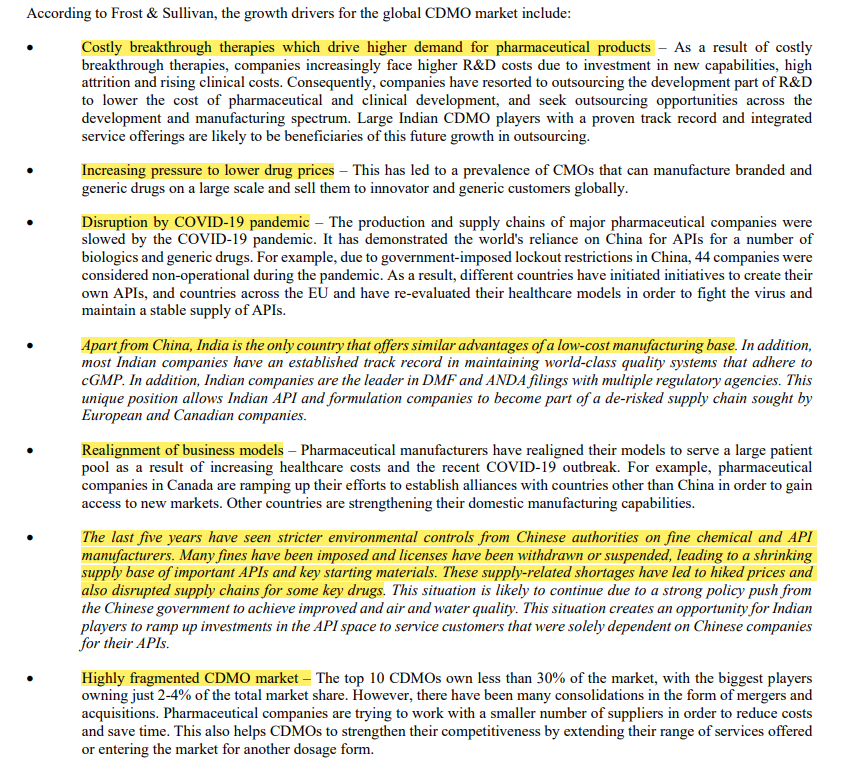
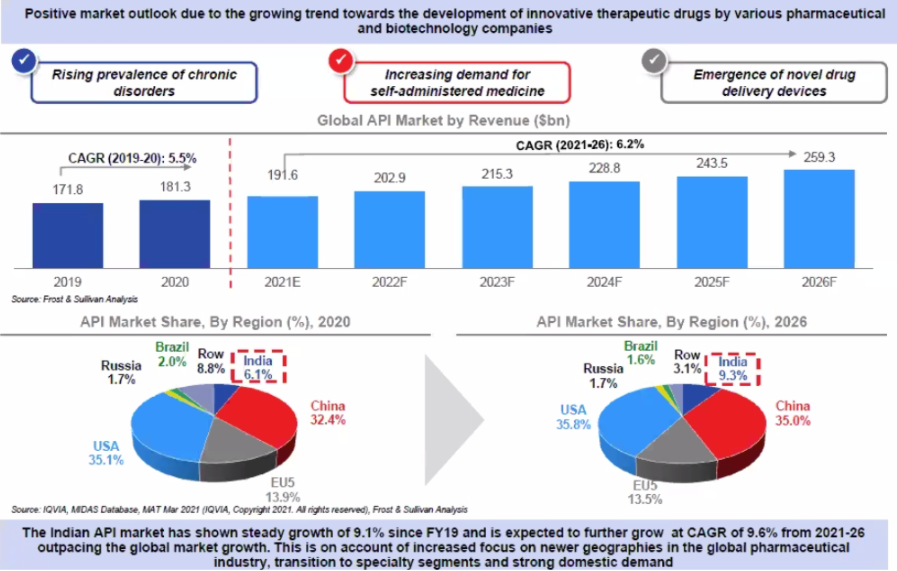
China+1: India API market growth (10% cagr projected from FY21-26) will outpace the industry: Driven by specialty API+ Strong domestic market
Highest no. of USFDA approved API facilities & % of DMFs filled
4/ Interesting facts
- 120 molecules: $142B market size
- Targetting 8 to 10 new molecules every yr (Key differentiator over time)
- 66% of sales from regulated markets
- Works with 16 of the top 20 generic cos.
- Top 7 customers: 5 to 15yrs old
5/ API Portfolio
Key products in generic API business 👇 (Shows cost leadership in few molecules as market share is 30%+)
Strategy to mix: High value & High Volume APIs
Complex API is a future growth market: Going into the development of Peptide APIs by FY22.
6/ R&D: the secret ingredient
Spends 2-2.5% of rev every year
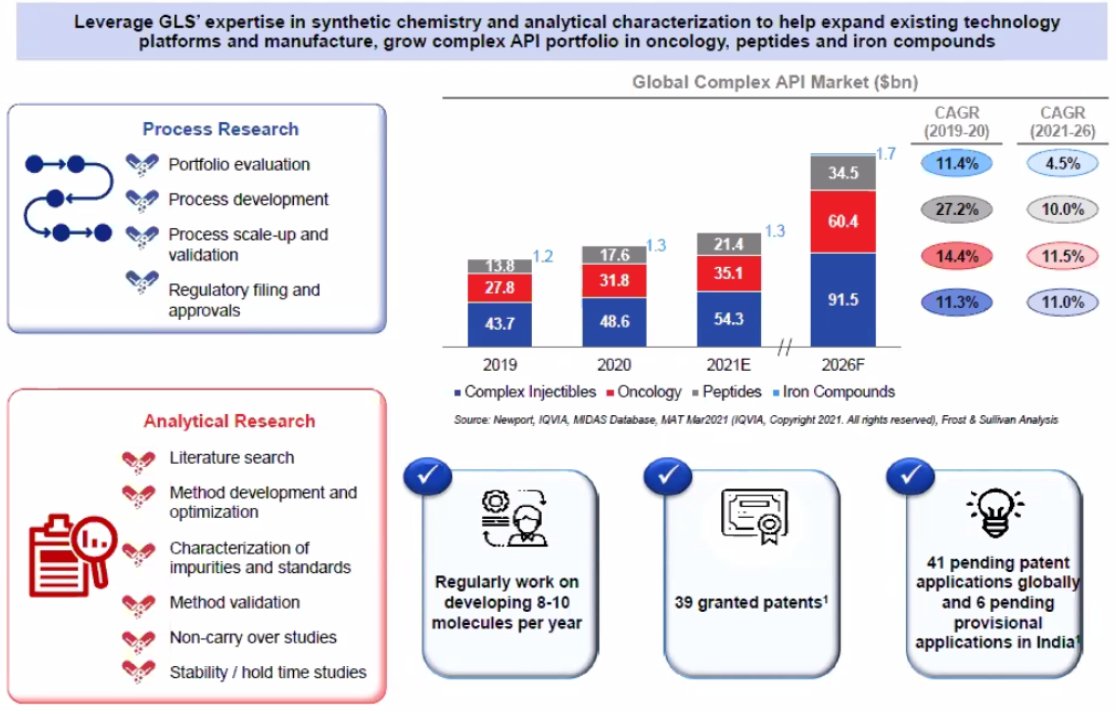
39 patents under the belt
213 R&D personnel in 3 dedicated facilities
Focus on cost improvements in existing products & developing newer products: onco, peptides, iron compounds
7/ Manufacturing Capacity & Capex
4 plants 762KL capacity, running at 85% capacity: 3 USFDA approved, 1 for emerging markets
Increasing capacity by 200KL in Dahej & Ankleshwar by FY23
Investing in a new greenfield capacity: will take it to aggregate 800KL capacity in 3-4yr
8/ Experienced Management with a proven track record: A total of 1537 permanent employees.
9/ CDMO business: 8-10% of their rev (will ramp up)
End of lifecycle management- when the innovator loses its patent & looks for a cheaper source of their API; they can choose GLS
The 🌎 trends that benefit this business 👇
10/ Financials
Rev scaled at 16% cagr from FY19-21
Margins consistently above 30% (high operational efficiency as GMs are 50-55%)
Stable cash flows: WC requirements are high, OCF & debt would be enough to increase capacity over the next 4-5yrs
11/ Risks:
- High Customer churn: Only 41% of the customers stayed from FY19 to FY21.
- Imports 40% of RM from China: could face huge pricing pressure which they are not able to pass on.
- Regulatory & compliance risks
- Client concentration: 56% of rev from the top 5 customers
12/
- Dependence on key products: Top 10 account for 66% of sales
- Capex implementation risk
- Multiple outstanding litigations against the promoter & the company
- COVID risk: some disruptions in acute products & favipiravir sales benefit: net 2-3% +ve effect in FY21.
13/
- Increased competition in their respective products: pricing pressure
- Working capital risk: have huge credit terms up to 180 days
- High employee attrition of 18-20%
- Failure to get the environmental clearances for new facilities.
14/
We believe Glenmark Life sciences IPO which is currently valued at 4.6x EV/sales, 15x EV/EBITDA & 25x Price/Earnings & following the lucrative strategy to become bigger in complex APIs, is rather reasonably valued.
End of thread.
Comparison with the peers
- Top quartile EBITDA margins
- Low capex requirements & high asset turnover business
- Cash conversion cycle is one of the worst: Needs to invest a lot of working capital to grow if it doesn't improve
- Valuation wise, A discount to industry averages
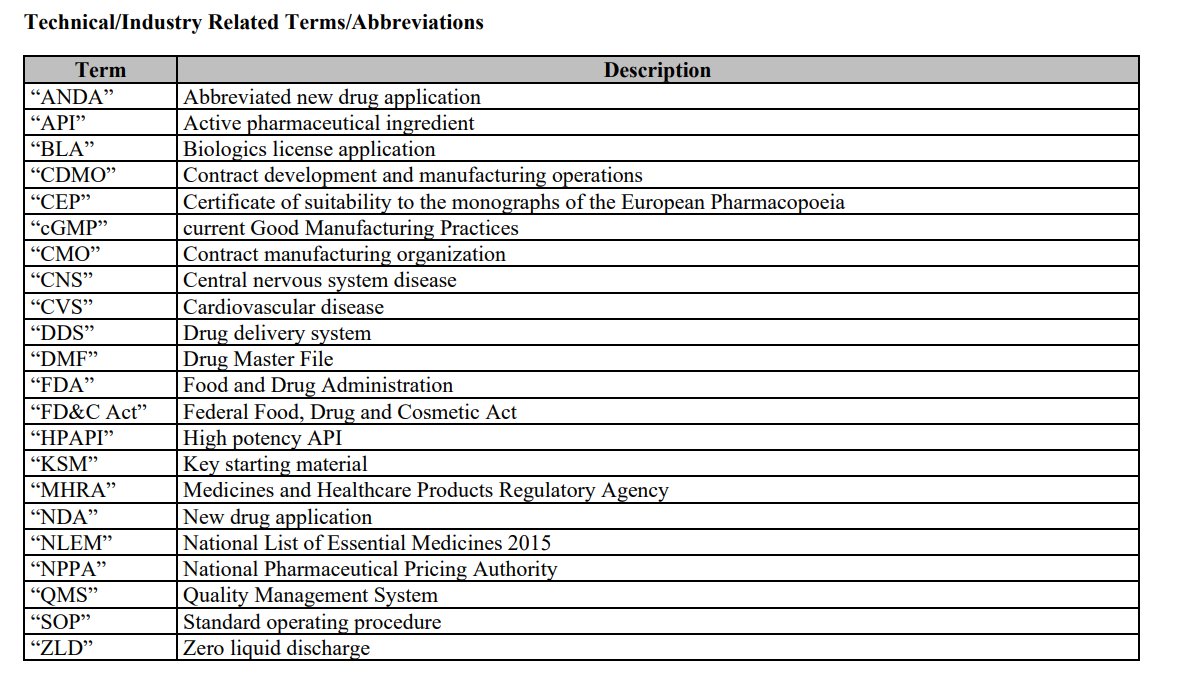
A glossary for the complex industry-related abbreviations I used above 👇
To understand more about the business dynamics of the API sector in depth
Watch this video by Sajal Sir @unseenvalue, hosted by @soicfinance (Better get the whole webinar from them)
• • •
Missing some Tweet in this thread? You can try to
force a refresh

Every additional minute your toddler spends on a screen, they hear about 7 fewer words from you. By age 3, they also make 5 fewer attempts to talk back and lose one back-and-forth exchange with a parent. That’s from a 2024 JAMA Pediatrics study that put speech-recognition recorders inside actual homes across Australia.
The 49% stat in this tweet is real. It comes from a 2017 study at SickKids Hospital in Toronto that tracked 894 children aged 6 to 24 months. For every 30 minutes of handheld screen time per day, the risk of a child being slow to form words and sentences increased by 49%. But only the speech output was affected. Gestures, body language, and social interaction were all fine.
The mechanism is displacement. A toddler’s brain learns language through something researchers call “serve and return”: baby babbles, parent responds, baby tries again. That loop is how the brain’s language wiring gets built. When a screen is on, that exchange drops off.
And we can now see it on brain scans. A 2020 JAMA Pediatrics study at Cincinnati Children’s Hospital scanned the brains of 47 kids aged 3 to 5. Kids with more screen time had weaker white matter, the insulation around nerve fibers that helps different parts of the brain talk to each other. The weak spots were in the exact areas that control language and early reading.
A 2023 study at Tohoku University in Japan followed 7,097 children from birth. More screen time at age 1 was associated with higher rates of communication delays at ages 2 and 4. Each additional hour widened the gap.
The AAP recommends zero screen time for children under 18 months, except for video calls. The average child under 2 already gets over an hour a day. But a 2023 systematic review found that when kids with speech delays stopped using devices for six months, 36.7% showed measurable improvement. The word in the tweet is “destroys.” The data says it’s closer to “delays,” and in many cases, delays that respond when the screens come off.
Part 2 on this because some of the other research is worse.
The “educational app” defense doesn’t hold up. children under 3 have what researchers call a “transfer deficit,” their brains cannot take something learned on a flat screen and apply it in the real world. A 2015 study at Georgetown and Binghamton gave 2.5 year olds a puzzle to solve, once on a touchscreen and once on a physical board. Same puzzle and live instructor both times. The kids who learned it on the screen couldn’t do it with their hands. That gap doesn’t close until around age 4.
So when an app says “educational” on the label for your 18 month old, there’s no regulatory body checking that claim. anyone can slap “educational” on a toddler app. A Penn State study found most top-downloaded kids’ learning apps scored low on actual educational quality, with free apps scoring even worse.
And it’s not just the kid’s screen that matters. background TV, the kind that’s just on in the room while nobody’s really watching, wipes out adult speech around the child. A Seattle Children’s Research Institute study put recorders on 329 kids aged 2 months to 4 years. every hour of audible television meant 770 fewer words from the adults in the room. The lead researcher, Dr. Dimitri Christakis, said adult speech was “almost completely eliminated” when the TV was on. 30% of American households report having the television on all day.
Separate study from Kathy Hirsh-Pasek’s lab: when a parent answered a phone call during a word-learning session with their toddler, the child learned zero of the new words. Same session and words, but the parent who didn’t pick up the phone, their kid learned them all. One interruption could lead to total wipeout.
Scale this up. The Australian LENA study found that at 36 months, based on the average screen time in their sample (just under 3 hours a day), kids were missing roughly 1,139 adult words, 843 of their own vocal attempts, and 194 conversational exchanges. Every single day.
If you like breakdowns like this, I regularly do deep dives into interesting topics. Follow along → @AnishA_Moonka
Attaching all links, if you'd like to dive deeper →
1. Birken et al. 2017 SickKids Toronto, 894 children, 49% speech delay per 30 min screen time sciencedaily.com/releases/2017/… 2. Brushe et al. 2024 JAMA Pediatrics, LENA recorders in Australian homes, word loss per minute of screen time pmc.ncbi.nlm.nih.gov/articles/PMC10… 3. Hutton et al. 2020 JAMA Pediatrics, Cincinnati Children’s MRI study, screen time and white matter integrity jamanetwork.com/journals/jamap… 4. Takahashi et al. 2023 JAMA Pediatrics, Tohoku University Japan, 7,097 children, dose-response communication delays jamanetwork.com/journals/jamap… 5. Christakis et al. 2009 Archives of Pediatrics, 329 kids, 770 fewer adult words per hour of audible TV sciencedaily.com/releases/2009/… 6. Moser et al. 2015 Journal of Experimental Child Psychology, transfer deficit from touchscreen to real world pubmed.ncbi.nlm.nih.gov/25978678/ 7. PMC 2023 systematic review, speech delay and smart media, six-month abstinence recovery data pmc.ncbi.nlm.nih.gov/articles/PMC10… 8. Children and Screens guide, Hirsh-Pasek phone interruption study and transfer deficit explainer childrenandscreens.org/learn-explore/…
The actual research is wild. Every time you push down a feeling, your brain has to choose between suppressing that emotion and recording what’s happening around you. It picks the suppression. The memory doesn’t get saved.
A 2000 Stanford study confirmed this: people told to hide their emotions while watching a film remembered far fewer details than people who just reacted naturally. Suppressing emotions uses up mental energy, and that leaves less brain power for saving new memories.
Brain scans show why. A 2012 study found that suppression quiets the hippocampus (your brain’s memory-recording center) right when it should be saving information. The two brain regions that normally team up to lock in memories stop talking to each other.
Over time it gets worse. Suppression keeps cortisol (the stress hormone) elevated, and cortisol shrinks the hippocampus. Chronically stressed people can lose 10 to 15% of its volume. Just three weeks of high cortisol can shrink the tiny connection points between brain cells by about 20%. The good news: studies show this shrinkage can partially reverse once stress levels drop. Not necessarily permanent.
A Finnish study of 1,137 older adults tracked over roughly a decade found that habitual emotion suppressors had nearly 5x the risk of developing dementia, even after controlling for genetics, smoking, obesity, and education.
There’s a better way to handle emotions that doesn’t cost you your memory. It’s called cognitive reappraisal: instead of bottling the feeling, you reframe what’s causing it. (“This meeting isn’t a threat, it’s practice.”) A 2003 Stanford/UC Berkeley study found reappraisers had more positive emotion, better relationships, and higher wellbeing. Suppressors got the opposite on every measure. And reappraisal carries zero memory cost.
The difference comes down to timing. Suppression kicks in after the emotion has already fired, so your brain is fighting its own response while simultaneously trying to record the moment. Reappraisal changes how you interpret the situation before the emotion fully activates. Same event, same person, but your hippocampus stays free to do its actual job: recording your life.
A lot of people are asking on how to reverse this so here’s what the research actually says.
The hippocampus (the part of your brain that records memories) can physically recover once you stop chronically suppressing. A study on patients with extreme cortisol levels found up to 10% volume recovery after their stress hormones normalized.
Three things that speed this up:
Exercise. A 2011 University of Pittsburgh study found that adults who walked 40 minutes, 3x a week for a year grew their hippocampus by about 2%, effectively reversing 1 to 2 years of age-related shrinkage. Walking. Not even intense exercise.
Reappraisal over suppression. Instead of pushing a feeling down, reframe what caused it. “This isn’t a disaster, it’s a setback I can fix.” A Stanford study found this costs your brain zero working memory, so your memory center keeps recording normally. Same situation, completely different outcome for your brain.
Sleep. Deep sleep is when your brain consolidates memories and clears cortisol. Chronic suppressors tend to have worse sleep quality because unprocessed emotions keep the stress system activated at night. Fixing the suppression habit improves sleep, which improves memory encoding, which compounds over time.
The damage from years of suppression isn’t a light switch (as expected). But the brain is more plastic than most people realize. The recovery starts when this pattern stops.
Top 10 prompts I use in Screener AI that do hours of research in minutes 🧵
Sharing as requested by many friends. Honestly, I should have charged for this. Steal this.
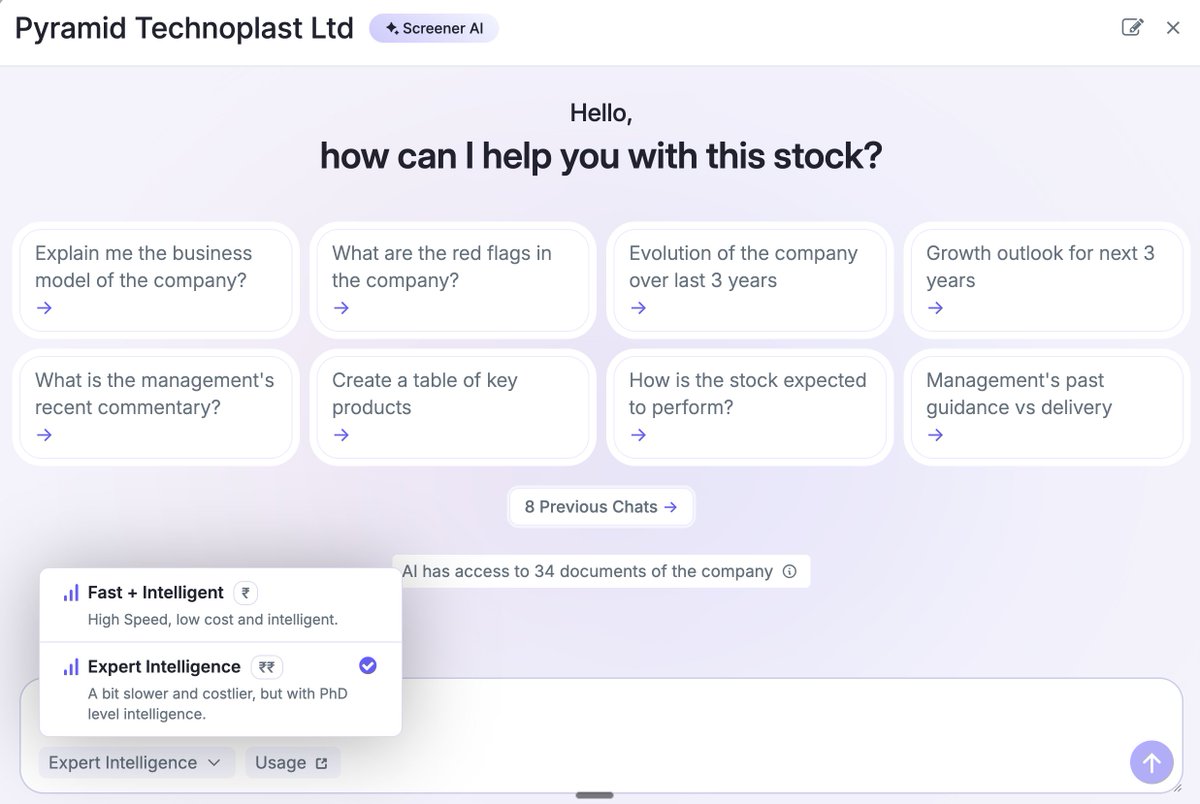
Pro Tip: Always use the Expert Intelligence feature. It's a bit slower and more expensive, but the depth of the answers is night and day.
Prompt 1: The Earnings Quality Detector
"I want you to do a deep forensic comparison between the company's reported Profit After Tax and its Cash Flow from Operations over the last 5 years. Pull the exact numbers for each year side by side. For every year in which PAT grew while operating cash flow declined, stayed flat, or grew significantly more slowly than PAT, I want a full breakdown of the causes of the divergence. Specifically, did trade receivables grow faster than revenue that year? Did inventory levels spike relative to the cost of goods sold? Were there any changes in depreciation or amortization policies mentioned in the annual report? Were there exceptional or non-recurring items inflating profit? Did the company capitalize expenses that were previously expensed? Go through the cash flow statement line by line for those divergent years and explain every major adjustment between net profit and operating cash flow. Also, check the conference call transcripts—did any analyst question the cash flow situation, and how did management respond? If management gave any explanation for weak cash conversion, pull the exact context. Finally, calculate the cumulative PAT vs. cumulative OCF over the entire 5-year period and tell me what percentage of reported profits actually converted to cash."
Why this works: Profit is an opinion. Cash flow is a fact. This prompt doesn't just flag the divergence. It forces the AI to trace exactly where the cash is leaking. You'll catch aggressive revenue recognition, channel stuffing, inventory buildup before a demand slowdown, and policy changes designed to inflate reported earnings. The cumulative conversion ratio at the end is the killer metric. A company that reported 500 crores of PAT over 5 years but only generated 300 crores of OCF has a 60% conversion ratio. That missing 40% went somewhere, and you need to understand where.
Prompt 2: The Management Consistency Scorecard
"Go through every con call transcript available, starting from the oldest. For each call, extract every specific forward-looking statement management made -- revenue growth targets, margin guidance, capex timelines, capacity expansion plans, new product or geography launches, debt reduction commitments, return ratio targets, order book projections, and client acquisition goals. Be exhaustive. Then, for each of these promises, track them into the subsequent quarters and check whether they were actually delivered. Build me a detailed scorecard in a table format: Column 1 is the con call date, Column 2 is the specific promise or guidance, Column 3 is the timeline they gave, Column 4 is what actually happened, Column 5 is a verdict -- Delivered, Partially Delivered, Missed, or Not Yet Due. I also want you to flag any instance in which management quietly stopped discussing a previously announced initiative without ever addressing what happened to it. Those silent abandonments are as telling as outright misses. At the end, give me an overall trust score -- what percentage of trackable promises were delivered or exceeded?"
Why this works: Everyone reads the latest con call and gets excited by the next quarter's guidance. Nobody tracks what management said 6 or 8 quarters ago. This prompt builds a trust database for you. A management team that consistently delivers on 80%+ of its commitments deserves a valuation premium. One that delivers on 40% is essentially guiding the market into buying a story that never materializes. The "silent abandonment" flag is particularly powerful: management loves to announce bold plans during bull runs and then pretend they never said it when things get tough. This prompt catches that pattern.
Started a week ago, not knowing how to write a single line of code
I wanted to read the Bhagavad Gita daily, but couldn't find an app that felt right. So I built one.
Ended with a full iOS app live @10minutegita on the App Store:
→ 239 daily readings of the Bhagavad Gita
→ Original Sanskrit shlokas + transliteration
→ Verse-by-verse translations & commentary
→ Personal daily reflections
→ Streak tracking with calendar heatmap
→ Shareable verse cards with 8 gradient themes
→ Hindi & English bilingual support
→ Light/dark mode, adjustable fonts
→ Completely offline after download
Total cost: $200 Claude Max Subscription + $20 ChatGPT Pro Subscription + $99 Apple Developer fee
Lines of code I wrote: 0
Claude Code wrote everything. I just described what I wanted in plain English (non-technical background). Codex reviewed it. Now it's live on the App Store.
The barrier to building isn't coding anymore. It's just knowing what problem you want solved.
If this is of value to you, I'd appreciate it if you downloaded the app & let me know your feedback. Process attached below
DM me if you want help building something similar.
What Claude Code actually did:
• Created 50+ files with React Native, Expo Router, TypeScript
• Set up file-based routing, state management, and AsyncStorage
• Wrote & validated 239 snippets in English and Hindi
• Ran 20+ parallel agents to fix Hindi data quality issues
• Built a share card generator from scratch
• Fixed bugs when I just pasted screenshots
• Set up GitHub Actions CI/CD
• Prepared App Store metadata and submission
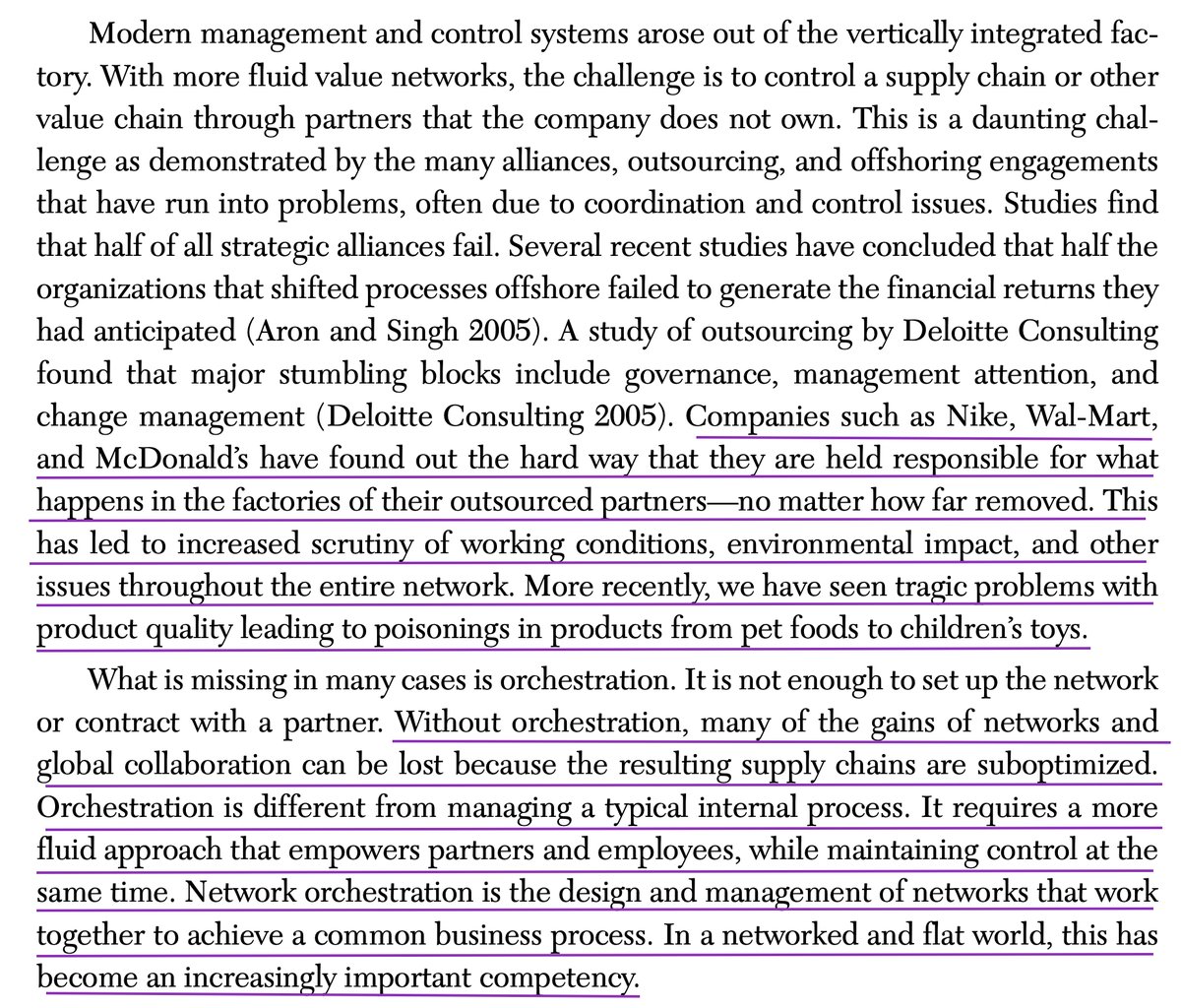
They play the role of the Orchestrator: A platform that connects to & finds synergies among 1000s of local networks across the world to create collective value for the network & its stakeholders
H/T @Chins1729 👑
2/ It's hard for a traditional firm to move towards being a Network Orchestrator
X | From thinking about their firm → The whole Network
Y | From Management control → Empowerment
Z | Shift in Value Creation through Specialisation → Integration
High Entry Barrier 🚧
3/ X
Two retail stores in New York City may appear to be direct competitors, but this is an illusion.
Each store has a supply chain stretching from its shelves out to the world
Before a customer walks into the store, often the game is over based on the superior supply chain.