Surprising to see @MAbsoud the senior author of the KCL study trying to explain the discrepancy between long COVID estimates from the very flawed Zoe KCL, and the nationally representative ONS study by critiquing the ONS without even understanding the ONS methodology.🧵
He says that ONS data are collected monthly & is retrospective so less valid. This isn't true- ONS collects data on long COVID every week for the first 5 wks & then monthly. Versus Zoe that depends on parents being motivated to report symptoms of a sick child for months.
It also assumes that symptoms resolved when parents stop reporting. How many parents would continue to report for 6 months or a year (ONS shows that sadly many children do have continuing symptoms for a year)- especially when they aren't even asked directly about common symptoms
ONS asks directly about 29 key symptoms, many of which were put forward after discussion with patients. Not only does the Zoe study not include many key common symptoms of long COVID, it also didn't consider it's relapsing & remitting nature.
I'm completely astonished that researchers who've conducted this research are rationalising their estimates based on flawed design by critiquing methodology of one of the most robust nationally representative studies, when they don't seem to even understand the methodology.
Surely publishing results that are lower than another study that was fairly robust it its methodology should mean at the very least that there should be explanations for why they are seeing differences- explanations that are based on an accurate assessment of the limitations.
It's very clear that the Zoe study bias will very likely underestimate incidence of long COVID and duration- researchers should be honest about this rather than flagging non-existent flaws in much better designed studies - which they clearly don't understand the methods for.
The idea that people are chronically ill or disabled because they don't want to get better or aren't trying to get better is borne out of nothing but abelism. It's easier to think it's the patient's fault rather than acknowledge you don't know how to help patients. 🧵
There isn't a shred of evidence to support this view, yet it gets constantly doled out by medics to patients who are struggling & would do anything to get better. The impact is further gaslighting a patient population that has been offered very little for decades.
The lack of curiosity about patients' illness means that no one delves further to try and understand it, because it's so much easier to just throw up your hands, and blame them for being ill. As if anyone would want to live with debilitating chronic illness if they had a choice.
Rather concerning that only 5% of dairy farmworkers *exposed to ill cows after H5N1 detection* wore CDC recommended PPE. H5N1 (avian influenza) is highly pathogenic, and this is really worrying, given the large numbers of spillover events that have been observed in humans lately
H5N1 has been adapting to mammals, with the recent circulating strain in dairy adapted specifically to binding to cells in the human respiratory tract. Mammal to mammal transmission has been suspected in specific outbreaks (e.g. mink in Spain), but not shown clearly in others.
Thankfully, efficient human to human transmission hasn't been observed yet, but if it's given a chance to spread across mammals in farms, with multiple spill overs into humans, it's only a matter of time.
The hubris of blaming those whose families & communities have been slaughtered by your leaders for not voting for those same leaders - because now *you* feel unsafe - while sitting in your intact homes that are not being razed to the ground, with your children alive and safe.
Implicit in this cry of American liberals is the devaluation of brown and Muslim lives. If it were their relatives murdered by their government, against their screams and protests, it's unlikely they would've voted for them. But white lives and safety always matter more.
A genocide becomes 'a single issue'. If it were a genocide of white Americans, I can guarantee it wouldn't be a 'single issue'. You can just see this by all the tweets about how Americans now feel unsafe.
If you've lived this long and have not had to realise that - *everything*- where you live, what you read, the streets you walk, what you eat, what you feel, where you work, the climate you live in, and even the air you breathe is political, I have news for you: that's privilege.
I automatically find myself looking at how people parse the world, and whether they fit into the former or the latter.
People who understand the systemically unjust & violent nature of the world, and how literally everything is shaped by capitalism, imperialism, colonialism are the people who understand the need for change, and the radical means necessary to enact this.
COVID has disproportionately affected disabled, clinically vulnerable, deprived & black/brown/indigenous communities. To say that that airborne precautions worsen inequity is BS. Rather, these protect *everyone*. If you care about equity, set air Q standards, provide respirators.
The WHO has done so much harm in this regard, & still continues to, because they simply cannot seem to acknowledge that they were wrong, and that very likely caused harm - which led to loss of life, and to chronic illness in many. We need accountability & learning here. Not lies.
If @WHO wants to restore any trust, they must acknowledge mistakes that have caused untold harm, and seek to show learning and change. None of this is happening when they say BS like this, and parade people like Farrar with more lies and BS to try to justify the unjustifiable.
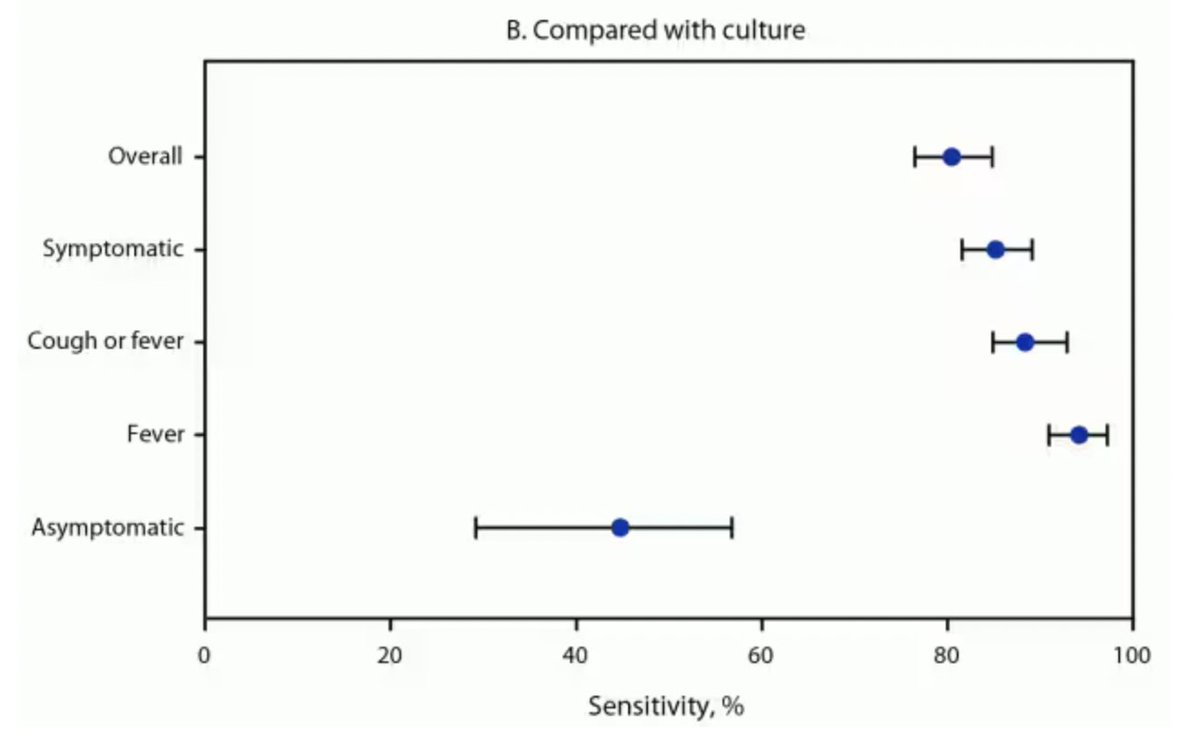
I remember all those who told us that RAT sensitivity was near 100% to detect 'infectiousness' - this study reports 47% compared with RT-PCR and 80% compared with viral culture. The lowest sensitivity is for those who are asymptomatic, and also during the pre-symptomatic phase.🧵
Sensitivity of RATs tends to rise when symptoms begin, but there is infectiousness before this that may not be picked up. Apart from the obvious impacts on transmission, this also has v. important impacts on treatment for people who are clinically vulnerable.
For many people who are clinically vulnerable, the primary consideration is getting treatment to them on time. Given the low sensitivity of RATs against PCR, especially in the early periods of infection, treatment may be significantly delayed by reliance on RATs over PCR.