

1/ There’s growing interest recently in the idea of decentralized mining pools, especially with the possibility of miners & pools being considered “brokers” based on the latest US infrastructure bill.
It seems about time we share our perspective on all of this. A thread👇
It seems about time we share our perspective on all of this. A thread👇
1a/ First, for those who missed it, here’s a great thread summarizing the relevant parts of the infrastructure bill.
https://mobile.twitter.com/jchervinsky/status/1421150344051048451
2/ The core idea of a decentralized mining pool is that there is no custodian of funds. Miners get paid directly from the coinbase transaction and don’t have to trust a 3rd party with their payouts.
This has some pros & cons.
This has some pros & cons.
3/ Pros:
+ More difficult to regulate or shut down the pool
+ More trustless than current model
Cons:
- Doesn’t scale
- Doesn’t work for the smallest miners
- Less space for non-miner txs (lower fee revenue)
- Prevents integration of value adds (e.g. financial services)
+ More difficult to regulate or shut down the pool
+ More trustless than current model
Cons:
- Doesn’t scale
- Doesn’t work for the smallest miners
- Less space for non-miner txs (lower fee revenue)
- Prevents integration of value adds (e.g. financial services)
4/ For smaller miners, the issue is UTXO size.
Take our pool for example. There are over 11k active users on Slush Pool, for an average of 460 TH/s per user.
However, many of these users have < 100 TH/s, so their rewards per block would be < 0.0001 BTC (& going📉 as ndiff 📈)
Take our pool for example. There are over 11k active users on Slush Pool, for an average of 460 TH/s per user.
However, many of these users have < 100 TH/s, so their rewards per block would be < 0.0001 BTC (& going📉 as ndiff 📈)

5/ Pools help these smaller miners by enabling them to accumulate BTC off-chain (in their pool accounts) so that they can receive larger but less frequent payouts that are more cost effective.
Direct coinbase payouts for garage miners don't scale.
Direct coinbase payouts for garage miners don't scale.
6/ There’s also a limit on the number of participants in a decentralized pool because the coinbase tx cannot contain thousands of outputs.
Each output in the coinbase tx consumes block space that could have been used to earn more revenue by including a user’s tx instead.
Each output in the coinbase tx consumes block space that could have been used to earn more revenue by including a user’s tx instead.
7/ Since miners in a pool accumulate rewards off-chain & receive payouts when their BTC threshold has been met or on a regular schedule (e.g. 1x/day), the total number of on-chain txs paying miners is greatly reduced and thus there is more room for user txs that earn revenue.
8/ Perhaps pools will offer Lightning payouts so that smaller miners can receive their funds more frequently without paying high fees.
However, we’re not aware of a way to implement LN in a decentralized way using the coinbase tx. Any LN experts out there that can weigh in?
However, we’re not aware of a way to implement LN in a decentralized way using the coinbase tx. Any LN experts out there that can weigh in?
9/ Another point for non-miners to understand is that most pools today are no longer just pools.
For example, many offer financial services to help miners with things like custody and earning interest on their sats.
Decentralized pools cannot vertically integrate.
For example, many offer financial services to help miners with things like custody and earning interest on their sats.
Decentralized pools cannot vertically integrate.
10/ Other technical issues:
+ Larger coinbase tx = heavier block template, leading to less efficient job distribution and higher probability of orphan blocks
+ Some ASIC firmwares don’t support larger coinbase sizes
+ Larger coinbase tx = heavier block template, leading to less efficient job distribution and higher probability of orphan blocks
+ Some ASIC firmwares don’t support larger coinbase sizes
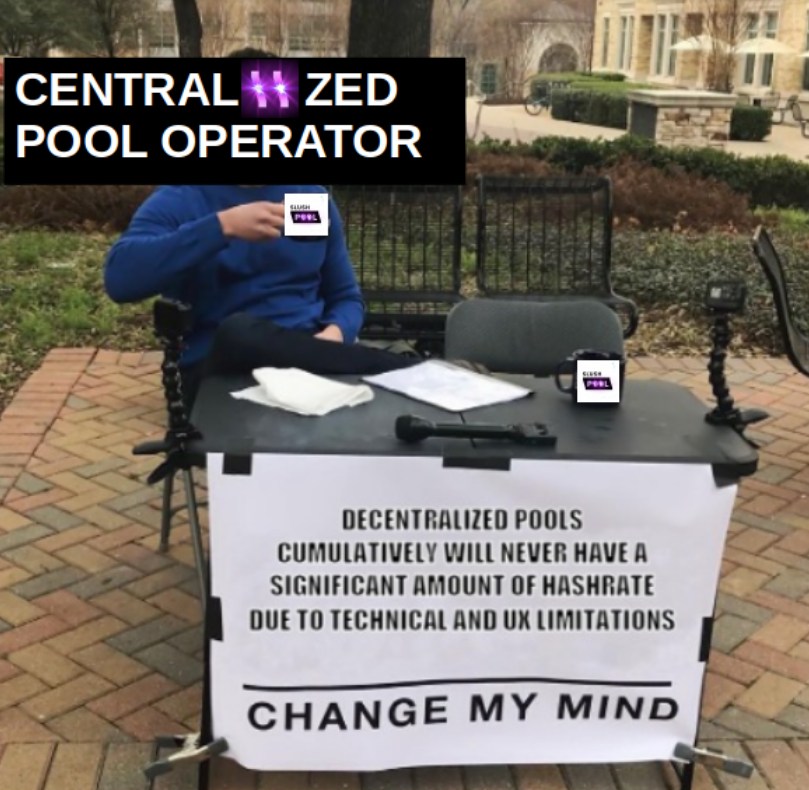
11/ In summary, it’s just not feasible to have large decentralized pools.
But wouldn’t many smaller pools be way better for decentralization anyway?
Well, sure. But this requires miners to accept much higher variance and less frequent payouts than they get today.
But wouldn’t many smaller pools be way better for decentralization anyway?
Well, sure. But this requires miners to accept much higher variance and less frequent payouts than they get today.
12/ There may be creative solutions to address some of these problems (e.g. Braidpool), but there’s little to be done about the drastically poorer UX of small decentralized pools vs. today’s pools.
But that doesn’t mean that all hope is lost for more decentralization.
But that doesn’t mean that all hope is lost for more decentralization.
13/ Once fully implemented, Stratum V2 will enable miners to continue benefiting from the UX offered by today’s cost-effective & vertically-integrated pools without trusting them to construct blocks.
Why that matters (tl;dr in next tweet): insights.deribit.com/market-researc…
Why that matters (tl;dr in next tweet): insights.deribit.com/market-researc…
14/ Tl;dr: As demand for block space increases & transaction fees become increasingly important for miner revenue, we may see a rise in out-of-band payments (users pay miners tx fees off-chain).
This is a risk for miners who rely on on-chain fees for part of their revenue.
This is a risk for miners who rely on on-chain fees for part of their revenue.
15/ Stratum V2 does not change the fact that pools act as temporary custodians.
Even in a future scenario with widespread V2 adoption, it would still be healthy to have a wide geographic distribution of pools.
Even in a future scenario with widespread V2 adoption, it would still be healthy to have a wide geographic distribution of pools.
16/ That said, pool infrastructure is already spread out across the world to improve robustness & reduce latency for geographically distributed miners.
As long as some countries remain friendly, pools can act like sovereign individuals, relocating to wherever they're welcome.
As long as some countries remain friendly, pools can act like sovereign individuals, relocating to wherever they're welcome.
End/ Conclusion: the idea of decentralized mining pools sounds great and can even look great on paper, but in reality there are few miners who will sacrifice UX to cut out pools as temporary custodians of their mining rewards.
• • •
Missing some Tweet in this thread? You can try to
force a refresh



