

So here's a funny, feel-good story.
In 2019, I wrote an essay for the @nytimes defending the widely ridiculed Oakland Coliseum.
nytimes.com/2019/10/02/spo…
In 2019, I wrote an essay for the @nytimes defending the widely ridiculed Oakland Coliseum.
nytimes.com/2019/10/02/spo…
In it, I called the Coliseum "baseball's last dive bar."
The piece went mildly viral in the baseball and Bay Area corners of the internet.
The piece went mildly viral in the baseball and Bay Area corners of the internet.

Hours after we published the piece, the Coliseum hosted its first @Athletics playoff game in years.
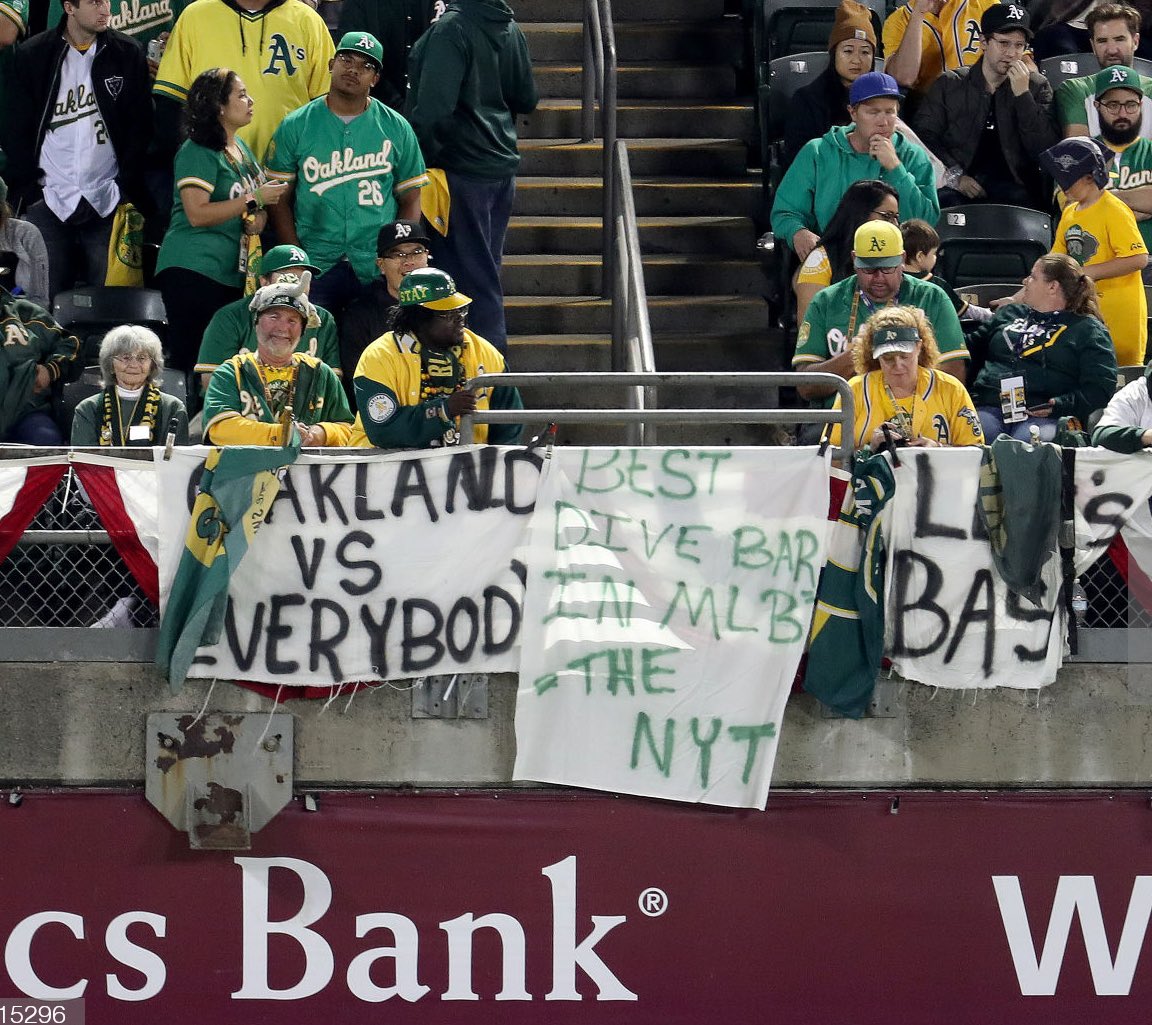
When I got there, I realized fans in the bleachers had already hung a sign referencing the essay!
Photo: @Tyska
When I got there, I realized fans in the bleachers had already hung a sign referencing the essay!
Photo: @Tyska
Soon the local news spotted me in the upper deck (because I was dancing like a fool, not because they recognized me).
But then they realized they had the author of that essay.
But then they realized they had the author of that essay.
The A's lost the game but a month later, two legendary A's fans, @SandLot408 and @209tacos, create shirts -- with all proceeds to charity.
https://twitter.com/SandLot408/status/1195806644489179136
The sales were so good they built an entire brand around it: @lastdivebar!
Now they sell last-dive-bar shirts, mugs, koozies, mouse pads, blankets 😆 - all made in the East Bay by @SimplyUniqueYou.
They've now given away roughly $20k to charity from it!
Lastdivebar.com
Now they sell last-dive-bar shirts, mugs, koozies, mouse pads, blankets 😆 - all made in the East Bay by @SimplyUniqueYou.
They've now given away roughly $20k to charity from it!
Lastdivebar.com
Finally, last night, A's pitcher @C_Bass419 had a dominant performance in the middle of a tight playoff race.
And then he wore this to the post-game press conference. 👏
And then he wore this to the post-game press conference. 👏
https://twitter.com/nbcsathletics/status/1423883241455509506
And speaking of drinking at the Coliseum: On Opening Day, fans needed to order beer via an app. Then the app broke.
So, yes, Telemundo's @Tomapapa interviewed me in Spanish.
So, yes, Telemundo's @Tomapapa interviewed me in Spanish.
I'll translate my part:
"It's a disaster. Because of the covid rules, we need to use an app. But the problem is: The app is broken!
So now no one here is drunk. It's the first time in the history of the Coliseum!"
"It's a disaster. Because of the covid rules, we need to use an app. But the problem is: The app is broken!
So now no one here is drunk. It's the first time in the history of the Coliseum!"
They’re out there rocking it again today.
https://twitter.com/athletics/status/1424084178165932032
• • •
Missing some Tweet in this thread? You can try to
force a refresh





