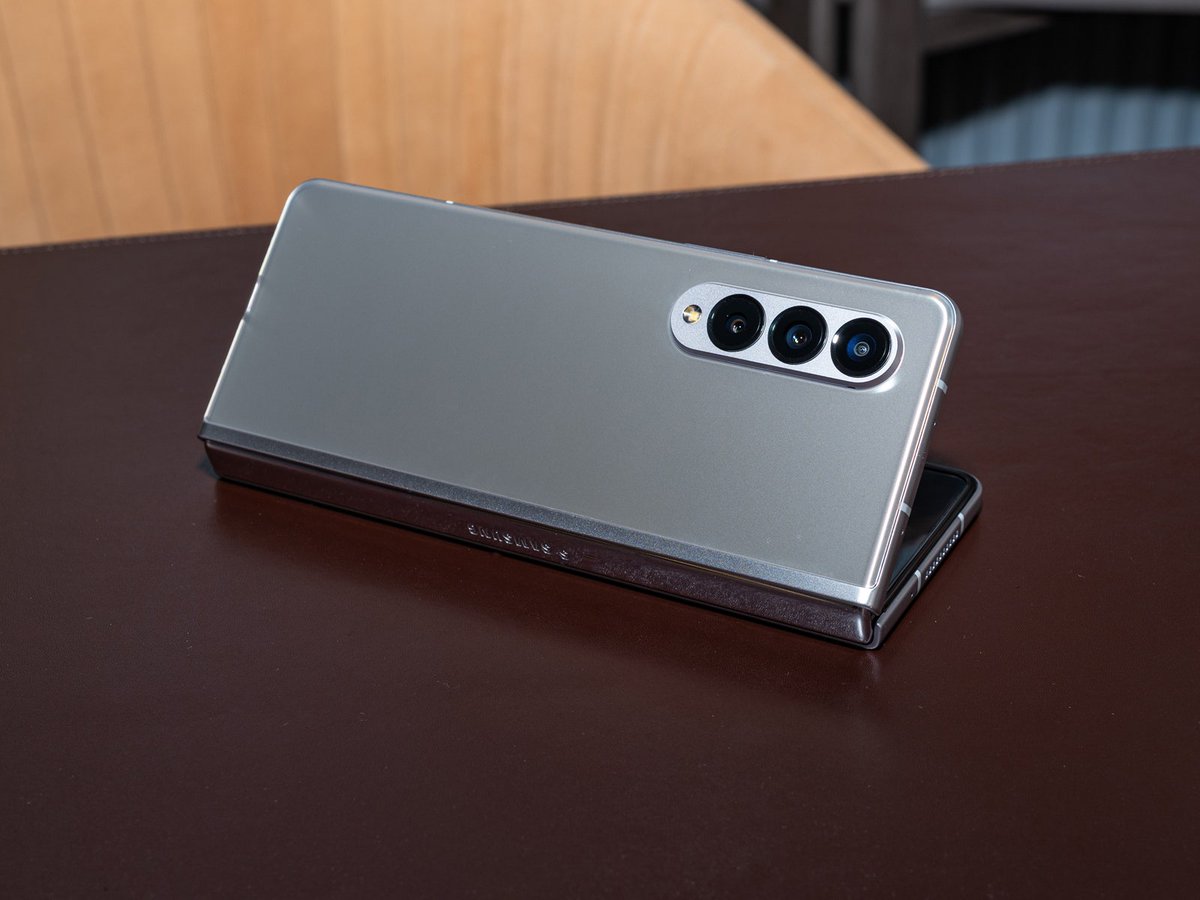
The second annual #SamsungUnpacked revealed some new gadgets from the nostalgic (hello, fliphones!), to the surprising (new watches!). Here's everything that was announced: wired.trib.al/o6ZGoTr 1/8
Meet the new #GalaxyZFold3 and #GalaxyZFlip3. Neither of the two devices unveiled reinvents the formula, but both phones have meaningful upgrades:
✔️ Water-resistance ratings (IPX8)
✔️ Gorilla Glass Victus in the front and back
✔️ Qualcomm's Snapdragon 888 chip
2/8
The #GalaxyZFold3 costs $1,799 and comes with a 6.2-inch AMOLED cover screen that has a 120-Hz refresh rate. Samsung has also added support for its S Pen stylus . If you preorder the Fold3, you'll get $200 in Samsung Credit for Samsung.com.
📷: @JulianChokkattu 3/8
The #GalaxyZFlip3 starts at $1,000. The screen on the front is now four times larger, it comes in an array of fun colors, and its main screen also gets its refresh rate bumped up to 120 Hz.
📷: @JulianChokkattu 4/8
Samsung is going in a new direction with its smartwatches by embracing Google's Wear OS operating system. That means Samsung watch fans gain access to more useful apps, such as Google Maps. 5/8
The #GalaxyWatch4 (left, in blue) starts at $250. The Watch4 Classic (right, in white) starts at $350. These are some of the new features:
✔️ Powered by a 5-nanometer Samsung processor
✔️ 16 gigs of storage
✔️ Up to 40 hours of battery life
✔️ Wireless fast charging
6/8
Samsung has a long history of making some of the best wireless earbuds, and the new Galaxy Buds2 are no exception. They cost $150 and some of the new features include:
✔️ Active noise-canceling
✔️ 3 sizes of ear tips
✔️ 5 hours of battery life
✔️ Qi wireless charging
7/8
Here's a full breakdown of what these new gadgets are all about. They're all available for preorder now, and they go on sale August 27: wired.trib.al/o6ZGoTr#SamsungUnpacked
8/8
• • •
Missing some Tweet in this thread? You can try to
force a refresh

Criminals posing as US immigration officers have carried out robberies, kidnappings and sexual assaults in several states, warns an FBI bulletin to law enforcement agencies issued last month. wired.com/story/fbi-warn…
Citing five 2025 incidents involving fake immigration officers, the bulletin says criminals are using ICE’s heightened profile to target vulnerable communities, making it harder to distinguish between lawful officers and imposters. wired.com/story/fbi-warn…
Federal rules require immigration officers to identify themselves and state the reason for an arrest “as soon as it is practical and safe to do so.” The standard has not changed since it was codified, yet advocates say it is increasingly ignored. wired.com/story/fbi-warn…
Thirty years ago, an Austrian theologian spoke to Peter Thiel about the theories of Carl Schmitt, the theorist tapped by the Nazis to justify Germany's slip from democracy to dictatorship. Those theories have been a roadmap for the billionaire ever since. wired.com/story/the-real…
Schmitt is remembered for two theories: his incisive Weimar-era critique of liberalism and his decision to join the Nazi party in the run-up to the Second World War.
In 1996, theologian Wolfgang Palaver introduced Thiel to these ideas at a conference. wired.com/story/the-real…
Also, some terms we gotta break down:
Mimetic Rivalry: Violence that results from humans’ fundamental tendency to imitate each other—specifically to mimic each other’s desires. A key concept for Rene Girard, Thiel’s biggest intellectual influence. wired.com/story/the-real…
In an industry once known for cushy perks, some founders are now asking staff to commit to a 72-hour weekly schedule. You’re either in or you’re out. wired.com/story/silicon-…
Would you like to work nearly double the standard 40-hour week? It’s a question that many startups in the US are asking prospective employees—and to get the job, the answer needs to be an unequivocal yes. wired.com/story/silicon-…
These companies are embracing an intense schedule, first popularized in mainland China, known as “996,” or 9 am to 9 pm, six days a week. That’s a 72-hour work week, in case you’re doing the math. wired.com/story/silicon-…
Generative AI has put data centers under the spotlight, and surging electricity needs could increase risk of fires. wired.com/story/x-data-c…
A recent, hours-long fire at a data center used by Elon Musk’s X may have begun after an electrical or mechanical issue in a power system, according to an official fire investigation. wired.com/story/x-data-c…
Data center giant Digital Realty operates the 13-acre site, and multiple people familiar with the matter previously told WIRED that the Musk-run social platform X has servers there. wired.com/story/x-data-c…
NEW: Metadata from the “raw” Epstein prison video shows approximately 2 minutes and 53 seconds were removed from one of two stitched-together clips. The cut starts right at the “missing minute.” wired.com/story/the-fbis…
The nearly three-minute discrepancy may be related to the widely reported one-minute gap—between 11:58:58 pm and 12:00:00 am—that attorney general Pam Bondi has attributed to a nightly system reset. wired.com/story/the-fbis…
This comes after WIRED reported that the video had been stitched together in Adobe Premiere Pro from two video files, contradicting the Justice Department’s claim that it was “raw” footage.
BREAKING: Metadata shows the FBI’s ‘raw’ Jeffrey Epstein prison video was likely modified. wired.com/story/metadata…
Metadata embedded in the video and analyzed by WIRED and independent video forensics experts shows that rather than being a direct export from the prison’s surveillance system, the footage was modified, likely using a Adobe Premiere Pro. wired.com/story/metadata…
Experts caution that it’s unclear what exactly was edited, and that the metadata does not prove deceptive manipulation. wired.com/story/metadata…