

Doing what we already know how to do takes the world from 1 to n, adding more of something familiar. But every time we create something new, we go from 0 to 1.
Humans are distinguished from other species by our ability to work miracles. We call these miracles technology.
Successful people find value in unexpected places, and they do this by thinking about business from first principles instead of formulas.
"What important truth do very few people agree with you on" 
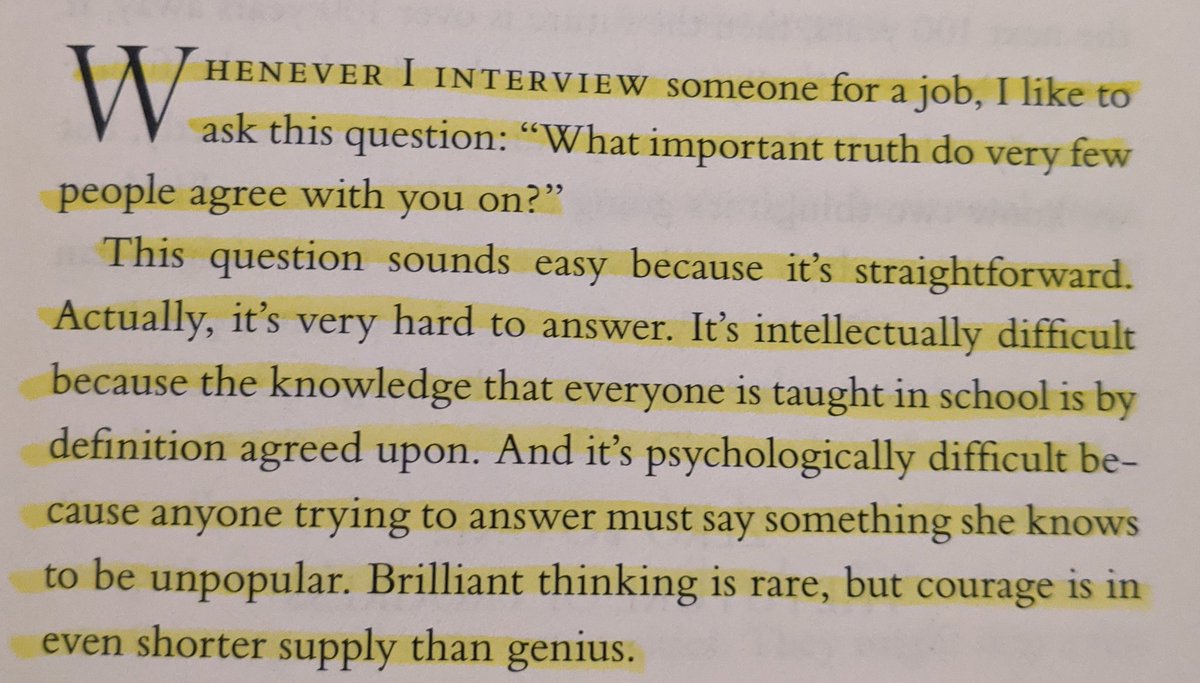
Conventional beliefs only ever come to appear arbitrary and wrong in retrospect; whenever one collapses, we call the old belief a bubble.
The most contrarian thing of all is not to oppose the crowd but to think for yourself.
How much of the world is actually monopolistic? How much is truly competitive?... There's an enormous difference between perfect competition and monopoly, and most businesses are much closer to one extreme than we commonly realize.
Monopolies drive progress because the promise of years or even decades of monopoly profits provides powerful incentive to innovate.


All happy companies are different: each one earns a monopoly by solving a unique problem. All failed companies are the same: they failed to escape competition.
For a company to be valuable it must grow and *endure*... Growth is easy to measure, but durability isn't. If you focus on near-term growth above all else, you miss the most important question you should be asking: will this business still be around a decade from now?
If you truly want to make something new, the act of creation is far more important than the old industries that might not like what you create. Don't disrupt.


The strange history of the Baby Boom produced a generation of indefinite optimists so used to effortless progress that they feel entitled to it... Since tracked careers worked well for them, they can't imagine that they won't work well for their kids, too.
The prospect of being lonely but right - dedicating your life to something that no one else believes in - is already hard. The prospect of being lonely and wrong can be unbearable.
Americans fear technology in the near future because they see it as a replay of the globalization of the near past. But the situations are very different: people compete for jobs and resources; computers compete for neither.
Social entrepreneurs aim to combine the best of both worlds and "do well by doing good." Usually they end up doing neither.
Progress isn't held back by some difference between corporate greed and nonprofit goodness; we're held back by the sameness of both. Whatever is good enough to receive applause from all audiences can only be conventional. Doing something different is what's truly good for society
A Scapegoat

The single greatest danger for a founder is to become so certain of his own myth that he loses his mind. But an equally insidious danger for every business is to lose all sense of myth and mistake disenchantment for wisdom.
@bradsling on China

• • •
Missing some Tweet in this thread? You can try to
force a refresh






