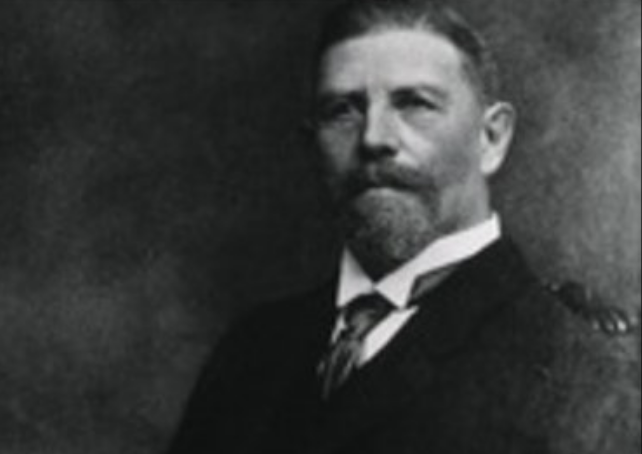
Cardiac surgery is 125 years old today! On September 9 1896, the German surgeon Ludwig Rehn performed the first successful operation on the human heart. 

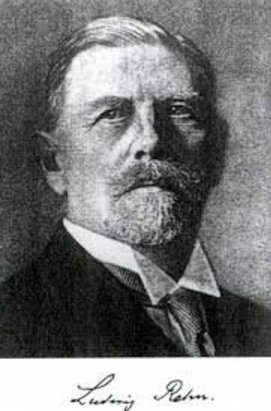
Born in Allendorf, Germany, in 1849, Rehn had an unusually varied career. While working as a GP near Frankfurt he noticed that workers at a local chemical works were prone to bladder cancer - deducing that the cause was a chemical they worked with, aniline.

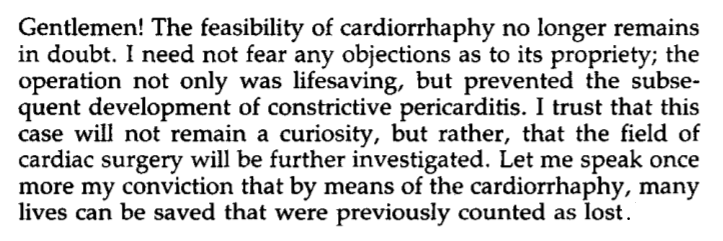
But he's better known for this famous paper, published in 1897. It begins: "In a desperate case of a stab wound of the right ventricle, I was forced to operate because of persistent bleeding." A sentence that heralded the era of cardiac surgery.

The patient was Willhelm Justus, a gardener aged 22. On Sept 7th 1896 Justus was stabbed in an apparently unprovoked attack. When the police found him he had been unconscious for three hours. They took him to the Frankfurt hospital where Rehn worked.
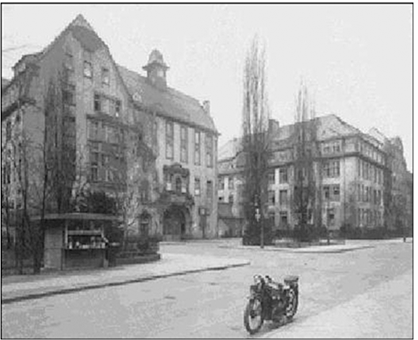
The doctors there found themselves examining a 'deathly pale' patient who 'groaned a great deal'. They assumed he would die. Rehn had been away on a trip, but when he returned two days later the patient had taken a major turn for the worse. He decided to operate.
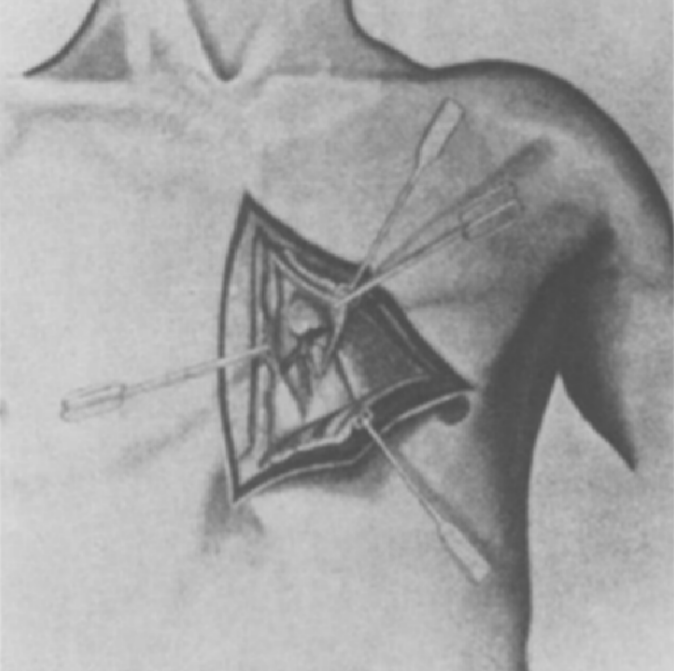
Rehn found a wound in the right ventricle, which he closed with three silk sutures - not easy, since the heart was still beating. "The heart continued to beat, and we could breathe freely," he wrote. The patient had a 'tendency to vomiting', but made a full recovery.
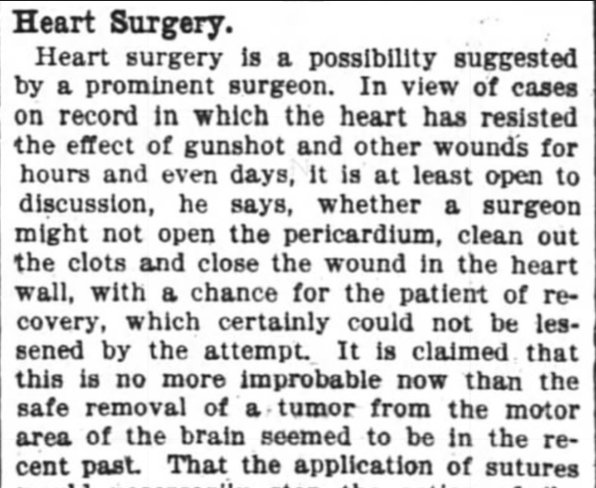
It's difficult to express just how great an advance this represented. Just a few weeks earlier, when another surgeon had suggested that heart surgery was not far from being a reality, it made front-page news.
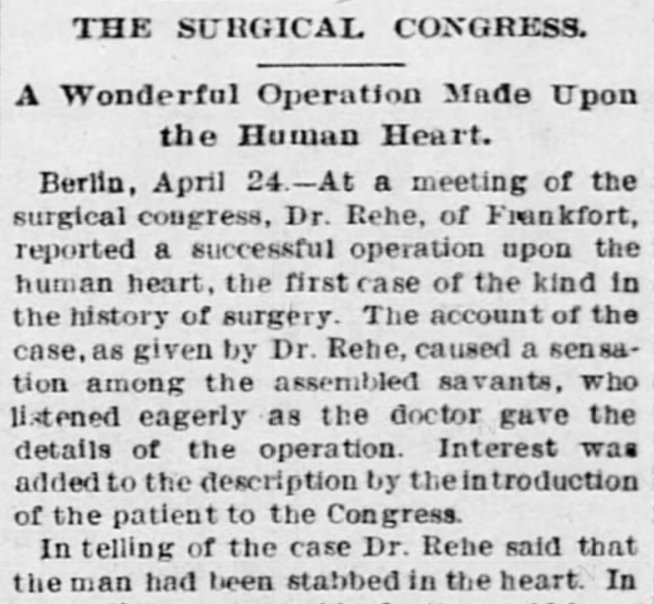
When Rehn announced the success of his operation at a conference the following April, it caused a sensation - not least because he introduced the audience to his patient Willhelm, who was fit and well.
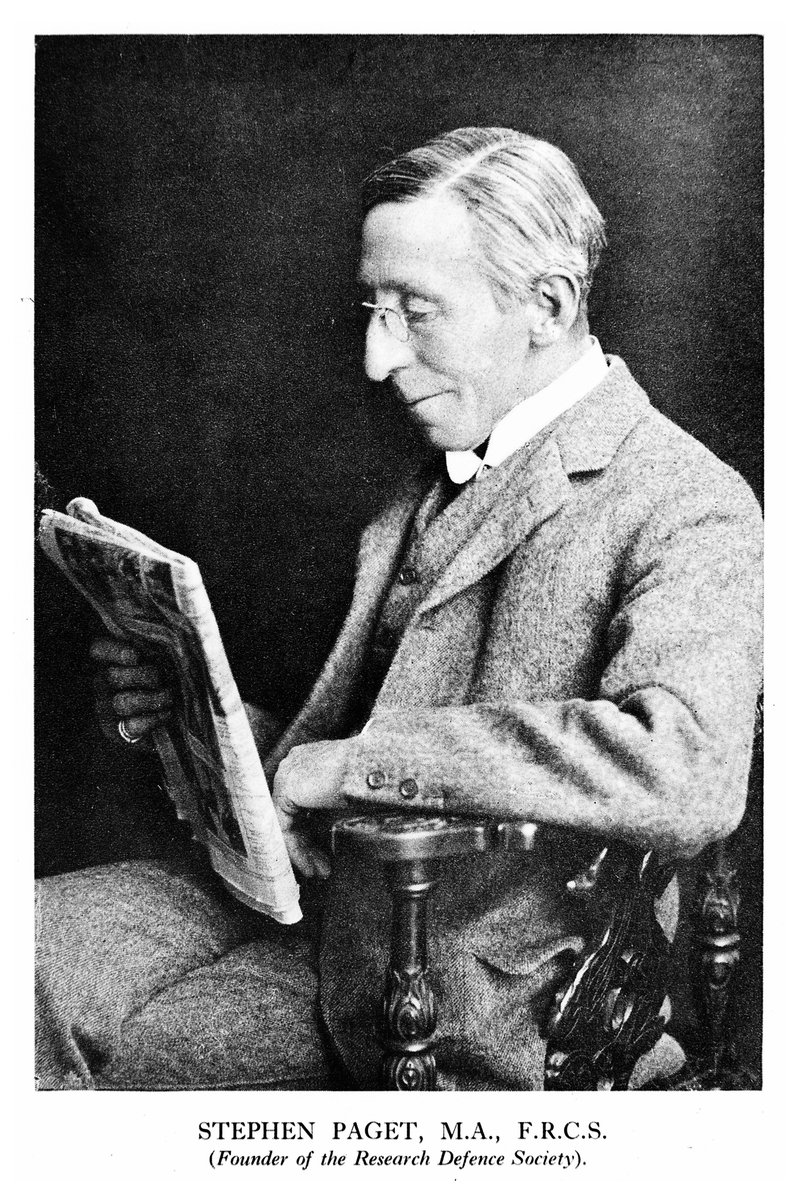
In a book published the same year as Rehn's operation, the British surgeon Stephen Paget had discussed cardiac injury, writing: "No new method, and no new discovery, can overcome the natural difficulties that attend a wound of the heart." He was happy to be proved wrong.
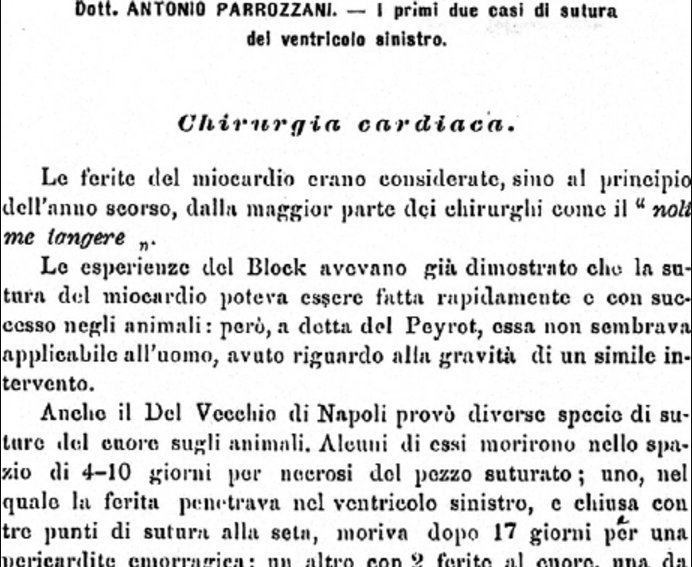
In April 1897, shortly after Rehn announced his triumph to the world, the Italian surgeon Antonio Parrozzani performed the second cardiac suture - and the first on the left ventricle. Operations in other countries followed. A new era had begun.
Rehn concluded his original case report by expressing the hope that 'this case will not remain a curiosity, but, rather, that the field of cardiac surgery will be further investigated.' He certainly got his wish!
It is thanks to Ludwig Rehn that we are today celebrating a century and a quarter of cardiac surgery - exactly 125 years after his pioneering surgical success.
For much more on this subject, and how the whole field of cardiac surgery has evolved in the 125 years since Rehn's operation, my book The Matter of the Heart is a good starting place: penguin.co.uk/books/1110892/…
• • •
Missing some Tweet in this thread? You can try to
force a refresh