THREAD: I spent a lot of the summer interviewing Congressional Black Caucus members from the South. Almost without exception, they now favor legal action to *unpack* their own hyper-safe seats to create more minority opportunities. theatlantic.com/politics/archi…
"We've only got one of six seats in a state that's a third Black," #LA02 Rep. Troy Carter (D) told me. "If Baton Rouge and Opelousas can be tied in for a second majority-minority district, I'm all in." theatlantic.com/politics/archi…
"If we're a quarter of the population, we should be a quarter of the seats," #AL07 Rep. Terri Sewell told me. "I'm for broadening the representation of African-Americans across Alabama, instead of concentrating it in my district." theatlantic.com/politics/archi…
"Some of our [CBC] members are beginning to rethink what the [Black] thresholds should be," said #NC01 Rep. G.K. Butterfield, whose old district (below) was unpacked by a racial redistricting lawsuit. theatlantic.com/politics/archi…
"If I had drawn the lines, my district would not be 58% Black," #SC06 Rep. Jim Clyburn wrote in an op-ed. "I am hopeful that when redistricting is done after the 2020 Census, stacking and bleaching will not be the primary goals." theatlantic.com/politics/archi…
"To suggest there is some numerical [50%] barrier that you have to achieve is absurd," said Rep. Bobby Scott, whose old #VA03 (below) was unpacked in 2016. "If the votes are changing, the standard ought to change." theatlantic.com/politics/archi…
"I was never comfortable with all the packing," said Rep. Alma Adams (D), whose previous snakelike #NC12 (below) was struck down by courts in 2016. "I think it limits the participation we can have as African-Americans." theatlantic.com/politics/archi…
Tbh, a big factor in this shift: over time, non-Black voters in the metro South (and beyond) have become more open to voting for Black candidates. Today, just 18 of the House's 53 @TheBlackCaucus members represent seats where Blacks are over 50% of the voting age population.
• • •
Missing some Tweet in this thread? You can try to
force a refresh

Pro tip: almost all the attention tonight will be on #NJGov, #VAgov and NYC mayor, but for '26 clues I'll be watching what happens in VA's House of Delegates. Here's why...
Nationally, the median House district voted for Trump by 3.1 pts in 2024. Depending on the final outcome of redistricting, Dems will need to hold/flip seats that voted for Trump by 3-5 pts to win control.
Today, the VA House of Delegates is effectively 51D-49R. But there are eight GOP delegates in districts that voted for Harris in '24, another six in districts that voted for Trump by 0-5 pts, and another seven in districts Trump won by 5-10 pts.
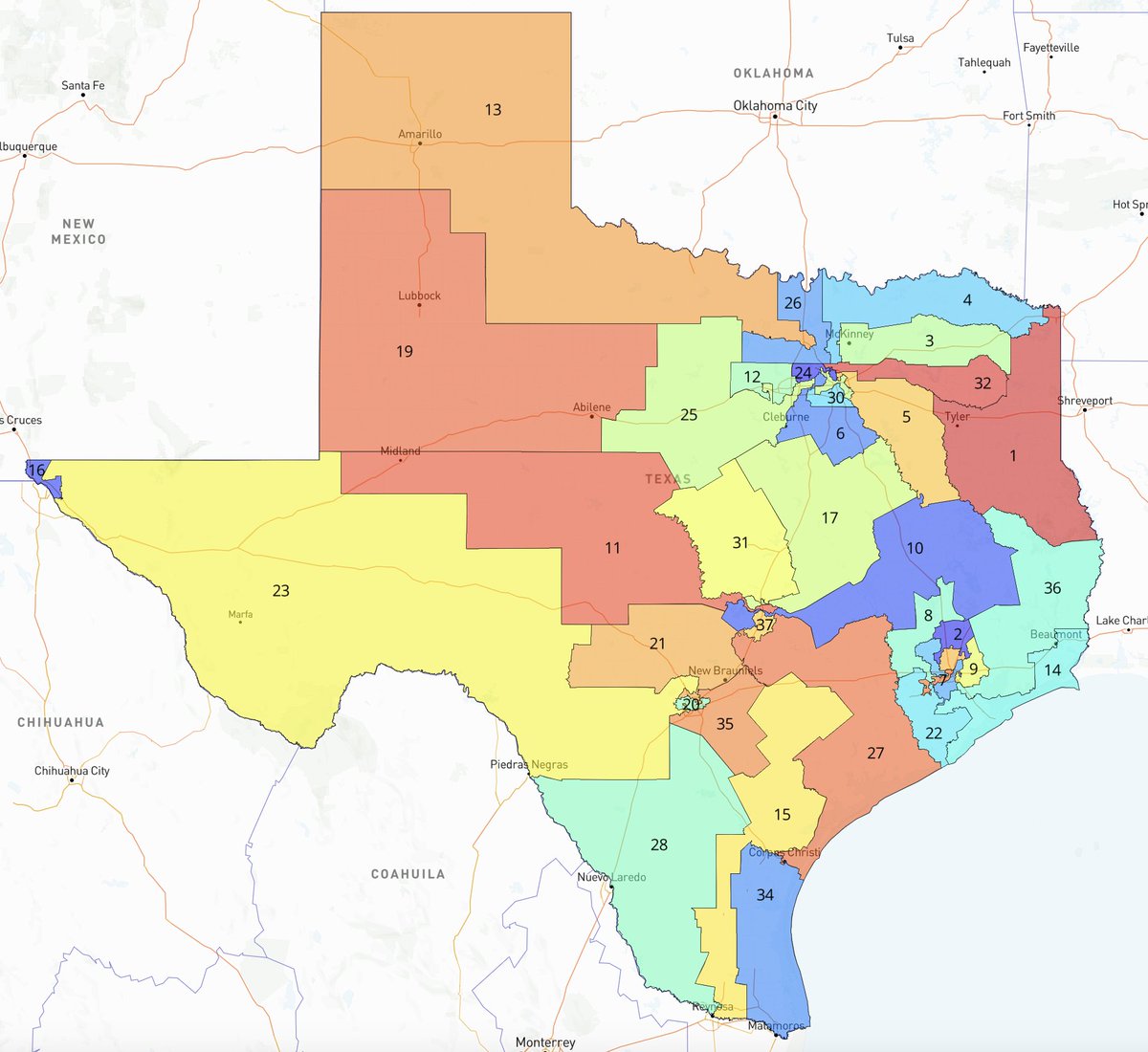
NEW: as expected, TX Republicans unveil a 30R-8D gerrymander (up from 25R-13D today) that puts Reps. Henry Cuellar (D) and Vicente Gonzalez (D) in double-digit Trump districts and axes one Dem seat each in DFW, Houston & Austin/San Antonio.
Interestingly, however, the map doesn't *totally* doom Cuellar & Gonzalez. Cuellar's #TX28 would move from Trump +7 to +10, Gonzalez's #TX34 would move from Trump +5 to +10. Both are potentially survivable given ancestral Dem ties & a midterm without Trump on the ballot.
In Houston, the GOP map merges Rep. Al Green's (D) #TX09 with the vacant safe Dem #TX18, and creates a new #TX09 in eastern Harris County that's 61% Hispanic but also Trump +15. That would be a pretty safe GOP pickup.
Thread: the key difference between when Biden was “counted out” last time vs. now is that in Feb. 2020, there was a plausible path to a comeback: Black voters & other Dems of color in SC, etc. hadn’t weighed in yet.
In fact, I made the argument after IA/NH in 2020 that there was still a lot of upside for Biden, though that view wasn’t widely shared at the time, and that he was among the most electable Dems in the race vs. Trump. nbcnews.com/news/amp/ncna1…
Today, a vast majority of voters believe Biden is incapable of finishing a second term, and there’s no legitimate reason to believe that defect will go away or become less of a dealbreaker for voters in the next four months.
How is it Dems are cleaning up in special elections/referendums if their national poll numbers are so bad? Because in the Trump era, Dems are excelling w/ the most civic-minded, highly-engaged voters.
Their biggest weakness? Peripheral voters who only show up in presidentials.
A big reason Dems beat pundit/historical expectations in the midterms? Only 112M people voted, including a disproportionate turnout among voters angry at Dobbs/abortion bans (many of them young/female).
But there will be ~160M voters in 2024. So who are those extra 48M voters?
They skew young, unaffiliated, nonwhite and non-college. They’re also more likely to base their choice on a simplistic evaluation of whether the economy was better under Trump or Biden.
On this question - and on immigration/age concerns - Biden is routinely getting clobbered.
Fact: of the 301 new House districts that have now been adopted, just 17 (5.6%) went for Biden or Trump by five points or less, down from 39 of 301 (13.0%) districts in the same states currently.
Back in 2012, after the last redistricting round, 66/435 districts went for Obama or McCain by five points or less. By 2020, only 51/435 districts went for Biden or Trump by five points or less - in other words, voter self-sorting explains a lot of the competitive decline.
But the 2022 redistricting cycle is rapidly compounding the decline. There may only be 30-35 seats in that range by the time all is said and done.
So the House's pro-GOP bias may be reduced or eliminated, but the House is also on pace to be more anti-competitive than ever.