Andy Constan Profile picture
Sep 26, 2021 25 tweets 4 min read Read on X
How I think about investing 101. This thread is designed to discuss investing for people who are not professionals. Your own situation should guide you through this framework and it is not advice for any one person.
First things first. If you have any credit card debt or similar high interest rate personal debt any savings should be used to pay that off.
Second you should always have a rainy day fund in cash that is equal to the amount of money you will need if your source of income stops and you can't find a job for a period of time
Third If you have a known need for a chunk of your savings say a car, house down payment, wedding, college etc.that will be needed in less than 5 years invest that money in a low risk investment. It can have some risk but not a ton. Add to these savings to meet your budget
Fourth after you have funded your nest egg and known soon spending any additional savings should first be placed in tax advantaged savings vehicles like IRA/401k and 529 plans. The asset allocation methods I mention below apply to these savings too.
So after the above are funded any additional savings go into taxable accounts. Besides the nest egg and the planned spending savings all of these vehicles are meant to be built properly and added to proportionately and infrequently rebalanced.
Now let's talk about long term savings. The goal of these savings depends on your age and ability to generate an income. The various age tracking funds offered in 401k's and other investment plans are conceptually good
The younger you are the less investment income and more risk you can take. As you age that need changes. Make sure you pay attention to this but it is a decade sort of thing. So don't shift much at all.
So what is a good portfolio to own if you know nothing about investing? Here is when we need to get into concepts like why invest at all, what do we know about the future, what is diversification, taxes, and transaction costs and fees.
I am going to start with transaction costs and fees. I believe outperforming the market on a risk adjusted basis is extremely hard. For that reason I believe that low fees and passive investing is better by far than active investing. You are reading this because you can't
Spend the time investing on your own and don't know enough to outperform. In order to pick an active manager who can consistently beat the market net of fees taxes and transaction costs you need the same skills to pick that manager as you already said you don't have
Passive mutual funds, cheap fee etf's will do just fine for your purposes.
Why invest at all? Long term investors receive a risk premium from those who need your cash. Harvesting that risk premium is the way one makes higher returns over decades than holding cash and getting whatever interest accrues in a bank account. Currently zero
Read my risk premium 101 thread to see why this is the case
What do we know about the future? If you are a market professional you may think you can predict the near term future. It is arrogant to believe this imho because lots of market professionals are trying to eat from the same plate. It's incredibly hard to be successful at this
It is a blessing to you if you accept that you don't know shit about the future and assume that all possible futures are already built into current prices. If you have that mindset all you have to do is create a portfolio that is indifferent to any potential future.
What drives prices over time. Well that is fairly simple. Growth, Inflation and specific idiosyncratic risk of a particular asset class or region.
Growth. If you own a lemonade stand and you get more people buying lemonade you are making more money and you are experiencing growth. Growth is good for stocks. However if you borrowed money to buy the business the lender would have been better off buying a lemonade stand
Growth is bad for bonds/loans because the opportunity cost of having placed money into stocks makes bonds unattractive. (Nitpickers will talk about bankruptcy being less remote when growth occurs but ignore them for the moment)
Inflation is bad for bonds because you receive less valuable money in the future. It can be good or bad for stocks. Good because the earnings you get are inflated. Bad because the wages and input costs inflate and potentially bad if the fed chokes growth to control inflation
Idiosyncratic risk is good and bad and thankfully diversification can reduce the risk while generating the same return as a concentrated portfolio. Diversification means investing in many different assets from many different countries and regions
What is most important is you buy a balance of assets some of which perform well in high growth some in low growth some in high inflation and some in low inflation environments. The 60/40 portfolio that most people use is tilted pro growth significantly and is not diversified.
Today finding assets that do well in low growth or low inflation environments is extremely difficult which compounds the problem. Bonds have typically been this asset but low/zero interest rates do not provide enough upside in bond prices to provide investors balance
My thoughts on this problem will be forthcoming in another 101 but for now US long term bonds are ok but still not great for this need. The implication for portfolios is that if you can't be balanced you should take less risk and expect less return
Balance to an unknown future, passive to reduce taxes and fees, rebalance only when markets have taken your portfolio significantly out of balance and every ten years compare your age to your investments to get more safe as time goes on

• • •

Missing some Tweet in this thread? You can try to force a refresh

 

Keep Current with Andy Constan

Andy Constan Profile picture

Stay in touch and get notified when new unrolls are available from this author!

Read all threads

This Thread may be Removed Anytime!

PDF

Twitter may remove this content at anytime! Save it as PDF for later use!

Try unrolling a thread yourself!

how to unroll video
  1. Follow @ThreadReaderApp to mention us!

  2. From a Twitter thread mention us with a keyword "unroll"
@threadreaderapp unroll

Practice here first or read more on our help page!

More from @dampedspring

Feb 14
Foreign stock investing 101

Us naive Americans dont think about currency returns as part of our portfolios as we have the biggest and for decades best place to invest in equities.

Every other global investor cares about currency returns at basic level for their investing
The basic idea for investors or all nationalities should be simple and obvious to all. But we Americans just haven't had to care. Maybe we still don't but at least we should be aware. This 101 will explain what is obvious to all non Americans and then show how it works
The goal of all investors is simple. We want to maximize the risk adjusted return of our investments in the currency we expect to spend in the future.

As Americans we want to maximize our USD returns

If we are Japanese we want to maximize our Yen returns

Etc.
Read 14 tweets
Nov 9, 2025
Money creation and credit creation in the private sector 101 part 2.

Role of Repo.

In the prior thread I outline credit creation which can happen without banks and money creation which requires banks.

I also hinted at bank reserves role as being one of grease to the
system and NOT necessary for bank money creation but necessary for interbank deposit shifts. I also didn't discuss base money creation from the Fed and won't be dealing with that in this thread either.

Here I will discuss the specific role of Repo in today's financial system
The big takeaway is it is one of many important and necessary means of credit creation AND it has no role in money creation unless a bank is a party to the transaction.

That will take some weedy mechanics to prove. But before we do that let's talk about the entire economy
Read 25 tweets
Nov 9, 2025
Money creation and credit creation in the private sector 101

There has been a lot of focus on the repo market lately. I get it. It's an important part of the capital markets in the credit creation process. But its growth and contraction is part of the credit creation process
The repo market where transactions are between hedge funds and money market investors, and those who desire leverage for whatever purpose is an important market in the credit creation process BUT is not part of the money creation process UNLESS a commercial bank or the Fed is
A party to the transaction. Because this is largely misunderstood by even some plumbing experts it's worth it for me to write out my understanding (maybe im wrong which would be awesome so I can learn). So here I go.
Read 26 tweets
Nov 3, 2025
I've been studying various versions of balance sheet expansions over my career. I'd classify them as

Japanese first failed effort
UK's version
U.S. Version 1
U.S. version 2
ECB version
Japanese all in version 2

They are all fairly different in approach. The big takeaway 🧵
The developing Fed version that most are excited about is most akin to the Japanese first failed effort.

Here's a rough summary of each

In 2001-2006 Japan the BOJ initiated QE. In their version they offered significant lending to the Japanese banking system for good collateral
The balance sheet doubled in size at a pace of 35 Tn yen per year. However of that 35tn only 5 was direct asset purchase and most of that was Japanese Tbills. This is very similar to the BTFP program from SVB time and the current SRF. It was also sorta similar to ECB LTRO
Read 14 tweets
Nov 1, 2025
Why do repo rates change and what do they have to do with reserves. This is a super technical issue and there are better folks to follow on this topic than me but I'll give it a go.

Firstly what are the two sides of a repo transaction and why do they want to interact.
One side is a guy with a bank deposit he wants to earn interest on. The other is a guy who wants to borrow money overnight and has assets he owns that he is willing to provide as collateral to the loan. We can go down a level on each side but for now let's keep it simple.
Most repo transactions are done with UST as the collateral and most UST collatarel used is TBills but. UST's are also highly common collateral but do to the marked to market risk they offer less borrowing capacity per unit of notional (higher haircut)
Read 22 tweets
Oct 21, 2025
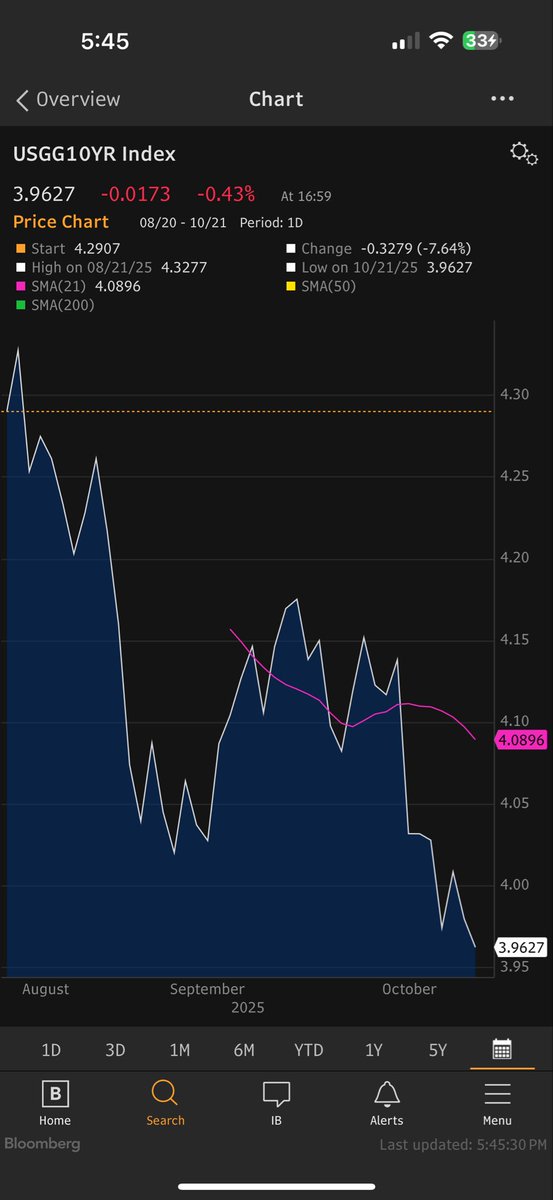
Some thoughts on 10 year notes since Powell guided for a restart of the cutting cycle at Jackson Hole. Trying to answer what the bond market is saying

Nominal yields have fallen 33bp Image
Note yields are driven lower by
1)Falling real GDP expectations
2)Falling Inflation expectations
3) Falling "risk" of owning assets
4) Improving supply/demand balance vs expectations.

In attributing nominal yield changes to these 4 things unfortunately market prices don't
Easily demonstrate these things. For instance 3&4 are only able to be measured via a model which estimates risk premiums or the expected return over holding cash

Even Breakeven inflation and real TIPS yields have risk premium buried in there market yields. However we can try
Read 15 tweets

Did Thread Reader help you today?

Support us! We are indie developers!


This site is made by just two indie developers on a laptop doing marketing, support and development! Read more about the story.

Become a Premium Member ($3/month or $30/year) and get exclusive features!

Become Premium

Don't want to be a Premium member but still want to support us?

Make a small donation by buying us coffee ($5) or help with server cost ($10)

Donate via Paypal

Or Donate anonymously using crypto!

Ethereum

0xfe58350B80634f60Fa6Dc149a72b4DFbc17D341E copy

Bitcoin

3ATGMxNzCUFzxpMCHL5sWSt4DVtS8UqXpi copy

Thank you for your support!

Follow Us!

:(