Santa Claus Rally 101. As the Yuletide season approaches I want to express my view that Santa exists some times and this year is one of those times. The Santa Claus Rally is strong outperformance of equities particularly the best performers of the year through year end.
While there are many theories of why this happens or if it exists at all. I believe there are two real world drivers. The first one generates buying flows. The second limits selling
In years when the market has had strong performance funds that have underperformed are forced into the market and chase both the overall market and the best performing stocks. This generates buying flows
Since 1928 when stocks are up 10% by Nov 1 buying stocks that day generates an average return of 4.68% with a max return of 14% and a positive return 83% of the time. The max loss is 2.01% and when a loss occurs the average loss is 0.60%. 36 observations exist. Santa is real!
Secondly as the year end approaches it makes little sense to crystallize a capital gain by selling the market or the best performers. Better to sell in January than sell in December. There is one exception which may be relevant this year but is unlikely to be relevant
When capital gains taxes are increased it makes sense to realize a capital gain when the rate on that gain is lower vs holding and realizing the gain when rates are higher. The Dem's Budget Plan includes an increase in capital gains taxes and could put coal in Xmas stockings.
However when the budget was originally proposed the capital gain rate was retroactive. It would be fairly unlikely that a bill passed in 2021 would shift the rate increase to 2022. I could be wrong and will follow this closely as Santa doesn't get going this early anyway
Nonetheless performance chasing generating buying and delayed capital gain realization causing less selling have historically been powerful forces. I expect this year to be no different
• • •
Missing some Tweet in this thread? You can try to
force a refresh

Money creation and credit creation in the private sector 101 part 2.
Role of Repo.
In the prior thread I outline credit creation which can happen without banks and money creation which requires banks.
I also hinted at bank reserves role as being one of grease to the
system and NOT necessary for bank money creation but necessary for interbank deposit shifts. I also didn't discuss base money creation from the Fed and won't be dealing with that in this thread either.
Here I will discuss the specific role of Repo in today's financial system
The big takeaway is it is one of many important and necessary means of credit creation AND it has no role in money creation unless a bank is a party to the transaction.
That will take some weedy mechanics to prove. But before we do that let's talk about the entire economy
Money creation and credit creation in the private sector 101
There has been a lot of focus on the repo market lately. I get it. It's an important part of the capital markets in the credit creation process. But its growth and contraction is part of the credit creation process
The repo market where transactions are between hedge funds and money market investors, and those who desire leverage for whatever purpose is an important market in the credit creation process BUT is not part of the money creation process UNLESS a commercial bank or the Fed is
A party to the transaction. Because this is largely misunderstood by even some plumbing experts it's worth it for me to write out my understanding (maybe im wrong which would be awesome so I can learn). So here I go.
I've been studying various versions of balance sheet expansions over my career. I'd classify them as
Japanese first failed effort
UK's version
U.S. Version 1
U.S. version 2
ECB version
Japanese all in version 2
They are all fairly different in approach. The big takeaway 🧵
The developing Fed version that most are excited about is most akin to the Japanese first failed effort.
Here's a rough summary of each
In 2001-2006 Japan the BOJ initiated QE. In their version they offered significant lending to the Japanese banking system for good collateral
The balance sheet doubled in size at a pace of 35 Tn yen per year. However of that 35tn only 5 was direct asset purchase and most of that was Japanese Tbills. This is very similar to the BTFP program from SVB time and the current SRF. It was also sorta similar to ECB LTRO
Why do repo rates change and what do they have to do with reserves. This is a super technical issue and there are better folks to follow on this topic than me but I'll give it a go.
Firstly what are the two sides of a repo transaction and why do they want to interact.
One side is a guy with a bank deposit he wants to earn interest on. The other is a guy who wants to borrow money overnight and has assets he owns that he is willing to provide as collateral to the loan. We can go down a level on each side but for now let's keep it simple.
Most repo transactions are done with UST as the collateral and most UST collatarel used is TBills but. UST's are also highly common collateral but do to the marked to market risk they offer less borrowing capacity per unit of notional (higher haircut)
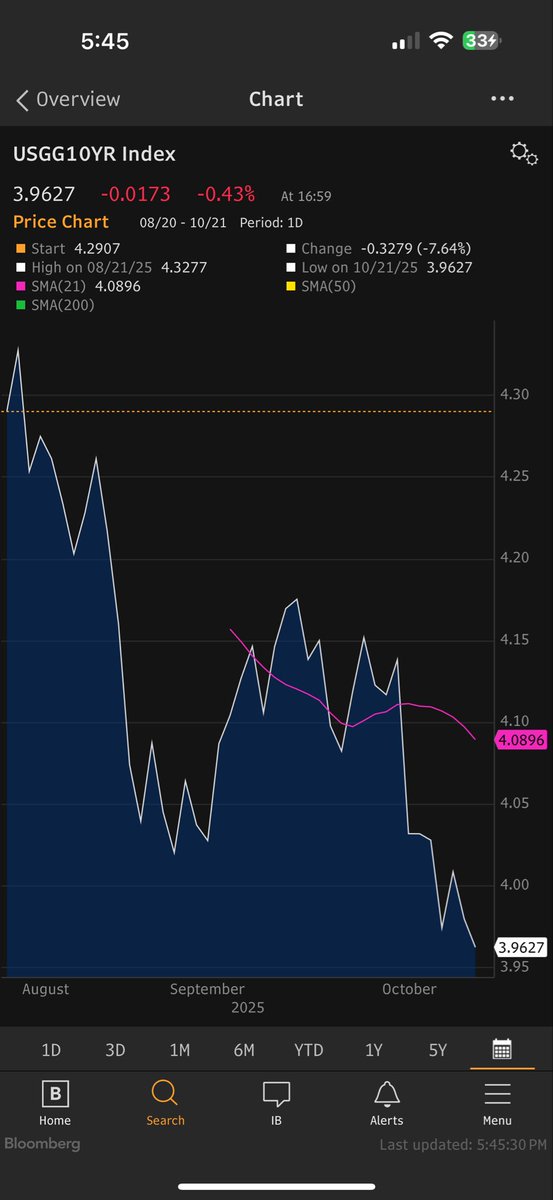
Some thoughts on 10 year notes since Powell guided for a restart of the cutting cycle at Jackson Hole. Trying to answer what the bond market is saying
Nominal yields have fallen 33bp
Note yields are driven lower by
1)Falling real GDP expectations
2)Falling Inflation expectations 3) Falling "risk" of owning assets 4) Improving supply/demand balance vs expectations.
In attributing nominal yield changes to these 4 things unfortunately market prices don't
Easily demonstrate these things. For instance 3&4 are only able to be measured via a model which estimates risk premiums or the expected return over holding cash
Even Breakeven inflation and real TIPS yields have risk premium buried in there market yields. However we can try
SPX has a trailing earnings yield of 4% with expected 1 year earnings growth of 11.7%. What's the bull case? For me the bull case is a combination of simply collecting the earnings accrual
and having the multiple expand slightly. In that case a 16% return would occur which is roughly 1 std higher and happens 1 out of 6 timer.
The big driver of equity returns is the accrual of earnings. Over the last 5 years earnings accrual has dominated historic returns
As long as companies continue to grow earnings they will go up over the long term.
Multiples rise and fall and as can be seen in the chart can dominate performance of equities in the short term. Furthermore multiples are impacted by interest rates