

The Ozy Media meltdown has a lot of lessons. As the reporter who caught them buying junk traffic in 2017, I'm biased. But I see it as a perfect, cautionary illustration of Paid versus Earned media. So: a 🧵 on why Ozy failed as a paid media company — and why it matters.
Definitions:
PAID media is advertising. Spend money to get an audience. In today's world that could be display ads, FB ads ppl click on, YouTube ads for your video.
EARNED media is when people choose to watch/read/listen to your content or the media chooses to cover you.
PAID media is advertising. Spend money to get an audience. In today's world that could be display ads, FB ads ppl click on, YouTube ads for your video.
EARNED media is when people choose to watch/read/listen to your content or the media chooses to cover you.
Ozy's strategy has been to buy audience, influence and the trappings of success. It appears to have worked until money from investors started to dry up. Ozy's problem is that all its paid media never turned into earned media aka real audience success. So they had to keep buying.
It was vicious cycle Ozy could not pull out of. My view: Ozy simply refused to change its vision and strategy to produce something people actually wanted in large enough numbers to build an audience. Interestingly, however, Ozy did manage to pull in millions from... paid content.
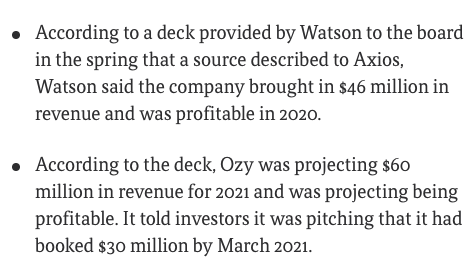
Brands paid millions to sponsor content on Ozy. This reveals a lot about advertisers imho, and their inability to to accurately judge real from fake in the digital media ecosystem. Or their propensity to simply not care about the difference... axios.com/how-ozy-fell-2… 
Backgorund: In 2017 I revealed Ozy bought a bunch of junk web traffic and had sent it to sponsored content pages on its website. They PAID for an audience to view this stuff. buzzfeednews.com/article/craigs…
This bought traffic was so low quality that it was marked as invalid/fraudulent by Double Verify. And data showed Ozy was sending this crap traffic to sponsored content from JPMorgan, Amazon, and Visa. JPMorgan had no idea when I reached out.
Now, it's not uncommon for a publisher to have to go out and spend some money on audience if they've promised certain metrics to a brand for a campaign. You might promote the link on FB to get ppl to click on it, for example. That's fine, but cuts into the publisher's profit.
But in this case Ozy was sourcing traffic from multiple extremely dubious sources, and the brands didn't know. It later told the brands that this traffic/content wasn't part of their deal. OK!
Let's move on. What has Ozy done since? It continued to pay for audience in a variety of formats. This pattern suggests Ozy's strategy of covering "the new and the next" wasn't building the kind of audience it was promising investors and advertisers.
So: it paid to place sponsored Ozy content in the LA Times and then quoted its own sponcon to create the impression it was getting good press. This thread has so many more examples like this
https://twitter.com/dudejohan/status/1442350935515140106
It placed a paid magazine supplement in the New York Times and also included deceptive claims about the rave reviews for the Carlos Watson Show.
https://twitter.com/dudejohan/status/1442350931794792448
It paid celebs like Alex Rodriguez and others to speak at Ozy Fest and pretended like they were there because it was a great event!
Axios reported that it paid for its social media following, and used these follower counts to try and impress investors and others. axios.com/how-ozy-fell-2…

.@benyt reported in the NY Times that Ozy paid to promote the Carlos Watson Show on YouTube, and I previously showed they were buying lots of FB ads for its clips. Axois also said Ozy was spending on YouTube preroll for the show.
https://twitter.com/CraigSilverman/status/1442671829756354569
The show was not doing well outside of paid promotion. The clips with the most views aligned with ones that received paid promotion on YouTube and FB. The big praise it touted came from Ozy-placed sponsored content. It was a vanity paid media project.
Meanwhile NY Magazine reported that in spite of all these efforts at buying attention and audience, Ozy's site was flatlining. Its journalists didn't get the paid media push that the CEO got... not that it was helping.
nymag.com/intelligencer/…
nymag.com/intelligencer/…

BUT in spite of all these obvious signs that the company was not connecting with an audience, Brands continued to spend money with Ozy. The one thing Ozy was good at was at selling itself and a vision. From the NYT tonight: nytimes.com/2021/10/03/bus…

Also, brands do completely bonkers shit with their money. In 2017 I gave JPMorgan a LOT of data and details to show how its sponson on Ozy was getting junk paid traffic. Yet here we are four years later and JPMorgan was still spending with Ozy.
https://twitter.com/CraigSilverman/status/1443960563814617092
As Ozy itself showed, its only success was building a brand that could be used for paid content. It had a good message and nice design and gave brands a good feeling. Brands went for it and ignored everything else.
Ozy was paid media property. It paid to promote itself, it paid for audience and followers, it paid to hit campaign goals. It paid for speakers, it paid for its own good press. It earned revenue by getting brands to pay for content inspired by the image Ozy bought paid for.
This is how you create the mirage. You raise money and you deploy it to buy the trappings of digital media success. But if you never build an actual audience, you have to *keep paying*. That's the rub.
There are lots of paid media entities. Many use an arbitrage strategy of buying traffic via ads, Taboola/Outbrain etc. and then monetizing the hell out of that traffic when it hits their sites. You gotta be ruthless to make money that way, and not give a shit about prestige.
Arbitrage pubs are rigorous about measuring which content performs, who clicks on ads, which traffic sources convert, how to maximize rev per page.
Ozy has the bloated ad tech stack you might see on an arbitrage site. But almost no ads. BIG RED FLAG
Ozy has the bloated ad tech stack you might see on an arbitrage site. But almost no ads. BIG RED FLAG
https://twitter.com/Chronotope/status/1442988685801164800
Maybe they got blacklisted after my 2017 piece and found it hard to monetize. I don't know. But I know that if you're a paid media outlet and you aren't monetizing your site, that's some weird shit.
But brands and investors didn't notice or didn't care. Ozy sold them on a vision that was propped up by bought-and-paid-for metrics and praise. Nobody looked past the surface.
One of the sad things is the Ozy journalists who were worked to exhaustion. They did their jobs, but they were doomed. Leadership loved the concept of Ozy so much that they were willing to spend millions on it even when it clearly didn't have an audience.
This matters because the money invested in Ozy and spent on campaigns with it could have been deployed elsewhere. It could have helped support mission-driven media that does the hard work of connecting with and serving a *real* audience.
I worry that other people of color building media businesses are going to face even more scrutiny and skepticism because of Ozy's deceptions.
And after years of covering ad fraud, I'm incensed that big brands still can't or won't take control of their digital spending.
And after years of covering ad fraud, I'm incensed that big brands still can't or won't take control of their digital spending.
Anyway, goodnight!
Oh look, Ozy says it’s not dead. Enjoy the ride everyone…
https://twitter.com/kantrowitz/status/1444999428008521728
I expect the vision for the rebirth of Ozy involves Carlos Watson hosting more Carlos Watson video shows and podcasts. Meanwhile, the Today show and CNBC let this guy come on and pump his own tires. He's not sorry and won't take responsibility. What a joke
https://twitter.com/nytimes/status/1445033492539232262
• • •
Missing some Tweet in this thread? You can try to
force a refresh





