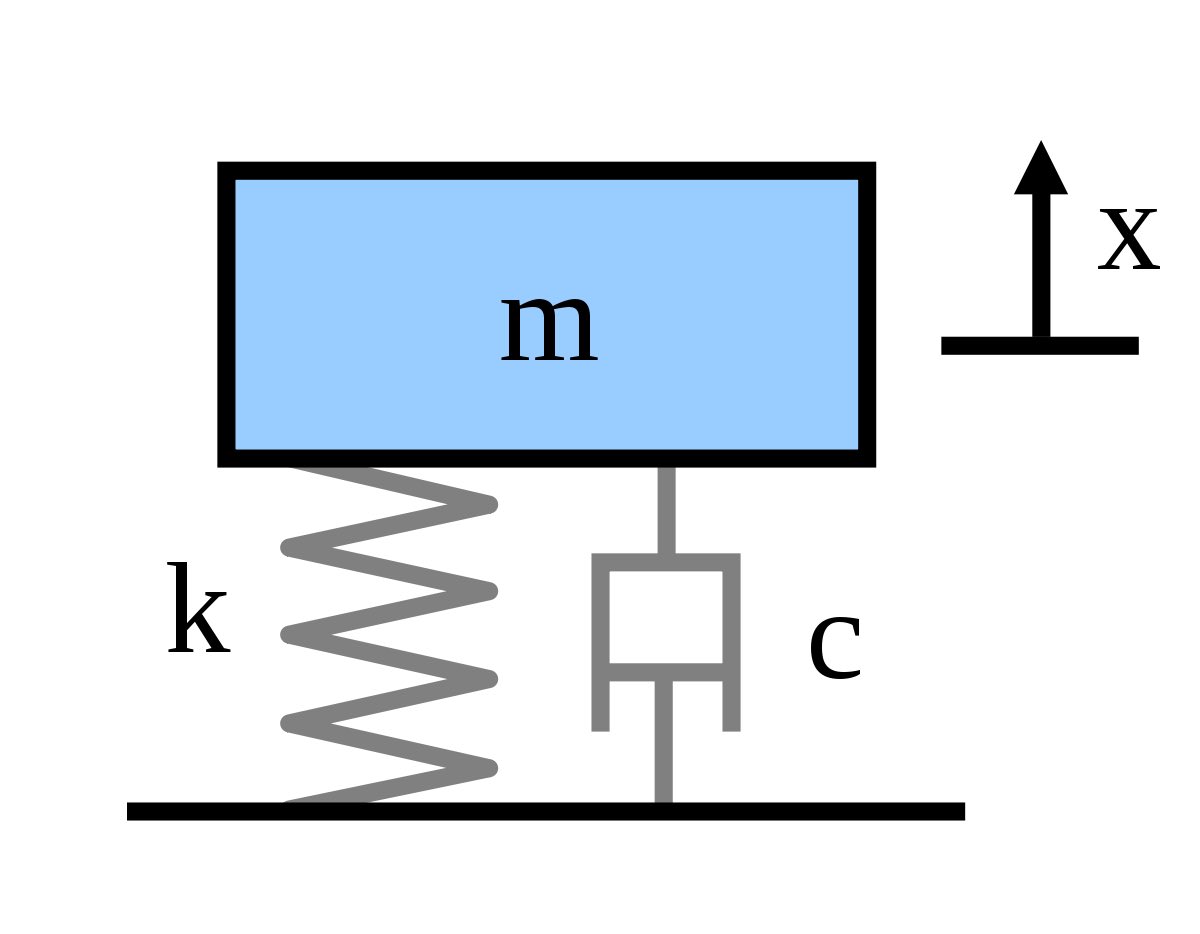
Damped spring model for volatility 101. This thread is about the concepts I use to model future volatility based on the idea that news moves markets to new equilibriums and conditions of participants and external stabilizing agents dictate the path that markets take on the way.
This is a conceptual model using a physical model of a force x impact a mass f and its energy being absorbed by a spring k and the spring action being dampened by a shock absorber c. Your car has this physical system to stay on the road over bumps
I will tell you what each variable is and then go into each later
M is the market being modeled
X is the news
K is the condition of the market participants
C is the condition of various market stabilizing agents
M is the market. Data that may matter includes. Absolute size
Type of asset
Characteristics of the asset such as inherent leverage or other asymmetry
Breadth and depth of interested investors
Other idiosyncrasies
X is the news
Essentially this shifts the equilibrium price.
News is shorthand for an impact. What is important is the news is not fully discounted. Even a coin flip can be properly discounted ahead of the flip but the result will impact the payoff.
News can be in the form of actual news or simply something that would result in a change in future expectation. It could simply be an unknown but impactful market participant changing her view and sending an order.
K is the conditions of market participants. which might include financial leverage, whether investors are in draw down and by how much, composition by investor type and geography, Investment strategies, including passive/active and the end saver conditions
C is the shock absorber and it includes those who provide short or long term liquidity to markets including banks, central banks, market makers, and fiscal policy makers. Shock absorbers also include market mechanisms like circuit breakers and limited hours of trading
Essentially by measuring each of these input conditions one can get a sense how volatile the path to equilibrium will be and how often and to what degree the equilibrium will be changed.
Further by observing the actual outcomes of markets in action data science can be used to understand the underlying variables based on the signal that occurs. Imaging watching a car bounce uncontrollably down a road. One could say wow that car needs some new shocks
Some examples. The BoE was a massive damper ahead of Soros. No matter what the X the market wouldn't move
Margin calls. Markets can wildly overshoot their market equilibrium price if K (market participants) are close to margin call forced selling or short covering eventually market equilibrium settles
When an M (market) has asymmetric pay off patterns the volatility can be skewed
This model is only conceptual. Lots of other physical devices may be useful to tune the system. In fact I'm pretty sure electronic components would do a better job. But I find the physical system intuitive and easy to explain to myself and others.
I actually use this model to trade markets. To do so the measurement and weighting of the various factors that impact the model variable is quite challenging. It's a crude tool that I constantly refine and improve
• • •
Missing some Tweet in this thread? You can try to
force a refresh

Us naive Americans dont think about currency returns as part of our portfolios as we have the biggest and for decades best place to invest in equities.
Every other global investor cares about currency returns at basic level for their investing
The basic idea for investors or all nationalities should be simple and obvious to all. But we Americans just haven't had to care. Maybe we still don't but at least we should be aware. This 101 will explain what is obvious to all non Americans and then show how it works
The goal of all investors is simple. We want to maximize the risk adjusted return of our investments in the currency we expect to spend in the future.
As Americans we want to maximize our USD returns
If we are Japanese we want to maximize our Yen returns
Money creation and credit creation in the private sector 101 part 2.
Role of Repo.
In the prior thread I outline credit creation which can happen without banks and money creation which requires banks.
I also hinted at bank reserves role as being one of grease to the
system and NOT necessary for bank money creation but necessary for interbank deposit shifts. I also didn't discuss base money creation from the Fed and won't be dealing with that in this thread either.
Here I will discuss the specific role of Repo in today's financial system
The big takeaway is it is one of many important and necessary means of credit creation AND it has no role in money creation unless a bank is a party to the transaction.
That will take some weedy mechanics to prove. But before we do that let's talk about the entire economy
Money creation and credit creation in the private sector 101
There has been a lot of focus on the repo market lately. I get it. It's an important part of the capital markets in the credit creation process. But its growth and contraction is part of the credit creation process
The repo market where transactions are between hedge funds and money market investors, and those who desire leverage for whatever purpose is an important market in the credit creation process BUT is not part of the money creation process UNLESS a commercial bank or the Fed is
A party to the transaction. Because this is largely misunderstood by even some plumbing experts it's worth it for me to write out my understanding (maybe im wrong which would be awesome so I can learn). So here I go.
I've been studying various versions of balance sheet expansions over my career. I'd classify them as
Japanese first failed effort
UK's version
U.S. Version 1
U.S. version 2
ECB version
Japanese all in version 2
They are all fairly different in approach. The big takeaway 🧵
The developing Fed version that most are excited about is most akin to the Japanese first failed effort.
Here's a rough summary of each
In 2001-2006 Japan the BOJ initiated QE. In their version they offered significant lending to the Japanese banking system for good collateral
The balance sheet doubled in size at a pace of 35 Tn yen per year. However of that 35tn only 5 was direct asset purchase and most of that was Japanese Tbills. This is very similar to the BTFP program from SVB time and the current SRF. It was also sorta similar to ECB LTRO
Why do repo rates change and what do they have to do with reserves. This is a super technical issue and there are better folks to follow on this topic than me but I'll give it a go.
Firstly what are the two sides of a repo transaction and why do they want to interact.
One side is a guy with a bank deposit he wants to earn interest on. The other is a guy who wants to borrow money overnight and has assets he owns that he is willing to provide as collateral to the loan. We can go down a level on each side but for now let's keep it simple.
Most repo transactions are done with UST as the collateral and most UST collatarel used is TBills but. UST's are also highly common collateral but do to the marked to market risk they offer less borrowing capacity per unit of notional (higher haircut)
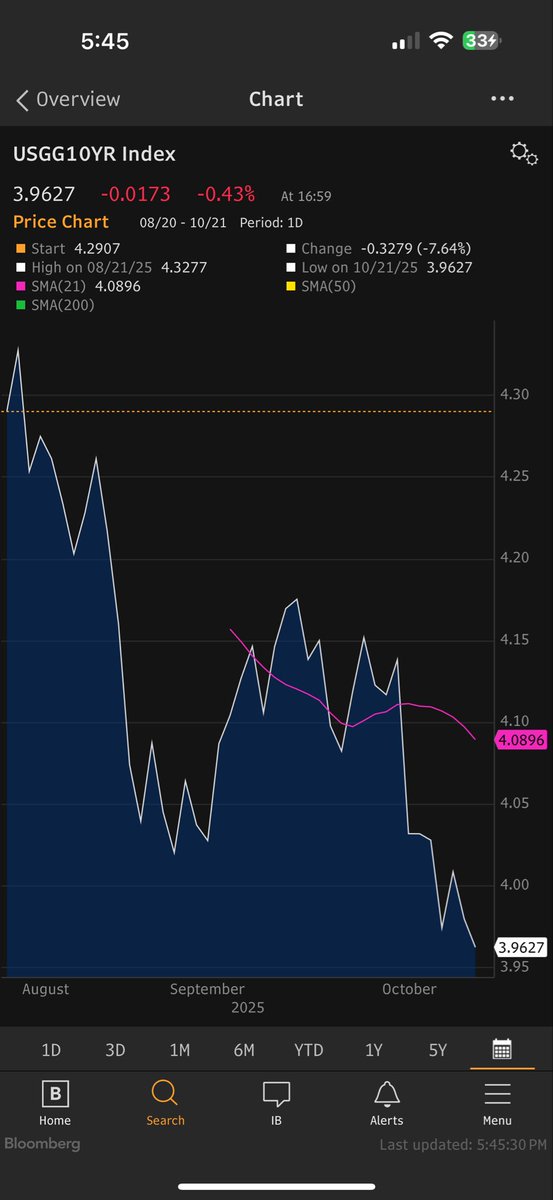
Some thoughts on 10 year notes since Powell guided for a restart of the cutting cycle at Jackson Hole. Trying to answer what the bond market is saying
Nominal yields have fallen 33bp
Note yields are driven lower by
1)Falling real GDP expectations
2)Falling Inflation expectations 3) Falling "risk" of owning assets 4) Improving supply/demand balance vs expectations.
In attributing nominal yield changes to these 4 things unfortunately market prices don't
Easily demonstrate these things. For instance 3&4 are only able to be measured via a model which estimates risk premiums or the expected return over holding cash
Even Breakeven inflation and real TIPS yields have risk premium buried in there market yields. However we can try