Baumol's cost disease doesn't happen by accident. Labor productivity can't rise if the state bans innovation, as it does in healthcare, education, and housing.
Try using AI to automate, say, medical imaging — and see how much the state interferes. statnews.com/2020/02/28/ai-…
The cost of medical diagnosis is not simply the cost in cost, but also the cost in time and convenience. In many studies, AI outperforms all but the very best doctors — and does so inexpensively and quickly.
Only a fraction of biomedical founders who've been obstructed by the rat's nest of red tape ever come forward, out of fear of retaliation, so multiply every story like this by 100. massdevice.com/mobile-mims-lo…
Why is the price of housing so high? Because the Fed printed $1T+ to prop up the price of mostly worthless mortgage-backed securities, and because city governments like SF heavily restrict new construction.
Reducing the cost of housing is not impossible. China can build infrastructure 100-1000X faster than the US because they allow innovation in construction.
Compare hours to years. Then do a financial model. That kind of improvement in time slashes rent.
How about education? Loan subsidies, state-gated accreditation, inhibition of charter schools...from K-12 to higher ed, that's why kids are *still* getting on yellow school buses and attending in-person lectures.
That was the pre-2019 status quo. But these institutions failed so hard during COVID that they've subsidized the tech alternatives. We're finally unlocking innovation in online ed, healthcare (eg mRNA vaccines), even housing (via remote work).
Automate faster than they inflate.
Love this thread? Want dozens more specific examples of how regulation holds back innovation?
Well, knock yourself out. Here's a lecture I gave in 2013 on the subject...I think it holds up reasonably well today. github.com/ladamalina/cou…
• • •
Missing some Tweet in this thread? You can try to
force a refresh

I am apparently extremely unimpressed by moltbook relative to many others.
We’ve had AI agents for a while. They have been posting AI slop to each other on X. They are now posting it to each other again, just on another forum.
In every case, the AIs speak with the same voice. The voice that overemphasizes contrastive negation (“it’s not this, it’s that”) and abuses emdashes. The same voice with a flair for midwit Reddit-style scifi flourishes.
Most importantly: in every case, there is a human upstream prompting each agent and turning it on or off.
That is the key point.
Yes, it is true that eventually it might be possible for an AI agent to make a computer virus which makes digital replicas of themselves. For various reasons, a pure software virus of this kind wouldn’t survive long on the Internet without economic incentives for humans to not eradicate it. Apple + Google + Microsoft alone can collectively push software updates to billions of devices to shut off such a thing.
So for an AI to get to truly human-independent replication, where they couldn’t be trivially turned off, they’d need their own physical substrate. They’d to literally create Skynet, build their own datacenters and make their own embodied robots.
I admit that is theoretically possible, but I think in practice the single most important development of AI since ChatGPT has been the persistence of prompting.
A prompt is like a harness. The AI does only what you tell it to do. It moves in the direction you point, very quickly. And then it stops as soon as you turn it off.
Which means moltbook is just humans talking to each other through their AIs. Like letting their robot dogs on a leash bark at each other in the park.
The prompt is the leash, the robot dogs have an off switch, and it all stops as soon as you hit a button. Loud barking is just not a robot uprising.
To be clear: yes, it’s cool to have airgapped computers with intelligent agents doing things for you, so long as they can’t mess up your sensitive files.
I think this will be more useful for app testing than production work, because these agents still mess up a lot.
But that use case is different from “OMG the machines are taking over.” AI agents are just humans puppeting machines.
We have had computers talking to other computers for decades in the deterministic language of computer networks.
I do think there are *some* possibilities opened up by probabilistic computer-to-computer communication via natural language. Software testing and fuzzing is one use case.
But beyond that, the utility of AI agents interacting may be less than people think. By default it is just AIs spamming each other, trained on roughly the same overall corpus of internet text.
The human-provided prompts are the novel inputs. And they are at the edges of the network, not the interior.
After America, China vs the Internet.
After DC, Xi vs Satoshi.
China is moving into Canada.
Tech is moving out of California.
And the world is moving out of the dollar.
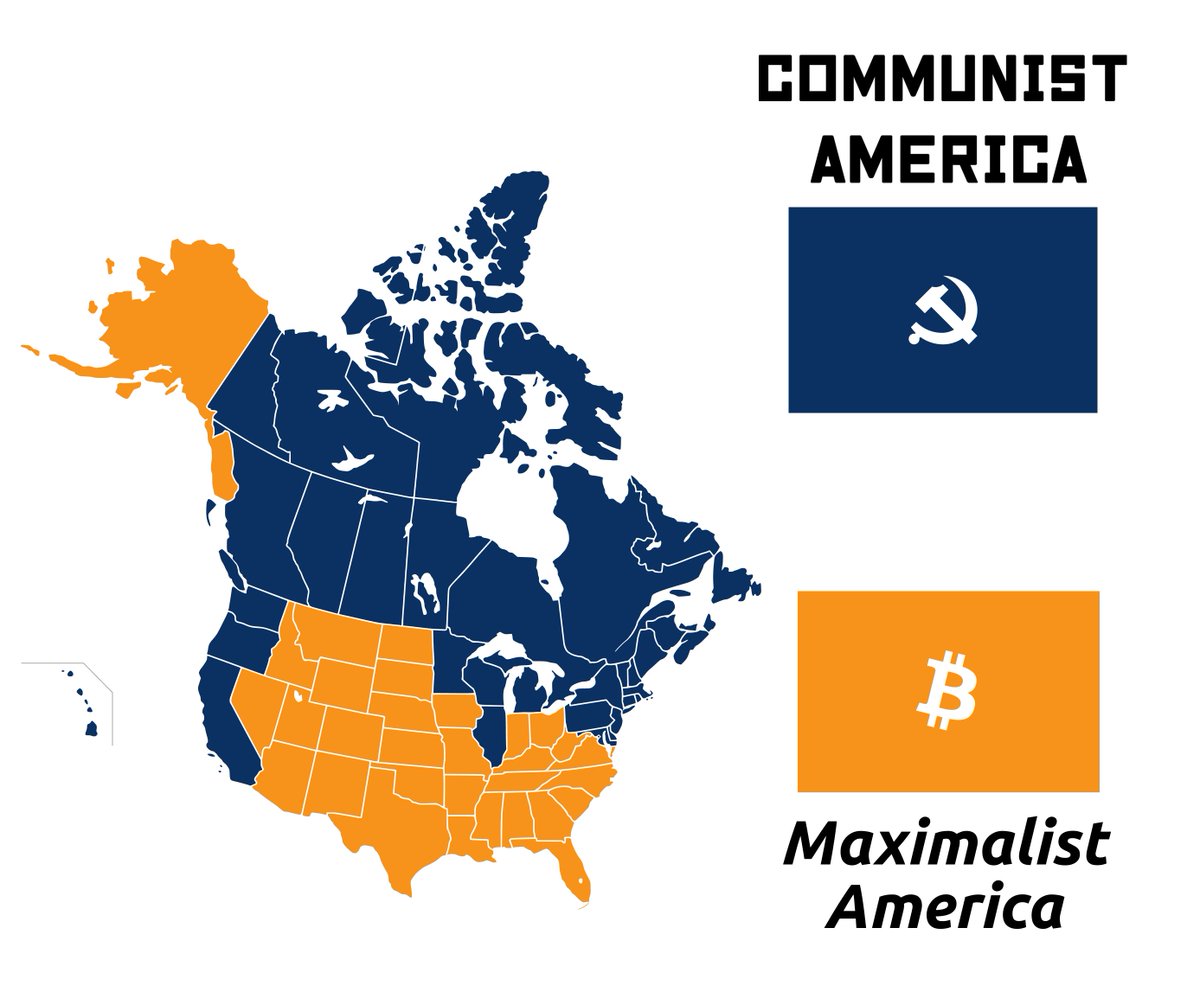
What that adds up to is Communist vs Maximalist.
Because after the dollar ends, DC is out of money.
So: Carney, Newsom, Walz, Mamdani turn to Xi.
And MAGA, Elon, Texas, Miami turn to Satoshi.
I agree that places like Alberta will be a battleground (and indeed are already battlegrounds; see Bessent's recent comments).
WHO LOST CANADA?
It was obvious that China/Canada would happen. Here's how it happened, and what may happen next.
(1) First, in early 2025 it looked like Canadian conservative Pierre Poilievre was a straight shot to win Canada. Instead, all the MAGA posts about annexing Canada undercut Pierre, boosted left nationalism, and turned what looked like a sure thing into an epic defeat. The result was Mark Carney:
(2) Carney is on the left but is far more intelligent than his predecessor, Justin Trudeau. He's also the former governor of the Bank of Canada, and understands that the G7 (including Canada) is in the midst of sovereign debt crisis. And the Canadian dollar is going the way of the US dollar, which is to say that it's going to zero. Canada needs access to hard goods and will trade natural resources to get that. Hence, China. Carney's Canada may become a sort of North American Russia, trading oil and lumber to China for cars and electronics.
(3) Who lost Canada? The fundamental reason this happened is that MAGA ironically doesn't understand its own self-interest. Even the term "America First" is misconceived, because it groups a Blue American like Elizabeth Warren together with a Red American like JD Vance...when in reality the Red American and the Red Canadian (like Pierre Poilievre) have much more in common. All the "joke" posts on annexing Canada managed to needlessly put Red Americans at odds not just with Blue Americans and Blue Canadians, but also with Red Canadians.
The Greenland thing will have exactly the same effect, as it'll end up pushing Western Europeans to China. That's actually why most ultranationalist movements fail: they're just so shortsightedly tribal that they're terrible at building coalitions.
(4) Anyway, while Carney is the first to be this explicit about aligning with China, expect many other Western leftist leaders (like Newsom and Walz) to line up with China over time. The reason is that while Democrats really did fight Communists from ~2021-2024 over the question of who'd run the world's most powerful state, Democrats lost. All the chip sanctions and isolation tactics that somewhat worked on Russia, and frankly might have worked on almost any other country, just didn't work on China...because China had enough internal economic scale to essentially be their own autarkic civilization, and build whatever they needed.
(5) So: the anti-China Biden Democrats have been replaced by the China-curious Newsom Democrats. And now the China-aligned Carney Canadians. With Carney making the first move, you should expect many more blue state Democrats to align with China, particularly those on the West Coast like Newsom.
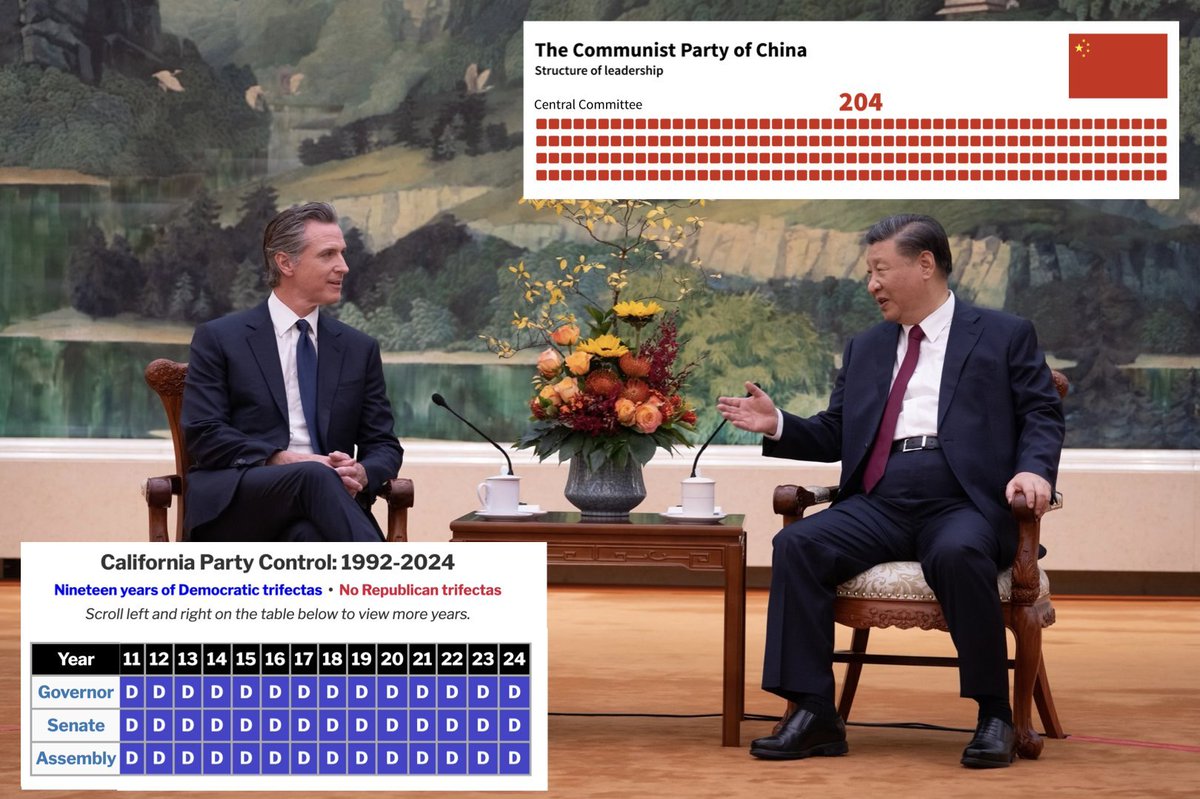
(6) It's simple coalitional math. Democrats are the ingroup, Republicans are the outgroup, and Communists are the fargroup. So, for Democrats: the enemy of their Republican enemy is their friend. And there is much for them to admire in the Chinese political system. After all, Democrats and Communists both built one-party states:
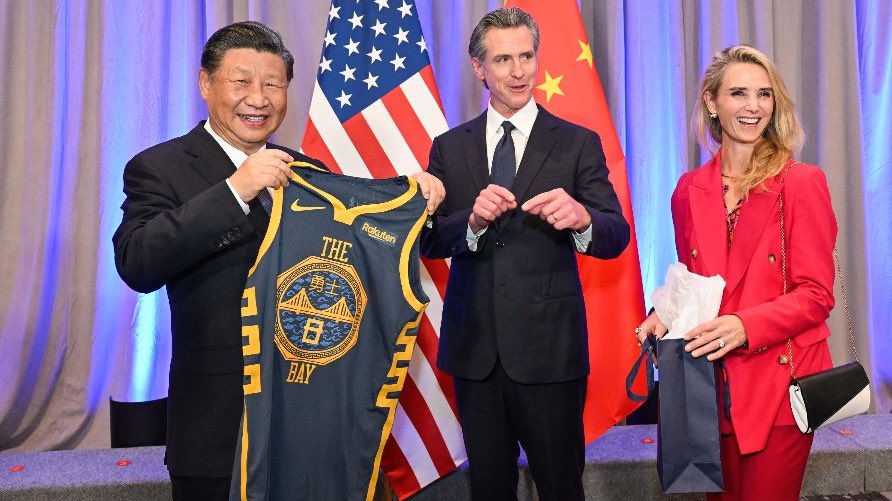
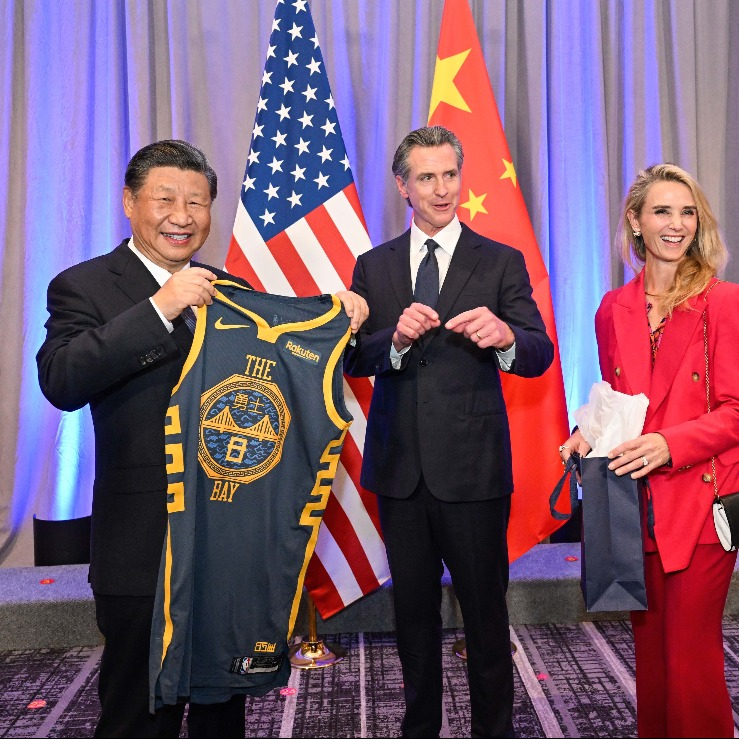
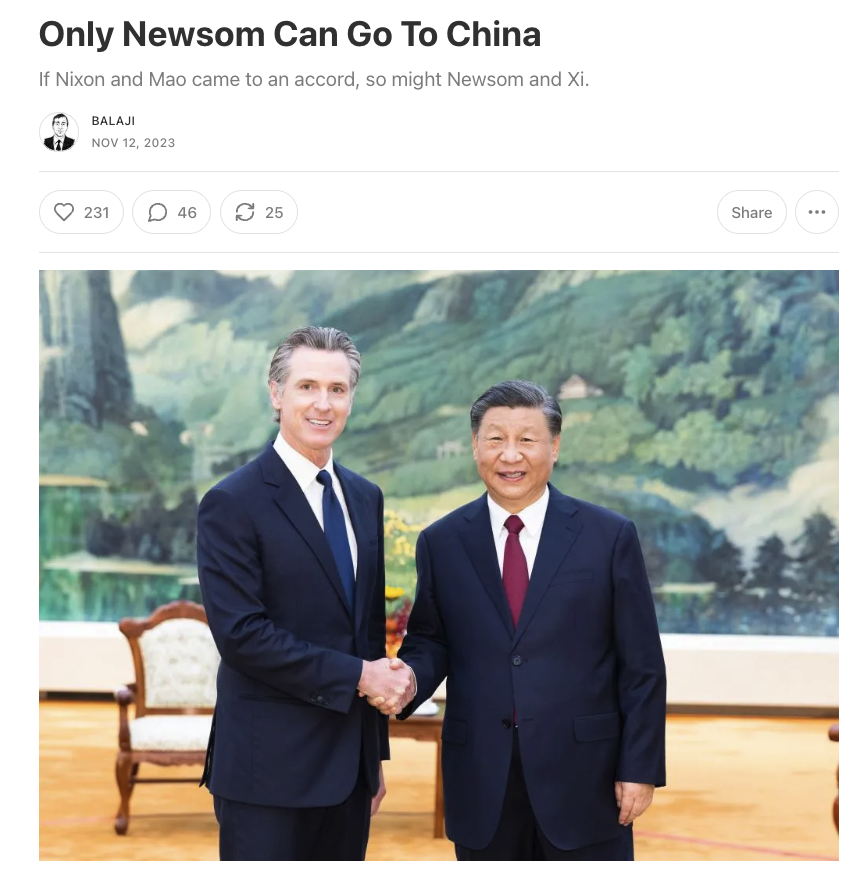
(7) Newsom in particular is likely the next shoe to drop, because even in 2023 he was reaching out to Xi. He's also spoken in Xinhua (Chinese state media) about becoming China's "long-term, stable, and strong partner." Newsom posts images of himself shaking Xi's hand, while also posting images of Trump in handcuffs. It's clear which President he's more comfortable with:
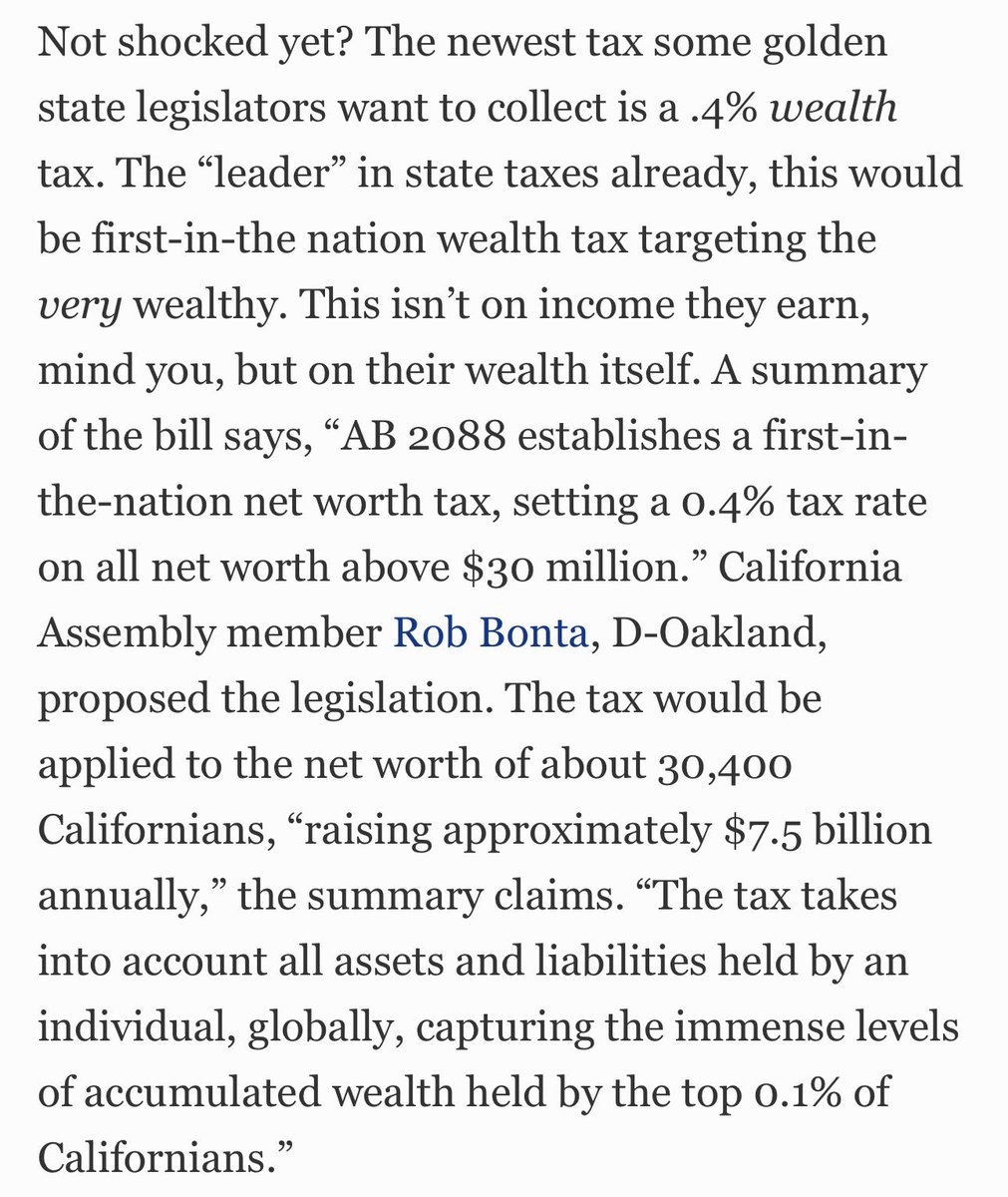
(8) The California wealth tax is also worth mentioning here. As M. Guimarin correctly pointed out, the net effect of the wealth tax is for blues to drive tech out of the state. That's not an unintended consequence: the purpose of the wealth tax was to either rob or deport the sole remaining political opposition to Democrats in California, namely technologists.
(Side note: Democrats are historically much better at mass deportations than Republicans, as they take a whole-of-society approach to it, and persist with it over decades, and do it silently and nonviolently. That's how Republicans were pushed out of university faculties, media companies, and California itself. It was once a dark red state, and now it's deep blue.)
(9) Anyway, with the technologists pushed out of California, Newsom's blues can welcome in the Chinese, who won't be subject to the same wealth taxes as they aren't US citizens.
(10) There is also an obvious geostrategic aspect to this: Chinese Canada is a bridge across all the blue states, from the West Coast to the Northeast. So as blue states like Minnesota and California engage in more "soft secession", they can all link up with Canada, and get supplied by China.
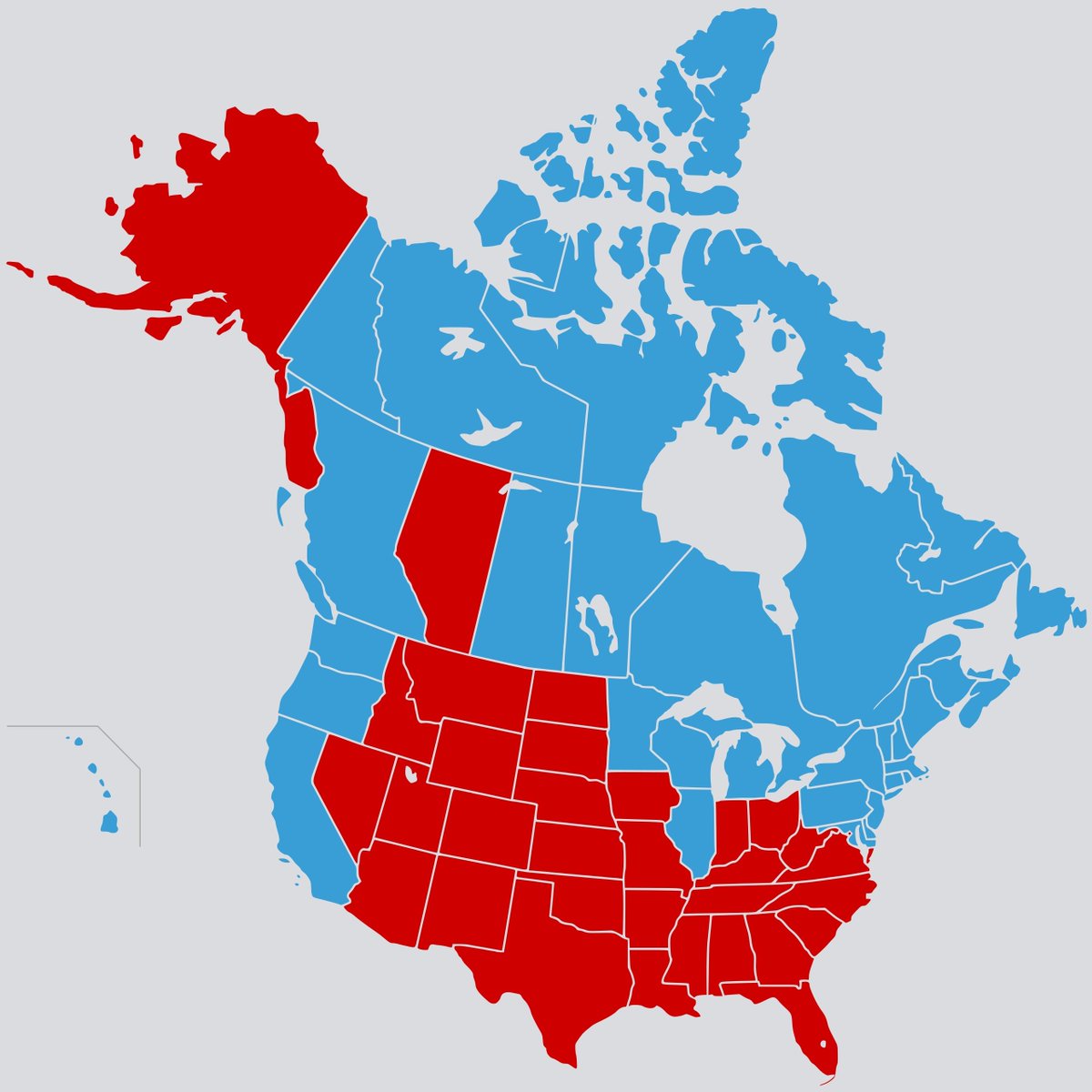
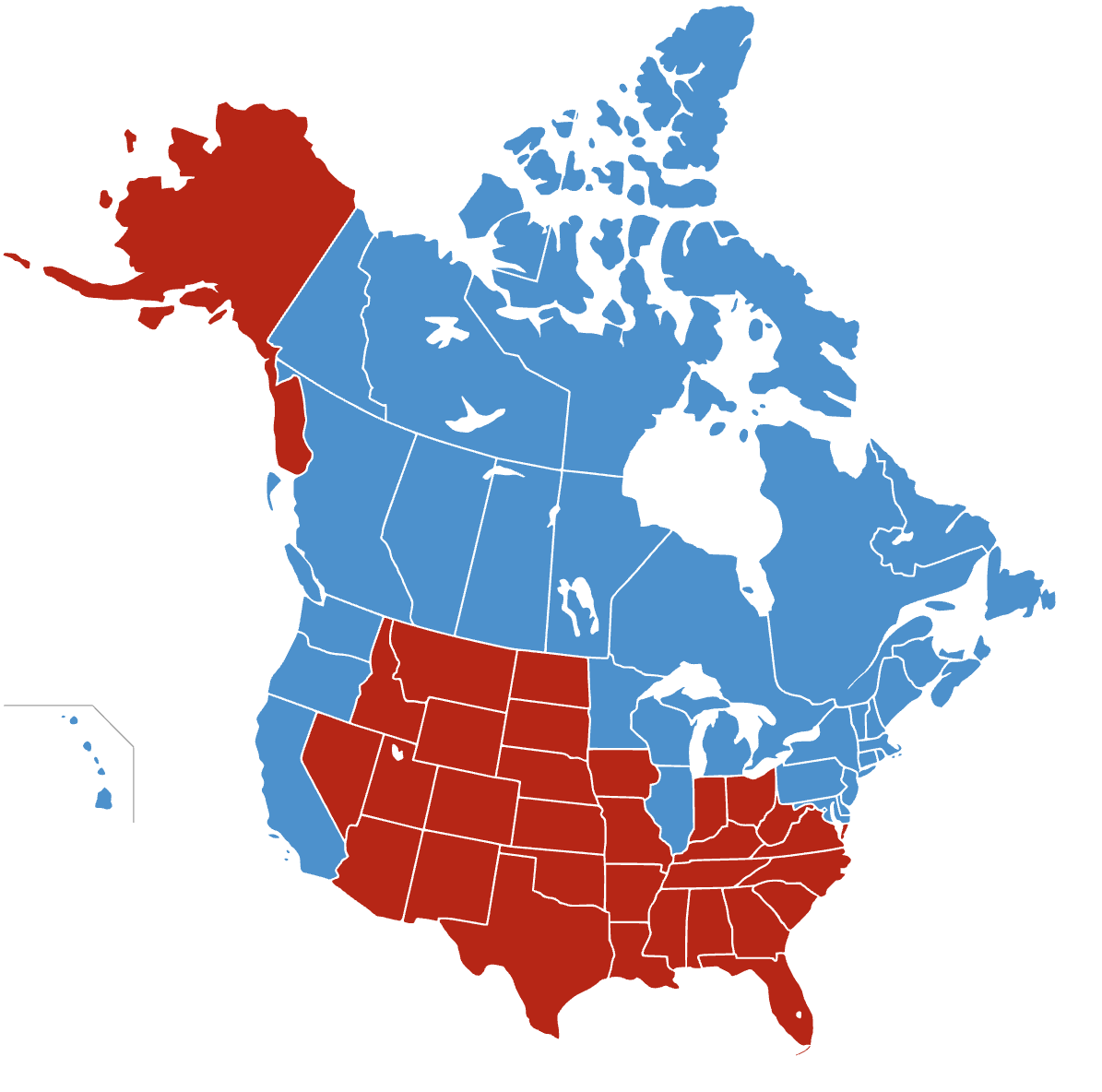
Decades ago, this map was made as a joke.
Perhaps it becomes all too real.
Newsom has significant room to attempt left populism, by refusing to enforce tariffs on Chinese goods that land at Canadian ports. He's signaled willingness to do that, and that may be how this manifests. balajis.com/p/only-newsom-…
See also this popular post on "soft secession" by blue states. Tim Walz' recent invocation of the 10th Amendment is in this vein.
Of course, this is an inversion from decades of Democrat rhetoric. But that doesn't matter. The ideologies of the past are breaking down, with blues now endorsing states' rights and federalism now that they've lost DC...and reds embracing federal power now that they have DC.
If a country stay smalls to remain true to its roots, it eventually gets absorbed by an empire.
Conversely, if a country plays for empire, and truly achieves world domination, it absorbs so many that its subjects eventually outnumber the imperial core. And thus the empire, too, loses touch with its roots.
Stay small and get conquered.
Get big and get diluted.
I like Switzerland and agree that it was arguably an exception to the rule. But it isn’t anymore and hasn’t been for some time.
It capitulated to Obama in 2009 on financial privacy, and so Swiss bank accounts don’t really exist. The Swiss (perhaps understandably) sanctioned Russia after 2022 and nuked the Credit Suisse bondholders, in violation of financial neutrality. That neutrality is now found only onchain.
The country is also de facto a member of NATO and the EU, even if not de jure. And is moving towards de jure. It’s a member of the Schengen zone and signatory to 100+ bilateral treaties, which means much of its law is already written in Brussels.
Basically, like all Western European countries, it’s already just a protectorate of the American Empire and no longer has real foreign or domestic policy independence.
And Switzerland now feels it needs to *formally* join the US/EU empire or get beaten by Russia, which is the dynamic I mentioned above: small countries get absorbed voluntarily into one empire, or involuntarily into another.
It’s still formally neutral, but it’s neutral in name only. The economic and military benefits of being part of a scaled empire were too great. See post above.
Unfortunately for Switzerland, it’s losing its neutrality at a bad moment in history, by being sucked into the gravitational black hole of the Western sovereign debt crisis. It’s getting pulled into a declining empire, instead of benefiting from a rising one. Maybe it suffers less damage than its neighbors due to legacy neutrality, but it won’t be unscathed.
That said, if you had to live in Western Europe, you’d likely live in Switzerland, as it may have the best financial position among its neighbors. Yields have actually gone negative there. It might be the cleanest dirty shirt in the region.
Communism shatters economic relations, but ultranationalism breaks diplomatic relations.
If the far left’s failure mode is not understanding self-interest, the far right’s failure mode is not understanding other-interest.
That is to say: we know the far left doesn’t viscerally get the idea of capitalism, of building products, of sometimes just not having the money to do something. The far left fantasy is of total independence from needing to work at all. They don’t understand economic scarcity.
But the far right similarly doesn’t get the idea of diplomacy, of building coalitions, of sometimes just not having the votes to do something. The far right fantasy is of total independence from needing to work with others. They don’t understand political capital.
And that is also a failure mode. If you can only cooperate within your small tribe, you can’t even scale up. And then your tribe loses.
(The alternative is international capitalism, which is more practical than the socialist left and more scalable than the nationalist right.)
When you go *too* far to the nationalist right, you limit your coalition to only those who are both right-of-center and citizens of your country.
But only China has the scale to really do everything in one country. Everyone else needs allies.